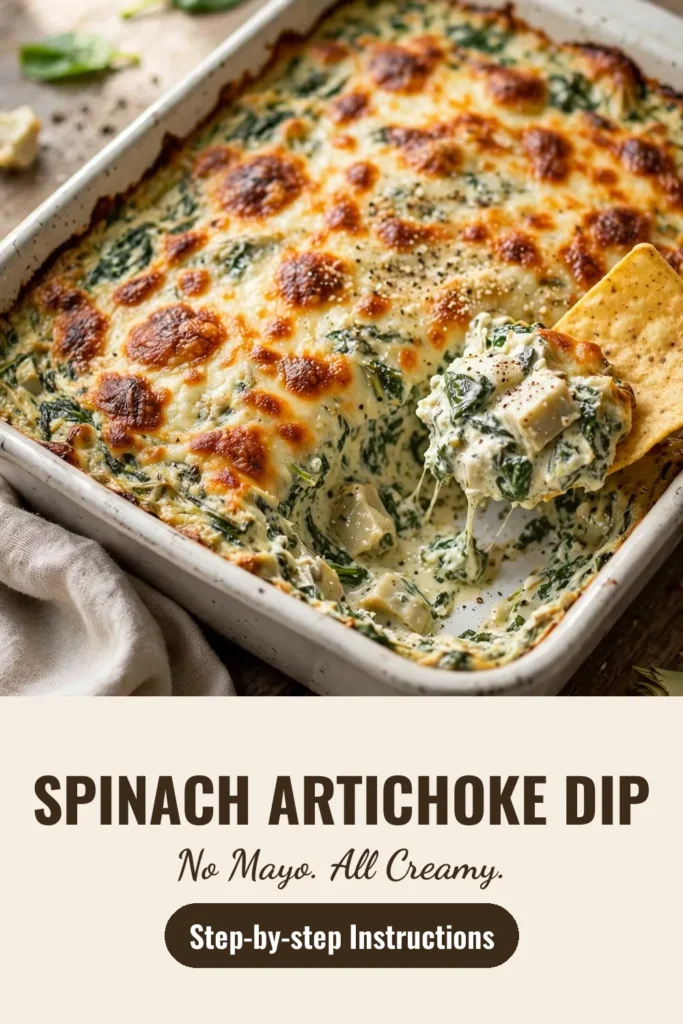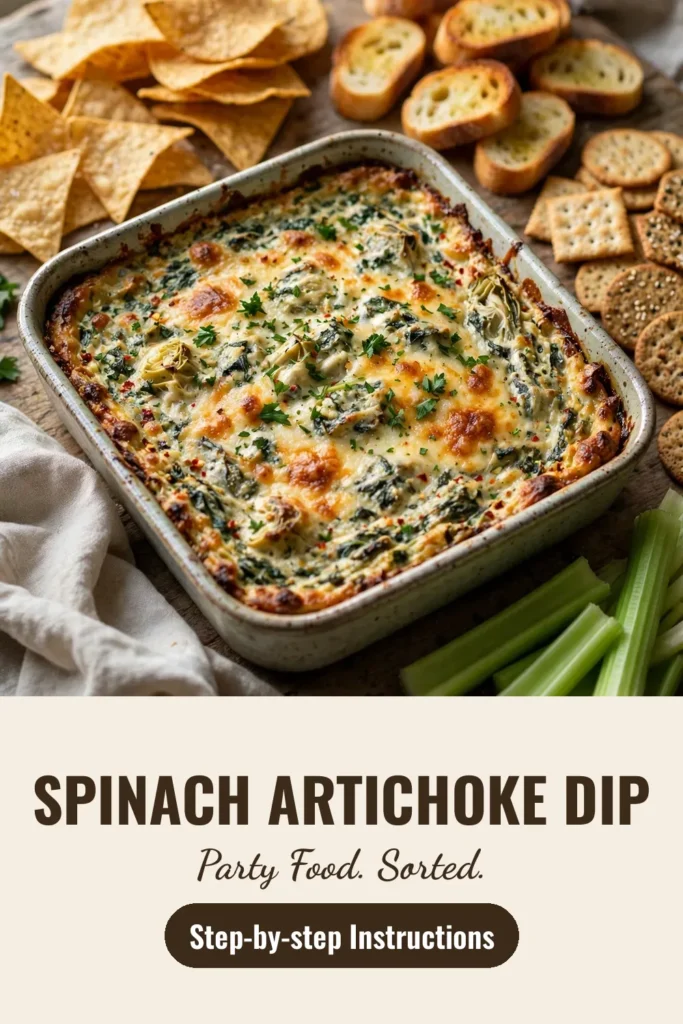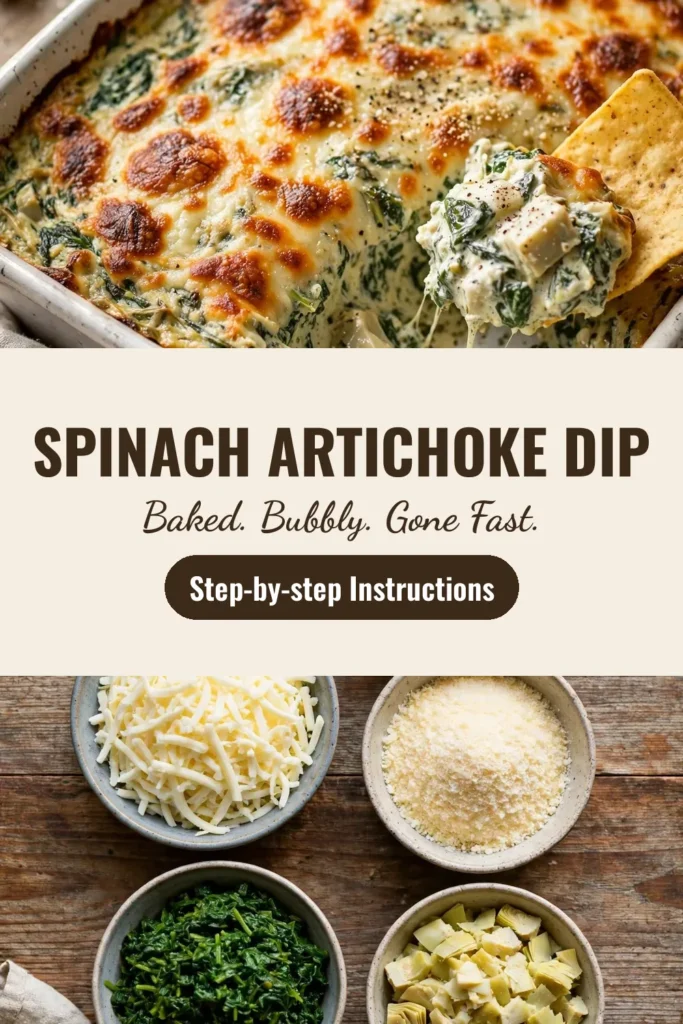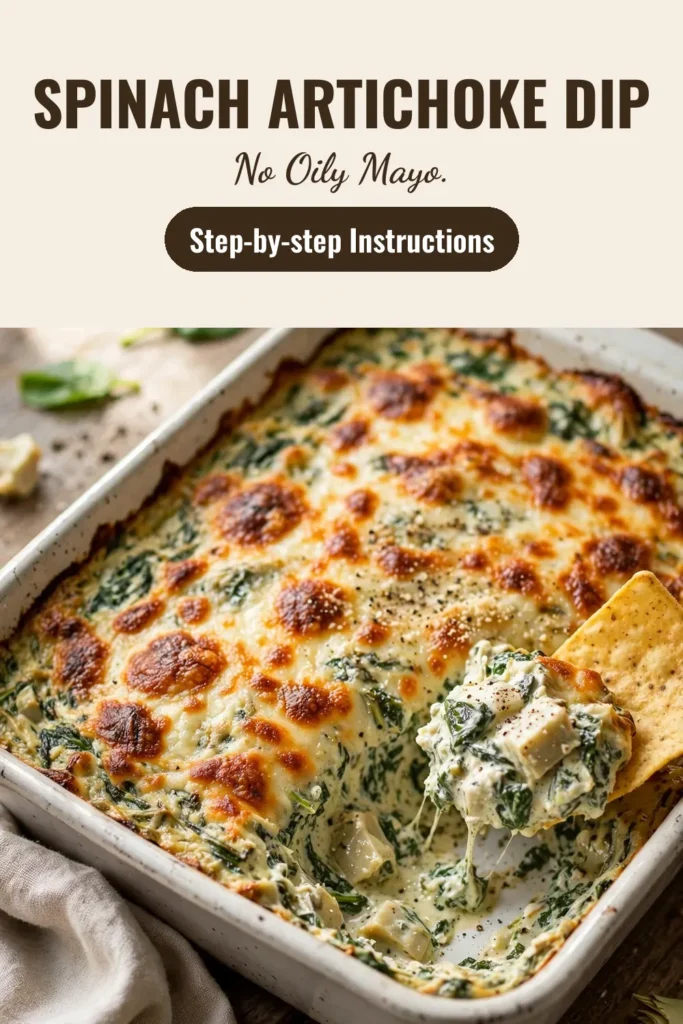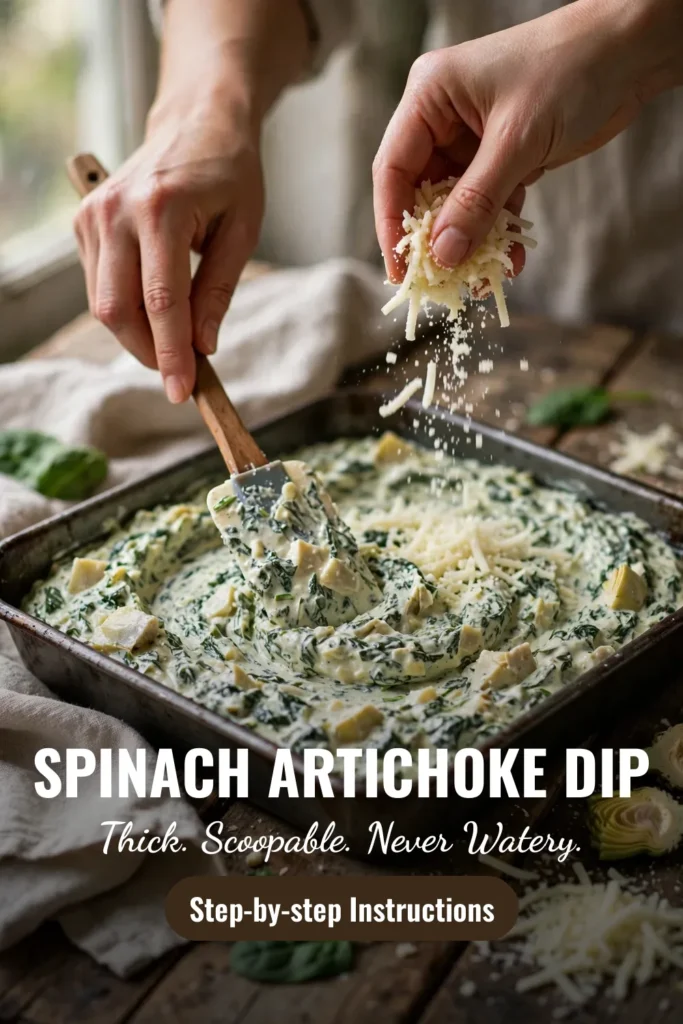
Baked Spinach Artichoke Dip (No Mayo, 35 Minutes)
Spinach artichoke dip without mayo is the appetizer that proves the mayo was never the point. One dish, 35 minutes — 10 of them hands-on — cream cheese, sour cream and Greek yogurt doing the work that mayo used to do, mozzarella pulling long strings off the chip, Parmesan browning golden on top, and not a drop of oil pooling at the edges. The page this post beats is built entirely on no-mayo searches — every one of its visitors is looking for a dip without mayo — yet it never once explains what replaces the mayo, or why mayo fails when it is baked, or how to keep the dip thick instead of watery. This page answers all three, with the amounts, the times and the reasons stated plainly. It is the same dip, made the way the search results’ best pages actually make it: frozen spinach squeezed bone-dry, artichokes patted dry, the cheese grated by hand, and five minutes of rest before the first chip goes in.
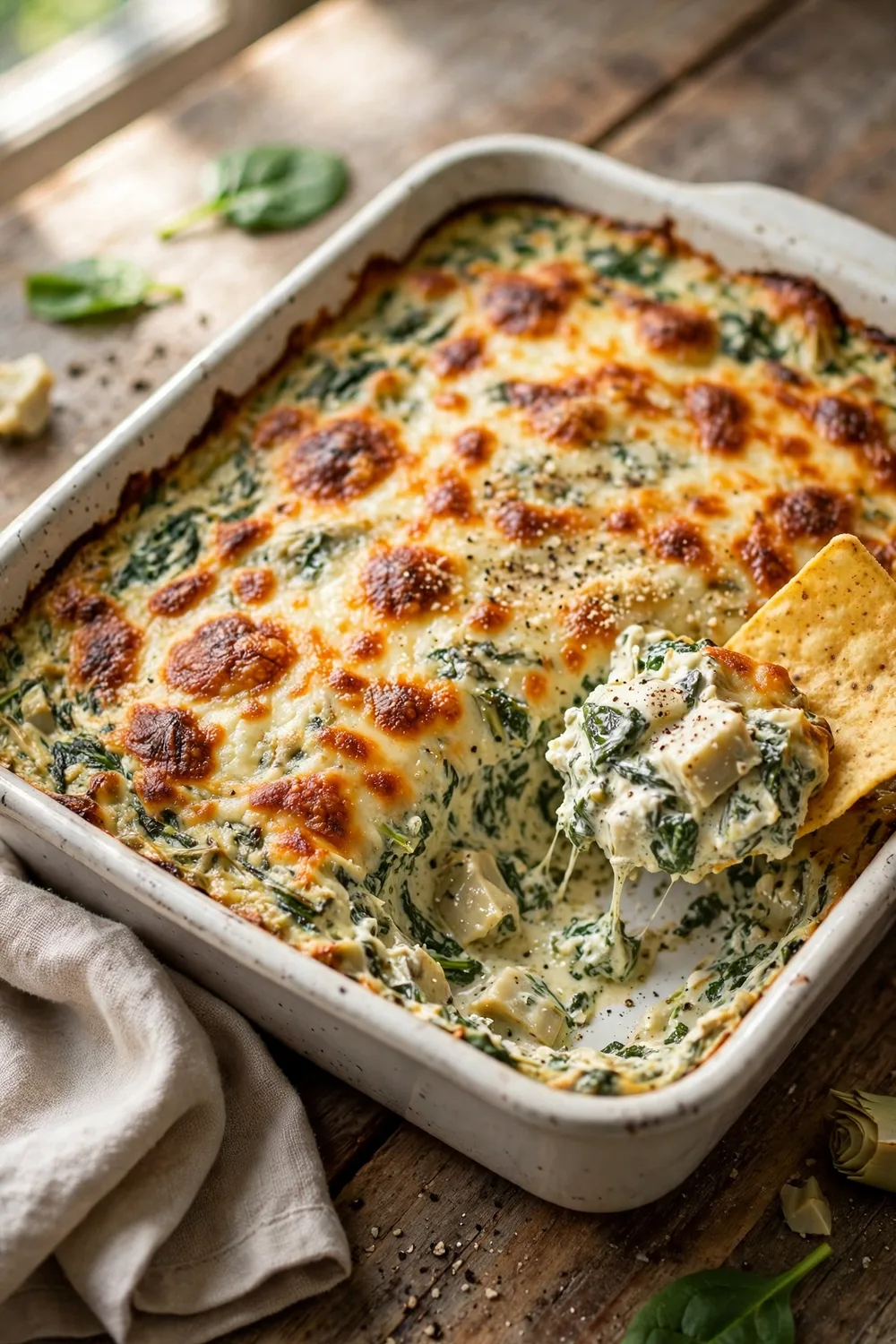
You will love this:
- No mayo, no oily puddle. The cream-cheese + sour-cream + Greek-yogurt trio gives the dip its body and its tang — and unlike mayo, none of the three turns oily and runny in a hot oven.
- Thick and scoopable, every time. The dryness rule is the whole recipe: spinach squeezed until no more water drips, artichokes patted dry, and a five-minute rest while the dip thickens as it cools.
- 35 minutes, 10 of them hands-on. Mix, spread, top, bake, broil, rest — and the dip is on the table while the rest of the party food is still being unwrapped.
Why This Spinach Artichoke Dip Works
It works because the three decisions that make or break this dip are made for you, in the open, before you start cooking. The spinach is frozen, thawed and squeezed VERY dry — because the whole search results page agrees that dryness, not fresh-versus-frozen, is what keeps a dip thick, and the page this post beats is the only one that says otherwise. The mayo is replaced by a trio — cream cheese for body, sour cream for tang, Greek yogurt for a sharper tang — because mayo turns oily and runny when it is baked, and the trio does not. And the cheese is mozzarella for the stretch and Parmesan for the nutty golden top, grated by hand, because the pre-shredded kind carries an anti-caking agent that turns a smooth sauce grainy.
What we tried, and what failed: the first version of this dip used spinach that was squeezed “well enough” — a quick press in a colander, the way a hurried cook would do it — and it baked up with a green puddle around the edges and a thin, loose centre. The towel-twist version, squeezed until no more water drips and then twisted again, baked up thick and held its shape on a chip. We also tried the canned Parmesan, the kind in the shaker, because it was already in the cupboard — and the sauce came out grainy, exactly the way the stovetop-cream-sauce page warns it will. And we tried baking a fridge-cold dip at 350°F for the same 25 minutes, the way a party cook with a made-ahead dip would, and the centre was still cold while the top was already dark. The cold-bake rule — five to ten extra minutes, or thirty minutes on the counter first — is in the make-ahead H2 because we learned it the hard way. Those three failures are why this post has a troubleshooting H2 instead of a testing-notes footnote.
The structure of this page is the structure of the gaps: the mayo question answered in full, the cheese guide in one table, the dryness rule in its own H2, the doneness test as its own H2, the three methods compared in one table, the dippers guide, the make-ahead and freezing answers the target page only half-gives, and ten FAQs where the target has none. Midwest’s page is about 600–700 words of prose with no FAQ block and no question-H2s; Front Range Fed’s is the FAQ bar at 9 questions and ~2,000–2,500 words, and Mama Knows’ is ~1,500–2,000 words built around a single problem — water. This page matches the FAQ bar and goes further on the mayo question, the cheese, the methods and the troubleshooting — that is the depth that beats a page whose only real strength is that it ranks #1 and #2 for the no-mayo long-tails.
What Is Spinach Artichoke Dip?
Spinach artichoke dip is a spinach dip with artichoke hearts as the other primary ingredient — and the word “dip” is doing more work than it looks like. Spinach dip, sometimes casually called “spin dip”, is a dip that uses spinach as a primary ingredient, and frozen spinach is often used in its preparation. The other primary ingredients are mayonnaise, cream cheese, sour cream and cheese — and the variation this page is about drops the first of those four and leans on the other three. It is commonly eaten as an hors d’oeuvre, an appetizer, or a party platter, and many casual restaurant chains offer a spinach dip on their menus — the version at chains like Applebee’s or Chili’s is the restaurant dip this post is better than, in the style of, not a copy of. Commercially prepared, mass-produced spinach dips are sold in grocery stores and supermarkets, and some commercial powdered mixes, such as Knorr, are available to flavor the dip — this post uses none of those; every ingredient here is a real one, with an amount.
The dip is served warm, or there may be no cooking involved at all — slow cookers may be used to prepare it, and it may be served warm from the oven or chilled after an hour in the fridge. The accompaniments are bread, crackers and chips: crostini, tortilla chips, pita chips, veggie sticks, and the presentation that steals the show — a bread bowl, a round sourdough loaf hollowed out, the dip in the well, the bread pieces arranged around it. Ingredient additions may include beans, and some recipes use spinach dip as a filling within other foods, like bread rolls. Ours sits in the middle of all of that: a baked dip, served hot from the oven, thick enough to hold its shape on a chip, with a golden top and a five-minute rest before serving — the version the search results’ best pages agree on, with the mayo left out on purpose.
Why No Mayo?
The whole page this post beats is built on no-mayo searches, and it never once says why. Here is the answer, in full, because the hook is the whole traffic driver and the cook who typed “without mayo” deserves to know what she is getting instead.
Mayo fails when it is baked. That is the short version, and it is the only reason any of the search results gives — Front Range Fed says it in two half-sentences, that mayo “can sometimes add an oily texture” and “when baked, can become runny” — and it is true: mayonnaise is an emulsion of oil and egg, and in a hot oven the emulsion breaks, the oil separates, and the dip comes out with a greasy sheen and a loose, runny centre. The traditional spinach artichoke dip hides that with enough cheese; the no-mayo version removes the problem instead of hiding it.
What replaces the mayo is a trio, and each member has a job. Cream cheese gives the dip its body — eight ounces, room temperature, beaten smooth first so it never breaks into white lumps. Sour cream keeps it tangy and scoopable — half a cup, full-fat, the tang that mayo used to fake. Greek yogurt adds a sharper tang and a lighter finish — it is the direct swap for the sour cream, half a cup for half a cup, and the version to use when the dip should taste a little brighter. The three together do everything mayo did — richness, tang, spreadability — and none of the three turns oily in a hot oven.
There is a third path, for the cook who wants no sour cream at all: the stovetop cream sauce. Melt butter in a saucepan, cook the onion, stir in flour and cook it a minute, stir in cream and milk until it thickens, then melt the cream cheese in, take it off the heat, and stir in the cheeses. The sauce goes over the spinach and artichokes, the whole thing goes into the dish, and it bakes the same way. It is the only method on the search results that never mixes and bakes — and it is the creamiest version on this page, because the sauce is already smooth before the dip ever sees the oven.
The comparison, stated plainly: the mayo version is richer on paper and oilier in the oven; the no-mayo version is tangier, thicker, and scoopable straight from the dish. The phrases that bring people to this page are the no-mayo long-tails — spinach artichoke dip no mayo, spinach and artichoke dip no mayo, spinach artichoke dip no mayonnaise, spinach artichoke dip without mayonnaise — and every one of them is answered here, in the trio above, instead of assumed.
The Cheese Guide
Every page on the search results mixes cheese into the dip and moves on. Nobody says what each cheese does — and the cook who wants to know whether the Asiago is worth buying, or whether the feta will work, is left to guess. Here is the guide, in one table, because the cheese is the whole question after the mayo, and the target page’s entire traffic comes from people who care about what is in the dip.
| Cheese | Role | Amount in our batch | Swap |
|---|---|---|---|
| Mozzarella | The stretch — long cheese pulls off the chip | 1¼ cups, divided (half mixed in, half on top) | Part-skim works, but whole-milk pulls longer; low-moisture, never fresh (fresh mozzarella is too wet). |
| Parmesan | The nutty, golden-brown top | ½ cup, divided, freshly grated | Pecorino Romano — same amount, but omit the salt (Pecorino is saltier). |
| Asiago | The X-factor — nutty and sharp, the cheese that makes people ask what is in it | Swap for half the Parmesan (¼ cup Asiago + ¼ cup Parmesan) | Pecorino Romano as the substitute, omit the salt. |
| Feta | The tangy exception — crumbly, salty, bright | 2 oz crumbled, in place of half the mozzarella | Goat cheese — same amount, same tang, softer. |
| Cheddar | The sharp option — a different, bolder dip | ½ cup sharp cheddar, in place of half the mozzarella | Smoked cheddar, for a smoky version. |
| Greek yogurt | Not a cheese, but the tang lever — the sour-cream swap | ½ cup, in place of the sour cream | Blended low-fat cottage cheese — the high-protein swap. |
The grate-it-yourself rule, stated plainly, because it is the one tip that saves a sauce: grate the Parmesan (and the Asiago, if you use it) yourself. The Parmesan in the can includes an anti-caking agent, and that agent makes the sauce grainy — the dip still tastes fine, but the texture is wrong, and there is no fixing it once it is baked. A microplane or the fine side of a box grater takes thirty seconds and the difference is visible. Pre-shredded mozzarella is fine — the anti-caking agent in shredded mozzarella is a smaller problem in a baked dip than it is in a stovetop sauce — but the Parmesan is non-negotiable. Freshly grated, every time.
Fresh vs Frozen Spinach — The Dryness Rule
Midwest’s whole fresh-versus-frozen section is an absolutism: “ALWAYS. USE. FRESH. SPINACH.” Frozen, she says, is “VERY watery” and the flavour is “quite dull”. The whole search results page disagrees — and the disagreement is the point, because the rule is not fresh-versus-frozen. The rule is DRY.
| Fresh spinach | Frozen spinach | |
|---|---|---|
| Amount | 5 oz (a little more than half of an 8 oz bag) | 10 oz (one package, chopped). |
| Prep | Wilt in a dry pan or a steamer, cool, then squeeze | Thaw completely, then squeeze. |
| Squeeze | Wilted leaves, wrung out in a clean kitchen towel | Thawed spinach, towel-twist squeezed until no more water drips. |
| Result | Bright, leafy, a little more work | Just as good, half the work — the whole SERP’s consensus. |
| Best for | The cook who already has fresh spinach | The default — the card’s spinach, the quality bars’ consensus. |
The squeeze test is the same for both, and it is the test that matters: put the spinach in a clean kitchen towel, gather the corners, and twist until no more water drips — then keep twisting, because the last twists push out more liquid than you would expect. A colander press is not enough; a paper-towel pat is not enough. The towel twist is the difference between a dip that holds its shape on a chip and a dip with a green puddle around the edges. One pound of fresh spinach, wilted, is about ten ounces of frozen — that is the conversion, and it is the only one you need: five ounces fresh for the card’s ten ounces frozen is Midwest’s amount, her method corrected with the squeeze step she left out.
The dip’s thickness comes from dryness, not from the spinach’s origin. Fresh spinach holds water too — wilt it and it weeps — and frozen spinach, squeezed bone-dry, bakes up thick, holds its shape, and tastes like spinach and cheese instead of watery dairy. Midwest’s fresh-only rule is the one thing on her page the search results prove wrong, and this post says so plainly instead of repeating it.
How to Keep the Dip Thick
Water is the enemy of this dip, and it comes from two places: the spinach and the artichokes. Both hold a lot of water, and anything left behind seeps out in the oven — that is how you get a green puddle around the edges and a thin, loose centre, and it is the number-one failure mode on the search results. The fix is three steps, and all three are in the card.
First, squeeze the spinach. Thaw it completely, put it in a clean kitchen towel, and twist until no more water drips — then twist again. The last twists push out more liquid than you would expect, and the dip’s thickness is decided right there, before anything is mixed. Second, pat the artichokes dry. Drain the can, chop the hearts, and press them between paper towels — the artichokes hold water in their folds, and a wet artichoke is a wet dip. Third, rest the dip for five minutes after it comes out of the oven. It thickens as it cools — the cheese sets, the starches settle — and a dip that looks a touch loose at the broil step is thick and scoopable five minutes later.
The “green puddle” diagnosis, so you know what you are looking at: if the dip comes out of the oven with a ring of greenish liquid around the edges, that is water from the spinach, not oil from the cheese. Oil pools yellow and sits on top; water pools green and sits at the edges. If it still bakes up loose after all three steps, rest it longer — ten minutes instead of five — and stir it once before serving, which pulls the loose liquid back into the dip. And next time, squeeze harder: the spinach is the lever, every time.
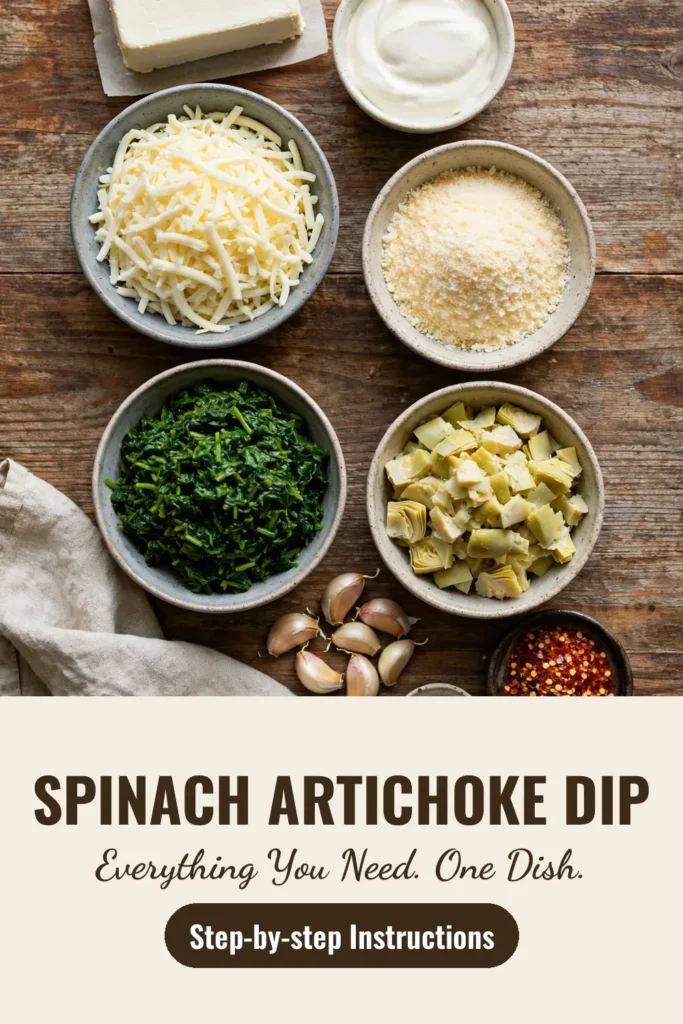
The Ingredients, With Amounts
Every page on the search results lists its ingredients, and the lists are close enough that the differences are the interesting part. Midwest uses 8 oz sour cream and 12 oz mozzarella and 5 oz Parmesan; Mama Knows uses 1¼ cups mozzarella and ½ cup Parmesan; Mamma C uses Asiago and a stovetop cream sauce; Front Range Fed uses a quarter cup of mozzarella and lets the cream cheese do the stretching. Here is every ingredient WITH its amount, and its job — because once you know the job, you can adjust the dip instead of guessing.
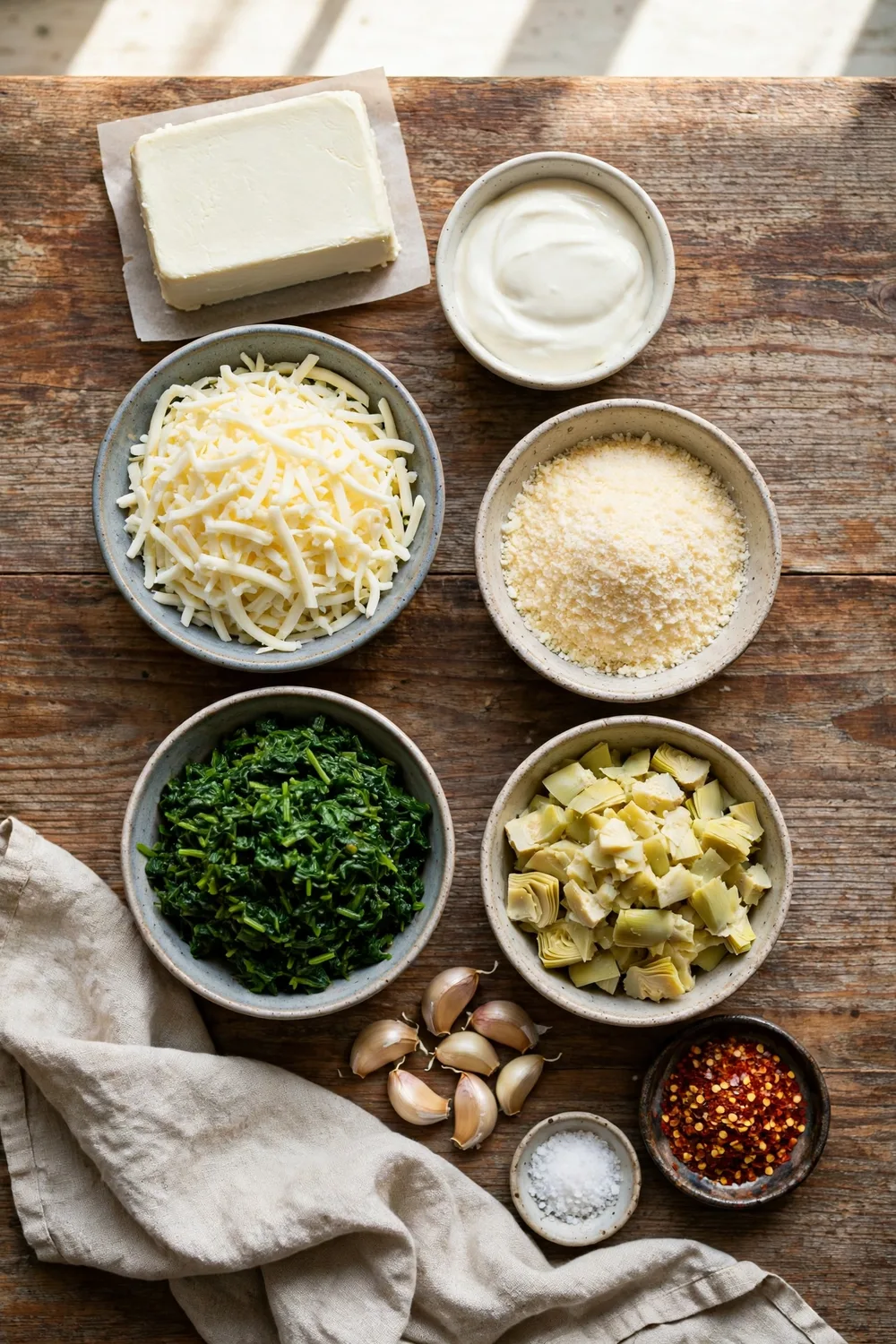
| Ingredient | Amount in our batch | What it does |
|---|---|---|
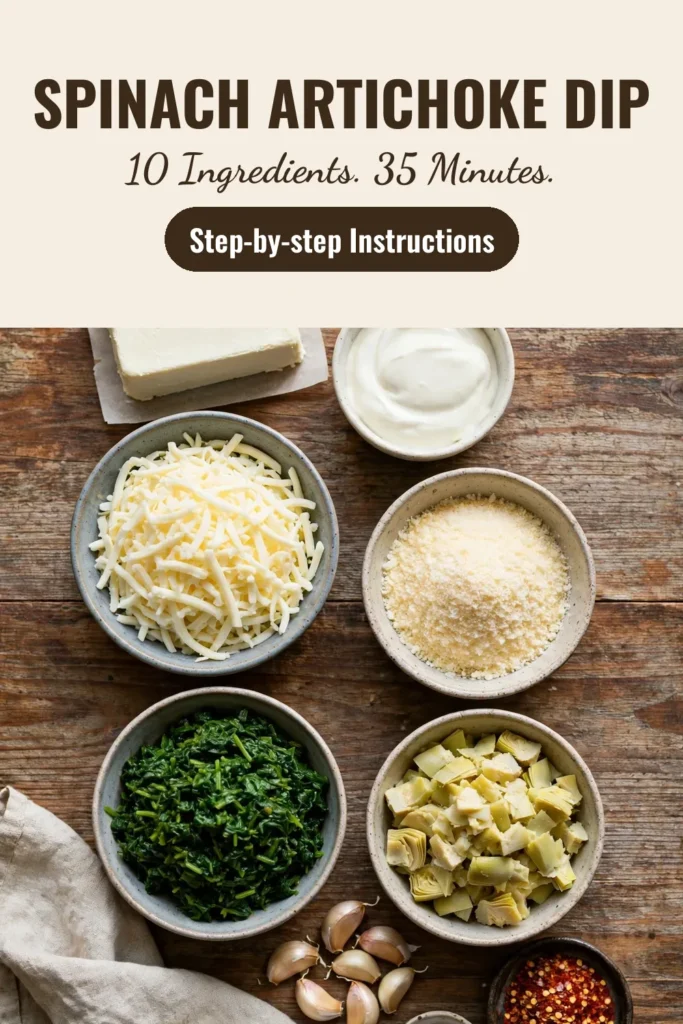
| Frozen chopped spinach | 10 oz, thawed and squeezed VERY dry | The green and the body. Ten ounces frozen is the card’s amount — fresh option 5 oz, wilted and squeezed (see the fresh-vs-frozen H2). The squeeze is the whole recipe; the spinach is the water risk. |
| Artichoke hearts | 1 (14 oz) can in water, drained, chopped, patted dry | The second primary ingredient. Canned in water (not marinated — marinated hearts bring oil and seasoning you did not ask for). Pat them dry between paper towels; wet artichokes are a wet dip. |
| Cream cheese | 8 oz full-fat, room temperature | The body. Eight ounces, truly soft — an hour on the counter, or ten to fifteen seconds in the microwave. Cold cream cheese breaks into white lumps that never melt out. |
| Sour cream | ½ cup full-fat (or plain full-fat Greek yogurt) | The tang and the scoopability. Half a cup keeps the dip tangy and spreadable; Greek yogurt is the direct swap, same amount, a sharper tang. |
| Mozzarella | 1¼ cups shredded, divided | The stretch. Half mixed in, half on top — the top half is what browns and pulls. Whole-milk pulls longer than part-skim; low-moisture, never fresh (fresh mozzarella is too wet). |
| Parmesan | ½ cup freshly grated, divided | The nutty, golden-brown top. Half mixed in, half on top. Grate it yourself — the canned kind carries an anti-caking agent that makes the sauce grainy. |
| Garlic | 3 cloves, minced | The depth. Three cloves, fresh — half a teaspoon of garlic powder is the pinch fallback, but fresh is the card. |
| Kosher salt | ½ tsp (taste first) | The seasoning. Taste before adding all of it — the Parmesan and the mozzarella are salty, and it varies by brand. Half a teaspoon is the starting point, not the rule. |
| Black pepper | ¼ tsp | The background heat. A quarter teaspoon, freshly cracked if you have it. |
| Red pepper flakes | ¼ tsp | The warmth. A quarter teaspoon is just enough heat; leave it out for a kid-friendly dip, or use half a teaspoon for more. |
| Fresh parsley | Chopped, to serve | The finish. Parsley goes on at the table, not in the oven — it stays green and fresh, and it is the only garnish this dip needs. |
| Dippers | Crostini, tortilla chips, crackers, veggie sticks | The delivery system. Not card lines — the serve-with H2 has the full guide, including which crackers NOT to use. |
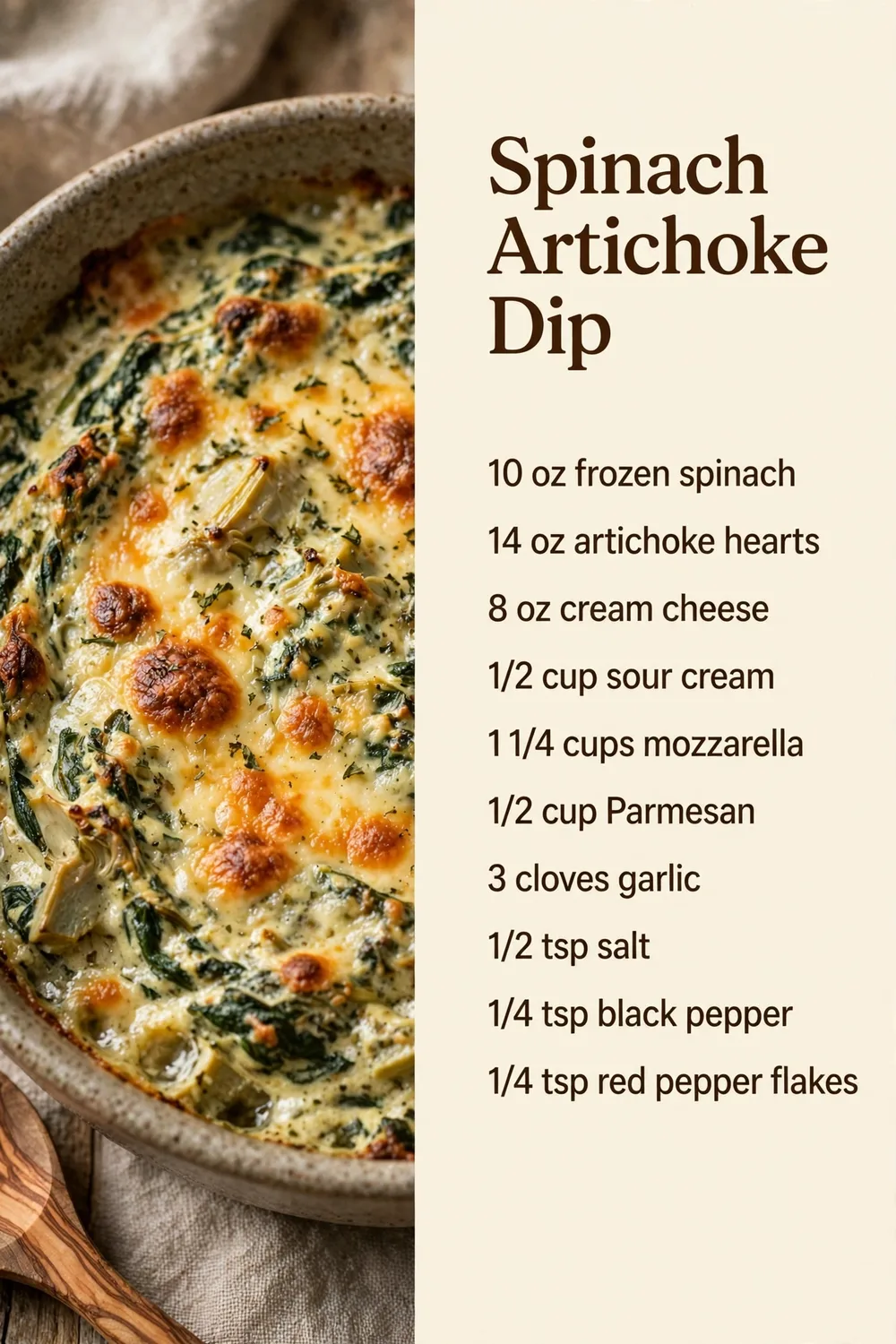
That is the whole list — ten dip lines, every one of them in the recipe card below with its amount, plus the parsley and the dippers as serve-with notes. The room-temperature rule is the one to respect: all the dairy at room temperature, thirty to sixty minutes on the counter, mixes smooth and bakes evenly. Cold cream cheese is the lumpy-dip failure, and it is in the troubleshooting H2 because it is that common. The taste-before-salting rule is the other one: the cheeses are salty, the salt is the lever, and the dip should be tasted before the last of the salt goes in — not after.
How to Make Baked Spinach Artichoke Dip
This is a baked spinach artichoke dip in the truest sense: ten minutes of prep, twenty-five minutes of cooking, one dish, and the batch makes 10 servings of about a quarter cup each — the most useful batch size on the search results, because the two fullest pages both yield 10 and nobody explains how to scale it. The dip is the four steps below, in order, and the squeeze is the first step — because the dip’s thickness is decided before anything is mixed, not after it is baked.
Squeeze it dry
Thaw the frozen spinach completely, then put it in a clean kitchen towel, gather the corners, and twist until no more water drips — then twist again, because the last twists push out more liquid than you would expect. Drain the artichoke hearts, chop them, and press them between paper towels. The spinach and the artichokes are the two water risks in this dip, and both are dealt with before the bowl comes out. If you are using the fresh-spinach option, wilt five ounces in a dry pan, cool it, and squeeze it the same way.
Mix it smooth
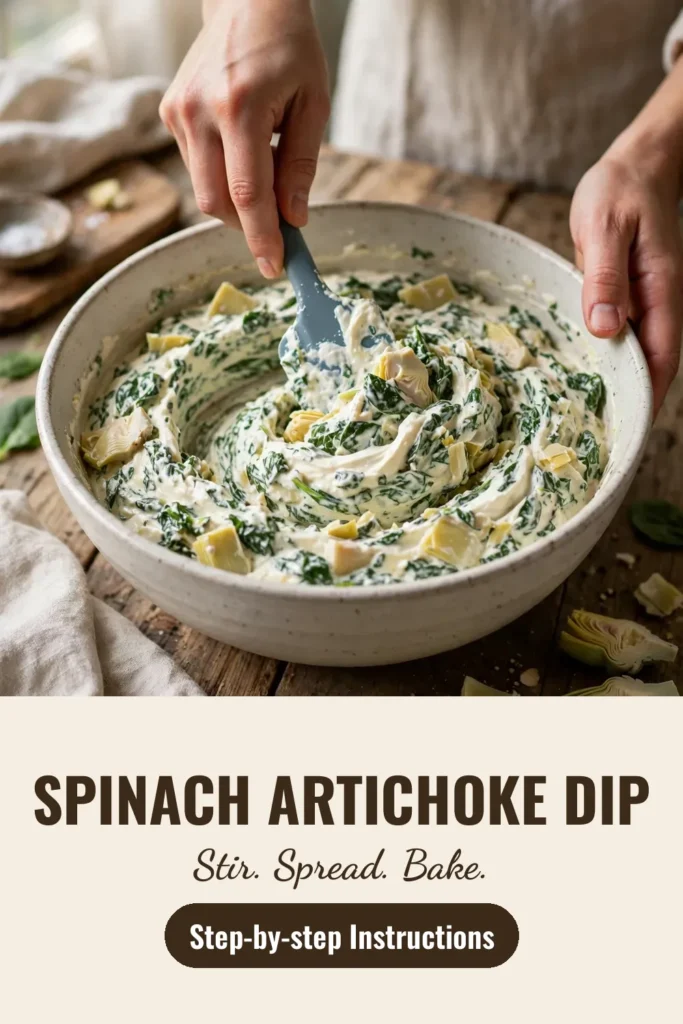
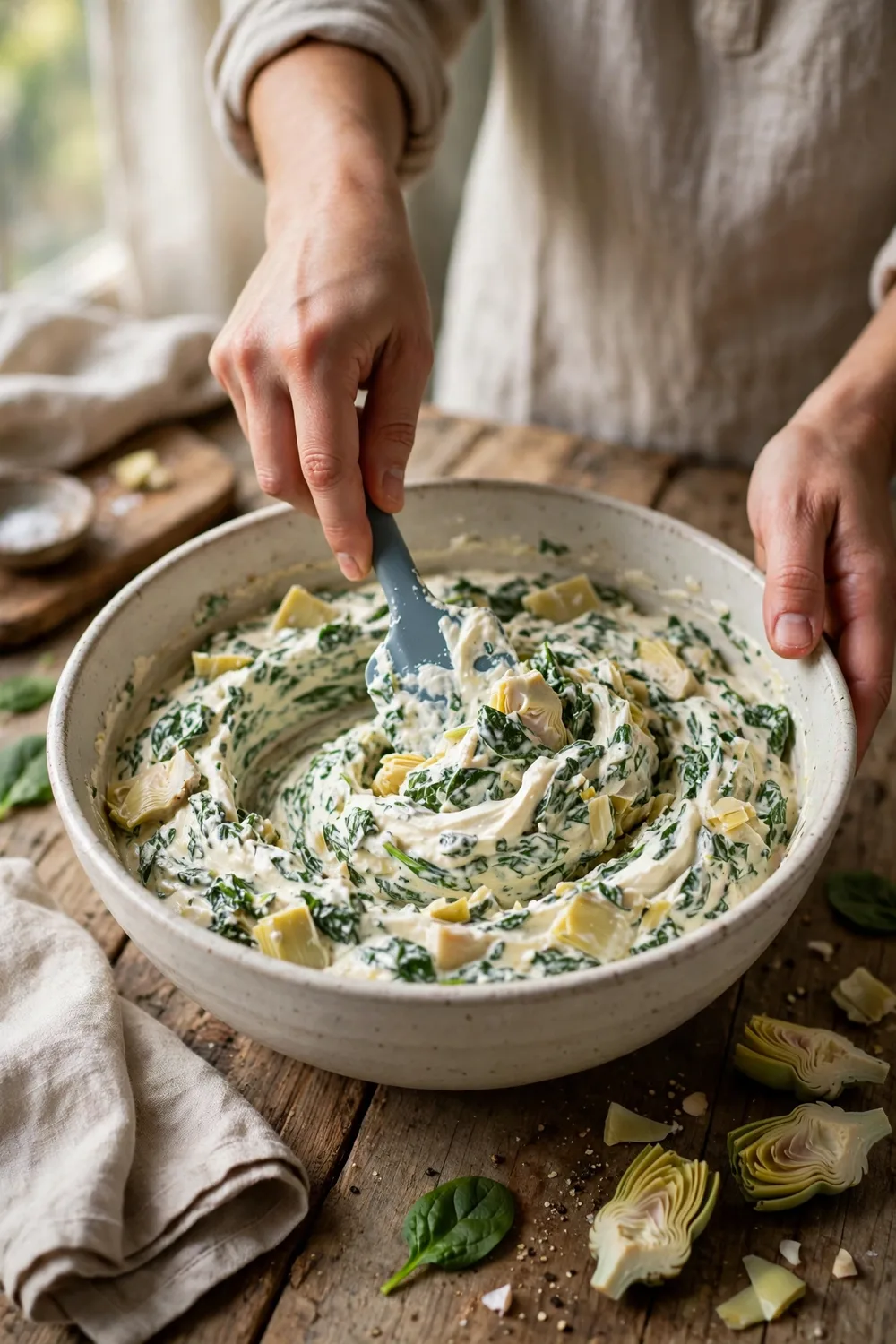
Stir the cream cheese and the sour cream together first, until smooth — this is the step that keeps the dip from going lumpy, because cream cheese beaten smooth before anything else goes in has nothing to clump against. Then add the squeezed spinach, the patted-dry artichokes, half the mozzarella, half the Parmesan, the garlic, the salt, the pepper and the red pepper flakes, and mix until everything is evenly distributed. Taste it now, before it goes into the dish — the Parmesan and the mozzarella are salty, and the salt is the lever. If it needs more salt, add it now; if it tastes right, leave it alone.
Top and bake
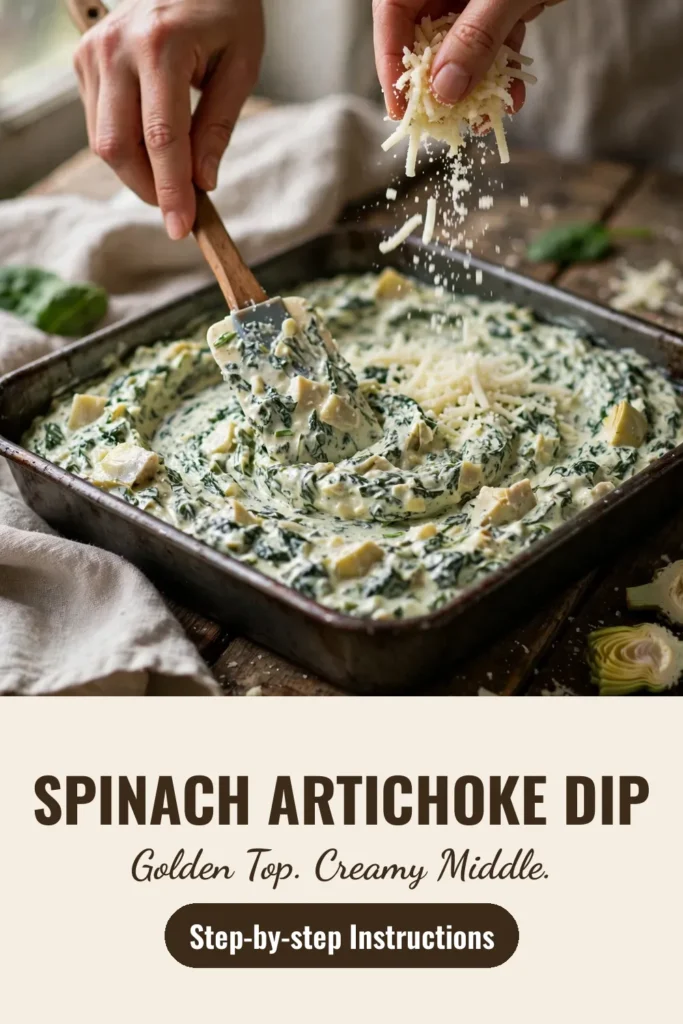
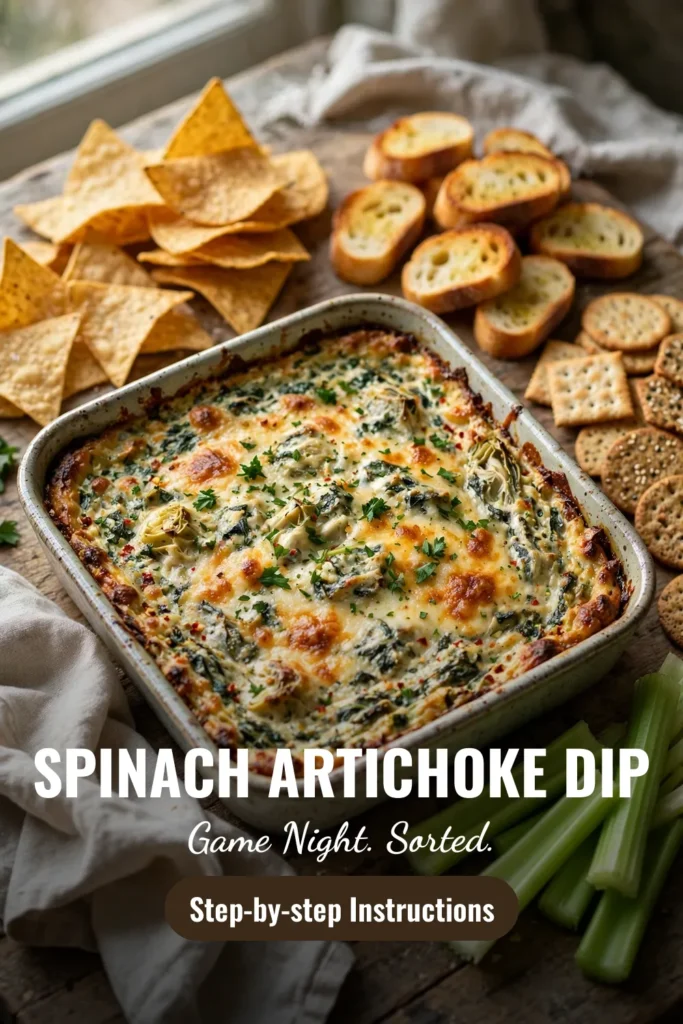
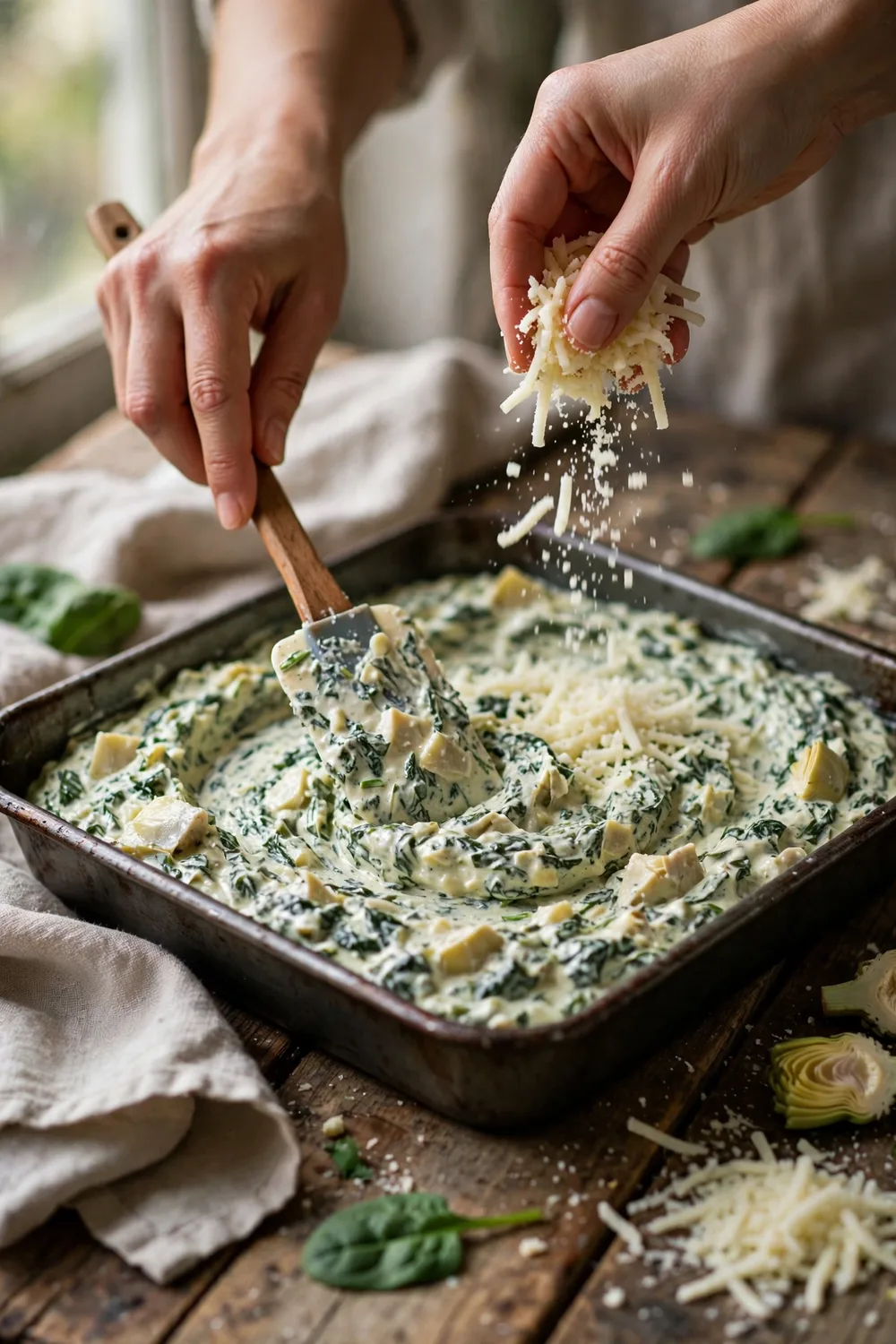
Heat the oven to 375°F and lightly grease a 9×9 baking dish (or a 9-inch round). Spread the dip in the dish in an even layer — an even layer bakes evenly, and a lumpy layer bakes lumpy — and top with the remaining mozzarella and Parmesan. Bake 20–25 minutes, until the edges are bubbling and the cheese on top has golden spots. The dip is done when the edges bubble and a spoon pulls up long strings of mozzarella; the doneness H2 has the full test.
Broil and rest
Broil 1–2 minutes for a dark golden top — watch it, because a broiler goes from golden to burnt in seconds, and the top is the part everyone sees first. Then rest the dip for five minutes before serving. It thickens as it cools — the cheese sets, the starches settle — and a dip that looks a touch loose at the broil step is thick and scoopable five minutes later. Garnish with parsley and serve with crostini, tortilla chips, crackers and veggie sticks.
How to Tell When the Dip Is Done
The dip is done when the edges are bubbling and the cheese on top has golden spots — that is the test Mama Knows gives, and it is the right one. Look at the edges first: they should be actively bubbling, not just warm. Then look at the top: the mozzarella should have golden spots, and the Parmesan should be nutty brown, not pale. The third sign is the spoon test: a spoon pulled up through the dip should bring long strings of mozzarella with it. If the spoon comes up clean and the dip looks flat, it needs a few more minutes.
The cold-centre check is the second test, and it is the one that saves a party: push a knife into the centre of the dip and touch it to your lip — it should come out hot, not warm. A dip with a golden top and a cold centre is a dip that went into the oven cold and did not get its extra five to ten minutes, or a dip baked in a deep dish at too low a temperature. If the centre is cold, cover the dish loosely with foil and bake five more minutes — the foil keeps the top from darkening further while the centre catches up. And the rule that applies to every method: rest five minutes before serving. The dip thickens as it cools, and a dip served straight from the oven is looser than the same dip five minutes later.
Troubleshooting: 5 Fixes
Midwest has “things I learned while testing this recipe” — five bullets — but no failure-mode section. Nobody on the search results explains what happens when the dip goes wrong. Here are the five failures, why they happen, and how to fix them.
Watery dip
Why: the spinach was not squeezed dry enough, or the artichokes were not patted dry, or the dip did not rest. Fix it now: rest it longer — ten minutes instead of five — and stir it once before serving, which pulls the loose liquid back into the dip. If there is a green puddle at the edges, spoon it off. Next time: towel-twist the spinach until no more water drips, then twist again; pat the artichokes between paper towels; and rest the full five minutes. The spinach is the lever, every time.
Grainy sauce
Why: the Parmesan (or Asiago) was the canned kind, and its anti-caking agent made the sauce grainy — or the dip was baked too hot and the cheese seized. Fix it now: nothing fixes a grainy dip once it is baked — but a grainy dip in a good bowl is still a good dip, so serve it and move on. Next time: grate the Parmesan yourself, and bake at 375°F, not 400°F, unless you are watching it closely. The canned Parmesan is the cause more often than the temperature.
Lumpy cream cheese
Why: the cream cheese was cold when it went into the bowl, and it broke into white lumps that never melted out. Fix it now: if the dip is still unbaked, beat it longer — a hand mixer on low will smooth out most lumps. If it is already baked, serve it as it is; the lumps are a texture problem, not a flavour problem. Next time: let the cream cheese sit on the counter for an hour, or microwave it for ten to fifteen seconds, and stir it together with the sour cream first, until smooth, before anything else goes in.
Burnt top, cold centre
Why: the dip went into the oven cold (made ahead, straight from the fridge) and baked for the room-temperature time, or the broiler was left on too long. Fix it now: cover the dish loosely with foil and bake five more minutes — the foil keeps the top from darkening further while the centre catches up. Next time: a fridge-cold dip needs five to ten extra minutes, or thirty minutes on the counter first; and broil for one to two minutes, watching it the whole time — a broiler goes from golden to burnt in seconds.
Bland dip
Why: the salt was held back too far, or the garlic was the powder fallback, or the red pepper flakes were left out and nothing replaced their warmth. Fix it now: stir in a pinch of salt and a pinch of red pepper flakes, and serve it with a squeeze of lemon — the lemon wakes the whole dip up. Next time: taste before the dip goes into the dish (the taste-before-salting rule cuts both ways — it also tells you when the dip needs more); use fresh garlic, not powder; and keep the red pepper flakes, even at a quarter teaspoon, because the warmth is the flavour that makes the dip taste like more than its parts.
Mix-and-Bake vs Stovetop vs Slow Cooker
Midwest mixes and bakes, and that is the only method on her page. The search results have three more — and the cook who owns a slow cooker, or who wants the creamiest version, deserves a method, not a link to a separate page. Here are all of them, in one table, because the method is the third question this page exists to answer, and the target page’s entire method section is one paragraph.
| Method | Time | Best for |
|---|---|---|
| Mix-and-bake (the card) | 35 min total (10 hands-on) | The default — the simplest, the most forgiving, the version all three quality bars agree on. |
| Stovetop-then-broil | 25 min total | The fastest — sauté, wilt, melt, transfer, broil 4–5 min; the Front Range Fed method. |
| Stovetop cream sauce | 45 min total | The creamiest — butter + flour + cream + milk, the sauce made smooth before the dip ever sees the oven; the Mamma C method. |
| Slow cooker | 2–3 hours on high | The hands-off party version — everything in, stir 2–3 times, no oven needed. |
| Slow-cooker warm hold | As long as the party lasts | Keeping the dip warm at a party — transfer the baked dip to a small slow cooker on the warm setting, stir occasionally. |
The bake-temp split, resolved: 375°F for 20–25 minutes is the majority and the card’s setting — Midwest bakes at 350°F for 25–30 minutes, Mama Knows and Mamma C and Mary all bake at 375°F for 20–25, and Cookie and Kate bakes at 400°F for 18–25. The rule: 375°F is the setting; 350°F is the gentler option for a deep dish or a fridge-cold dip (with five to ten extra minutes); 400°F is the fastest golden top and the easiest to scorch. A fridge-cold dip baked at 350°F for the room-temperature time is the burnt-top-cold-centre failure in the troubleshooting H2 — the temperature and the time have to move together.
The variations, because the search results are full of them and the target page has none: the buffalo kick — hot sauce or cayenne, stirred in with the red pepper flakes; the feta swap — two ounces crumbled feta in place of half the mozzarella, for a tangier dip; the cottage-cheese swap — blended low-fat cottage cheese in place of the sour cream, for a high-protein version; and the leftover idea — reheat the dip and stir it into pasta or rice, where it becomes a sauce instead of a dip. None of these is a separate recipe; all of them are one swap in the card’s method, and the card is the recipe.
What to Serve with Spinach Artichoke Dip
This is a party dip, and the search results agree that the dippers are half the dish. Midwest serves it with sliced French baguette and nothing else. Mama Knows has the dippers guide Midwest lacks, and this post follows her — with one rule: the dipper should be something the dip does not already have — crunch, or green, or bread for dunking.
- Flatbread Pizza Crust — the bread for dunking. A thin, crisp flatbread, torn into pieces, is the thing the dip’s creamy top was made for — and the flatbread’s 25-minute total means it can be in the oven while the dip bakes.
- Crack Green Beans — bacon and brown sugar glaze, 30 minutes. The other party side on this site — the sweet-salty glaze is the contrast a creamy dip wants, and the green beans are the green the table needs.
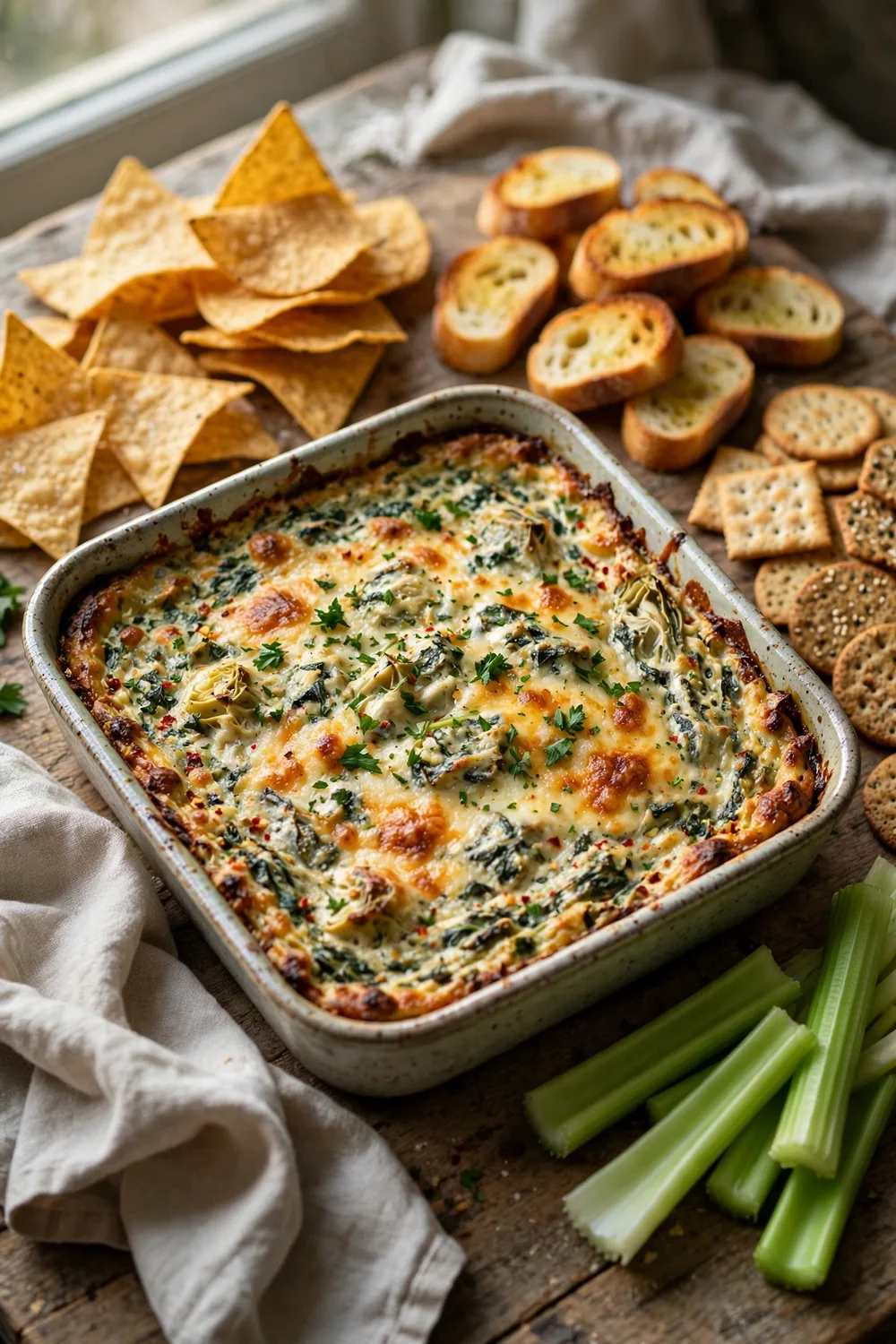
Crostini is the classic: sliced baguette, brushed with olive oil, toasted at 375°F for six to eight minutes — and the toasting matters, because soft bread turns soggy fast under a hot dip. Tortilla chips are the party default, but thick restaurant-style ones — thin ones snap under a thick dip, and a snapped chip in the dip is a party foul. Crackers should be the thicker style over thin rice crackers, and NOT salty crackers — the dip has enough sodium already, and a salty cracker on top of a salty dip is the one thing the sodium note in the Nutrition H2 warns about. Fresh veggies are the low-carb option: cucumbers, carrot sticks, bell pepper strips, celery. And the bread bowl is the presentation that steals the show: a round sourdough loaf, hollowed out, the dip in the well, the bread pieces arranged around it — the dip in the middle, the bread as the dipper, nothing else needed.
Make Ahead, Storage, and Freezing
Midwest’s page says the dip keeps in the fridge for up to a week and can be frozen before or after baking, up to three months — and the make-ahead section is one paragraph. No topping-cheese rule, no cold-bake rule, no dairy-separation warning, no reheating rules. Here is the full answer, because a dip that takes 35 minutes is a dip worth making ahead, and the cheese is the part that does not keep the same way twice.
Assemble the dip up to 24 hours ahead, cover it, and put it in the fridge — but wait to add the topping cheese until right before it goes into the oven. The topping cheese is the golden top, and a topping cheese that sits on a cold dip overnight weeps and bakes unevenly. Bake straight from the fridge with five to ten extra minutes, or sit the dish on the counter for thirty minutes first. Either way works; the cold-bake rule is the one that matters, because a fridge-cold dip baked for the room-temperature time is the burnt-top-cold-centre failure in the troubleshooting H2.
| Storage method | How long | How to reheat |
|---|---|---|
| Assembled, unbaked, fridge | Up to 24 hours | Add the topping cheese, bake straight from the fridge (+5–10 min) or sit on the counter 30 min first. |
| Baked dip, fridge | 4–5 days, airtight | Oven, covered with foil, 350°F 15–20 min, uncover the last 5 min to re-crisp the cheese; or microwave in 30-second bursts, stirring between each. |
| Baked or unbaked, freezer | 2–3 months | Thaw overnight in the fridge, then bake as directed (unbaked) or reheat (baked); the dairy may separate slightly — stir well while reheating and it comes back together. |
| Leftover dip | 4–5 days in the fridge | Stir back any liquid that collects on top; reheat gently, or stir the dip into pasta or rice as a sauce. |
The freezing answer, stated honestly, because the search results disagree about it: freezing works, baked or unbaked, two to three months — and the dairy may separate slightly on thawing, so stir well while reheating and it comes back together. That is Mama Knows’ rule, and it is the rule this post follows. Mary’s “I do not recommend freezing this dip, the texture may get weird!” is the caution, stated honestly here instead of hidden: the texture can change, and a dip that has been frozen and reheated is never quite as smooth as a fresh one. If the texture matters more than the convenience, make the dip fresh and freeze nothing. If the convenience matters more, freeze it, stir it well on reheat, and serve it with confidence.
Reheating rules, because the search results agree on them and the target page never states them: reheat in the oven, covered with foil, at 350°F for fifteen to twenty minutes, and uncover for the last five minutes to re-crisp the cheese; or microwave in thirty-second bursts, stirring between each. A little liquid may collect on top after a day in the fridge — stir it back in, it is water from the spinach, not a failure. And do not reheat on high heat: a hot oven dries the dip out, and a scorched top on a reheated dip is the one failure that tastes worse the second time.
Frequently Asked Questions
Can I make spinach artichoke dip without mayo? Yes — the trio replaces it: cream cheese for body, sour cream for tang, Greek yogurt for a sharper tang. Mayo turns oily and runny when it is baked; the trio does not. The mayo H2 has the full explanation.
Can I use frozen spinach instead of fresh? Yes — thaw it and squeeze it VERY dry in a clean kitchen towel until no more water drips. The rule is dry, not fresh-versus-frozen, and frozen is the card’s spinach. The fresh-vs-frozen H2 has the full comparison.
Why is my spinach artichoke dip watery? Water left in the spinach or the artichokes — the number-one failure mode on the search results. Squeeze the spinach harder, pat the artichokes dry, and rest the dip five minutes after baking. The thickness H2 has the full fix.
Can I make spinach artichoke dip ahead of time? Yes — assemble up to 24 hours ahead, add the topping cheese just before baking, and bake straight from the fridge with five to ten extra minutes (or sit it on the counter for thirty minutes first). The make-ahead H2 has the full storage table.
Can I freeze spinach artichoke dip? Yes — baked or unbaked, two to three months. The dairy may separate slightly on thawing; stir well while reheating and it comes back together. Mary’s “I do not recommend freezing” is the caution, stated honestly in the freezing H2 — the texture can change, and a fresh dip is always smoother.
How long does spinach artichoke dip last in the fridge? Four to five days, airtight. A little liquid may collect on top — stir it back in, it is water from the spinach, not a failure. The storage H2 has the full table.
What cheese is best for spinach artichoke dip? Mozzarella for the stretch, Parmesan for the nutty golden top, Asiago for the X-factor, feta for tang. Grate the Parmesan yourself — the canned kind makes the sauce grainy. The cheese guide has the full table.
Can I make spinach artichoke dip in the slow cooker? Yes — everything in, two to three hours on high, stir two to three times. The slow cooker also holds the dip warm at a party on the warm setting. The method-comparison H2 has the full table.
What do you serve with spinach artichoke dip? Crostini, tortilla chips, crackers, veggies, or a bread bowl — and not salty crackers, because the dip has enough sodium already. The serve-with H2 has the full dippers guide.
Can I serve spinach artichoke dip cold? Yes — chill it for an hour and it works cold, and it is fine at room temperature too. Baking gives the best flavour and texture, and the dip thickens as it cools either way.
More Easy Appetizers
- Avocado Sauce for Tacos — creamy, 5 minutes. The dip neighbour — ripe avocados, sour cream, lime and cilantro, blended smooth.
- Taco Seasoning — homemade in 5 minutes. The party-food staple — 10 spices, one jar, 3 tablespoons replaces one packet.
- Best Cheese Quesadilla — crispy, 10 minutes. The cheesy party food — the 2:1 cheddar-to-Jack blend, the cover trick, the perfect pull.
- Crack Green Beans — bacon and brown sugar glaze, 30 minutes. The other party side — the sweet-salty contrast a creamy dip wants.
- Flatbread Pizza Crust — 5 minutes, no yeast. The bread for dunking — torn into pieces, it is the thing the dip’s creamy top was made for.
- Greek Pasta Bake — a real bake plus the 15-minute stovetop version, 45 minutes. The party main — feta, beef and Mediterranean veggies, baked golden.
- Chicken and Dumpling Soup — creamy, one pot, 50 minutes. The comfort-food neighbour — fluffy homemade drop dumplings, rotisserie chicken and a rich broth.
- Cheeseburger Soup — 45 minutes, 8 servings. The party soup — creamy, cheesy, and the one that links back to the cheeseburger pasta.
- Broccoli Cheddar Soup — 35 minutes, 6 servings. The other cheesy soup on this site — broccoli, cheddar, and the same roux-first thickening.
- Gigi Hadid Pasta — spicy vodka pasta, 30 minutes. The party pasta — the oil fix, the tomato-paste technique, the no-vodka substitutes ranked.
Ingredients
Equipment
Method
- Heat the oven to 375°F; lightly grease a 9×9 baking dish. Squeeze the spinach dry in a clean kitchen towel until no more water drips; pat the chopped artichokes dry.
- Stir the cream cheese and sour cream together until smooth; add the spinach, artichokes, half the mozzarella, half the Parmesan, garlic, salt, pepper, and red pepper flakes, and mix until evenly distributed. Taste and adjust the salt.
- Spread in the dish in an even layer; top with the remaining mozzarella and Parmesan.
- Bake 20–25 min until bubbly and golden; broil 1–2 min for a dark golden top.
- Rest 5 min (it thickens as it cools); garnish with parsley and serve.
Notes
Nutrition information
| Nutrient | Per serving (1 of 10, ~¼ cup) |
|---|---|
| Calories | ~185 kcal |
| Sodium | ~440mg |
| Carbohydrates | ~7g (sugars ~2g) |
| Fat | ~15g (saturated ~9g) |
| Protein | ~8g |
| Fiber | ~2g |
| Cholesterol | ~44mg |
The inputs, shown plainly (USDA FoodData Central values for the exact ingredients listed): the batch (10 servings, ~¼ cup each) — 10 oz frozen chopped spinach ≈ 283.5g ≈ 82 kcal, ~9g protein, ~13g carbs, ~8g fiber, ~1g sugars, ~215mg sodium (USDA “Spinach, frozen, chopped or leaf, unprepared”: 29 kcal, 3.04g protein, 4.48g carbs, 2.76g fiber, 0.48g sugars, 76mg sodium per 100g — squeezing removes water, not nutrients, so the as-purchased weight is the right basis) · 1 (14 oz) can artichoke hearts in water, drained ≈ 240g ≈ 127 kcal, ~8g protein, ~27g carbs, ~14g fiber, ~2g sugars, ~816mg sodium (USDA “Artichokes, (globe or french), cooked, boiled, drained, without salt”: 53 kcal, 3.27g protein, 11.39g carbs, 5.70g fiber, 0.99g sugars per 100g; sodium ~340mg per 100g for canned-in-water drained) · 8 oz full-fat cream cheese ≈ 226.8g ≈ 776 kcal, ~14g protein, ~13g carbs, ~13g sugars, ~78g fat (saturated ~49g), ~728mg sodium, ~229mg cholesterol (USDA “Cheese, cream”: 342 kcal, 6.15g protein, 5.52g carbs, 34.24g fat, 21.47g saturated fat, 321mg sodium, 101mg cholesterol per 100g) · ½ cup sour cream ≈ 115g ≈ 222 kcal, ~2g protein, ~5g carbs, ~5g sugars, ~22g fat (saturated ~14g), ~46mg sodium, ~60mg cholesterol (USDA “Sour cream, cultured”: 193 kcal, 2.11g protein, 4.70g carbs, 19.35g fat, 12.08g saturated fat, 40mg sodium, 52mg cholesterol per 100g) · 1¼ cups shredded whole-milk mozzarella ≈ 141g ≈ 422 kcal, ~31g protein, ~3g carbs, ~32g fat (saturated ~19g), ~884mg sodium, ~111mg cholesterol (USDA “Cheese, mozzarella, whole milk”: 299 kcal, 22.17g protein, 2.22g carbs, 22.36g fat, 13.35g saturated fat, 627mg sodium, 79mg cholesterol per 100g; USDA cup weight for shredded mozzarella 113g) · ½ cup freshly grated Parmesan ≈ 50g ≈ 216 kcal, ~19g protein, ~2g carbs, ~15g fat (saturated ~9g), ~765mg sodium, ~40mg cholesterol (USDA “Cheese, parmesan, grated”: 431 kcal, 38.46g protein, 4.07g carbs, 28.99g fat, 17.34g saturated fat, 1,529mg sodium, 79mg cholesterol per 100g) · 3 cloves garlic ≈ 9g ≈ 13 kcal, ~3g carbs, ~2mg sodium (USDA “Garlic, raw”: 149 kcal, 33.06g carbs per 100g) · ½ tsp kosher salt ≈ 0 kcal, ~950mg sodium (Morton kosher: ~1,900mg sodium per teaspoon) · black pepper + red pepper flakes ≈ 4 kcal, negligible sodium. Batch ≈ 1,858 kcal and ~4,406mg sodium — per serving ≈ 186 kcal and ~441mg sodium, rounded to about 185 kcal and about 440mg sodium per serving. The dippers (crostini, tortilla chips, crackers, veggie sticks) are NOT in these numbers — they are serve-with items, and the dip’s nutrition is the dip alone.
The SERP comparison, honestly: the published numbers on the search results range from 164 to 248 kcal, and the serving sizes are part of the reason they disagree. Midwest’s 248 kcal / 606.8mg sodium is per 1/10 of her dip (hers has 12 oz mozzarella + 5 oz Parmesan — the most cheese on the SERP, hence the highest on both); Mama Knows’ 164 kcal / 839mg is per serving with the serving size unstated — and her sodium does not recompute from her own ingredients, so it is flagged here, not copied; Mamma C’s 181 kcal / 462mg and Front Range Fed’s 178 kcal / 503mg per 1/10 are the two most credible numbers on the SERP. Ours (~185 kcal, ~440mg per 1 serving of 10, ~¼ cup each) sits with Mamma C and Front Range Fed — which makes sense, because our cheese amounts sit between theirs — and it states the serving size plainly and shows the USDA working so the number can be checked instead of trusted. Midwest’s published 606.8mg sodium is taken at face value here — her own cheese recomputes close to it, so it is not flagged the way Mama Knows’ is.
The sodium is worth telling honestly: the CHEESE TRIO is the driver — mozzarella (~884mg) + Parmesan (~765mg) + cream cheese (~728mg) ≈ 2,377mg of the ~4,406mg batch, about 54% — and that is the number the analysis got right. The rest is the salt (~950mg), the artichoke hearts (~816mg, canned in water), and the spinach (~215mg). The low-sodium lever is the “taste before you add all the salt” rule and serving with NOT-salty crackers — NOT cutting the cheese, which is the dip. The savings, if a reader wants them: use half a teaspoon of salt instead of a full one and save ~95mg per serving; and know that marinated artichoke hearts instead of canned-in-water would ADD sodium (the marinade is oil + seasoning you did not ask for), which is why the card specifies canned in water. The analysis’s claim that the sodium is “~435mg” holds within rounding — the drafter’s USDA working gives ~440mg — but the analysis’s calories (~175), carbs (~4g), sugars (~3g), fat (~14g), saturated fat (~8g) and cholesterol (~35mg) do not hold, and this table corrects all six.
Nutrition is an estimate calculated from USDA FoodData Central values for the exact ingredients listed. Values will vary with brands and substitutions.
Pin this recipe