Old El Paso Taco Seasoning Recipe (5 Minutes)
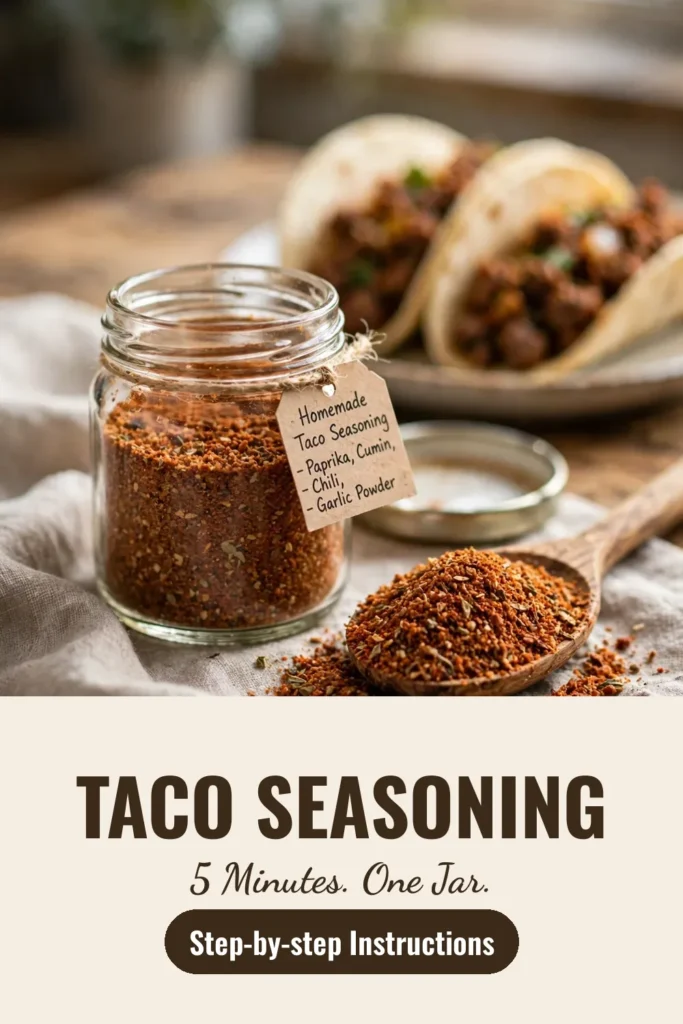
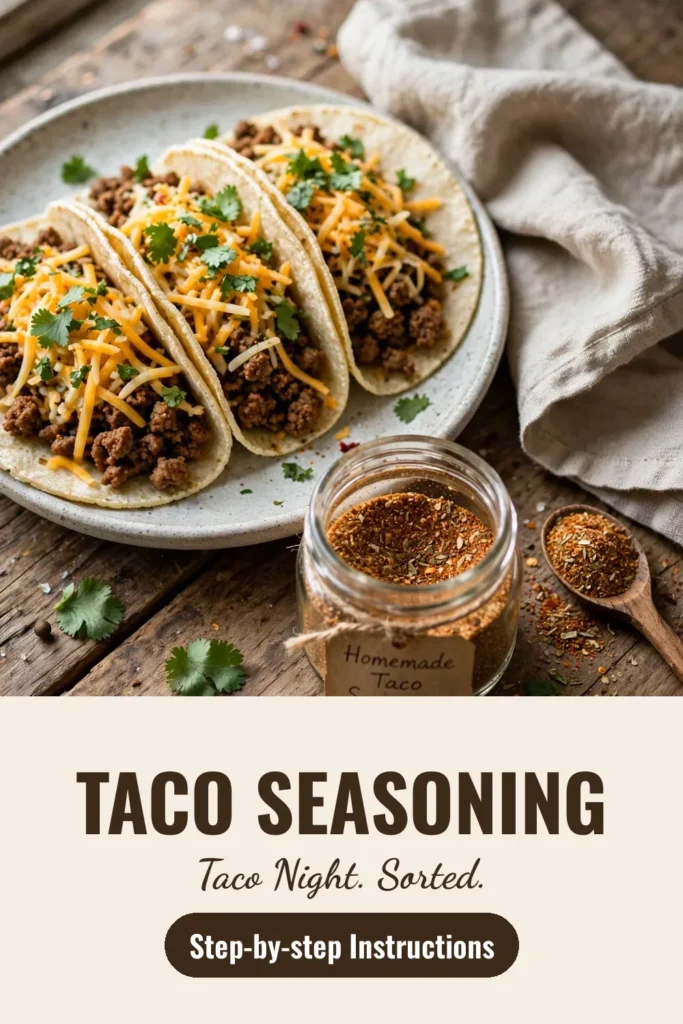
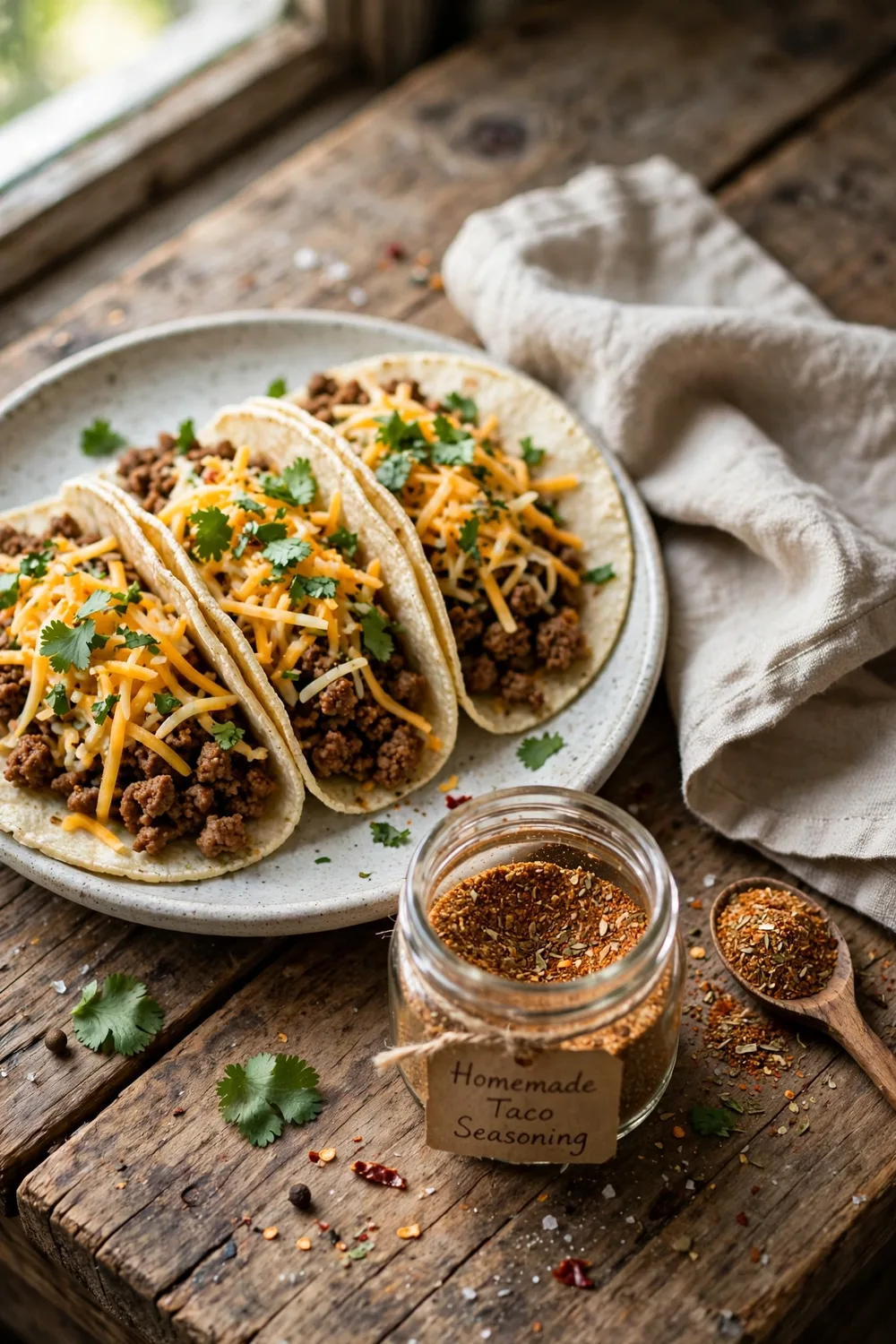
This old el paso taco seasoning recipe takes 5 minutes, one bowl, and ten spices you probably already own — and it tastes like the packet you grew up with, without the packet. If you have ever searched for a taco seasoning recipe and landed on a page that lists eight spices with no amounts, no explanation of what each one does, and no answer to how much goes on a pound of meat, this is the page that fixes that. The blend is right here in the first paragraph: 3 tablespoons chili powder, 1½ tablespoons cumin, 1 tablespoon smoked paprika, 1 tablespoon garlic powder, 1 tablespoon onion powder, 1½ teaspoons oregano, 1½ teaspoons fine sea salt, 1 teaspoon black pepper, 1 tablespoon cornstarch and ½ teaspoon cayenne. Whisk it, jar it, and 3 tablespoons of it replaces one packet — on a pound of meat, with ⅔ cup of water, simmered 3 to 4 minutes. That is the whole recipe. The rest of this page is everything the packet never tells you: what is actually in the packet, what each spice does, how much to use and why the search results disagree about it, and how to make it mild, hot, low-sodium or fajita-style.
You will love this:
- 5 minutes. One bowl, one whisk, no cooking at all — and a jar that seasons three pounds of meat.
- No fillers. No maltodextrin, no modified corn starch, no silicon dioxide — just spices, and you control the salt.
- About 12¢ a batch. Against 89¢ to $1.50 for a packet at the store, the pantry version pays for itself by the second taco night.
What’s in Taco Seasoning? (The 10 Spices, and What Each One Does)
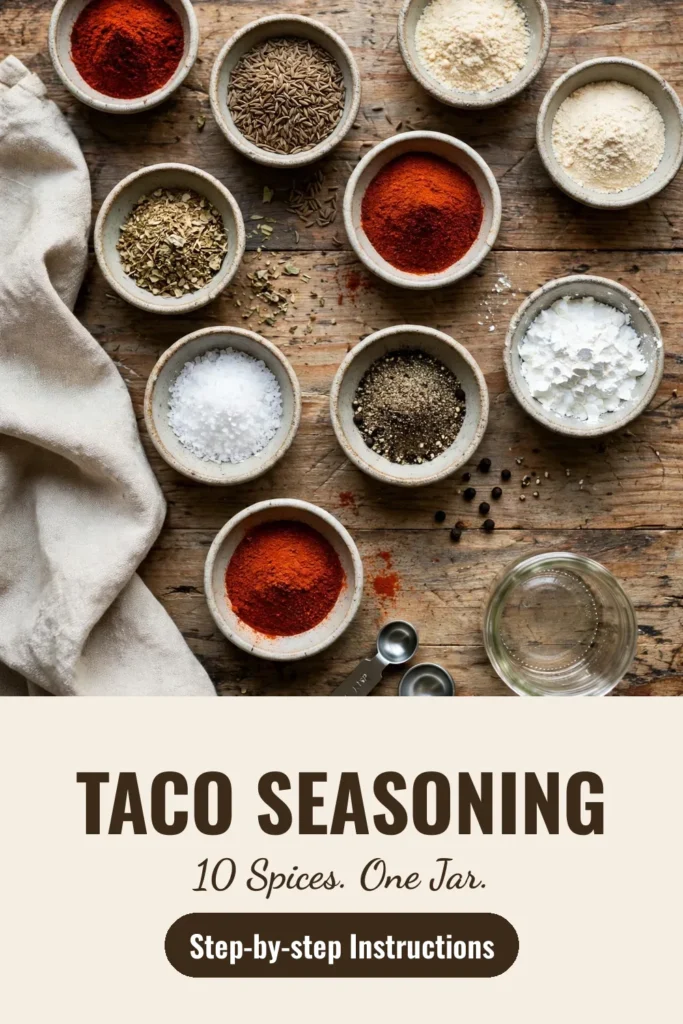
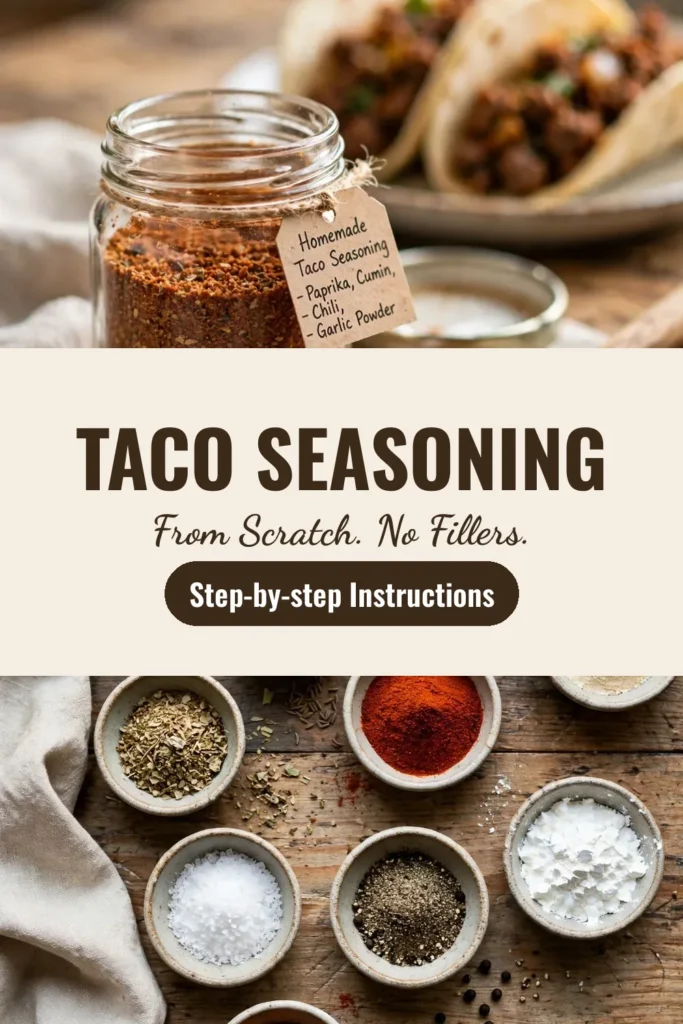
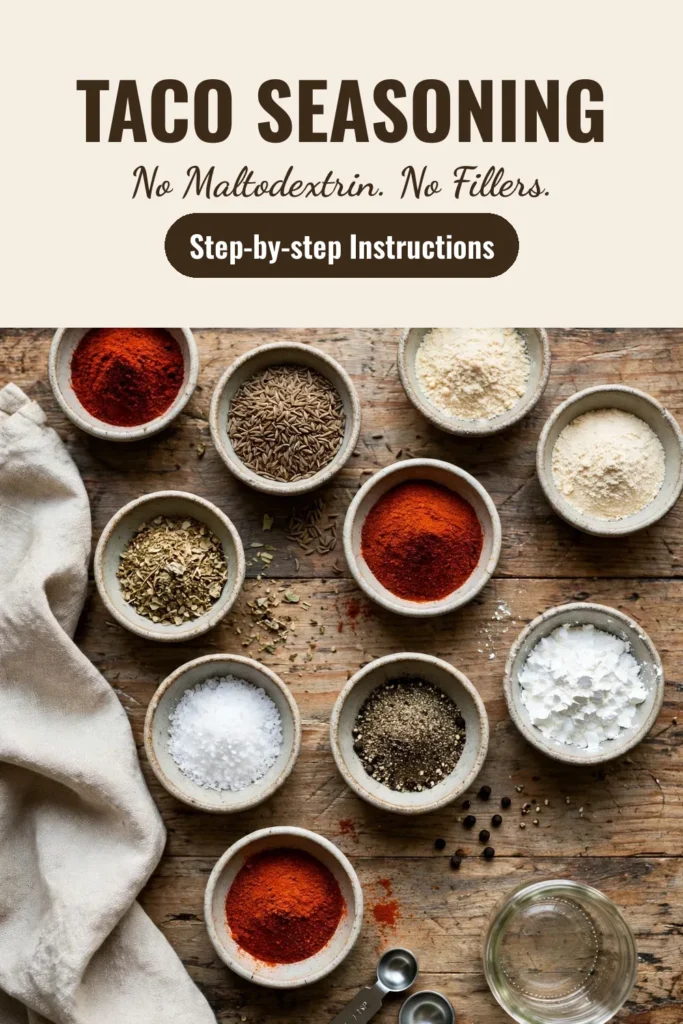
Every page on the search results names the same eight spices and explains none of them. Here is what each one is doing in the jar — because once you know the job of each spice, you can adjust the blend instead of guessing.
| Spice | Amount in our batch | What it does |
|---|---|---|
| Chili powder | 3 Tbsp | The base. This is the flavour the packet drinkers recognise — and it is a BLEND, not pure ground chile. American-style chili powder is ground chiles mixed with cumin, garlic and oregano already, which is why it carries the whole recipe. Pure ground chile (ancho, cayenne) is much stronger — use less, or the blend turns hot and one-note. |
| Ground cumin | 1½ Tbsp | The signature. Cumin is the warm, earthy note that makes taco seasoning taste like taco seasoning instead of like generic spice mix. Toast it in the dry pan for a minute before mixing if you want it louder. |
| Smoked paprika | 1 Tbsp | Colour + smoke. Paprika gives the blend its red-brown colour; the smoked version adds a char-like depth that reads as if the meat came off a grill. (See the paprika H2 below for the sweet swap.) |
| Garlic powder | 1 Tbsp | The savoury base, half of it. Garlic powder is the background note you only notice when it is missing — the blend tastes flat without it. |
| Onion powder | 1 Tbsp | The savoury base, the other half. Onion powder rounds out the garlic and gives the seasoning its mellow, cooked-onion depth without any chopping. |
| Dried oregano | 1½ tsp | The herbaceous note. Oregano is the green, slightly bitter edge that keeps the blend from tasting like pure heat. Mexican oregano is the traditional choice if you have it — it is earthier than the Mediterranean kind. |
| Fine sea salt | 1½ tsp | The control. Salt is the one ingredient that decides whether the blend tastes seasoned or salty — and the one you cut first for the low-sodium version. |
| Ground black pepper | 1 tsp | The bite. Pepper adds a sharp, bright heat that is different from cayenne’s slow burn — it hits the front of the tongue instead of the back of the throat. |
| Cornstarch | 1 Tbsp (optional) | The thickener. Cornstarch is what turns the water into a glossy sauce that clings to the meat instead of pooling in the pan. (See the cornstarch H2 below.) |
| Cayenne pepper | ½ tsp (optional) | The heat. Cayenne is the dial — omit it for mild, keep ½ teaspoon for medium, go to 1 teaspoon for hot. |
That is the whole list — ten items, every one of them in the recipe card below, and every one of them on the ingredients card image. “What is in taco seasoning” and “what’s in taco seasoning” are the two most-asked versions of this question, and the answer is the table above: a chili-powder base, cumin as the signature, paprika for colour, garlic and onion for the savoury base, oregano for the herb note, salt for control, pepper for bite, cornstarch for the sauce, cayenne for the heat.
What’s Actually in the Old El Paso Packet? (The Label, Read Plainly)
Midwest’s page is titled “Better Than Old el Paso” and never shows the packet’s label. Here it is, read plainly — because the label is the whole reason to make your own.
The Old El Paso Original packet lists: chili pepper, maltodextrin, salt, spices, modified corn starch, silicon dioxide. Three of those six are not spices at all:
- Maltodextrin is a processed sugar filler. It bulks the packet out and adds sweetness you did not ask for — it is the reason the packet’s first ingredient after chili pepper is not a spice.
- Modified corn starch is a thickener. It is the packet’s version of our optional cornstarch — it turns the water into the glossy sauce. The packet needs it because the blend is designed to be saucy; ours lets you choose.
- Silicon dioxide is an anti-caking agent. It keeps the powder flowing in the packet for months on a shelf. It does nothing for flavour — it is a shelf-life ingredient, and the reason the packet lasts longer than a homemade jar.
Now the numbers, honestly — because one of them corrects a claim that circulates on the search results:
| Homemade (ours) | Old El Paso packet | |
|---|---|---|
| Sodium per packet-equivalent | ~1,200mg (no-salt chili powder) to ~1,400mg (salted chili powder) | 1,400mg (official label: 280mg × 5 servings) |
| Sodium per person (1 lb meat, 4 servings) | ~300–350mg | ~350mg |
| Cost per batch / packet | ~12¢ | 89¢–$1.50 |
| Fillers | None | Maltodextrin, modified corn starch, silicon dioxide |
| Shelf life | 6 months best flavour | Longer (the anti-caking agent earns its keep) |
| Salt control | Yours — cut it or omit it | Fixed |
Two things to say plainly here. First, the packet is 1,400mg of sodium per packet, not 1,680mg — the 1,680 figure that circulates (including on Copycat Spices) comes from counting six servings of 280mg, but the official Old El Paso label says five servings per 1 oz packet (five × 280mg = 1,400mg; the packet weighs 28g and five 5g servings is 25g — six servings would weigh more than the packet). Second, that means our standard blend is roughly equal to the packet on sodium, not 25–30% lower — about 1,200mg per packet-equivalent with a no-salt chili powder, about 1,400mg with a salted one. The sodium in the blend is mostly the salt you add (1½ teaspoons is about 3,450mg) plus whatever your chili powder brand brings — and chili powder brands vary enormously on salt, from none at all to 229mg per tablespoon. The honest win is not the standard blend’s sodium. It is the cost (about 12¢ a batch), the absence of fillers, and the fact that the low-sodium version — half a teaspoon of salt per batch — drops the whole packet-equivalent to about 470mg, which is less than half the packet and less than the 25%-less-sodium packet’s 1,050mg. That version is in its own H2 below.
The shelf-life trade-off is honest too: the packet lasts longer, because silicon dioxide does its job. Our jar is best within 6 months — after that it is still safe, just weaker. For 12¢ a batch, remaking it twice a year is not a hardship.
The Recipe — Our Blend (9 Tablespoons = 3 Packets)
This is an easy taco seasoning recipe in the truest sense: five minutes, one bowl, no cooking. The batch makes 9 tablespoons — three packets’ worth — because a single-packet batch is barely worth opening the spice jars for, and a 9-tablespoon jar seasons three pounds of meat.
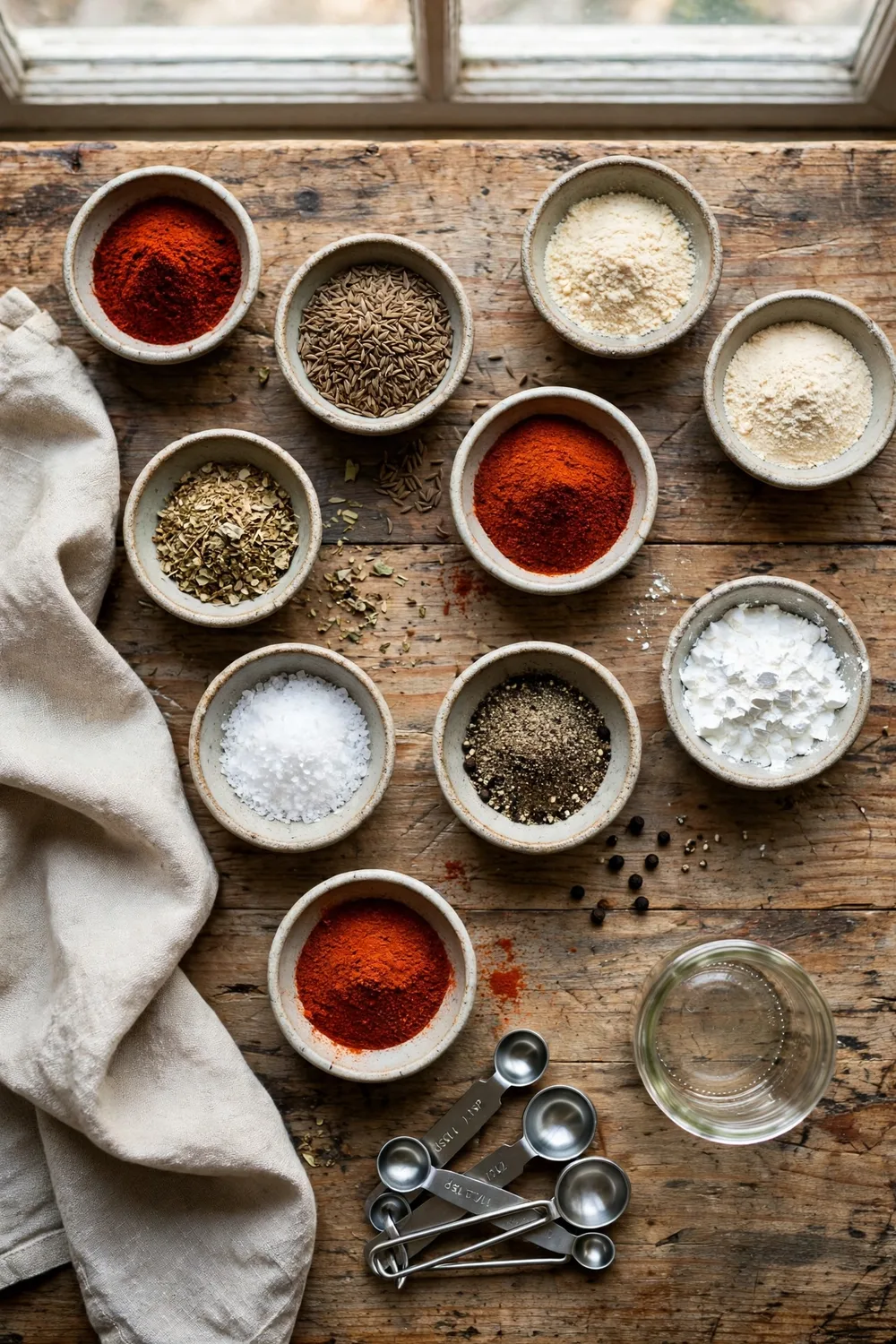
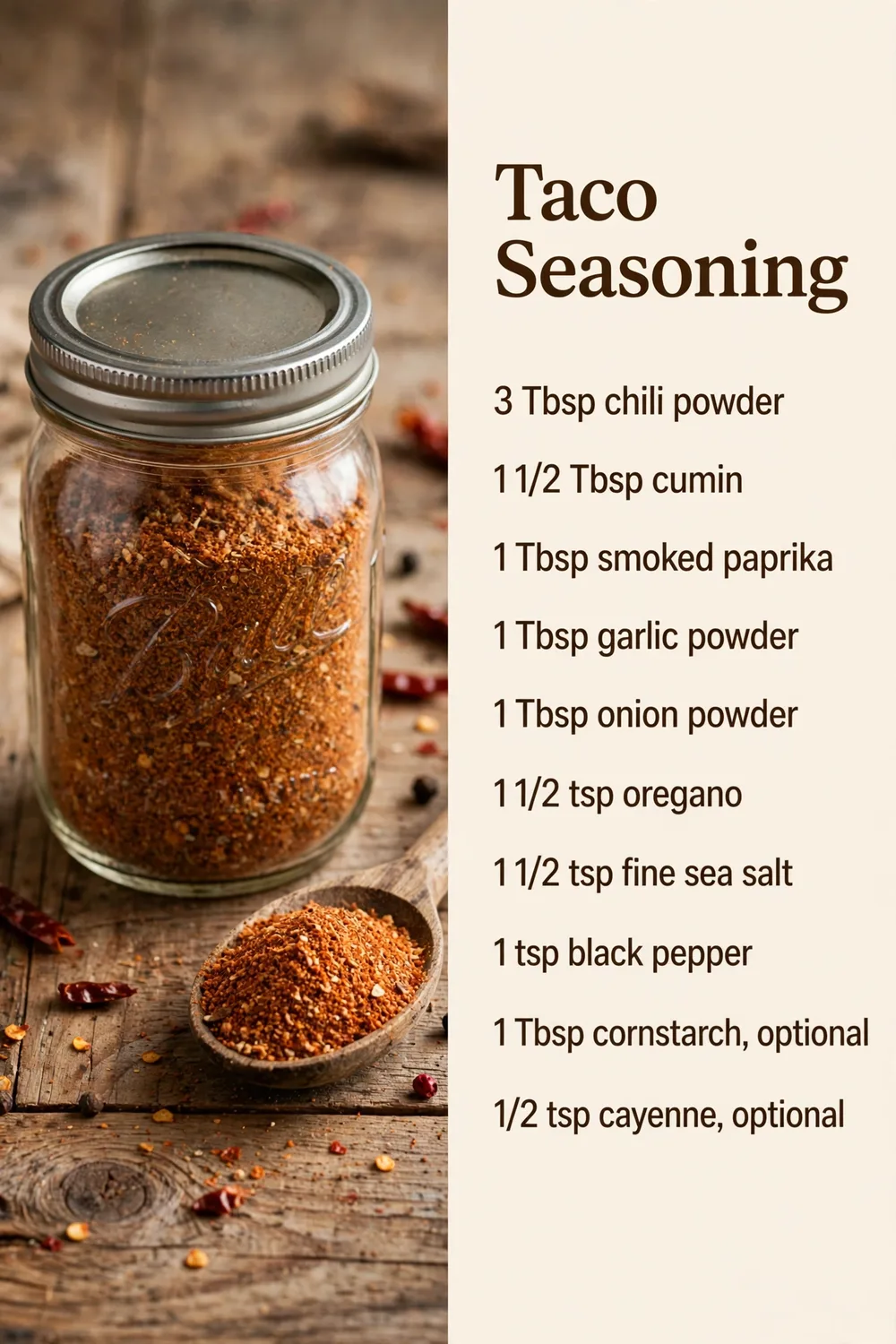
- 3 Tbsp chili powder (mild American-style blend — NOT pure ground chile)
- 1½ Tbsp ground cumin
- 1 Tbsp smoked paprika (sweet paprika swaps in — see the paprika H2)
- 1 Tbsp garlic powder
- 1 Tbsp onion powder
- 1½ tsp dried oregano (Mexican oregano if you have it)
- 1½ tsp fine sea salt
- 1 tsp ground black pepper
- 1 Tbsp cornstarch (optional — for the saucy finish)
- ½ tsp cayenne pepper (optional — for heat; omit for mild)
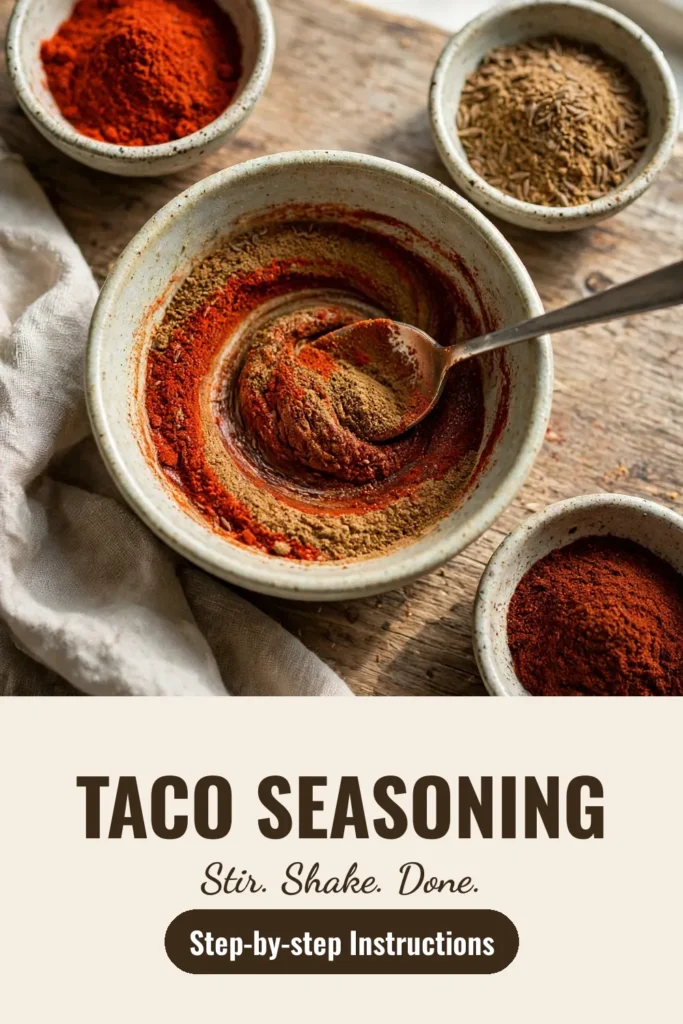
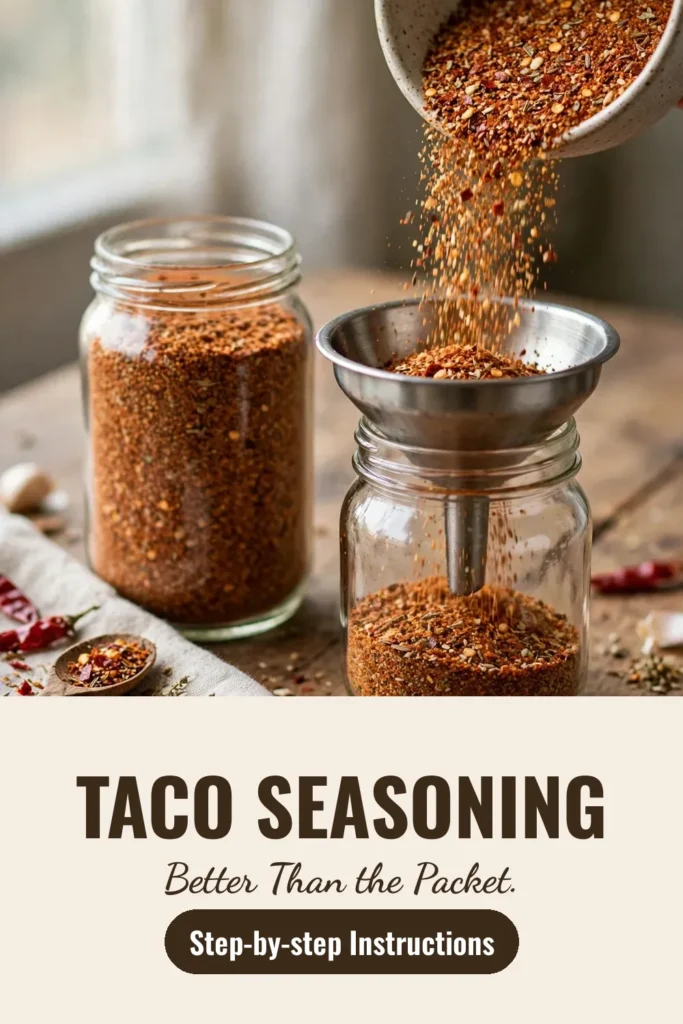
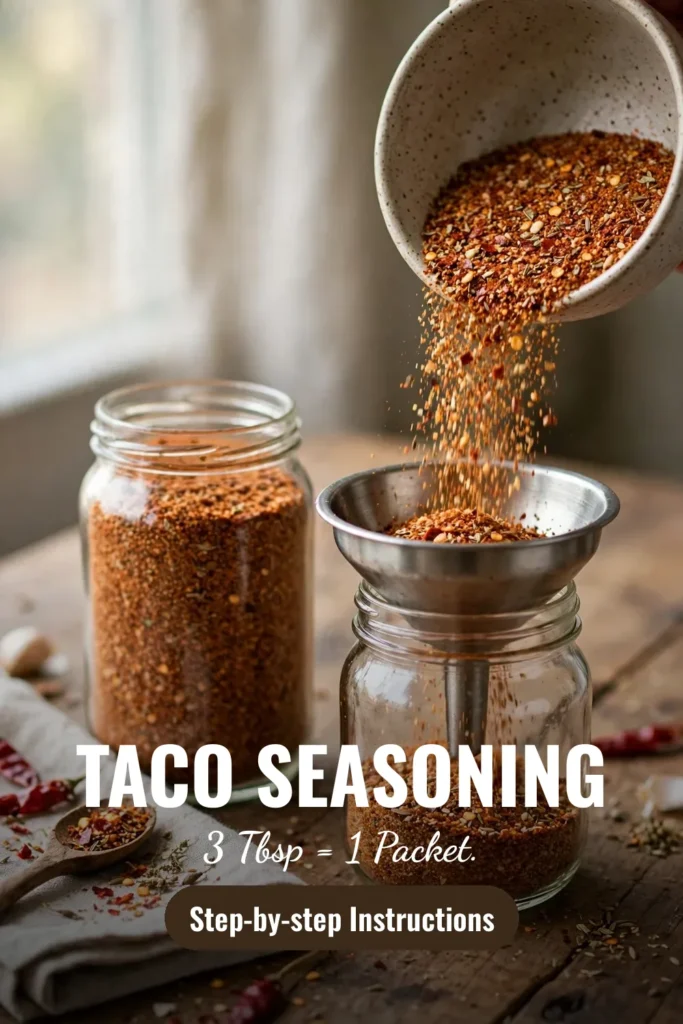
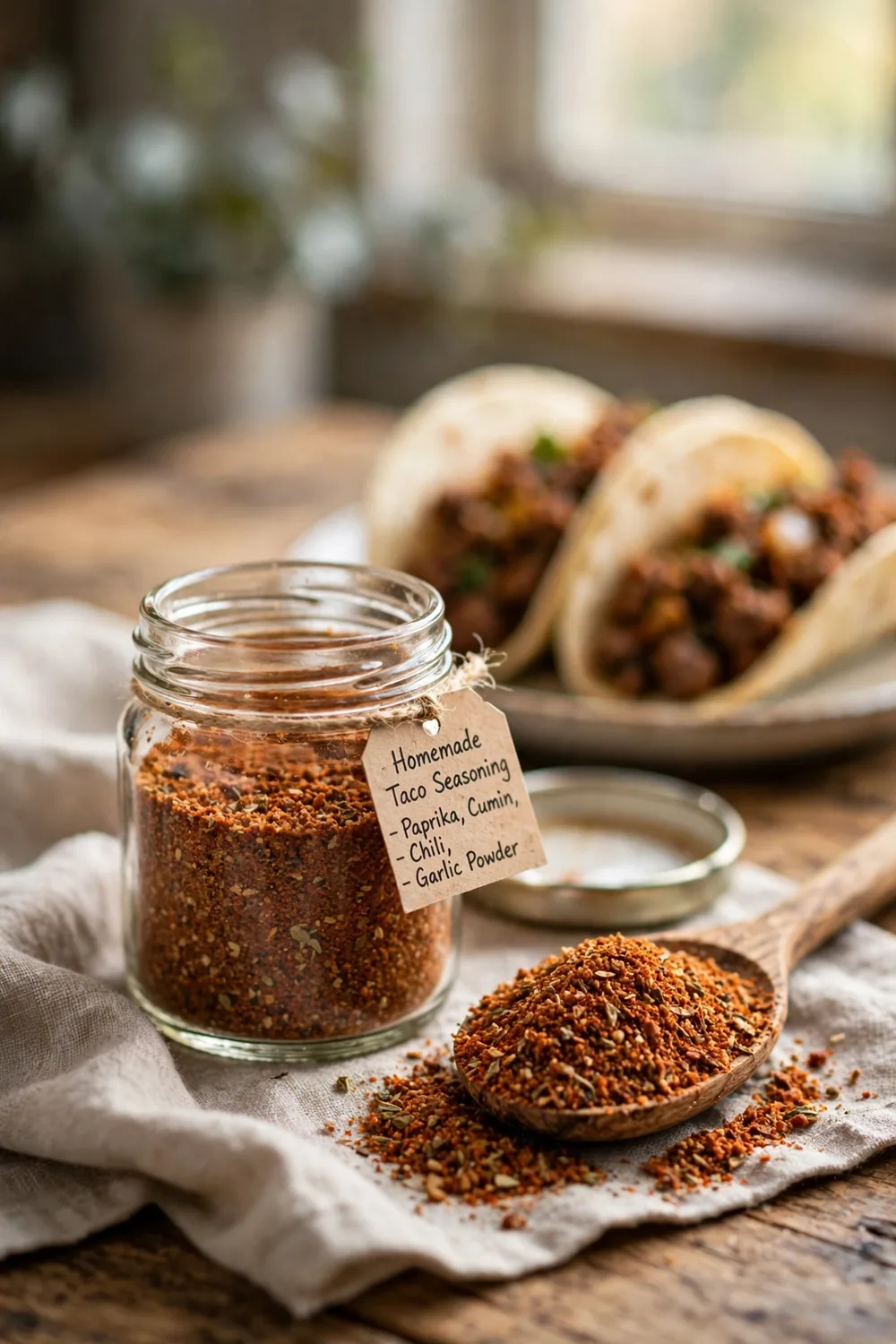
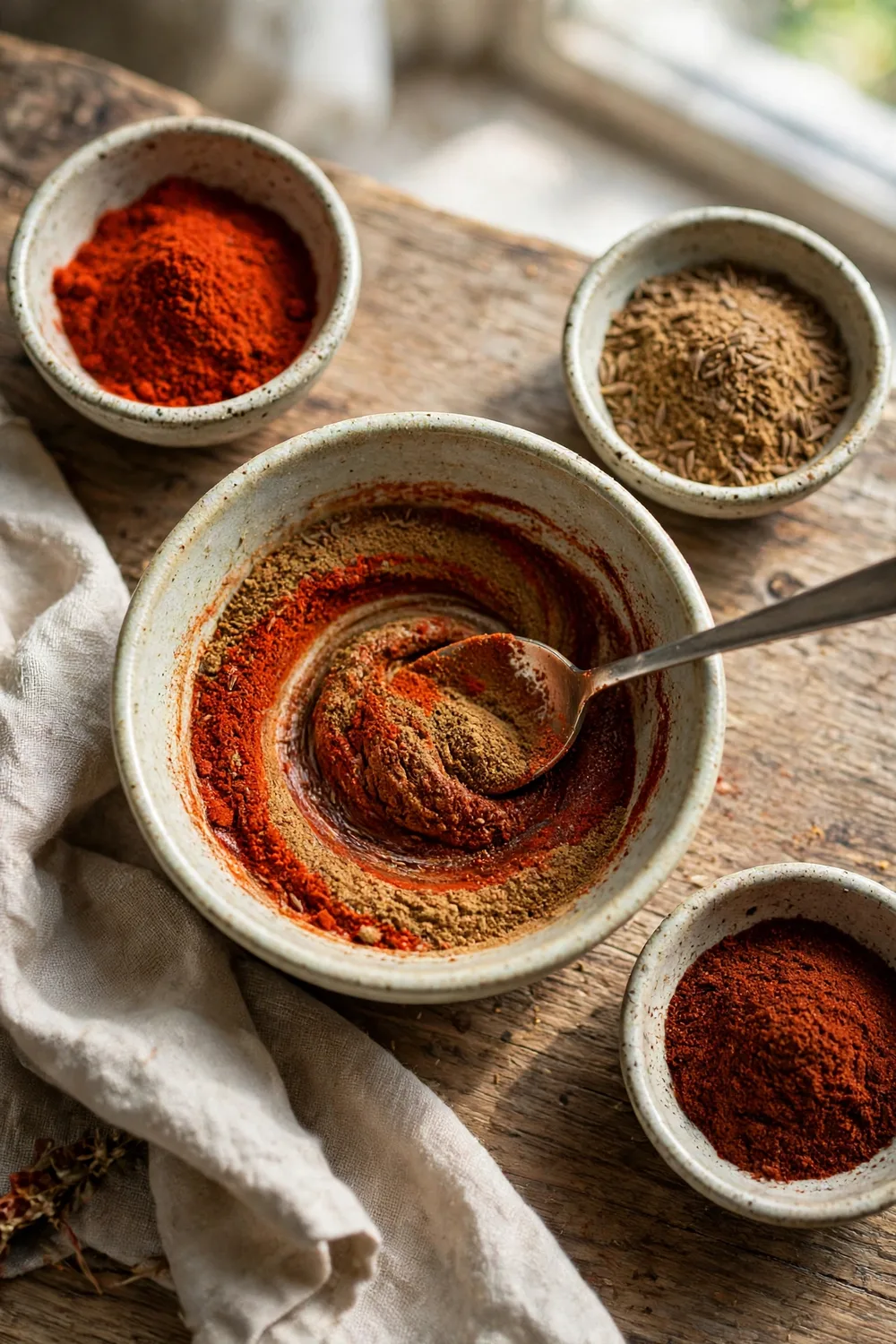
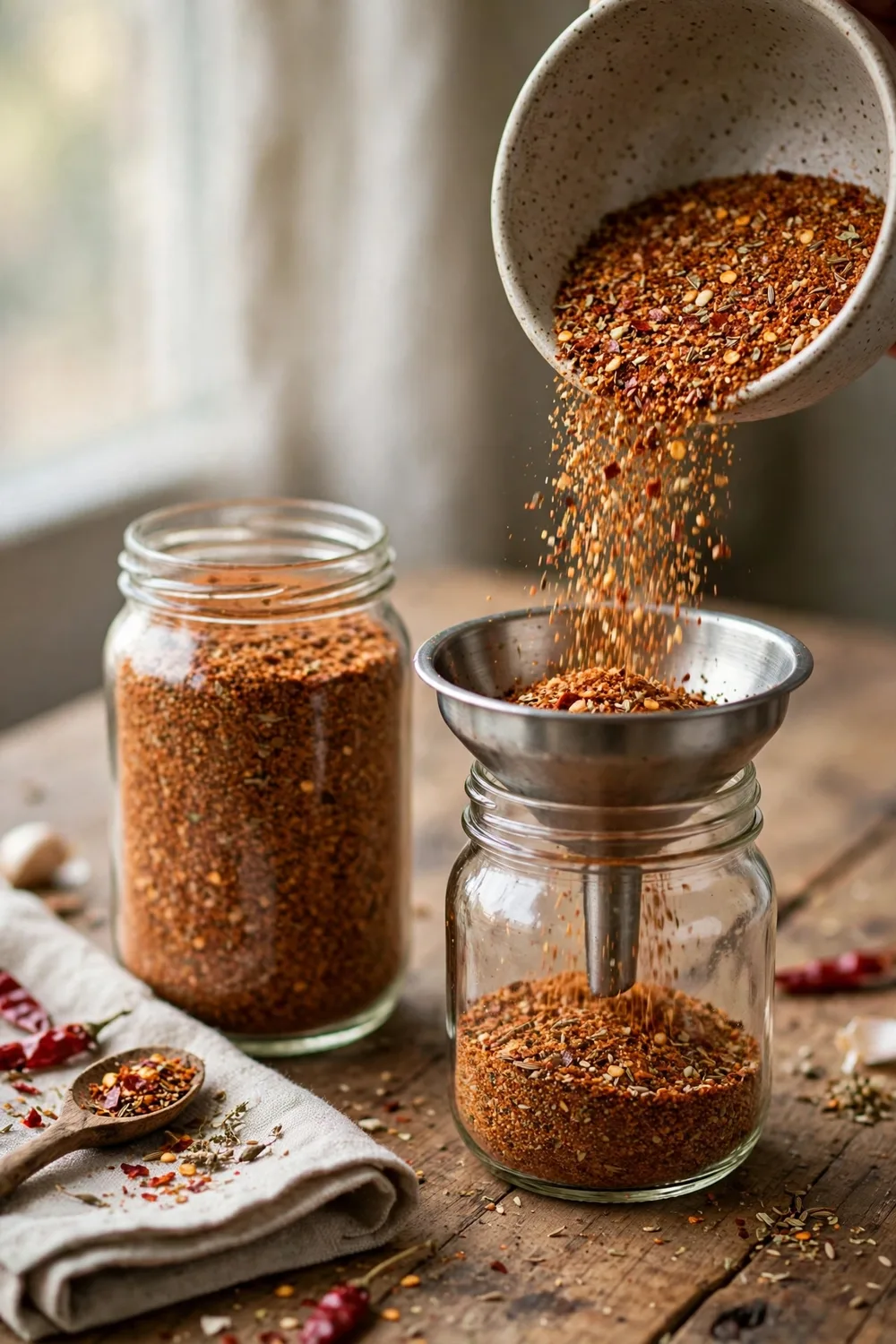
How to mix it: add everything to a small bowl and whisk until it is one even reddish-brown colour, pressing out any lumps with the back of the spoon. Or put it all in a jar and shake it — the jar is the mixing bowl and the storage in one step. Label the jar with the date (a strip of tape and a pen is enough) and keep it somewhere cool, dark and dry — not above the stove, where heat and steam shorten its life.
The 60-second bloom — the step most home cooks skip. When you use the blend on taco meat, don’t just stir it into the liquid. Brown the meat, drain it, then scatter the seasoning over the meat in the dry pan and cook it for 60 seconds before adding the water. Heat wakes up the fat-soluble compounds in chili powder and cumin, and the difference between bloomed and unbloomed seasoning is the difference between a blend that tastes like itself and one that tastes like dust. It costs one minute and it is the single best technique on this page.
How Much Taco Seasoning Per Pound of Meat?
This is the question the search results answer three different ways — and nobody on the SERP explains why they disagree. Here are the numbers, side by side, and then the resolution.
| Use | Seasoning | Liquid |
|---|---|---|
| 1 lb ground beef, turkey or chicken | 3 Tbsp | ⅔ cup water |
| ½ lb ground meat | 1½ Tbsp | ⅓ cup water |
| 1 lb chicken strips or shrimp | 1½–2 Tbsp | 1 Tbsp oil (no water) |
| 1 can (15 oz) beans, drained | 1–2 Tbsp | ¼ cup water |
| Taco soup (~8 servings) | 3 Tbsp | (in the soup — no extra liquid) |
| Taco dip (1 cup sour cream) | 1–2 tsp | none |
The settled rule: 3 tablespoons per pound, by flavour. Four pages on the SERP say a packet equals 3 tablespoons — Midwest, Copycat Spices, RecipeFairy and The Dude Cooks all agree — and that is the rule this page uses. The two dissenters are measuring different things. Get On My Plate says 4 tablespoons, but her blend is lighter by design (she uses 2 tablespoons per pound herself, with more black pepper and no fillers), so her packet-equivalent is a different blend measured on a different scale. The Cookful’s packet recipe makes 2 tablespoons, but theirs is a cumin-forward blend — cumin leads, chili powder is minor — so less of it carries the same flavour. And Inspired Taste uses 5 teaspoons per pound, because their blend is salt-heavy and concentrated.
Why does the same weight of packet and homemade blend measure differently at all? A 1 oz (28g) Old El Paso packet is mostly spice plus fillers — maltodextrin and modified corn starch make it denser, so the same weight is less volume than a filler-free homemade blend. Three tablespoons of a filler-free blend carries about the same flavour as one packet. That is the density explanation, and it is why “3 tablespoons = 1 packet” is a flavour equivalence, not a weight equivalence. If you weigh it instead of spooning it, one packet is 28g and our 3-tablespoon measure is about 25g — close enough that the spoon rule works in practice.
How to Use It — Taco Meat, Step by Step
An easy taco seasoning recipe is only useful if the using part is as clear as the mixing part. Here it is, for the classic case — a pound of ground meat — and then the variations from the table above.
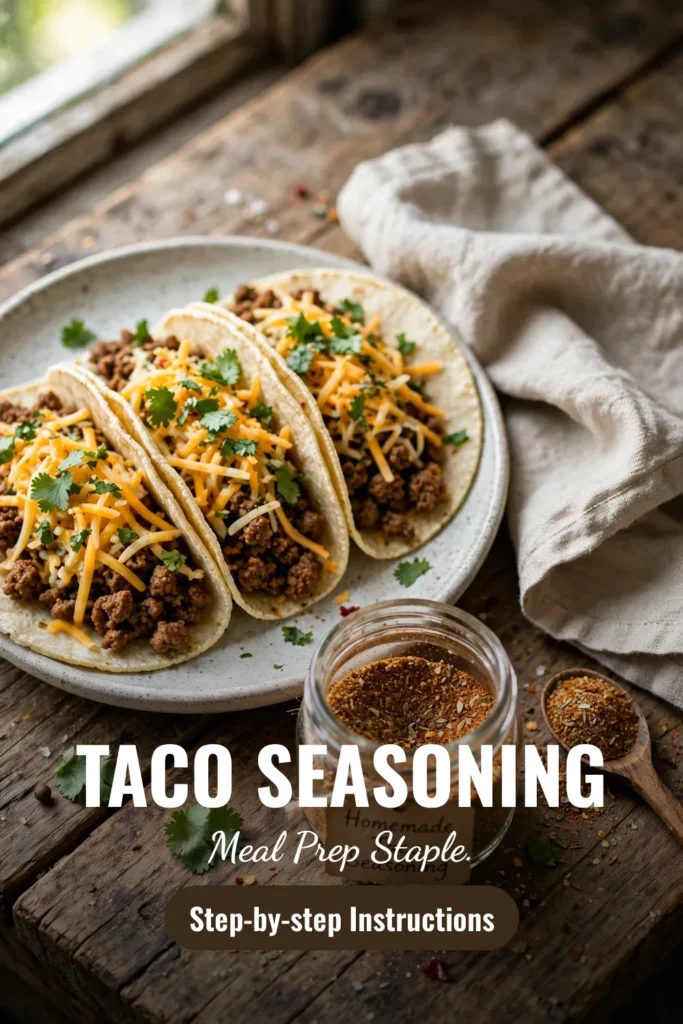
Ground beef, turkey or chicken (1 lb): brown the meat in a skillet over medium-high heat, breaking it up as it cooks, until no pink remains. Drain the fat. Scatter 3 tablespoons of the blend over the meat in the dry pan and cook for 60 seconds — the bloom from the recipe H2 above — stirring once. Add ⅔ cup of water, stir, and simmer 3–4 minutes, uncovered, until the sauce thickens and clings to the meat instead of pooling. That cling is the finish you are looking for: the meat should look coated, not swimming. Serve right away — in tacos, burritos, on nachos, over rice.
Chicken strips or shrimp: the rule changes because there is no fat to drain and no long simmer to survive. Toss 1 lb of chicken strips or shrimp with 1½–2 tablespoons of the blend and 1 tablespoon of oil, then cook in a hot skillet — chicken 5–6 minutes until cooked through, shrimp 2–3 minutes until pink and curled. No water: the oil carries the seasoning onto the surface, and the short cook keeps the shrimp from turning rubbery.
Beans: a can of black beans or pinto beans, drained, plus 1–2 tablespoons of the blend and ¼ cup of water, simmered 5 minutes. The beans are the vegetarian lane — the blend does the same work on beans that it does on beef, and the water is just enough to make a sauce.
Taco soup and taco dip: the blend goes in dry. Taco soup takes 3 tablespoons stirred into the pot with the rest of the soup ingredients. Taco dip takes 1–2 teaspoons per cup of sour cream, stirred in and left for 10 minutes so the flavours bloom.
Heat Levels — Mild, Medium, Hot
Cayenne is an “optional” line on every page on the SERP, and nobody tables what mild, medium and hot actually mean. Here it is.
| Level | Cayenne | Who it’s for |
|---|---|---|
| Mild | Omit the cayenne | Kid-friendly, and the closest to the packet’s “original” mild. The chili powder blend still gives a warm background heat. |
| Medium | ½ tsp cayenne (ours) | The house blend on this page. Noticeable warmth that sits behind the tomato and the cheese instead of on top of it. |
| Hot | 1 tsp cayenne + ½ tsp red pepper flakes | Real heat. The flakes add a second, sharper burn on top of the cayenne’s slow one. |
One thing the table doesn’t show: the heat comes from the chili powder blend first and the cayenne second. A hot chili powder changes the level before the cayenne ever enters the picture — if your chili powder is a hot blend, start with the mild version of the recipe and add cayenne only after tasting the meat. And the reverse is true too: a mild American-style chili powder (the kind this recipe calls for) is the reason the medium level tastes warm rather than hot.
Smoked Paprika vs Sweet Paprika — Which One?
Copycat Spices answers this in one FAQ paragraph; Midwest doesn’t mention it at all. It deserves an H2, because it is the one choice in the blend that changes the flavour’s direction.
Smoked paprika is paprika made from peppers dried over oak smoke. It tastes char-like and deep — the closest thing to grill flavour you can get from a jar. On stovetop taco meat, where there is no real smoke, smoked paprika is the note that makes the meat taste like it came off a fire. That is why it is in our blend.
Sweet paprika is the same pepper, dried without smoke. It gives the same red colour and a mild, sweet pepper flavour, but no smokiness. If you are grilling — chicken, shrimp, steak for fajitas — sweet paprika is fine, because the grill supplies the smoke itself. If your jar only has sweet paprika, use it: the tacos still taste good, they just lose the char note.
Either works, and the swap is one-for-one — 1 tablespoon of sweet for 1 tablespoon of smoked, no other change. The one paprika to avoid is hot paprika, which is a different heat entirely and will push the blend up a level without warning.
Cornstarch — Do You Need It?
The packet uses modified corn starch for the saucy finish. RecipeFairy has the best tip on the SERP — cornstarch thickens the water into a glossy sauce — buried in a “Tips for Success” list. Copycat Spices explicitly rejects fillers without answering the saucy question at all. Here is the section, plainly.
What it does: cornstarch thickens the ⅔ cup of water into a glossy sauce that clings to the meat. Without it, the water mostly evaporates and the meat is drier; with it, the meat looks coated and saucy, the way packet taco meat looks.
When to use it: when you want saucy taco meat — the classic packet texture, the kind that holds together in a taco shell instead of falling out dry. Keep the tablespoon in the blend.
When to leave it out: when you want a drier filling (taco salad, nachos where sauce would sog the chips), or when you eat grain-free — cornstarch is a grain starch, and leaving it out costs nothing but the sauce. Simmer a minute longer instead; the water reduces and the meat still seasons.
The packet comparison: the packet’s modified corn starch does exactly this job, in a form that survives longer on a shelf. Ours is plain cornstarch, and it is optional, not required — the blend works either way, and the choice is about texture, not flavour.
Low-Sodium Version
Get On My Plate owns this lane outright — updated October 2026, 4.84 from 12 votes — and Midwest has nothing on it. Our version is a reader angle, not a keyword target, and it is the one place in this post where the sodium saving is real and large.
The change: cut the salt to ½ teaspoon per batch (or omit it entirely and season at the table). Everything else stays the same.
The math, honestly: the standard blend is about 1,200mg of sodium per packet-equivalent with a no-salt chili powder (about 1,400mg with a salted one) — roughly the same as the packet’s 1,400mg. The low-sodium version drops that to about 470mg per packet-equivalent: ½ teaspoon of salt is about 1,150mg for the whole batch, plus roughly 230mg from the chili powder and a few milligrams from the other spices, divided by three packet-equivalents. That is about a third of the packet, and less than half of the 25%-less-sodium packet’s 1,050mg. Per person (a pound of meat serves four), the low-sodium version is about 120mg of sodium against the packet’s 350mg.
The chili-powder warning — GOMP’s note, and it matters: chili powder itself can contain salt, and the amount varies enormously by brand. Some chili powders are salt-free; some carry 229mg of sodium per tablespoon. If you are making the low-sodium version, check your chili powder’s label — a no-sodium chili powder exists, and it is the difference between a low-sodium blend and a regular one that happens to have less added salt. If your chili powder is salted, the low-sodium version still helps (about 625mg per packet-equivalent), but it is not as low as the 470mg figure above.
The taste note: the low-sodium version tastes slightly less punchy straight from the jar, because salt is a flavour carrier as well as a seasoning. It catches up in the pan — the bloom and the simmer do the work — and a squeeze of lime at the table finishes what the salt would have done.
Taco Seasoning vs Fajita Seasoning
They share chili powder, cumin, garlic and onion — and they are not the same blend. Copycat Spices gives the conversion in one FAQ paragraph; The Dude Cooks has an H2 from a snippet; Midwest has nothing. Here is the conversion, as a table.
| Change | Taco seasoning (ours) | Fajita seasoning |
|---|---|---|
| Chili powder | 3 Tbsp | 2 tsp per batch — less, because fajita seasoning leans on cumin, not chile |
| Ground cumin | 1½ Tbsp | 2 tsp per batch — more; cumin leads in fajita seasoning |
| Dried oregano | 1½ tsp | Omit it — fajita seasoning skips the herb note |
| Black pepper | 1 tsp | 1½ tsp — more bite |
| Citric acid / lime | None | ¼ tsp citric acid in the blend, or a squeeze of lime in the pan — the brightness fajita seasoning is known for |
| Everything else | As listed | Unchanged |
The flavour difference, in one line: taco seasoning leans earthy and warm; fajita seasoning leans smoky and bright. If you are making fajitas from this jar, pull out the conversion above and mix a small batch — don’t just use the taco blend and hope. And the reverse works too: if a recipe calls for fajita seasoning and all you have is this jar, add a squeeze of lime in the pan and a little extra cumin, and you are close enough for a weeknight.
Substitutions — What If You’re Missing a Spice?
Midwest’s “What can I use if I don’t have taco seasoning?” is answered with “make your own!” and nothing else. The real question is the one below it: what if you are missing one spice from the blend?
| Missing | Swap | What changes |
|---|---|---|
| Chili powder (1 Tbsp) | 1 tsp paprika + ½ tsp cumin + ¼ tsp cayenne | Close, but flatter — the chili powder’s own cumin-garlic-oregano mix is hard to fake exactly |
| Ground cumin | Extra chili powder + a pinch of coriander | Loses the signature earthy note; coriander is cumin’s closest relative and helps |
| Smoked paprika | Sweet paprika, or extra chili powder | Loses the smoke; sweet paprika keeps the colour |
| Dried oregano | Dried basil or marjoram, same amount | Softer and sweeter — marjoram is the closer match |
| Onion powder | Extra garlic powder, same amount | Sharper and less mellow — the blend leans garlicky |
| Garlic powder | Extra onion powder, same amount | Milder and sweeter — the blend loses its savoury edge |
| Cornstarch | Leave it out, simmer a minute longer | Drier filling, no glossy sauce — a texture change, not a flavour one |
| Cayenne | Red pepper flakes, same amount (or omit) | Flakes are sharper and less even — crush them fine first |
| Fine sea salt | Kosher salt (1½ tsp fine sea salt ≈ 2 tsp kosher) | Kosher crystals are bigger, so the same volume is less salt — measure by the conversion, not by eye |
And the other direction — what if you have no taco seasoning at all and a recipe calls for a packet? Three tablespoons of this blend is the packet. That is the whole answer, and it is why the jar is worth keeping: any recipe that says “1 packet taco seasoning” takes 3 tablespoons from this jar, with ⅔ cup of water if the recipe is a meat dish.
Storage, Scaling & Freezing
Storage — 6 months best flavour. Keep the blend in a glass jar with a tight lid, somewhere cool, dark and dry. Label the jar with the date you mixed it. Keep it away from the stove — heat and steam are what kill a spice blend, and a jar that lives above the hob fades in weeks instead of months. Always use a dry spoon: one damp spoonful introduces enough moisture to start clumping, and a clumped jar is a jar you have to break apart with a fork. The 3-month, 6-month and 12-month claims on the SERP, resolved honestly: the blend is safe well past 6 months — ground spices do not go bad, they go weak. After 6 months it is still usable, just less punchy; after 12 months it is noticeably faded. Six months is the best-flavour window, not an expiry date.
Scaling — the batch doubles and quadruples cleanly, because every ingredient scales linearly:
| Batch | Yield | Packets | Jar |
|---|---|---|---|
| 1x (ours) | 9 Tbsp | 3 | Small mason jar (½ pint) |
| 2x | 18 Tbsp | 6 | Pint jar |
| 4x | ¾ cup | 12 | Quart jar |
| 8x | 1½ cups | 24 | Large quart jar, or two pints |
The pre-measured-bag trick: for packet-style convenience, mix a 4x batch and divide it into zipper bags of 3 tablespoons each — twelve bags, each one a packet, ready to grab. Label each bag with the date. It is the packet’s convenience without the packet’s fillers.
Freezing: Midwest is the only page that mentions freezing the blend (6 months in a freezer-safe container). It works, but it is unnecessary — a dry jar in a cupboard keeps just as long, and the freezer adds condensation risk every time the jar comes out. Skip it unless your kitchen runs hot and humid year-round.
Troubleshooting — 5 Fixes
Nobody on the search results has this section. Every page is the same blend with the batch size changed; none of them explains what happens when it goes wrong. Here are the five failures, why they happen, and how to fix them.
It clumped
Why: moisture got in — a damp spoon, a shake over a steaming pan, or a jar stored above the stove. Ground spices are hygroscopic; they pull water out of the air and weld themselves together. Fix it now: break the lumps with the back of a spoon, or spread the blend on a baking sheet and dry it in a low oven (200°F, 10 minutes), then re-jar it. Next time: dry spoon only, never shake the jar over a steaming pan, and keep the jar away from the stove.
It tastes flat
Why: old spices. Ground chili powder and cumin lose their volatile oils within months of opening, and a blend made from faded spices tastes like coloured dust. Fix it now: there isn’t a real one — add a pinch of fresh cumin and a squeeze of lime to the finished dish and move on. Next time: the smell test. Open the chili powder and the cumin and smell them — if they smell faint, replace them. Fresh chili powder smells warm and sharp; old chili powder smells like nothing at all.
Too salty
Why: the salt was measured generously, or the chili powder already contains salt and the added salt doubled it. Fix it now: this batch is what it is — use 2 tablespoons per pound instead of 3, and add more meat or vegetables to spread it thinner. Next time: make the low-sodium version (½ teaspoon of salt per batch) and check your chili powder’s label for sodium.
Too spicy
Why: a hot chili powder, or the cayenne measured with a heavy hand. Fix it now: more meat, more beans, or a dollop of sour cream on the finished tacos — fat and dairy blunt heat. Next time: omit the cayenne and start from the mild version; add heat only after tasting the meat.
Too bland
Why: the bloom was skipped. Seasoning stirred straight into liquid never wakes up — the fat-soluble compounds in chili powder and cumin need heat and a little fat to open. Fix it now: a splash of lime juice and a pinch more cumin in the finished dish. Next time: bloom 60 seconds in the dry pan before the water goes in, and check the chili powder is a blend, not pure chile — pure chile needs less volume, a blend needs the full amount, and using a blend’s amount of pure chile is a different mistake in the other direction.
Ways to Use It
The blend’s home is taco meat, but the jar earns its shelf space on more than one dish:
- Taco meat. The classic — ground beef, turkey or chicken, 3 tablespoons per pound, the bloom and the simmer from the H2 above.
- Chicken tacos. Strips or thighs, 1½–2 tablespoons per pound with a tablespoon of oil, hot skillet, no water.
- Shrimp tacos. Same as chicken, 2–3 minutes — the blend’s smoky note is at its best on shrimp.
- Beans. Black beans or pintos, 1–2 tablespoons per can with ¼ cup of water — the vegetarian lane, and the cheapest taco filling there is.
- Taco soup. Three tablespoons stirred into the pot — the blend is the whole seasoning for the soup.
- Taco dip. One to two teaspoons per cup of sour cream, left for 10 minutes.
- Casseroles. Walking taco casserole, cheesy taco pasta, crunchwrap — anywhere a packet used to go, the jar goes now.
- Roasted vegetables. A tablespoon tossed with sweet potatoes, cauliflower or chickpeas before roasting — the blend is a vegetable seasoning, not just a meat one.
The Brand Behind the Packet — Old El Paso in 150 Words
The name on the packet is a place and a date. Old El Paso is a Tex-Mex food brand owned by General Mills — Pillsbury acquired it in 1995, and before that Pet, Inc. took it over in 1968 from the Mountain Pass Canning Company, founded in 1917. The trademark was registered in 1938, and the name references El Paso, Texas, and the “Old” period when Texas was part of Mexico. In 1969 Old El Paso became the first national brand to offer a full line of Mexican meals in American supermarkets, and the first to advertise Mexican cuisine in the US — and in the 1970s, supermarkets created Mexican food sections for the first time, driven by Old El Paso, with taco dinner kits following globally. The 2010 “Smart Fiesta” line brought reduced-sodium seasoning; the tagline is “Make some noise”; and in September 2026 General Mills made Old El Paso the title sponsor of the Sun Bowl — the Old El Paso Sun Bowl.
Old El Paso is a trademark of General Mills, used here only to describe the dish this recipe recreates. This is an independent homemade copycat written in our own words — Dinner Ideas Daily is not affiliated with, endorsed by or sponsored by Old El Paso or General Mills.
Frequently Asked Questions
How much homemade taco seasoning equals one packet?
Three tablespoons equals one packet, and seasons one pound of meat with ⅔ cup of water. For half a pound, use 1½ tablespoons. The rule is by flavour, not by weight — the packet’s fillers make it denser, so the same weight is less volume than a filler-free blend.
What’s in taco seasoning?
Ten spices: chili powder, cumin, smoked paprika, garlic powder, onion powder, dried oregano, fine sea salt, black pepper, cornstarch (optional) and cayenne (optional). The per-spice guide above explains what each one does — chili powder is the base, cumin is the signature, paprika is colour and smoke, garlic and onion are the savoury base.
Is this the same as Old El Paso’s formula?
No. This is a homemade copycat in the style of Old El Paso — close in taste, not the company’s formula, and with no maltodextrin, modified corn starch or silicon dioxide. Dinner Ideas Daily is not affiliated with, endorsed by or sponsored by Old El Paso or General Mills.
How long does homemade taco seasoning last?
Six months best flavour, in a glass jar with a tight lid, somewhere cool, dark and dry. Label the jar with the date. After six months it is still safe — ground spices don’t go bad, they go weak — but the flavour fades noticeably by twelve months. Always use a dry spoon, and never shake the jar over a steaming pan.
Is it gluten-free?
Pure spices are naturally gluten-free, and this blend has no wheat, no malt and no fillers. Check your spice labels for shared-equipment warnings if you cook for someone with celiac disease — the risk is cross-contact at the factory, not the recipe.
Is it spicy?
Mild, like the packet’s “original” — if you omit the cayenne. The house blend on this page (½ teaspoon of cayenne) is medium: noticeable warmth behind the tomato and the cheese. For hot, use 1 teaspoon of cayenne plus ½ teaspoon of red pepper flakes. A hot chili powder changes the level before the cayenne does, so start mild if your chili powder runs hot.
Can I use it on chicken, shrimp or beans?
Yes — the amounts are in the table above. Chicken strips or shrimp take 1½–2 tablespoons per pound with a tablespoon of oil and no water; a can of beans takes 1–2 tablespoons with ¼ cup of water. Taco soup takes 3 tablespoons; taco dip takes 1–2 teaspoons per cup of sour cream.
What’s the difference from fajita seasoning?
They share chili powder, cumin, garlic and onion, but fajita seasoning omits the oregano, increases the cumin, adds more black pepper and sometimes citric acid for brightness. The conversion table is in the H2 above — taco seasoning leans earthy and warm, fajita seasoning leans smoky and bright.
Do I need the cornstarch?
Only if you want saucy taco meat. Cornstarch thickens the water into a glossy sauce that clings; without it, the meat is drier and the water mostly evaporates. Leave it out for a drier filling or a grain-free blend, and simmer a minute longer instead.
Can I make it low-sodium?
Yes — cut the salt to ½ teaspoon per batch, or omit it and season at the table. The low-sodium version is about 470mg of sodium per packet-equivalent, against the packet’s 1,400mg — and check your chili powder’s label, because some chili powders contain salt and some don’t. That label is the difference between a low-sodium blend and a regular one with less added salt.
Conclusion
This homemade taco seasoning takes 5 minutes and 10 spices, and one batch makes 9 tablespoons — the same as three store-bought packets. Mix a batch this weekend — one jar replaces the packets in your pantry.
More Recipes to Use It With
- Crockpot Chicken Tacos — 10 minutes of prep, 6 hours of waiting.
- Cheeseburger Soup — the potato-camp cheeseburger soup, 45 minutes.
- Crockpot Beef Stew — 8 hours in the slow cooker, 25 minutes of prep.
- Gigi Hadid Pasta — the 30-minute vodka pasta, with a no-vodka version.
- Greek Pasta Bake — a real bake plus the 15-minute stovetop version, 45 minutes.
- Crack Green Beans — bacon and brown sugar glaze, 30 minutes.
- Vegetarian Lasagna Soup — one pot, 35 minutes, broken lasagna noodles and herbed ricotta.
- Olive Garden Chicken Gnocchi Soup — creamy, one-pot, 35 minutes, with a cream blend that never splits.
- Broccoli Cheddar Soup — 35 minutes, Panera-style at home.
- Baked Ziti — sausage baked ziti, 55 minutes.
Ingredients
Equipment
Method
- Add all 10 ingredients to a small bowl and whisk until one even reddish-brown colour, pressing out any lumps with the back of the spoon — or put everything in a jar and shake it.
- Label the jar with the date and store cool, dark and dry for up to 6 months.
- To use on taco meat: brown 1 lb meat, drain, scatter 3 Tbsp of the blend over the meat in the dry pan and cook 60 seconds (the bloom), add ⅔ cup water, simmer 3–4 min until the sauce thickens and clings.
- Chicken strips/shrimp: 1½–2 Tbsp + 1 Tbsp oil, no water.
- Beans (1 can): 1–2 Tbsp + ¼ cup water.
- Taco dip: 1–2 tsp per cup of sour cream.
Notes
Nutrition information
| Nutrient | Per 1 Tbsp | Per packet-equivalent (3 Tbsp) | Low-sodium version, per 1 Tbsp |
|---|---|---|---|
| Calories | ~25 kcal | ~75 kcal | ~25 kcal |
| Sodium | ~400mg | ~1,200mg | ~160mg |
| Carbohydrates | ~5g (sugars ~0.4g) | ~14g (sugars ~1g) | ~5g |
| Fat | ~0.7g (saturated ~0.1g) | ~2g | ~0.7g |
| Protein | ~1g | ~3g | ~1g |
| Fiber | ~1.6g | ~5g | ~1.6g |
The inputs, shown plainly (USDA FoodData Central values for the exact ingredients listed): 3 Tbsp chili powder ≈ 69 kcal, ~230mg sodium (USDA SR28: 282 kcal/100g, 2,867mg sodium/100g — note that chili powder brands vary on salt, from none to 229mg per tablespoon) · 1½ Tbsp ground cumin ≈ 40 kcal, ~20mg sodium · 1 Tbsp smoked paprika ≈ 19 kcal, ~5mg sodium · 1 Tbsp garlic powder ≈ 31 kcal, ~6mg sodium · 1 Tbsp onion powder ≈ 25 kcal, ~2mg sodium · 1½ tsp dried oregano ≈ 4 kcal · 1½ tsp fine sea salt ≈ 0 kcal, ~3,450mg sodium · 1 tsp black pepper ≈ 6 kcal · 1 Tbsp cornstarch ≈ 30 kcal · ½ tsp cayenne ≈ 3 kcal. Batch total ≈ 227 kcal and ~3,740mg sodium with a no-salt chili powder (≈ 4,170mg with a salted one) — divided by 9 tablespoons, about 25 kcal and about 400mg sodium per tablespoon. The low-sodium version (½ tsp salt per batch) is about 160mg sodium per tablespoon, about 470mg per packet-equivalent.
The packet comparison, from the official Old El Paso label (not Copycat’s figure): the Original packet is 15 kcal and 280mg sodium per 2-teaspoon serving, 5 servings per 1 oz packet — 75 kcal and 1,400mg sodium per packet, about 350mg per person. Our standard blend is about 1,200mg per packet-equivalent with a no-salt chili powder (about 1,400mg with a salted one) — roughly the same as the packet, not 25–30% less. The low-sodium version, at about 470mg per packet-equivalent, is about a third of the packet and less than half of the 25%-less-sodium packet’s 1,050mg.
Nutrition is an estimate calculated from USDA FoodData Central values for the exact ingredients listed. Values will vary with brands and substitutions.
Pin this recipe