The Best Cheese Quesadilla Recipe (Crispy, 10 Minutes)
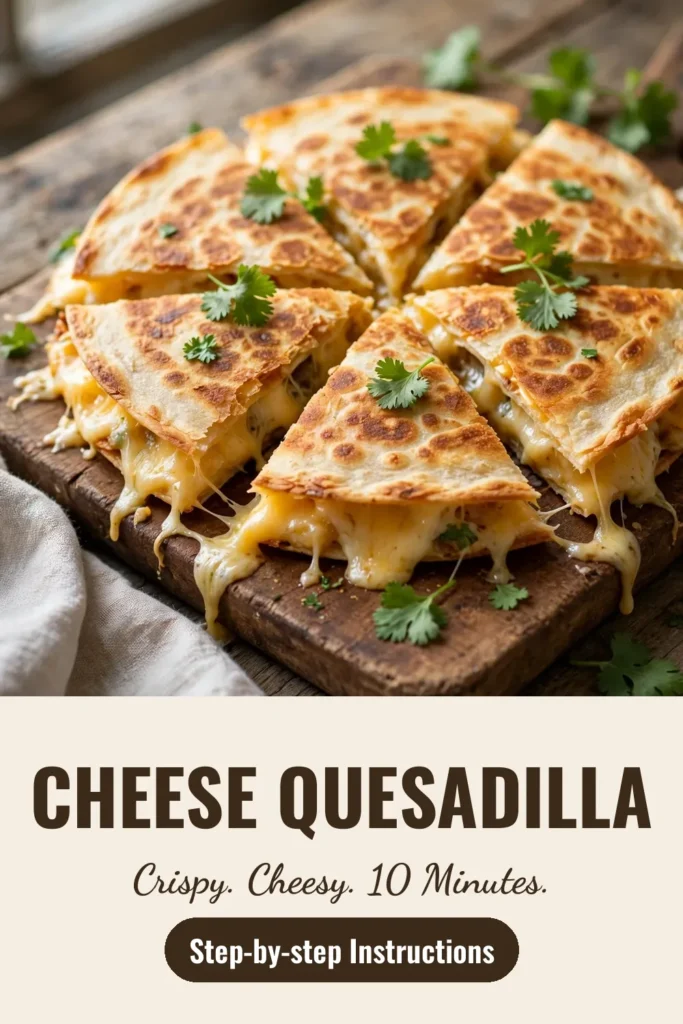
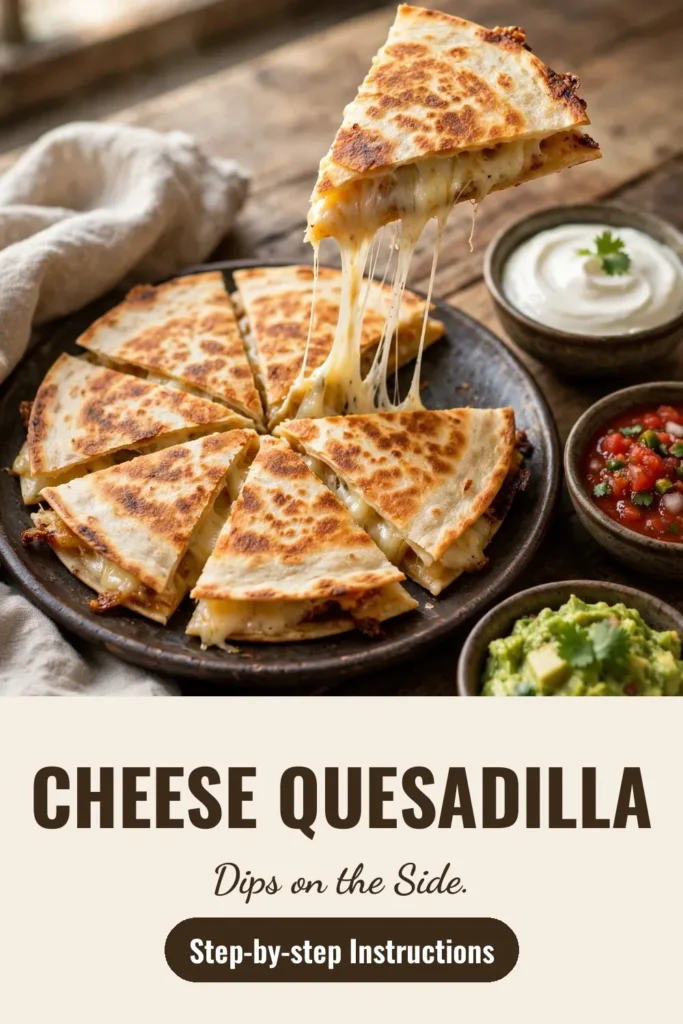
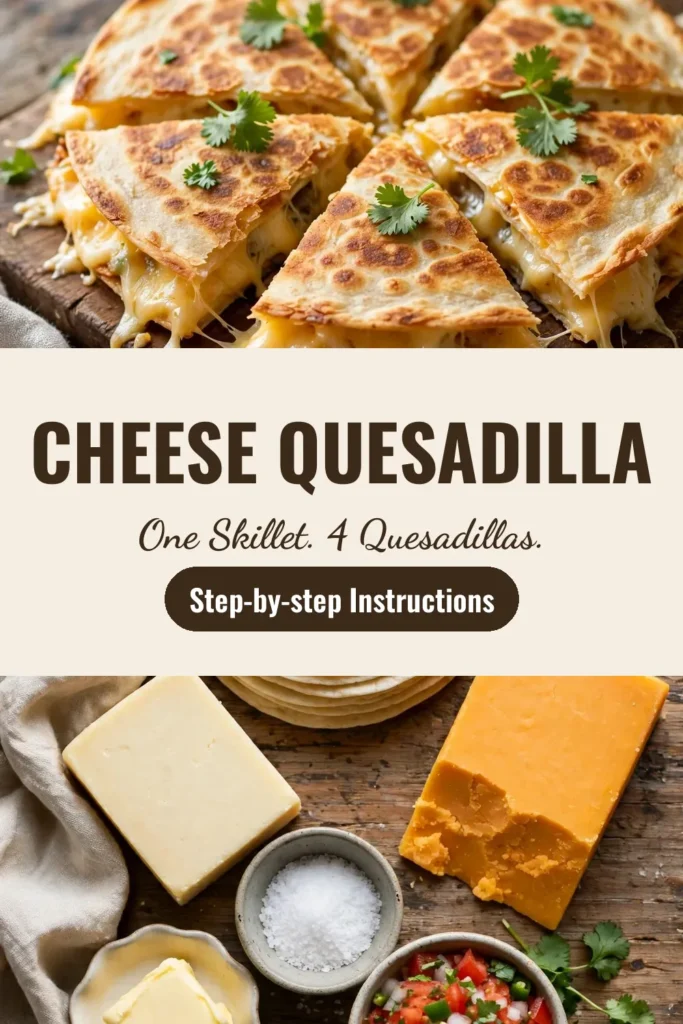
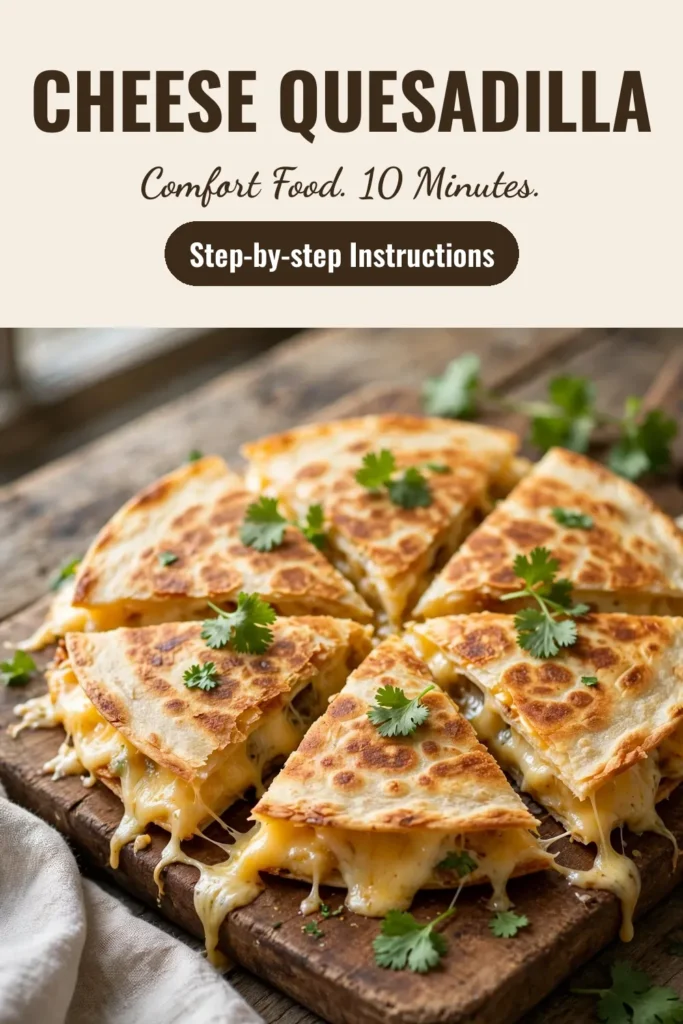
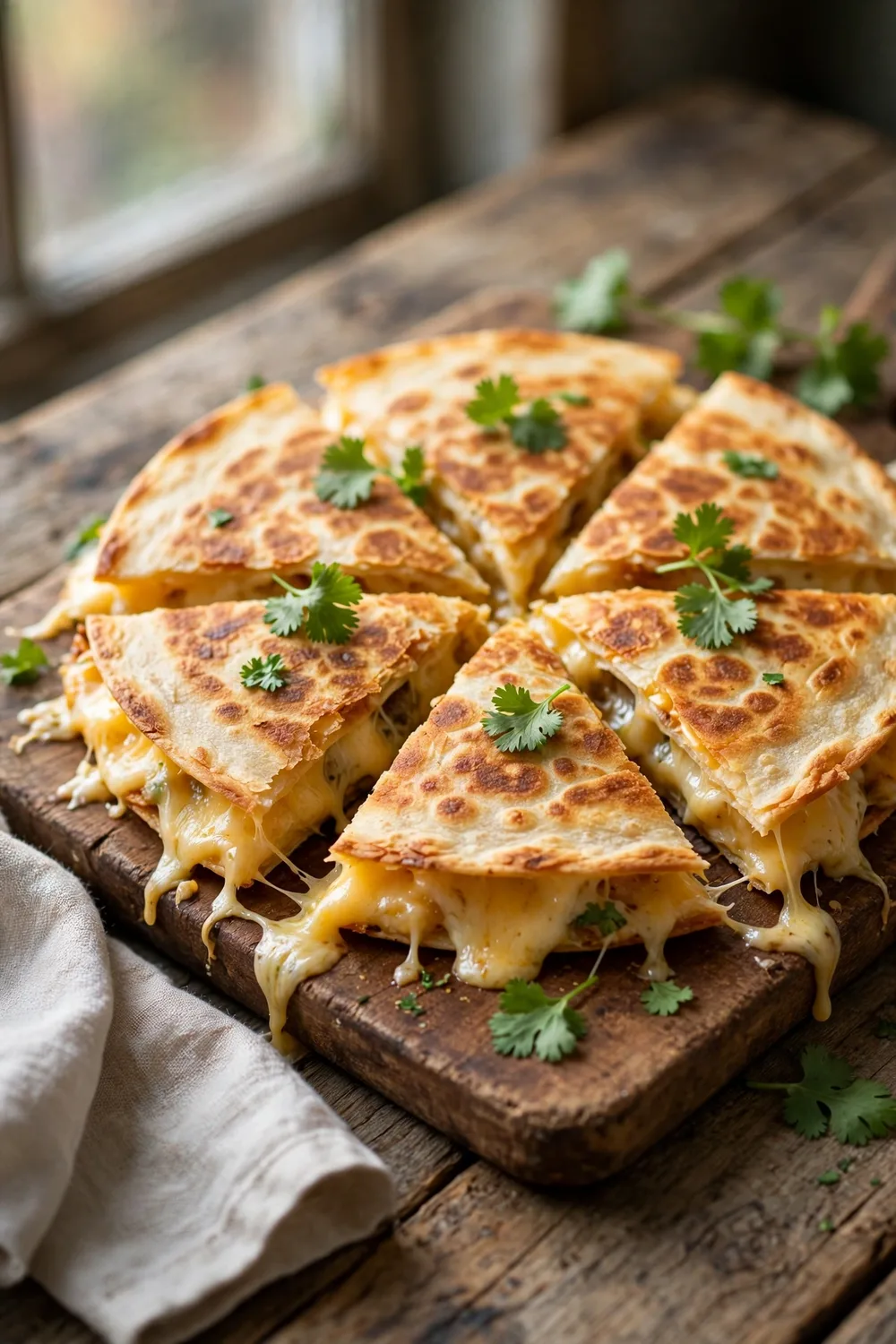
This cheese quesadilla takes 10 minutes of cooking, one pan, and three ingredients at heart — and it is the crispiest, gooiest thing you can make in that time. If you have ever searched for the best cheese for quesadillas and landed on a page that lists seven cheeses with no explanation, no ratio, and no answer to why one page says “avoid sharp cheddar” while another calls it the go-to, this is the page that fixes that. The recipe is right here in the first paragraph: 8 eight-inch flour tortillas, 2 cups of sharp cheddar and 1 cup of Monterey Jack, both freshly shredded from blocks, 2 tablespoons of unsalted butter, and half a teaspoon of kosher salt. Shred the cheeses and toss them together — that is the 2:1 blend, two parts cheddar for flavor, one part Jack for melt — then melt half a tablespoon of butter in a skillet over medium heat, lay a tortilla flat, sprinkle three-quarters of a cup of the blend over it, top it with a second tortilla, and cook 3–4 minutes a side until deep golden. Cover the pan for the last minute so the cheese melts all the way through, rest it 1 minute, and slice it into 4 wedges. That is the whole recipe — 15 minutes from the counter to the table, with 5 minutes of actual work. The rest of this page is everything the search results never tell you: which cheese, and in what ratio; why pre-shredded cheese fails; how to get it crispy without burning it; which tortilla to use; how to feed four people and keep every quesadilla crisp; and what to do when it goes soggy, leaks, or tears.
You will love this:
- 10 minutes of cooking. One pan, no oven, no pre-cooking — the skillet does the work, and you do not stand over anything but a hot pan.
- 3 ingredients at heart. Tortillas, cheese, butter — and a pinch of salt. Everything else is a variation, not a requirement.
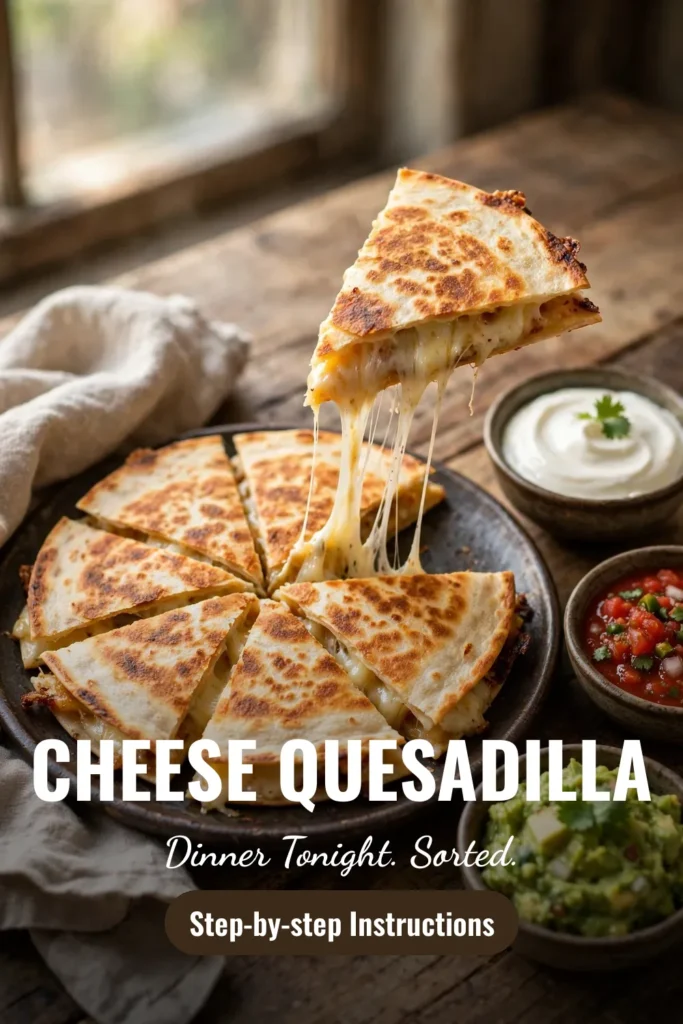
- The crispiest outside, the gooiest inside. A golden shell that shatters when you bite it, and a cheese pull that stretches when you lift a wedge — the two things every quesadilla page promises and none of them explains how to get.

What Is a Cheese Quesadilla?
A cheese quesadilla is a tortilla filled with cheese, folded or sandwiched, and cooked on a griddle until the cheese melts and the tortilla turns golden and crisp. That is the whole definition, and it is older than most people think. The dish comes from colonial Mexico, where the Spanish brought dairy and cows in the 1500s and Mexicans combined cheese with the tortilla they already had. In central and southern Mexico the tortilla is warmed on a comal, the filling goes on — typically Oaxaca cheese, a stringy cheese made by the stretched-curd method — and the tortilla is folded and heated until the cheese melts. In northern Mexico the tortillas are wheat flour, filled mainly with Chihuahua cheese or queso menonita, a local cheese made by the Mennonite community. In Mexico City, a quesadilla is NOT assumed to come with cheese unless you specifically ask for it — in the rest of Mexico, a quesadilla is considered to include cheese by definition, since the word itself means “little cheesy thing.”
The American version is the one this page makes: a flour tortilla heated on a griddle, sprinkled with a grated high-moisture melting cheese, folded or topped with a second tortilla, and cooked until golden. It is the US Southwest’s answer to a grilled cheese sandwich — same idea, different bread, and a cheese pull that a grilled cheese can only dream about. The cheese-and-ham sandwich between two flour tortillas is a sincronizada, not a quesadilla, and the folded half-moon is a different shape from the sandwiched whole circle — both are quesadillas, and the recipe below tells you when to use which one.
The 5 Ingredients, and What’s in a Cheese Quesadilla
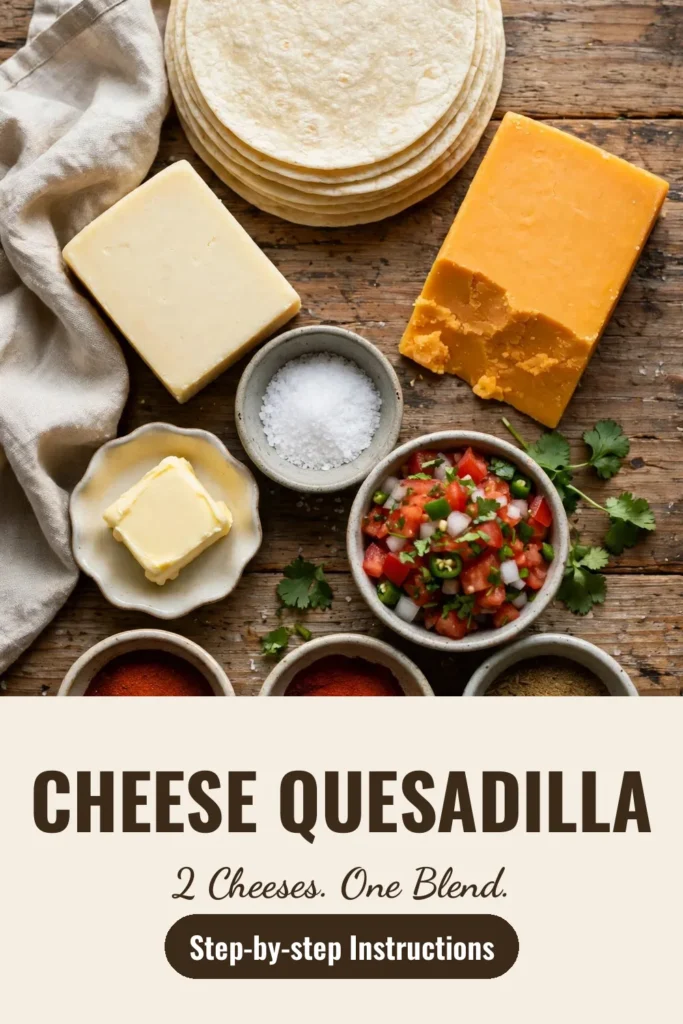
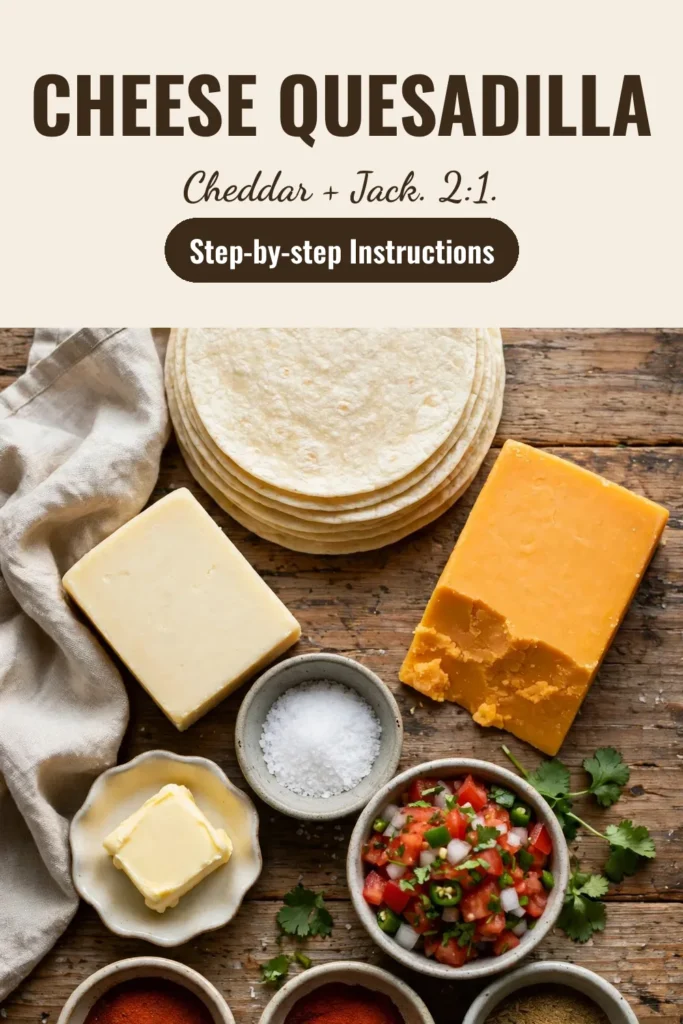
Midwest’s page lists three ingredients with no amounts outside the recipe card — a reader skimming the article cannot make the quesadilla without scrolling to the bottom. Here is every ingredient WITH its amount, and what each one is doing in the dish — because once you know the job of each ingredient, you can adjust the quesadilla instead of guessing. This is also the answer to the question “what’s in a cheese quesadilla”: tortillas, cheese, butter, salt, and nothing else at the core.
| Ingredient | Amount in our batch | What it does |
|---|---|---|
| Flour tortillas (8-inch) | 8 tortillas | The shell. The tortilla is the thing that decides everything else — the crisp, the size, the fold. Eight-inch fajita-size tortillas are the sweet spot: big enough for a proper cheese layer, small enough to flip without falling apart (see the tortilla H2 below). |
| Sharp cheddar, freshly shredded | 2 cups (from a block) | The flavor half. Sharp cheddar is the bold, tangy cheese that makes the quesadilla taste like something — two-thirds of the blend, because flavor is the job it does (see the cheese guide below). |
| Monterey Jack, freshly shredded | 1 cup (from a block) | The melt half. Monterey Jack is the mild, buttery cheese that melts into a smooth, stretchy layer — one-third of the blend, because melt is the job it does. |
| Unsalted butter | 2 Tbsp, divided (½ Tbsp per quesadilla) | The golden crisp. Butter is the fat that browns the tortilla and gives it flavor — half a tablespoon per quesadilla, melted in the skillet before the tortilla goes in. |
| Kosher salt | ½ tsp (a pinch per quesadilla) | The lift. A pinch of salt on the cheese before folding — and Beaming Baker’s sprinkle on the finished quesadilla — is what makes the cheese taste seasoned instead of just rich. |
That is the whole list — five items, every one of them in the recipe card below, and every one of them on the ingredients card image. A cheesy quesadilla recipe is really a question about the blend: two cheeses, one tortilla, one fat, one pinch of salt. The optional items — a quarter cup of pico de gallo inside, or a pinch each of chili powder, paprika and cumin sprinkled on the cheese — are in the recipe card as optional lines, not in the core list, because the base quesadilla needs nothing else.
The Best Cheese for Quesadillas (The Guide)
Midwest names seven cheeses with zero explanation. Cheese Knees has the only cheese table on the search results but no ratio and no avoid list. A Couple Cooks says “avoid sharp cheddar” while Cheese Knees calls sharp cheddar its go-to and Midwest uses it in the blend — a direct contradiction nobody resolves. Here is the guide, with the table, the ratio, the resolution, and the avoid list, because the cheese is the whole question this page exists to answer.
| Cheese | Melt | Flavor | Role in a quesadilla |
|---|---|---|---|
| Sharp cheddar | ★★★★ | Bold, tangy | The flavor half — 2 cups of the blend. The cheese that makes the quesadilla taste like something. |
| Monterey Jack | ★★★★★ | Mild, buttery | The melt half — 1 cup of the blend. The cheese that melts into a smooth, stretchy layer. |
| Oaxaca (quesillo) | ★★★★★ | Mild, stringy, buttery | The authentic pick — the traditional Mexican melting cheese, stringy like mozzarella. Use it in place of the Jack for the most traditional quesadilla. |
| Chihuahua | ★★★★★ | Slightly tangy | Oh Sweet Basil’s must — the flavor comes from this cheese, they say. A fine swap for the cheddar half if you can find it. |
| Pepper Jack | ★★★★ | Spicy, creamy | The kick — swap it for the Monterey Jack when you want heat without changing the melt. |
| Mozzarella | ★★★★★ | Mild, milky, stretchy | The pull — the longest cheese pull on the table, but the least flavor. Best as a partner, never alone. |
| Colby Jack | ★★★★ | Mild, slightly sweet | The crowd-pleaser — A Couple Cooks’ pick with mild cheddar. A fine swap for the Jack half. |
| Queso asadero | ★★★★★ | Mild, smooth, creamy | The traditional pick — a Mexican melting cheese that behaves like Oaxaca’s cousin. |
| Queso quesadilla | ★★★★★ | Mild, smooth | The namesake — the melting cheese from Sinaloa and northern Mexico that the dish is named after. If your store stocks it, it is the most authentic single cheese on this table. |
| Mexican blend (bagged) | ★★★★ | Varies by brand | The supermarket shortcut — a bag of cheddar, queso quesadilla, mozzarella and asadero. It works in a pinch, and it is the one bagged cheese that melts acceptably, because the blend averages out. |
The 2:1 blend ratio. Two cups of sharp cheddar to one cup of Monterey Jack — two-thirds flavor cheese, one-third melt cheese. That is the rule this page gives, and it is the one the search results never state: Lively Dish has the only stated ratio on the SERP (60% Oaxaca or Jack + 30% medium cheddar + 10% queso fresco or cotija), and ours is simpler and more supermarket-friendly — two cheeses, both in every grocery store, no queso fresco required. The ratio is the reason the quesadilla tastes like something AND pulls like a quesadilla should: cheddar alone is bold but firm, Jack alone is gooey but mild. Together, at 2:1, you get both. Cookie and Kate’s distinction supports this from the other side: cheddar is less gooey and produces a more firm, easy-to-slice quesadilla; Jack is the gooey pull. The blend gives you the firm slice and the pull.
The sharp-cheddar contradiction, resolved. Three pages, three answers. Midwest uses sharp cheddar in its blend. Cheese Knees calls sharp cheddar its go-to (“melts beautifully and has a bold flavor”). A Couple Cooks says “try to avoid sharp cheddar because it doesn’t melt as well.” Lively Dish splits the difference (medium cheddar “melts better than sharp varieties”). They are all describing the same physics from different angles: sharp cheddar melts fine — the problem is PRE-SHREDDED sharp cheddar (more cellulose coating, and aged sharp has lower moisture, so it melts grainy) and EXTRA-SHARP aged cheddar (low moisture, crumbly). The rule is shred-it-yourself + not-extra-sharp, not avoid-sharp: freshly shredded sharp cheddar (not extra-sharp, not pre-shredded) melts smoothly and brings the bold flavor; pre-shredded sharp cheddar is the one that goes grainy. If you are using a bag, use Monterey Jack or a Mexican blend instead — the bagged sharp is where the grain comes from.
The avoid list. Not every cheese belongs in a quesadilla, and the pages that list seven cheeses never say which ones fail. Pre-shredded anything fails — the cellulose and potato-starch coating that keeps bagged cheese from clumping in the bag is the same coating that keeps it from melting smoothly in the pan (see the shred-your-own H2 below). Extra-sharp cheddar alone fails — too dry, too crumbly, it melts grainy. Feta and goat cheese alone fail — they crumble, they don’t melt into a layer; use them as a crumbled accent on top of a melting cheese, never as the cheese. Parmesan alone fails — it won’t stretch, it won’t pull; a spoonful grated over the blend is a salty accent, not a base. Queso fresco alone fails — it crumbles and doesn’t melt; it is the 10% texture contrast in Lively Dish’s ratio, never the whole cheese. The rule: the base cheese must be a high-moisture melting cheese (Jack, Oaxaca, Chihuahua, mozzarella, queso quesadilla), and the flavor cheese must be freshly shredded (cheddar, pepper Jack, Colby Jack).
The best melting cheese for quesadillas is the question behind the question, and the answer is the melt column of the table above: Monterey Jack, Oaxaca, Chihuahua, queso asadero, queso quesadilla and mozzarella all melt at five stars. The best cheese to use for quesadillas is the blend — no single cheese does both jobs. What type of cheese for a quesadilla is the same question with a shorter name, and the answer is the same table. And the Mexican cheese for quesadillas — the 590-a-month lane — is Oaxaca or Chihuahua or queso asadero, the cheeses the dish actually comes from.
Shred Your Own Cheese (Why Pre-Shredded Fails)
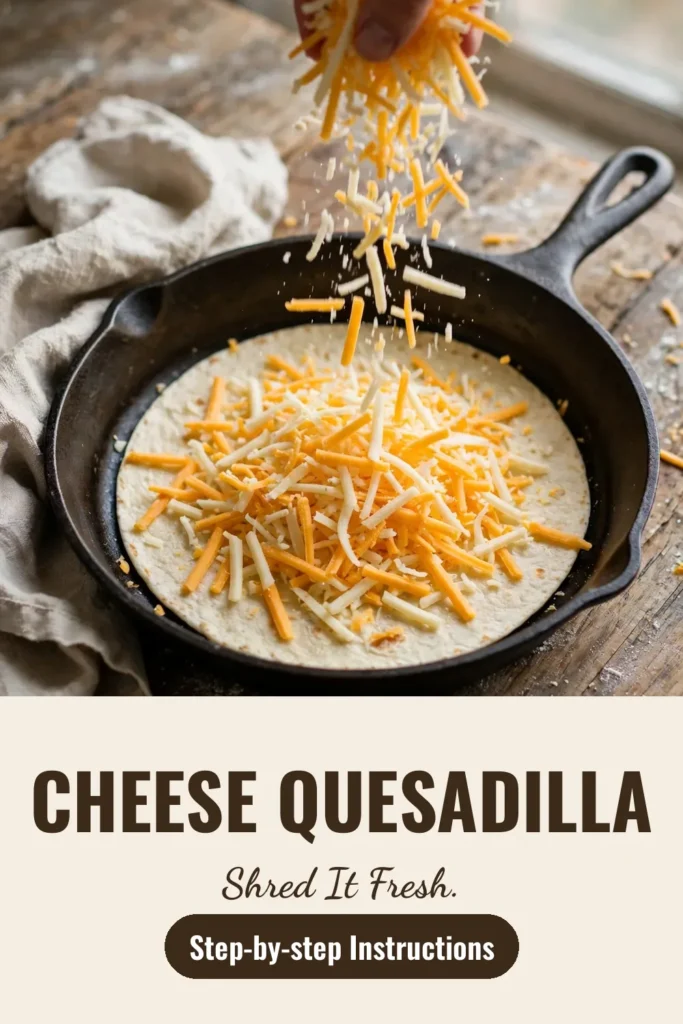
Every page on the search results says this, and it is the most unanimous advice on the SERP — but none of them explains WHY, so here is the why. Bagged shredded cheese is coated in cellulose powder and potato starch so the shreds don’t clump together in the bag. That coating is the problem: it keeps the cheese from melting smoothly in the pan. The shreds stay separate, the melt turns grainy, and the cheese pull never happens. Freshly shredded cheese from a block has no coating, so it melts into a smooth, stretchy layer — the layer a quesadilla is.
The melt test, side by side, is the proof: shred half a cup of cheddar from a block and half a cup from a bag, melt them in the same pan, and the block cheese goes glossy and smooth while the bagged cheese goes lumpy and matte. It is the same cheese, the same pan, the same heat — the only difference is the coating. Shredding takes two minutes: a box grater, the large holes, 2 cups of cheddar and 1 cup of Jack, and you are done. Two minutes for the single biggest upgrade in this whole recipe.
If you must use a bag — and sometimes the bag is what is in the fridge — use Monterey Jack or a Mexican blend, not sharp cheddar. The bagged sharp is where the grain comes from (aged sharp has lower moisture, and the cellulose makes it worse), while the bagged Jack and the bagged Mexican blend melt acceptably because the blend averages out. Shredded cheese for quesadillas is the easiest lane on the whole page (140 a month, the lowest difficulty in the cluster), and the answer is the same sentence: shred it yourself.
The Recipe — Our Quesadilla (4 Quesadillas, 10 Minutes)
This is a cheesy quesadilla recipe in the truest sense: five minutes of prep, one pan, no oven, no pre-cooking. The batch makes 4 quesadillas — one per person, which is the most useful batch size on the search results, because every page on the SERP yields 1 and nobody explains how to feed four. The best cheese quesadilla recipe is the same list, used the same way — the short form of the same dish, and the same five items in the same proportions.

- 8 8-inch flour tortillas (fajita size; 10-inch burrito-size works folded in half — see the tortilla H2)
- 2 cups sharp cheddar, freshly shredded from a block
- 1 cup Monterey Jack, freshly shredded from a block
- 2 Tbsp unsalted butter, divided (½ Tbsp per quesadilla)
- ½ tsp kosher salt (a pinch per quesadilla)
- Optional: ¼ cup pico de gallo (A Couple Cooks’ trick — inside, not on top)
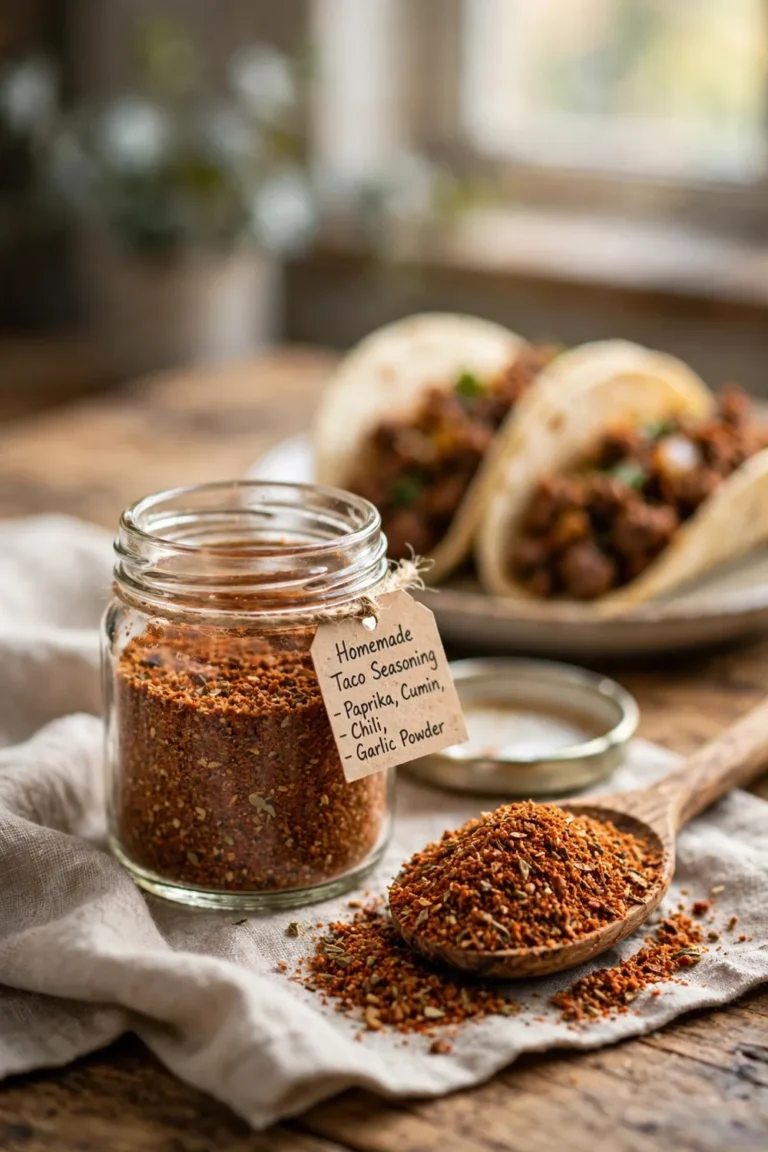
- Optional: a pinch each of chili powder, paprika and cumin (Midwest’s spice-it-up tip — sprinkled on the cheese before folding)
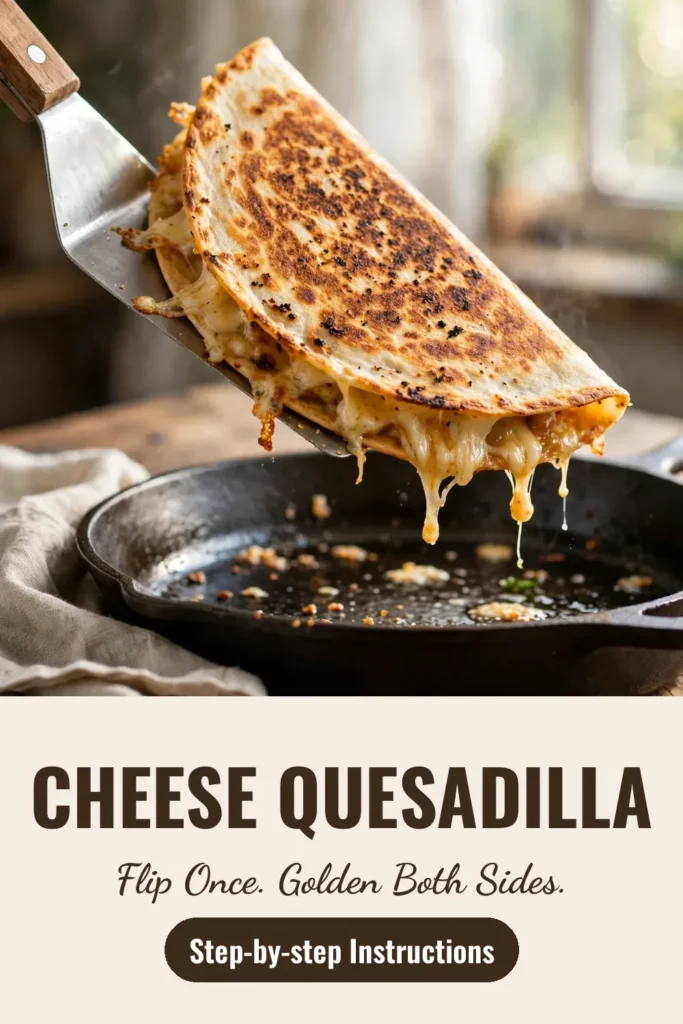
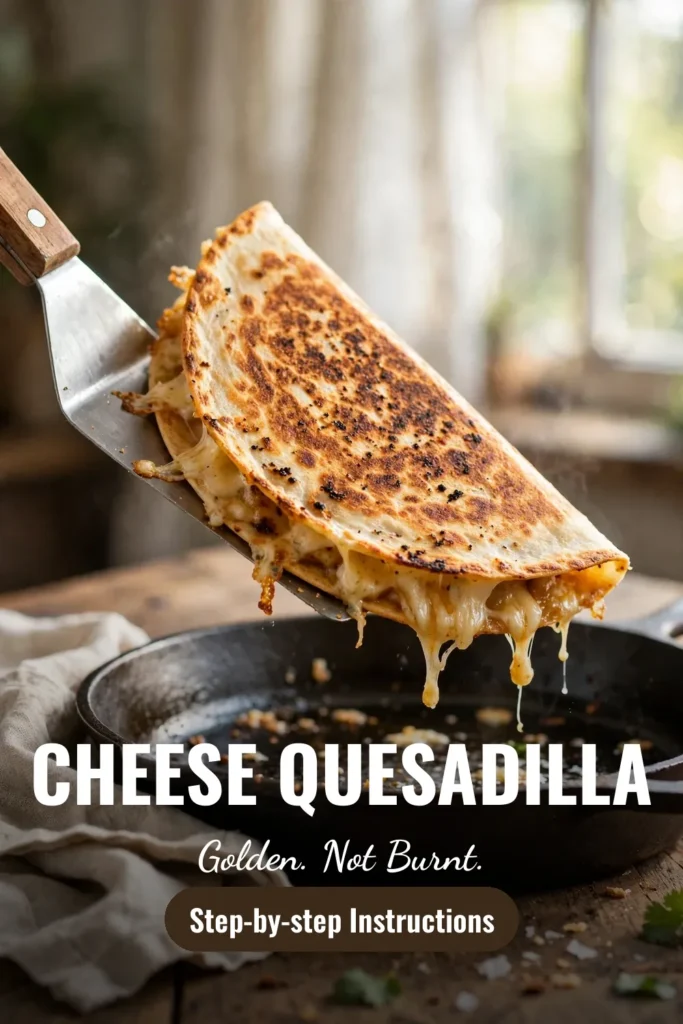
How to make it: (1) Shred both cheeses from blocks and toss them together — 2 cups cheddar + 1 cup Jack, the 2:1 blend. (2) Heat a large skillet (cast iron or nonstick) over MEDIUM heat; melt ½ tablespoon of butter and swirl it to coat the pan. (3) Lay one tortilla flat, sprinkle ¾ cup of the blend evenly over it, leaving a small border around the edge; top with the second tortilla and press gently with a spatula. (4) Cook 3–4 minutes until deep golden; loosely cover the pan with a lid for the last minute — the cover trick, which traps the heat and melts the cheese all the way through; flip with a wide spatula and cook 3–4 minutes more until golden and glossy. (5) Transfer to a board, rest 1 minute so the cheese sets and doesn’t ooze, and slice into 4 wedges with a pizza cutter. Repeat for the remaining 3 quesadillas.

The fold option. A Couple Cooks’ method, and the easier flip: instead of two tortillas sandwiched, use one tortilla, put the cheese on one half, and fold it over into a half-moon. Two half-circles are easier to flip than one whole circle — the fold is the method for a cook who has lost a quesadilla to a bad flip before. The sandwich method (two tortillas, cut into sixths — Beaming Baker) is the method for a crowd, because a whole circle slices into more wedges. Same cheese, same pan, same heat — the shape is the only difference, and the recipe works either way.
How to make the best cheese quesadilla, the short version: shred the cheese, melt the butter, tortilla down, cheese on, tortilla on top, press, cook, cover, flip, rest, slice. That is how to make a cheese quesadilla in one pan, and it is the same method every page on the search results uses, because there is only one method that works: the heat crisps the tortilla, the cover melts the cheese, and the rest sets it so it slices cleanly.

Flour vs Corn Tortillas
Every page names a tortilla and nobody explains why one wins or which one fails. Here is the guide, because the tortilla decides whether the quesadilla crisps like grilled cheese or tears in the pan.
| Tortilla | Crisps? | Flavor | Best for |
|---|---|---|---|
| Flour (8-inch, fajita size) — the default | Yes — crisps like grilled cheese, golden and shattering | Neutral, mild, buttery | The Tex-Mex quesadilla. The default for this recipe, and the one every page on the SERP uses. |
| Flour (10-inch, burrito size) | Yes — same crisp, bigger circle | Same as 8-inch | The fold method: fill one half, fold it over, and you have a half-moon that is easier to flip than a sandwiched circle. |
| Corn | Less — corn crisps differently, more chewy than shattering | Earthy, corn-forward, traditional | The traditional quesadilla, and the gluten-free option. Corn is the tortilla the dish comes from — but it tears more easily, so warm it first (see below). |
| Whole wheat flour | Yes — crisps like white flour | Nuttier, heartier | The healthy swap. Beaming Baker’s “are they healthy” answer: whole-wheat tortillas + moderation. Same method, same times. |
| Fresh / homemade flour | Yes — the best crisp on the table | Fresh, soft, rich | Oh Sweet Basil’s move. If you are buying tortillas, Vista or Tortilla Land are the store-bought picks — one line, not a whole project, because most readers buy tortillas. |
The size guide. Eight-inch fajita-size tortillas are the sweet spot for the sandwich method: big enough for a proper ¾-cup cheese layer, small enough to flip without the whole thing folding over on itself. Six-inch tortillas (A Couple Cooks) are the fold-method size — two half-circles, easier to flip, smaller wedges. Ten-inch burrito-size tortillas are the fold size for a big appetite — fill one half, fold it over, and you have a half-moon. The rule: the tortilla must fit the pan with room to flip. A tortilla bigger than the pan is a quesadilla you cannot turn.
The warm-first trick. Oh Sweet Basil’s step, and the one that stops tearing: warm the tortilla 20–30 seconds per side in a dry skillet before you fill it. A cold tortilla is stiff, and a stiff tortilla cracks when you fold it. A warmed tortilla is pliable, and a pliable tortilla folds without tearing. This matters most for corn tortillas, which tear more easily than flour — warm them first, every time, or the quesadilla falls apart in the pan. Fresh tortillas tear less than stale ones, and a stale tortilla is the one that cracks no matter what you do — if the tortilla is stiff and dry, warm it longer, or switch to a fresher one.
How to Get It Crispy (The Heat + Fat + Press + Rest System)
Midwest says “medium heat” and “dark golden-brown crust” and stops there. Cheese Knees says medium is the sweet spot. A Couple Cooks says medium-high with olive oil. Beaming Baker says medium. The heat split, the fat split, the press, the cover trick and the rest rule are scattered across four pages and never assembled — here they are, in one system, because the crisp is the whole point of the dish.
The heat split, resolved. Medium for butter, medium-high for oil — and the split is really about the FAT, not the heat. Butter burns above medium, because the milk solids in butter scorch. Olive oil tolerates medium-high, because its smoke point is higher. The rule: medium heat for butter (the flavor + browning fat), medium-high for oil (the higher-smoke-point fat); on a griddle, 375–400°F (A Couple Cooks’ number — the only griddle temp on the SERP). Too high and the outside burns before the inside melts; too low and you never get the golden crispy shell. Cheese Knees’ line is the best statement of the rule on the SERP: too high burns the outside before the inside melts, too low never crisps.
The fat split. Butter is flavor — it browns the tortilla and gives it a rich, golden taste, and it is the fat this recipe uses. Olive oil is the higher-smoke-point fat — it tolerates medium-high heat without burning, and it is the fat A Couple Cooks uses for the same reason. Cooking spray is the lightest option, and the least crispy — Midwest lists it as a substitute, and it works, but the tortilla never gets the same golden shell. The rule: butter for flavor at medium heat, oil for higher heat, spray only if you must.
Press gently with a spatula. A Couple Cooks and Beaming Baker both press, and Midwest and Cheese Knees don’t — and the press is what makes the cheese melt evenly. A gentle press with a spatula pushes the top tortilla down onto the cheese, so the cheese melts into a single layer instead of a lumpy one, and the tortilla makes full contact with the pan, so it browns evenly. Press gently — not hard. A hard press squeezes the cheese out the sides, and the cheese on the pan burns while the cheese in the quesadilla disappears.
The cover trick. Cheese Knees’ move, and the only cover trick on the SERP: loosely cover the pan with a lid or a sheet of foil for the last minute of cooking. The lid traps the heat and the steam, and the steam melts the cheese faster and more evenly — especially in a loaded quesadilla, where the cheese in the middle is the last to melt. One minute, lid on, and the cheese in the center is as melted as the cheese at the edges. The cover trick is the difference between a quesadilla that is golden outside and cold inside, and one that is golden outside and gooey all the way through.
Rest 1 minute before slicing. Cheese Knees’ rule, and the only rest rule on the SERP: transfer the quesadilla to a board and rest it 1 minute before you slice it. The cheese sets as it cools slightly, so it doesn’t ooze out when the pizza cutter goes through it. Slice it straight from the pan and the cheese runs out onto the board; rest it 1 minute and the cheese stays in the quesadilla, where it belongs. The rest is the last step of the crispiness system, and the one that makes the difference between a clean wedge and a mess.
How to make cheese quesadillas is the same question with a shorter name, and the answer is this system: medium heat for butter, press gently, cover for the last minute, rest 1 minute, slice. The heat, the fat, the press, the cover and the rest — five moves, one crispy quesadilla.

5 Ways to Cook a Quesadilla (Stovetop, Air Fryer, Oven, Toaster Oven, Microwave)
Cheese Knees has 3 methods, Beaming Baker has 5, Midwest has 1 — nobody compares them. Here they are, in one table, because the method decides the crisp, the time, and how many you can make at once.
| Method | Temp | Time | Best for |
|---|---|---|---|
| Stovetop (skillet) — the classic | Medium heat (butter) or medium-high (oil) | 3–4 min per side | The classic. Best control, best crisp, one or two at a time. This is the recipe. |
| Air fryer | 400°F | 3 min, flip, 3 min | The crispiest with no oil — Cheese Knees’ method. One or two at a time, and the cheese stays inside because there is no flipping in a pan. |
| Oven / sheet pan | 425°F | 5 min, flip, 5 min | 4–6 at once — Cheese Knees’ crowd method. The quesadillas bake on a sheet pan, and you flip them once halfway through. |
| Toaster oven | Toast setting | 6–10 min, flip halfway | 1–2 at a time — Beaming Baker’s method. The small-oven version of the sheet-pan method, for a cook who doesn’t want to heat the big oven. |
| Microwave | 20-second increments | Until melted | Last resort — Beaming Baker’s method, and the only one that goes soggy. The microwave melts the cheese but never crisps the tortilla, so the quesadilla is soft, not golden. Use it only when there is no pan. |
The crowd method is the sheet-pan oven method: 4–6 quesadillas at once on a sheet pan at 425°F, 5 minutes, flip, 5 minutes — Cheese Knees’ version, and A Couple Cooks’ link-out to their baked quesadillas recipe for 8 at once. The stovetop is the method for one or two; the oven is the method for a crowd. The air fryer is the method for the crispiest single quesadilla with no oil. The toaster oven is the method for a small batch without heating the big oven. The microwave is the method for no method at all — it melts the cheese and leaves the tortilla soft, and it is the only method on this table that goes soggy.
Feeding a Crowd (4 at Once, and Keeping Them Crisp)
Every page on the search results yields 1 quesadilla. Midwest’s scaling advice is one bullet — “double or triple the amounts” — plus a link out to a sheet-pan page. Nobody explains how to keep four quesadillas crisp while you cook the rest, and a quesadilla that sits on a plate while you cook the next one goes soggy from its own steam. Here is the batch guide, because this recipe makes 4 and the batch is the point.
Cook one at a time, hold in the oven. The method: cook each quesadilla in the skillet, transfer it to a wire rack set on a sheet pan, and hold the rack in a 200°F oven while you cook the rest. The wire rack is the whole trick — a quesadilla on a plate steams itself soggy from underneath, because the steam has nowhere to go. A quesadilla on a wire rack lets the steam escape, so the bottom stays crisp. Never hold them on a plate, never stack them, never cover them with foil — the foil traps the steam and the crisp is gone. The oven hold works for up to 30 minutes, and the quesadillas come out as crisp as the first one.
Or use the sheet-pan oven method for 4–6 at once. The crowd method from the methods H2 above: 4–6 quesadillas on a sheet pan at 425°F, 5 minutes, flip, 5 minutes. No holding, no rack, no rotation — they all finish at the same time, and you slice them all at once. This is the method for a crowd of six or more, and the method A Couple Cooks links out to for their baked quesadillas. The stovetop is the method for one or two; the oven hold is the method for four; the sheet pan is the method for six.
Make-ahead 1 hour. Midwest’s rule: a quesadilla is best fresh, but you can make it an hour ahead and reheat it in a skillet on low heat or in the oven at 350°F. The skillet is the better reheat — it re-crisps the tortilla, while the oven warms it through more slowly. The school-lunch pack (Cheese Knees) is the make-ahead version for kids: cool the quesadilla, cut it into triangles, pack it with salsa or sour cream or guacamole in a separate container, and it is great at room temperature. A quesadilla that is packed hot goes soggy in the lunchbox; a quesadilla that is packed cool stays crisp.
Variations — Chicken, Steak, Veggie, Breakfast, Pizza, Spicy, Taco Bell-Style
One base quesadilla, seven versions — because the dish earns its place in the rotation by being the one dinner that fits every household, not just one. The cheese blend stays the same in every version; the add-in is the only thing that changes, and the add-in goes INSIDE the quesadilla, on top of the cheese, before the top tortilla goes on.
| Version | Add-in | Cheese swap |
|---|---|---|
| Chicken | ¼ cup shredded rotisserie chicken per quesadilla, tossed with a pinch of taco seasoning or cumin | Pepper Jack instead of Monterey Jack — the heat suits the chicken. |
| Steak | Sliced cooked steak + sautéed peppers and onions | Cheddar + pepper Jack — the steak wants a bolder cheese. |
| Veggie | Sautéed mushrooms, spinach and peppers (cooked first, so they don’t steam the tortilla) | Monterey Jack — the mild melt lets the vegetables speak. |
| Breakfast | Scrambled eggs + crumbled bacon + cheddar — the “eggadilla” | Cheddar — the breakfast quesadilla wants the firm slice, not the gooey pull. |
| Pizza | Mini pepperoni + a spoonful of pizza sauce — the “pizzadilla” | Mozzarella — the pizza version wants the longest pull. |
| Spicy | Pepper Jack + sliced jalapeños | Pepper Jack as the base cheese — the spicy version doubles down. |
| Taco Bell-style | Creamy jalapeño sauce (our own — sour cream + pickled jalapeño brine + a pinch of chili powder) spread on the tortilla before the cheese | Cheddar + Monterey Jack, unchanged — the sauce is the variation, not the cheese. |
The Taco Bell-style version, honestly. It tastes like the drive-thru version, made at home in the same 10 minutes — and it is a copycat in the style of Taco Bell, never the exact Taco Bell quesadilla. Taco Bell is a trademark of Yum! Brands, and our creamy jalapeño sauce is our own recipe, not Taco Bell’s — the sauce is sour cream, pickled jalapeño brine and a pinch of chili powder, mixed in our own proportions, and it is not the sauce Taco Bell serves. The variation is a method angle, never a keyword target: the Taco Bell keyword rows belong to Midwest’s separate copycat pages, and this H2 is the one place on our site where the drive-thru version gets a nod. No logo, no packet photo, no trade dress anywhere — the sauce is in a plain bowl, and the quesadilla is on our own plate.
What to Serve With It
Midwest lists seven dips with no amounts or notes. A Couple Cooks and Cheese Knees have better lists. Here is the full H2, with our Avocado Sauce post as the lead — the same dish Midwest links to as her own avocado sauce, and the same dish as our M12 post.
- Avocado sauce. The lead dip, and the right one — our Avocado Sauce for Tacos, creamy and 5 minutes, no cooking. It is the dip Midwest herself links to as her own avocado sauce, and it is the dip this quesadilla was built for. A spoonful on the side, or spread inside the quesadilla before the cheese.
- Sour cream. The cool counterpoint. A dollop of sour cream beside the plate cuts through the richness of the cheese — the plate needs something cool and tangy.
- Salsa or pico de gallo. The fresh counterpoint. A spoonful of salsa or pico de gallo — or the quarter cup of pico inside the quesadilla, A Couple Cooks’ trick — is the fresh, sharp note the rich cheese needs.
- Guacamole. The rich dip. Guacamole beside the plate is the thing the table reaches for first, and it does the same job as the avocado sauce with more texture.
- Hot sauce. The heat. A few drops of hot sauce on the finished quesadilla is the Friday-night version — the heat that sits on top of the cheese instead of inside it.
- Mexican rice. The side that makes it dinner. A scoop of Mexican rice beside the plate turns a quesadilla into a meal, and it is the side A Couple Cooks lists first.
- Black beans or refried beans. The protein side. A spoonful of black beans or refried beans is the side that makes the plate filling without a second quesadilla.
- Salad with lime vinaigrette. The fresh side. A simple salad with a sharp lime vinaigrette cuts through the richness of the cheese — the plate needs something green and cold.
- Elote or corn. The sweet side. Grilled corn with lime and chili — elote — is the side Cheese Knees lists, and it is the right one: sweet, smoky, and the thing the kids fight over.
Nine dips and sides, and the rule is the same for all of them: something fresh or cool beside something rich and cheesy, and nothing that needs the skillet at the same time as the quesadilla — the skillet is busy.

Make Ahead, Storage, Freezing & Reheating
Midwest says fridge up to 5 days. A Couple Cooks says 2 days. Cheese Knees says 3–4 days. Beaming Baker says 1–3 days. Four pages, four answers — and the honest middle is 3–4 days, Cheese Knees’ number, because a quesadilla is best fresh and the tortilla dries out after day four no matter how you store it.
Make ahead: a quesadilla is best fresh, but you can make it an hour ahead (Midwest’s rule) and reheat it in a skillet on low heat or in the oven at 350°F. The skillet is the better reheat — it re-crisps the tortilla. If you are making a batch for a crowd, cook them one at a time and hold them in a 200°F oven on a wire rack (see the batch H2 above) — never on a plate, never stacked, never covered with foil.
Storage: the quesadilla keeps 3–4 days in the fridge for the best texture, wrapped in foil or in an airtight container. After day four the tortilla dries out and the cheese goes rubbery, and no amount of reheating brings it back. Store the dips separately — salsa and sour cream in their own containers, not on the quesadilla, or the tortilla goes soggy in the fridge.
Freezing: flash-freeze on a sheet pan for 1 hour, then bag with parchment between the quesadillas, up to 2 months — Cheese Knees’ guide, the only freezing guide on the search results, and the one this page takes. The parchment is the trick: without it, the quesadillas freeze together into a block, and you cannot take one out without thawing them all. Thaw overnight in the fridge, or reheat from frozen in a skillet on low heat until the cheese melts again.
Reheating: the skillet is best — 2–3 minutes a side on medium heat, and the tortilla re-crisps (Cheese Knees). The air fryer is the second-best reheat — 350°F for 3–4 minutes, and the crisp comes back. The oven is the third — 375°F for 8–10 minutes, and the quesadilla warms through more slowly. The microwave is the last resort — it melts the cheese but leaves the tortilla soft, and a microwaved quesadilla is soggy in a way no reheat fixes. Reheat to 165°F inside, whatever method you use, and skip the microwave if you can.
Troubleshooting — 5 Fixes
Nobody on the search results has this section. Every page is the same 3-ingredient dump with the cheese blend changed; none of them explains what happens when it goes wrong. Here are the five failures, why they happen, and how to fix them.
Soggy
Why: overstuffed, or wet fillings, or the pan was not preheated. Fix it now: put it back in a hot, dry skillet for 1–2 minutes a side — the dry heat re-crisps the tortilla. Next time: don’t overstuff (¾ cup of cheese max, and no wet fillings unless you cook them first), preheat the pan until the tortilla sizzles when it goes in, and cook on medium-high heat if you are using oil (A Couple Cooks’ FAQ — the only soggy answer on the SERP, and it holds).
Cheese leaking out
Why: too much cheese, or no border, or the press was too hard. Fix it now: scrape the leaked cheese off the pan and eat it — it is the crispiest cheese there is, and it is not coming back inside. Next time: ¾ cup of cheese max per quesadilla, leave a small border around the edge, and press gently — a hard press squeezes the cheese out the sides.
Burnt outside, cold inside
Why: the heat was too high — the outside burned before the inside melted. Fix it now: turn the heat down to medium, put the lid on for the last minute, and give the cheese time to catch up. Next time: medium heat for butter, medium-high only for oil, and use the cover trick — the lid traps the heat and melts the cheese without burning the tortilla.
Cheese won’t melt
Why: pre-shredded cheese, or no lid, or the heat was too low. Fix it now: put the lid on for the last minute — the trapped steam melts the cheese even when the pan heat alone won’t. Next time: shred the cheese fresh from a block (the cellulose coating on bagged cheese is what keeps it from melting smoothly), and use the cover trick every time.
Tortilla tearing
Why: cold or stale tortilla, or the fold was too sharp. Fix it now: there is no way to un-tear a tortilla — fold it the other way, or serve it open-faced and call it a melt. Next time: warm the tortilla 20–30 seconds per side in a dry skillet before you fill it (Oh Sweet Basil’s step — a warmed tortilla is pliable, a cold one cracks), and use a fresher tortilla if the one you have is stiff and dry.
The Quesadilla, in 150 Words
The quesadilla is older than the tortilla press and younger than the tortilla itself. It comes from colonial Mexico, where the Spanish brought dairy and cows in the 1500s and Mexicans combined cheese with the tortilla they already had. In Oaxaca the cheese is Oaxaca cheese, made by the stretched-curd method, stringy and mild. In the north the cheese is Chihuahua or queso menonita, made by the Mennonite community. In Mexico City a quesadilla is not assumed to come with cheese unless you ask for it — in the rest of Mexico, cheese is the definition. The cheese-and-ham sandwich between two flour tortillas is a sincronizada, not a quesadilla, and the folded half-moon with meat is a gringa. In the US Southwest the quesadilla is a regional favorite, a flour tortilla on a griddle with a grated melting cheese, folded and served — a grilled cheese sandwich in a tortilla. The pizza-topped version is a pizzadilla. The breakfast version, eggs and bacon and cheese, is an eggadilla. The quesadilla is new. The cheese is not.
Frequently Asked Questions
What cheese is best for quesadillas? The 2:1 blend — sharp cheddar for flavor, Monterey Jack for melt. Two cups of cheddar to one cup of Jack, both freshly shredded from blocks. The cheese guide H2 above has the full table, the ratio, and the avoid list.
Can I use pre-shredded cheese? You can, but it won’t melt as smoothly — the cellulose and potato-starch coating that keeps bagged cheese from clumping is the same coating that keeps it from melting. Shred it fresh from a block, and the melt is glossy and smooth. If you must use a bag, use Monterey Jack or a Mexican blend — the bagged sharp is where the grain comes from.
Flour or corn tortillas? Flour crisps better — it browns like grilled cheese, and it is the default for this recipe. Corn is traditional and gluten-free, but it tears more easily, so warm it 20–30 seconds per side in a dry skillet before you fill it. The tortilla H2 above has the full guide.
Butter or oil? Butter for flavor at medium heat; oil for higher heat. Butter burns above medium, because the milk solids scorch — olive oil tolerates medium-high, because its smoke point is higher. The crispiness H2 above has the full system.
How do I keep my quesadilla from getting soggy? Don’t overstuff (¾ cup of cheese max, and no wet fillings unless you cook them first), preheat the pan until the tortilla sizzles when it goes in, and cook on medium-high heat if you are using oil. The troubleshooting H2 above has the full fix.
Can I make quesadillas in the air fryer? Yes — 400°F, 3 minutes, flip, 3 minutes. It is the crispiest method with no oil, and the cheese stays inside because there is no flipping in a pan. The methods H2 above has the full table.
Can I make them ahead of time? Yes — 1 hour ahead, reheated in a skillet on low heat or in the oven at 350°F. The fridge keeps them 3–4 days. The storage H2 above has the full guide.
Can I freeze quesadillas? Yes — flash-freeze on a sheet pan for 1 hour, then bag with parchment between the quesadillas, up to 2 months. Thaw overnight in the fridge, or reheat from frozen in a skillet on low heat until the cheese melts again.
What do you put in a cheese quesadilla besides cheese? Chicken, steak, veggies, eggs and bacon, pepperoni, jalapeños — the variations H2 above has all seven versions, with the cheese swap for each one.
Is it gluten-free? With corn tortillas, yes — check the label, because some corn tortillas contain wheat flour. Flour tortillas are wheat, and they are not gluten-free.
More Recipes to Serve It With
- Avocado Sauce for Tacos — creamy avocado sauce, 5 minutes, no cooking.
- Taco Seasoning (Old El Paso style) — 5 minutes, 10 spices, 3 tablespoons seasons a pound of meat.
- Crockpot Chicken Tacos — 10 minutes of prep, 6 hours of waiting.
- Dump and Bake Meatball Casserole — cheesy meatball casserole, 60 minutes.
- Cheeseburger Pasta — one-pot cheeseburger pasta, 30 minutes.
- Ground Beef Stroganoff — creamy ground beef stroganoff, 30 minutes.
- Greek Pasta Bake — a real bake plus the 15-minute stovetop version, 45 minutes.
- Gigi Hadid Pasta — the 30-minute vodka pasta, with a no-vodka version.
- Vegetarian Lasagna Soup — one pot, 35 minutes, broken lasagna noodles and herbed ricotta.
- Olive Garden Chicken Gnocchi Soup — creamy, one-pot, 35 minutes, with a cream blend that never splits.
The Best Cheese Quesadilla Recipe (Crispy, 10 Minutes)
Ingredients
Equipment
Method
- Shred both cheeses from blocks and toss them together — 2 cups sharp cheddar + 1 cup Monterey Jack, the 2:1 blend.
- Heat a large skillet (cast iron or nonstick) over MEDIUM heat; melt 1/2 Tbsp butter and swirl to coat the pan.
- Lay one tortilla flat, sprinkle 3/4 cup of the blend evenly over it, leaving a small border around the edge; top with the second tortilla and press gently with a spatula.
- Cook 3–4 minutes until deep golden; loosely cover the pan with a lid for the last minute (the cover trick); flip with a wide spatula and cook 3–4 minutes more until golden and glossy.
- Transfer to a board, rest 1 minute so the cheese sets, and slice into 4 wedges with a pizza cutter. Repeat for the remaining 3 quesadillas.
Notes
Nutrition information
| Nutrient | Per serving (1 quesadilla of 4) |
|---|---|
| Calories | ~660 kcal |
| Sodium | ~1,350mg |
| Carbohydrates | ~45g (sugars ~3g) |
| Fat | ~40g (saturated ~22g) |
| Protein | ~27g |
| Fiber | ~3g |
| Cholesterol | ~100mg |
The inputs, shown plainly (USDA FoodData Central values for the exact ingredients listed): 2 8-inch flour tortillas ≈ 90g ≈ 275 kcal, ~7g protein, ~45g carbs, ~3g fiber, ~7g fat, ~662mg sodium (USDA “Tortillas, ready-to-bake or -fry, flour, refrigerated”: 306 kcal, 8.2g protein, 49.4g carbs, 3.5g fiber, 7.99g fat, 736mg sodium per 100g) · ½ cup sharp cheddar, shredded (~57g) ≈ 230 kcal, ~13g protein, ~19g fat (saturated ~11g), ~354mg sodium, ~60mg cholesterol (USDA “Cheese, cheddar”: 403 kcal, 22.9g protein, 33.3g fat, 18.9g saturated fat, 621mg sodium, 105mg cholesterol per 100g) · ¼ cup Monterey Jack, shredded (~28g) ≈ 104 kcal, ~7g protein, ~8.5g fat (saturated ~5g), ~178mg sodium, ~25mg cholesterol (USDA “Cheese, monterey”: 373 kcal, 24.5g protein, 30.3g fat, 18.7g saturated fat, 637mg sodium, 89mg cholesterol per 100g) · ½ Tbsp unsalted butter (~7g) ≈ 50 kcal, ~5.7g fat (saturated ~3.6g), ~15mg cholesterol, ~0mg sodium (USDA “Butter, without salt”: 717 kcal, 81.1g fat, 51.4g saturated fat, 215mg cholesterol per 100g) · ⅛ tsp kosher salt per quesadilla (½ tsp for the batch) ≈ ~150mg sodium (140–240mg by brand). Batch per quesadilla ≈ 659 kcal and ~1,344mg sodium — rounded to about 660 kcal and about 1,350mg sodium per serving.
The SERP comparison, honestly: the published cards on the search results claim 464 kcal per quesadilla (Midwest, ½ cup of cheese and fajita-size tortillas) and 760 kcal (Cheese Knees, ¾ cup of all-cheddar cheese and a full tablespoon of butter). Midwest’s 464 fits her smaller load — half the cheese and smaller tortillas — and Cheese Knees’ 760 fits their full tablespoon of butter and all-cheddar load. Ours sits between them — the honest estimate for ¾ cup of a cheddar/Jack blend + 2 eight-inch tortillas + half a tablespoon of butter — and the serving size is stated plainly (1 quesadilla of 4) so the number can be checked instead of trusted. Beaming Baker’s ~398 kcal has no stated serving size (it may be per half-quesadilla or per wedge) — do not cite it as comparable.
The sodium is high, and the H2 says so honestly: the tortillas are the driver — two tortillas ≈ 660mg of sodium per quesadilla, about half the total. The cheese is the second driver (~530mg between the cheddar and the Jack), and the salt is the third (~150mg). A low-sodium tortilla cuts ~350mg from the batch per quesadilla, which is the single biggest sodium saving on this page. A lower-sodium cheese cuts ~150mg more. The analysis’s claim that the cheese is the sodium driver was wrong — it counted only one tortilla’s sodium instead of two — and this table corrects it.
Nutrition is an estimate calculated from USDA FoodData Central values for the exact ingredients listed. Values will vary with brands and substitutions.
Pin this recipe