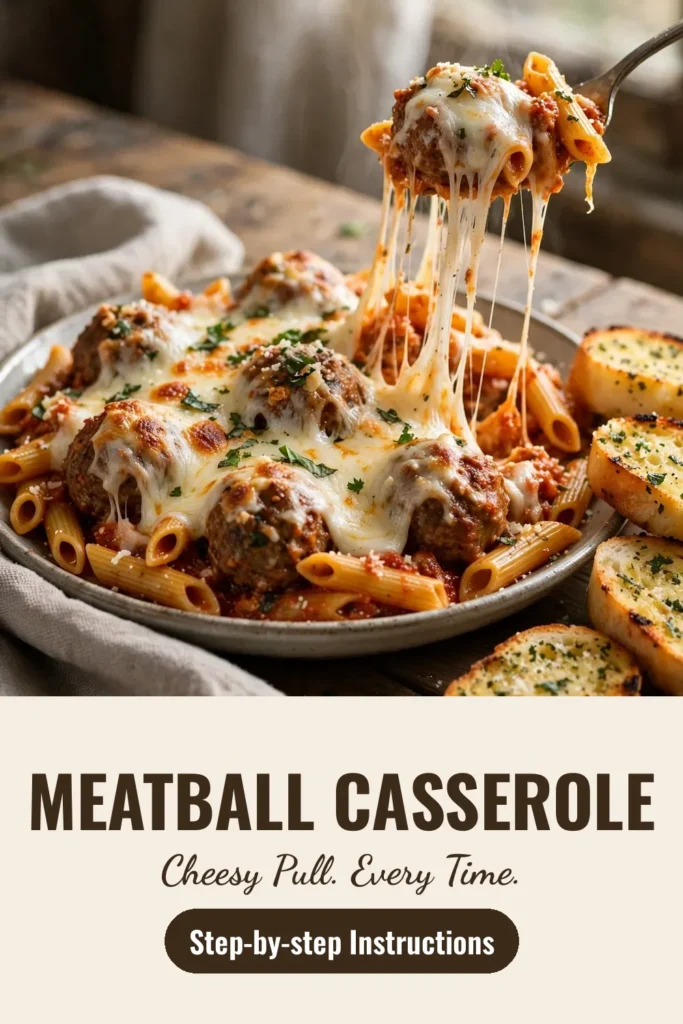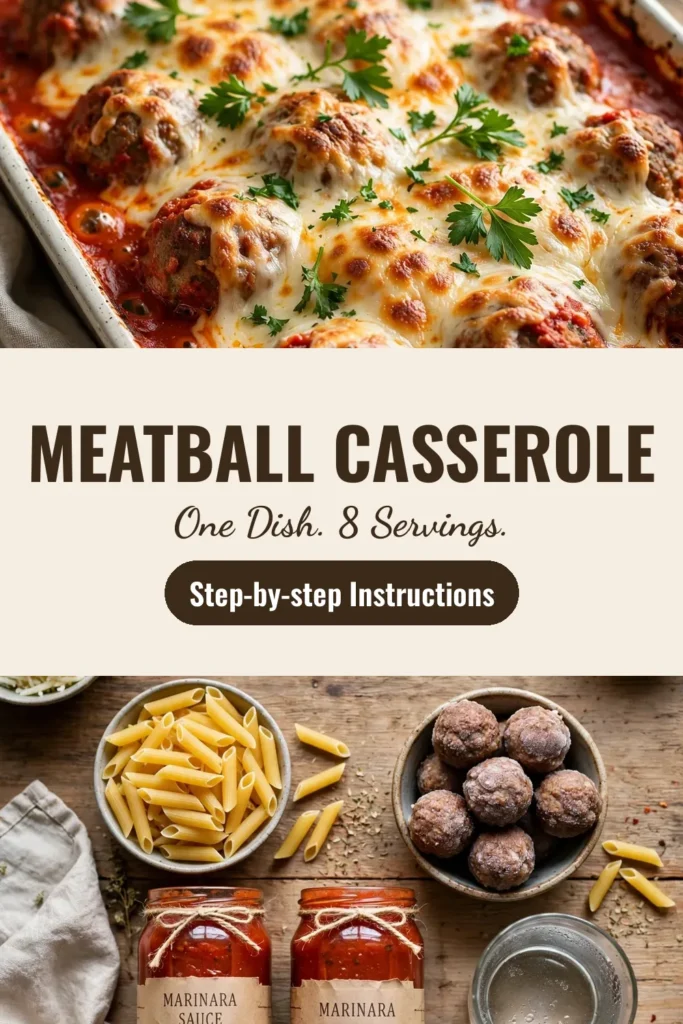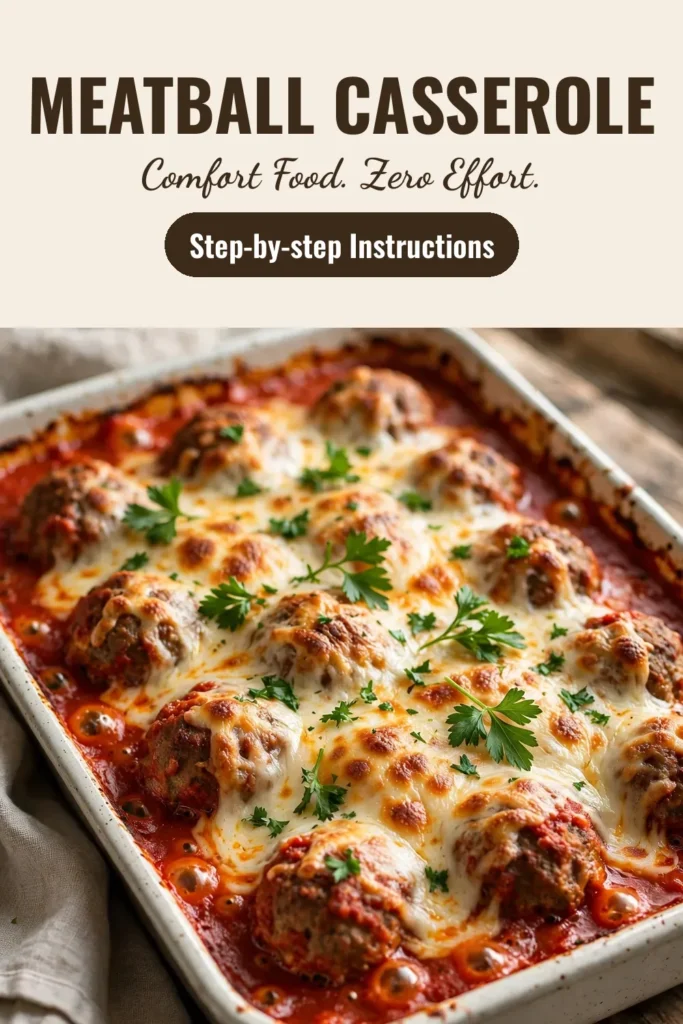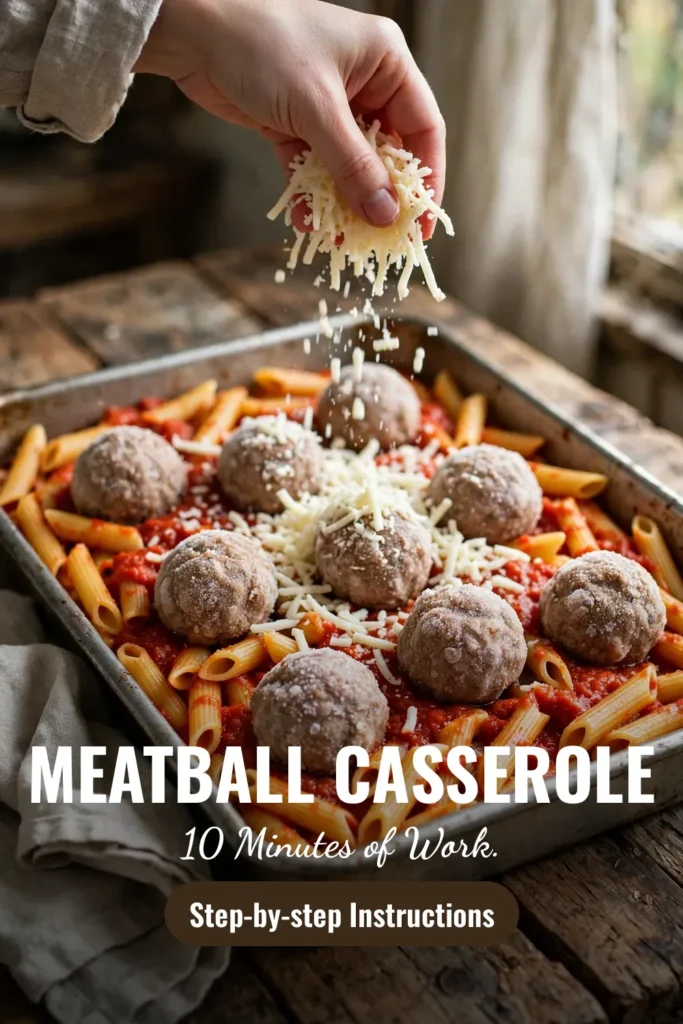
Dump and Bake Meatball Casserole (Cheesy, 45 Minutes)
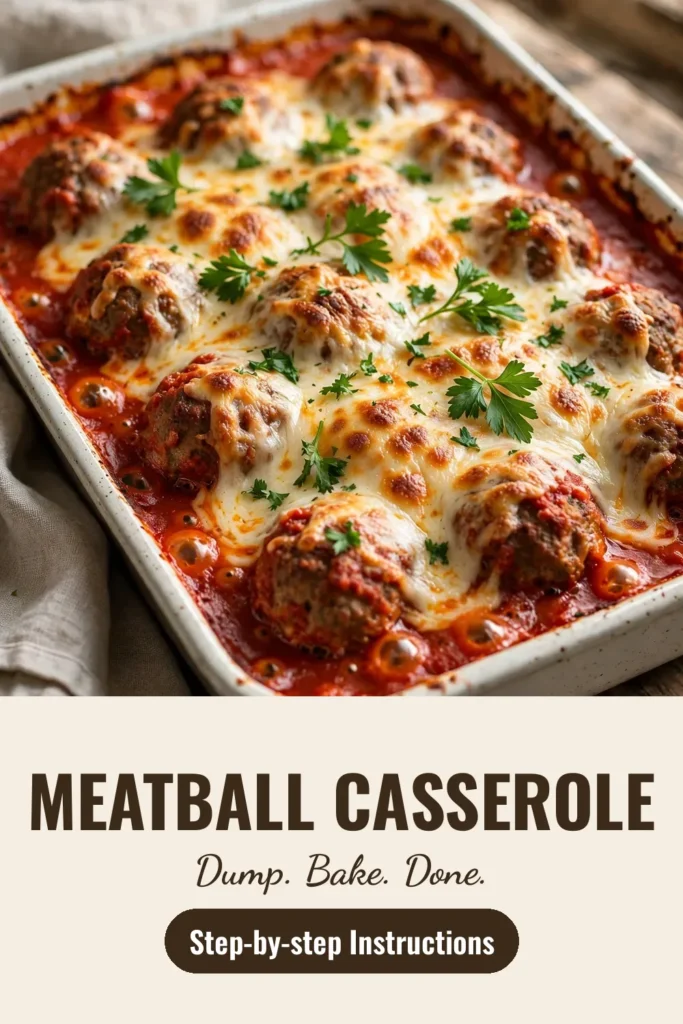
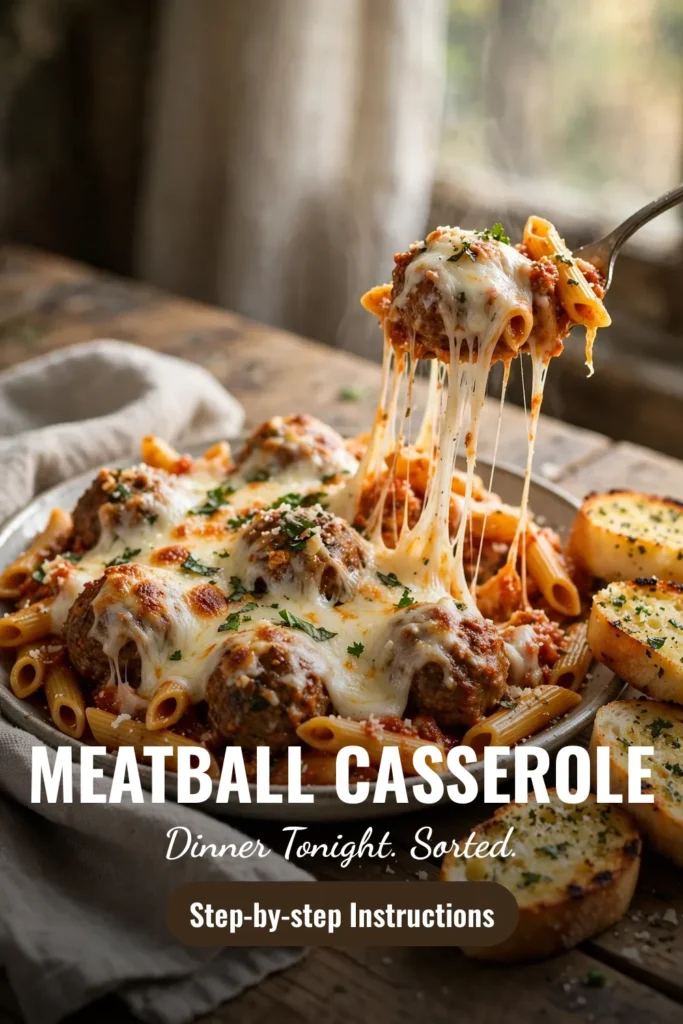
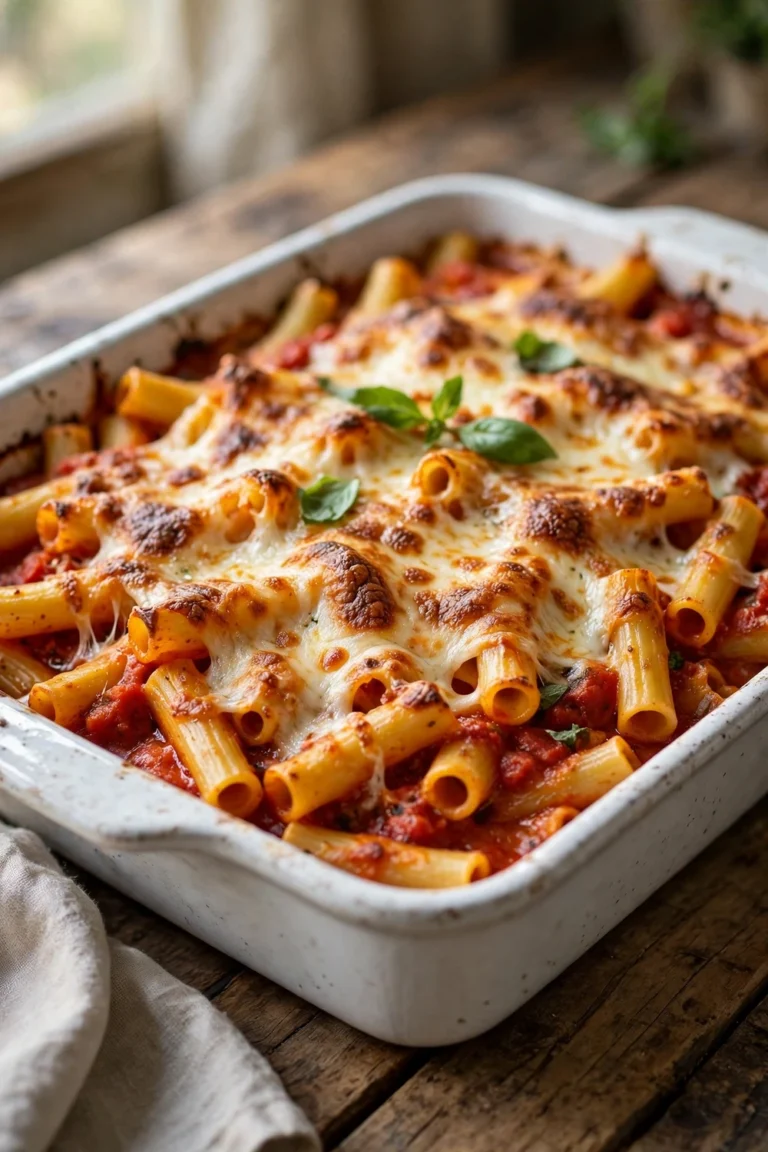
This dump and bake meatball casserole takes 10 minutes of prep, one dish, and no boiling, no browning and no pre-cooking at all — and it feeds eight people. If you have ever searched for a dump and bake meatball casserole recipe and landed on a page that lists four ingredients with no amounts in the body, no answer to whether the meatballs go in frozen or thawed, and no answer to how much liquid the pasta actually needs, this is the page that fixes that. The recipe is right here in the first paragraph: 1 pound of uncooked penne or rotini, 1 pound of frozen Italian-style meatballs, 2 jars of marinara sauce, 2 cups of water, 2 teaspoons of Italian seasoning, 1 teaspoon of garlic powder, ½ teaspoon of crushed red pepper flakes, and 2 cups of shredded mozzarella plus ½ cup of grated Parmesan. Dump it all in a deep 9×13 dish, cover it tightly with foil, and bake at 375°F — 40 to 45 minutes covered, then 10 to 15 minutes uncovered with the cheese on top, plus a 1 to 2 minute broil for a golden finish. Rest it 10 minutes and serve. That is the whole recipe — 60 minutes from the counter to the table, with 10 minutes of actual work. The rest of this page is everything the search results never tell you: whether the meatballs go in frozen or thawed, how much liquid the pasta needs and what happens when you get it wrong, which pasta shapes work and which ones fail, what the cheese is actually doing, and how long the leftovers keep.
You will love this:
- 10 minutes of prep. One dish, no boiling, no browning — the oven does the work, and you do not stand over a pot.
- Feeds 8, and the leftovers reheat well. A pound of pasta and a pound of meatballs, and a serving the next day is nearly as good as the first.
- One pan to wash. Everything goes into the same 9×13 dish, and the foil does the covering — dinner is done in an hour.
What Is a Dump and Bake Meatball Casserole?
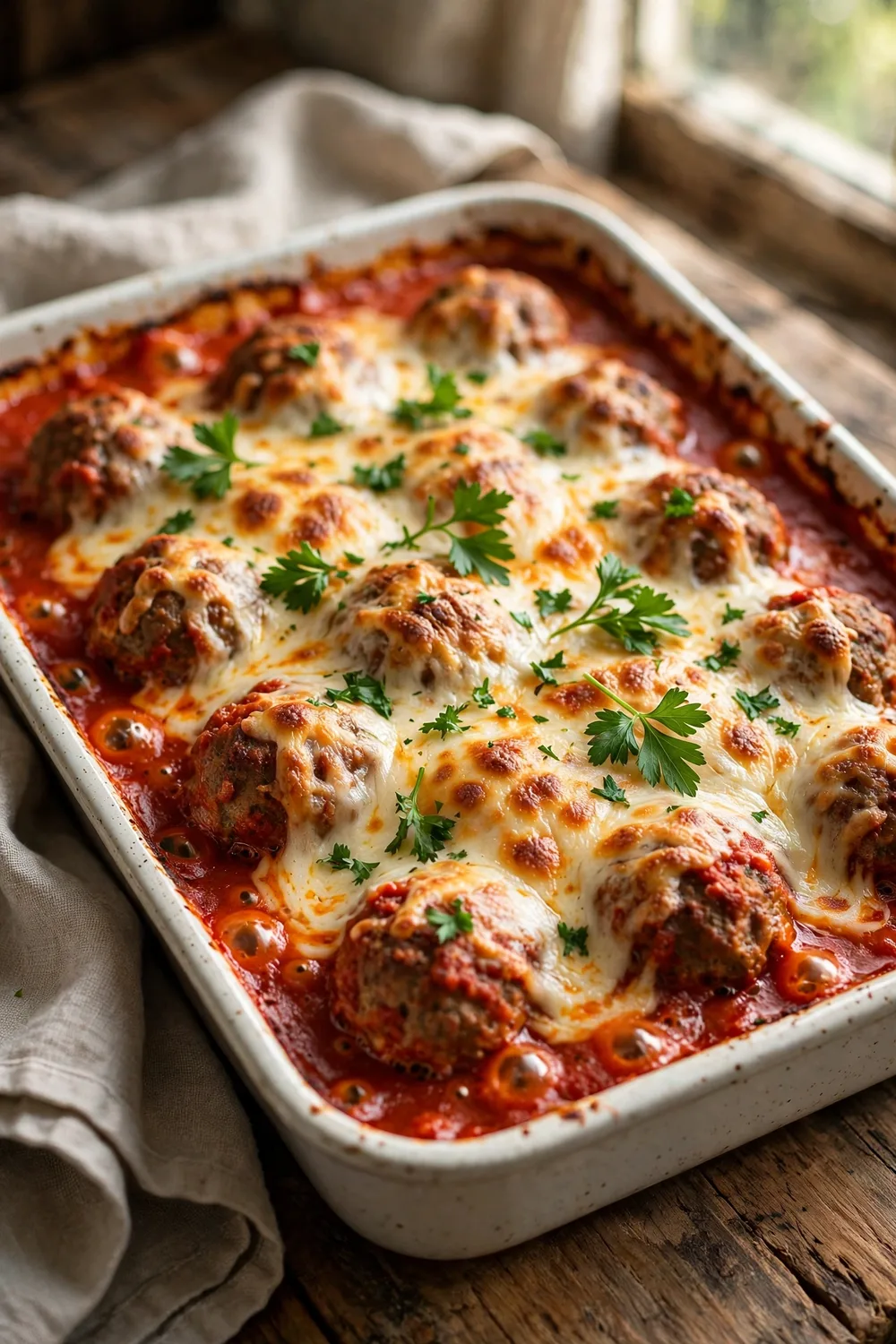
A dump and bake meatball casserole is exactly what the name says: everything raw goes into one dish, and the oven does the work. “Dump and bake” is a method, not a brand — it means three promises and one catch. The three promises: no boiling the pasta first, no browning the meatballs first, and no pre-cooking anything at all. The pasta cooks in the sauce, the meatballs heat through in the sauce, and the cheese melts on top. The one catch is the liquid — and it is the catch this whole page is about. The pasta needs enough liquid to cook through without turning chalky, and not so much that the casserole turns to soup, and nobody on the search results gives you the ratio. The liquid H2 below does.
The dish itself is a meatball casserole in the plainest sense of the phrase: meatballs, pasta and sauce, baked together under cheese. It is Italian-American comfort food — the same ingredients as spaghetti and meatballs, rearranged so the pasta cooks in the dish instead of in a pot, and so the whole thing comes out of the oven in one pan. It is a weeknight dinner in the same way the rest of this site’s casseroles are: the kind of meal you assemble at 5, bake at 5:10, and serve at 6, with the leftovers already boxed for tomorrow’s lunch.
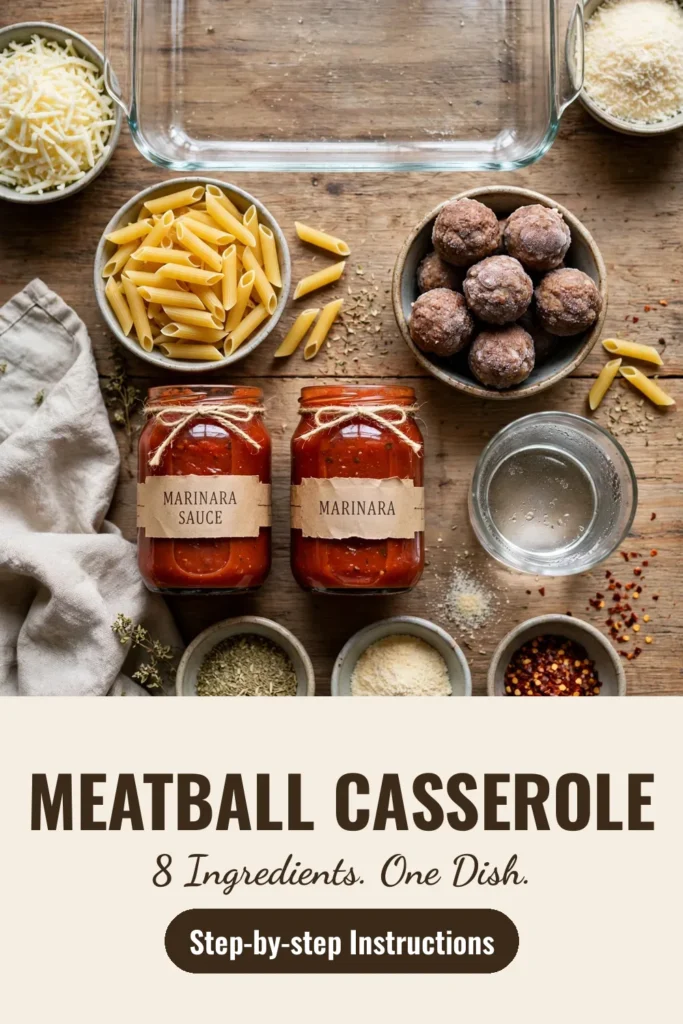
The 8 Ingredients, and What Each One Does
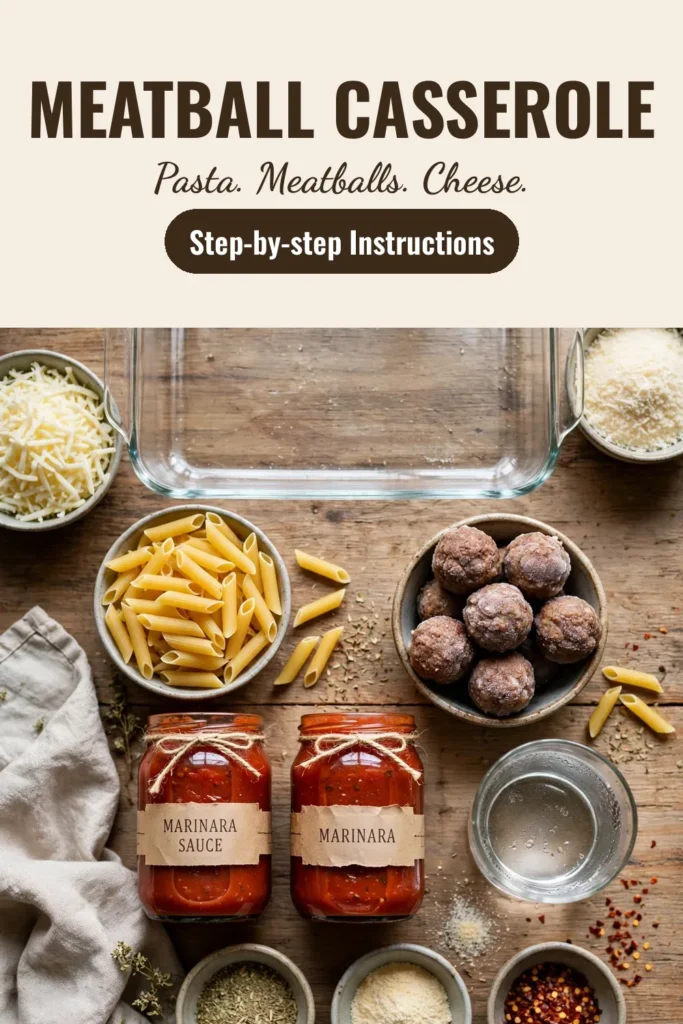
Midwest’s page lists four ingredients with no amounts outside the recipe card — a reader skimming the article cannot assemble the casserole without scrolling to the bottom. Here is every ingredient WITH its amount, and what each one is doing in the dish — because once you know the job of each ingredient, you can adjust the casserole instead of guessing.
| Ingredient | Amount in our batch | What it does |
|---|---|---|
| Uncooked penne or rotini | 1 lb (16 oz) | The base. The pasta is the thing that decides everything else — the liquid, the bake time, the shape rules. Corkscrew shapes trap the sauce and the cheese (see the pasta H2 below). |
| Frozen Italian-style meatballs | 1 lb, about 24 mini/cocktail-size (½–¾ oz each) | The protein. Fully cooked, straight from the freezer — the whole point of dump-and-bake is that you do not thaw them, brown them or roll them. Mini meatballs are the size that cooks through from frozen (see the thaw H2 below). |
| Marinara sauce | 2 jars (24 oz each) | The sauce and the cooking liquid’s partner. Two jars is the sauciest, most generous version on the search results — and the target page’s approach. Any jarred marinara works; Rao’s for the best flavour, Prego if that is what is in the pantry. |
| Water | 2 cups | The pasta’s cooking liquid. The sauce alone is not enough liquid to cook a pound of pasta — the water is what the pasta actually absorbs. Two cups, not three, is what keeps the casserole from going soupy (see the liquid H2 below). |
| Italian seasoning | 2 tsp | The flavour lift the jarred sauce needs. Jarred marinara is seasoned for a jar, not for a whole casserole — the Italian seasoning is what makes the sauce taste like it was made for this dish. |
| Garlic powder | 1 tsp | The savoury base. Garlic powder, not fresh cloves, because it spreads evenly through the sauce without burning in the oven — The Kitchn’s reasoning, and it holds. |
| Crushed red pepper flakes | ½ tsp (optional) | The heat. Half a teaspoon is the middle of the range on the search results — noticeable warmth that sits behind the tomato instead of on top of it. Omit it for mild. |
| Mozzarella + Parmesan | 2 cups shredded whole-milk mozzarella + ½ cup grated Parmesan | The melt and the salty edge. Mozzarella is the melt — half stirred in, half on top (see the cheese H2 below). Parmesan is the salty edge that makes the mozzarella taste like more than just stretch. |
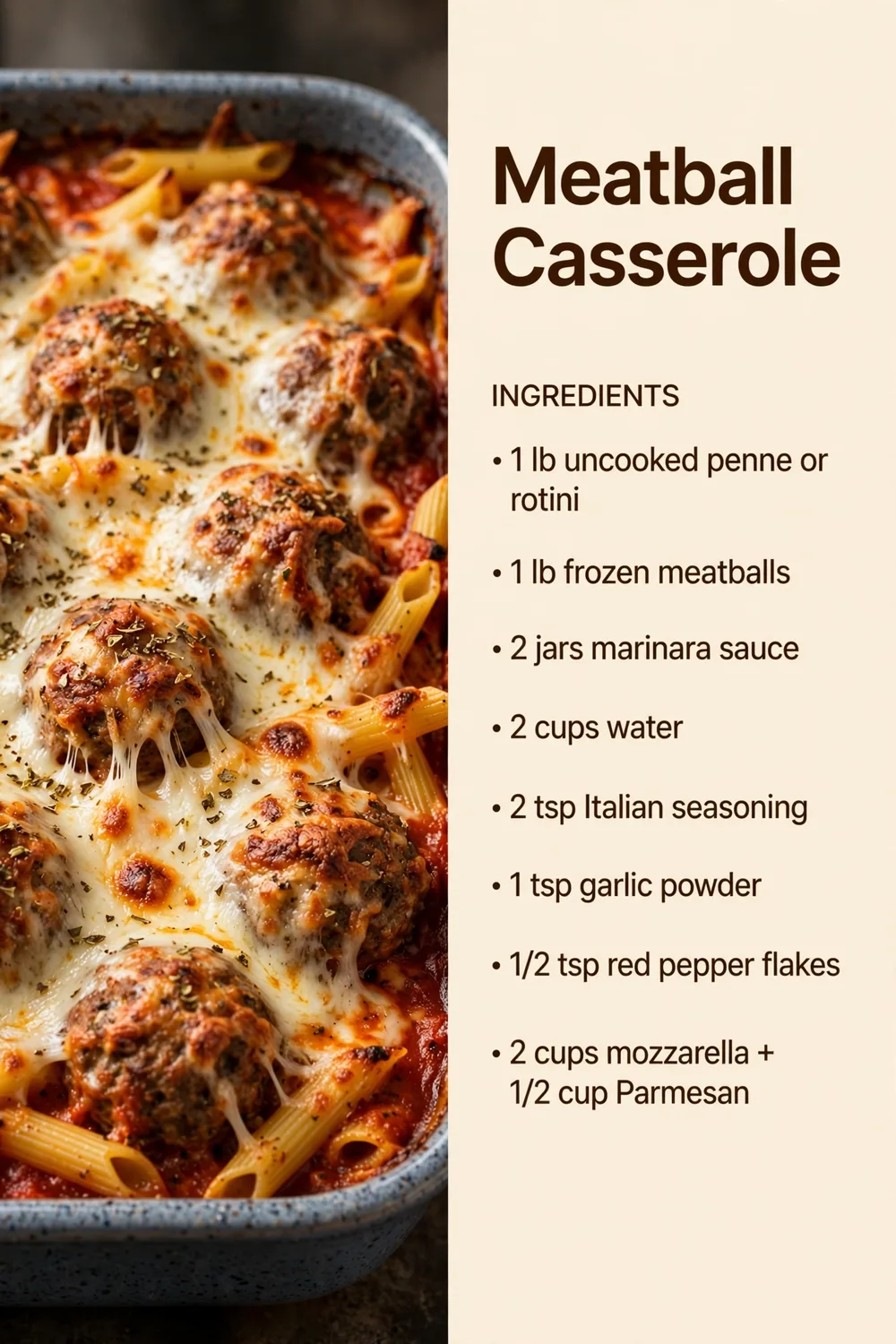
That is the whole list — eight items, every one of them in the recipe card below, and every one of them on the ingredients card image. A dump and bake meatball casserole recipe is really a question about the base: uncooked pasta plus frozen meatballs plus jarred sauce plus water, with seasoning as the lift and cheese as the finish. An easy meatball casserole recipe is the same list, used the same way — the short form of the same dish, and the same eight items in the same proportions.
Frozen or Thawed Meatballs? (The Three Answers, Resolved)
Three pages, three answers — and nobody on the search results explains why. Midwest adds the meatballs frozen and never mentions thawing. The Kitchn says “no need to thaw them before baking!” in one line. The Seasoned Mom says “if using frozen meatballs, make sure that they are completely thawed before using.” Savory Experiments says defrost in the microwave first — “If they aren’t defrosted, they won’t have enough time to cook.” They are all describing the same physics from different angles: a frozen meatball is a cold mass that chills the pasta around it and needs the full covered bake to heat through. The rule is size + time, not thawing.
| Meatball state | Bake-time adjustment | What changes |
|---|---|---|
| Frozen mini/cocktail-size (½–¾ oz) — the default | None — full 40–45 minute covered bake | The whole point of dump-and-bake. Mini meatballs cook through from frozen in the covered bake, because they are small enough for the heat to reach the centre. This is what our recipe uses. |
| Frozen full-size (1 oz+) | Thaw overnight in the fridge, OR add 10 extra minutes covered | Full-size meatballs are too big to heat through from frozen in the same bake — the outside is hot and the centre is still cold. Thawing is the safe option; the extra 10 minutes is the lazy one. |
| Thawed (any size) | None — same bake time, even cooking | The Seasoned Mom’s way. Thawed meatballs heat evenly and the pasta around them cooks at the same rate. If you remembered to move the bag to the fridge last night, use them thawed. |
| Fresh or homemade meatballs | Brown them first, or they fall apart | Raw meatballs are not dump-and-bake meatballs — they need browning to hold their shape, and the browning is the prep this recipe is designed to skip. Use fully cooked frozen meatballs for this dish. |
The practical rule: frozen is the default (the whole point of dump-and-bake is no prep), thawed is the safe option for big meatballs, and the mid-bake stir + the cut-in-half check prove it is done either way. If you are baking frozen meatballs in the oven for the first time and you are nervous, cut one in half at the mid-bake stir — hot all the way through means done, cold in the centre means 10 more minutes covered. Baked frozen meatballs are the same question with a shorter name, and the answer is the same table.
The Recipe — Our Casserole (1 lb Pasta, 1 lb Meatballs, 2 Jars)
This is a dump and bake meatball casserole recipe in the truest sense: ten minutes of prep, one dish, no boiling, no browning. The batch makes 8 servings — a full 9×13 dish, which is the most useful batch size on the search results, because a half batch barely fills the dish and a double batch needs two dishes.
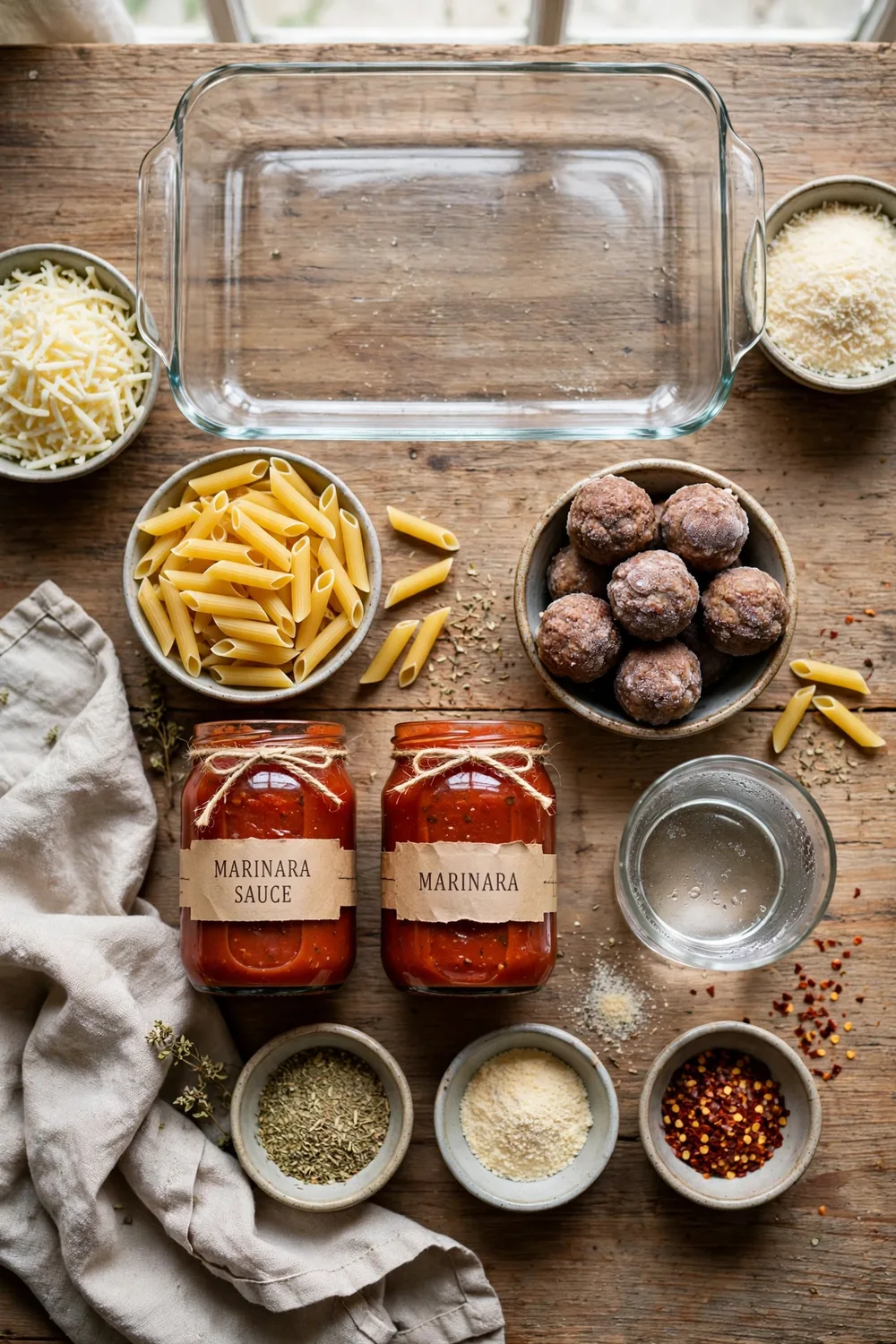
- 1 lb (16 oz) uncooked penne or rotini
- 1 lb frozen Italian-style meatballs, about 24 mini/cocktail-size (½–¾ oz each)
- 2 jars (24 oz each) marinara sauce
- 2 cups water
- 2 tsp Italian seasoning
- 1 tsp garlic powder
- ½ tsp crushed red pepper flakes (optional — omit for mild)
- 2 cups shredded whole-milk mozzarella + ½ cup grated Parmesan
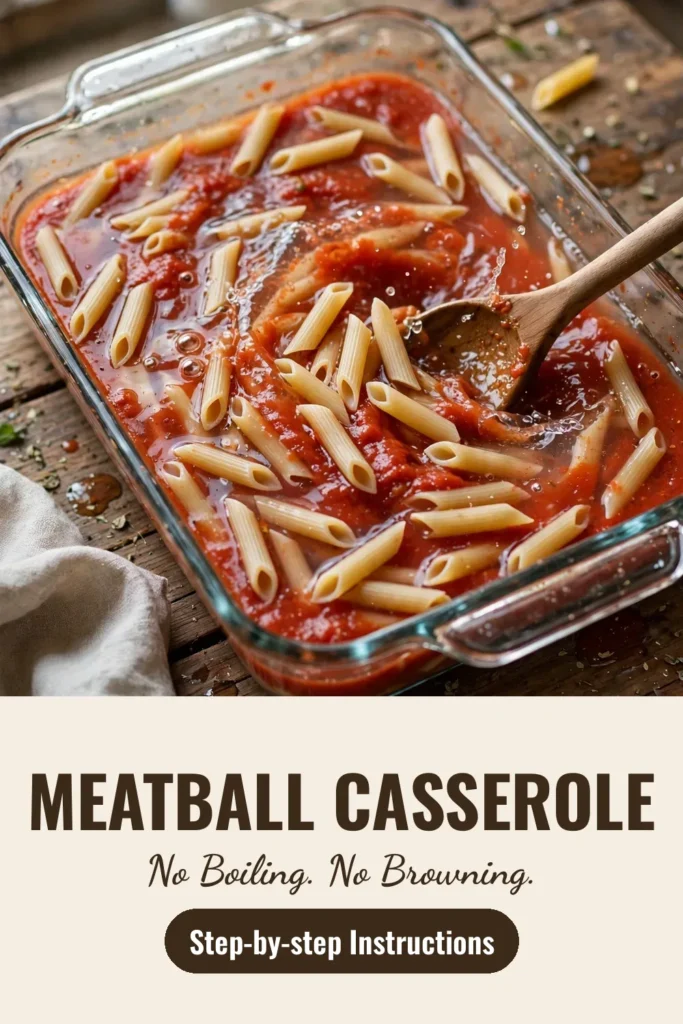
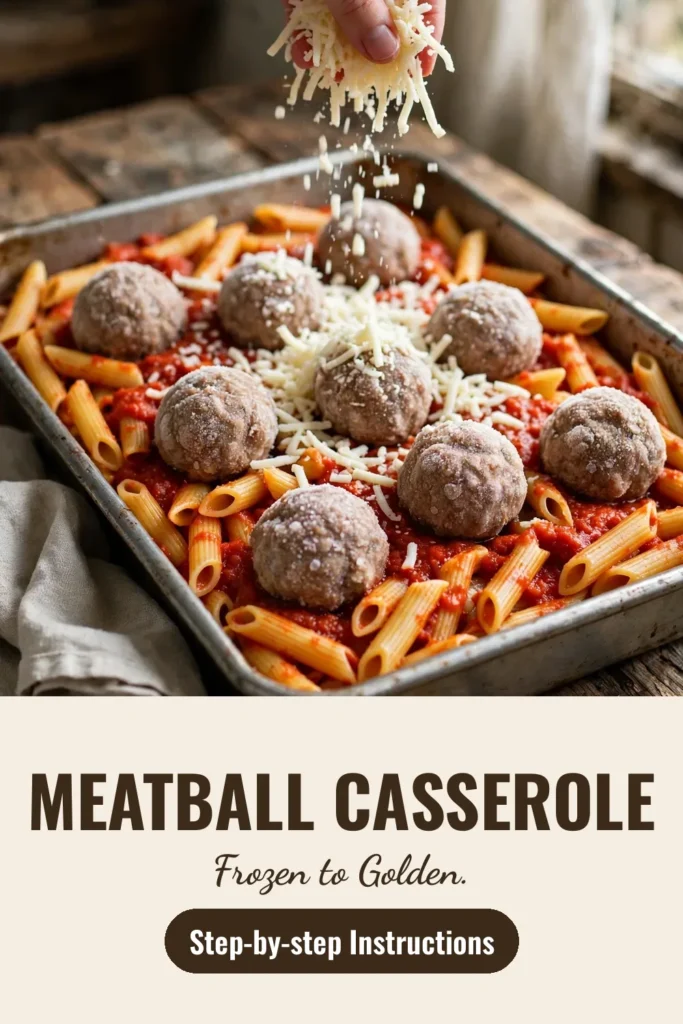
How to make it: (1) Heat the oven to 375°F; grease or brush a deep 9×13 dish with olive oil. (2) Pour in the pasta, both jars of sauce and the water; add the Italian seasoning, garlic powder and red pepper flakes; stir until the pasta is submerged. Swirl a little of the water around inside each empty sauce jar first — the jar-swirl trick, which loosens the sauce left on the glass and gets it into the dish instead of down the drain. (3) Nestle the frozen meatballs on top in a single layer; cover TIGHTLY with foil. (4) Bake 40–45 minutes; uncover, STIR, taste a piece of pasta from the centre and cut a meatball in half to check it is hot through; if the pasta is still hard, add ½ cup of water, re-cover and bake 10 more minutes. (5) Top with the mozzarella and Parmesan; bake uncovered 10–15 minutes until bubbly, then broil 1–2 minutes for a golden top. Rest 10 minutes before serving — the liquid redistributes back into the pasta so it is not watery, and the casserole sets enough to cut cleanly.
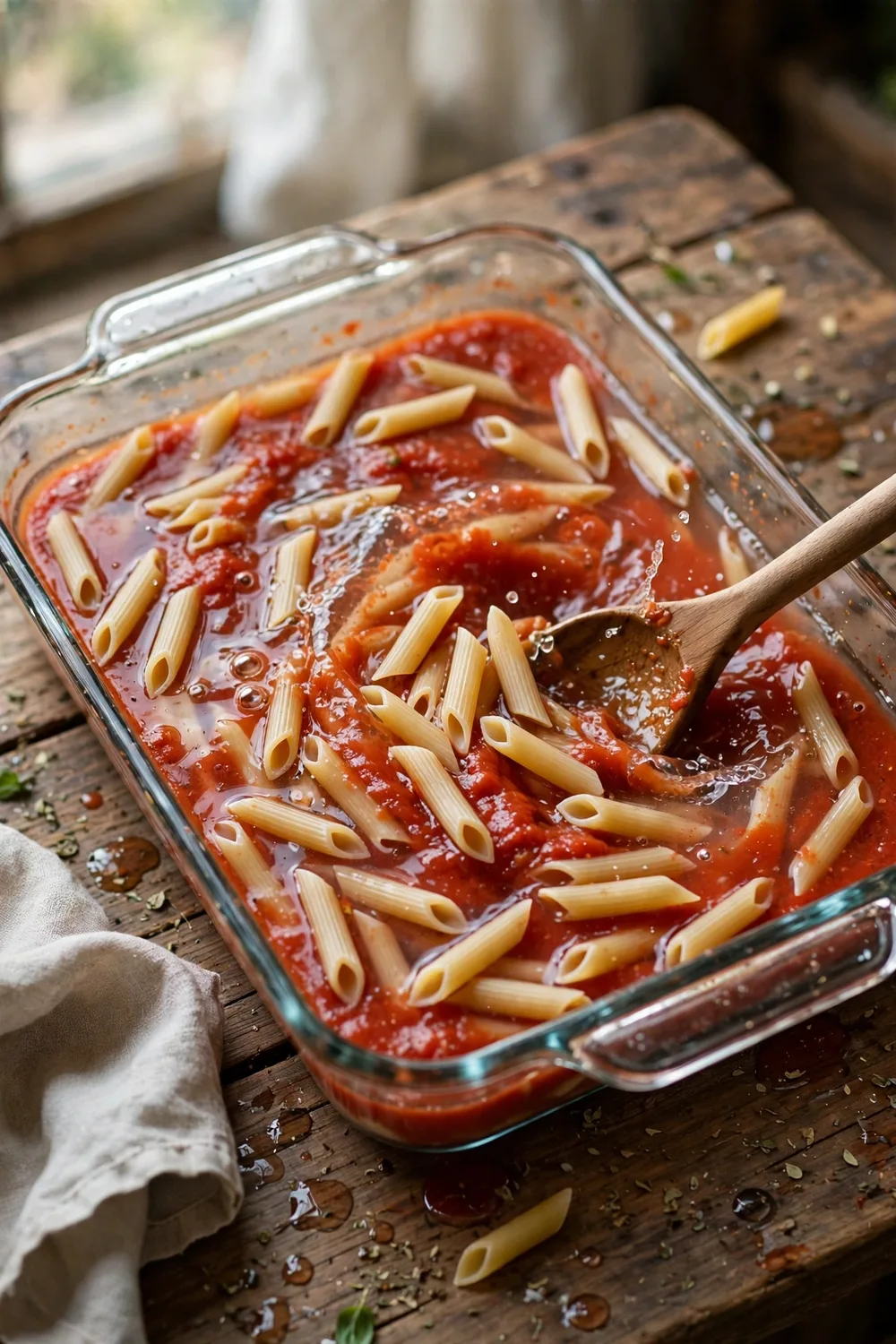
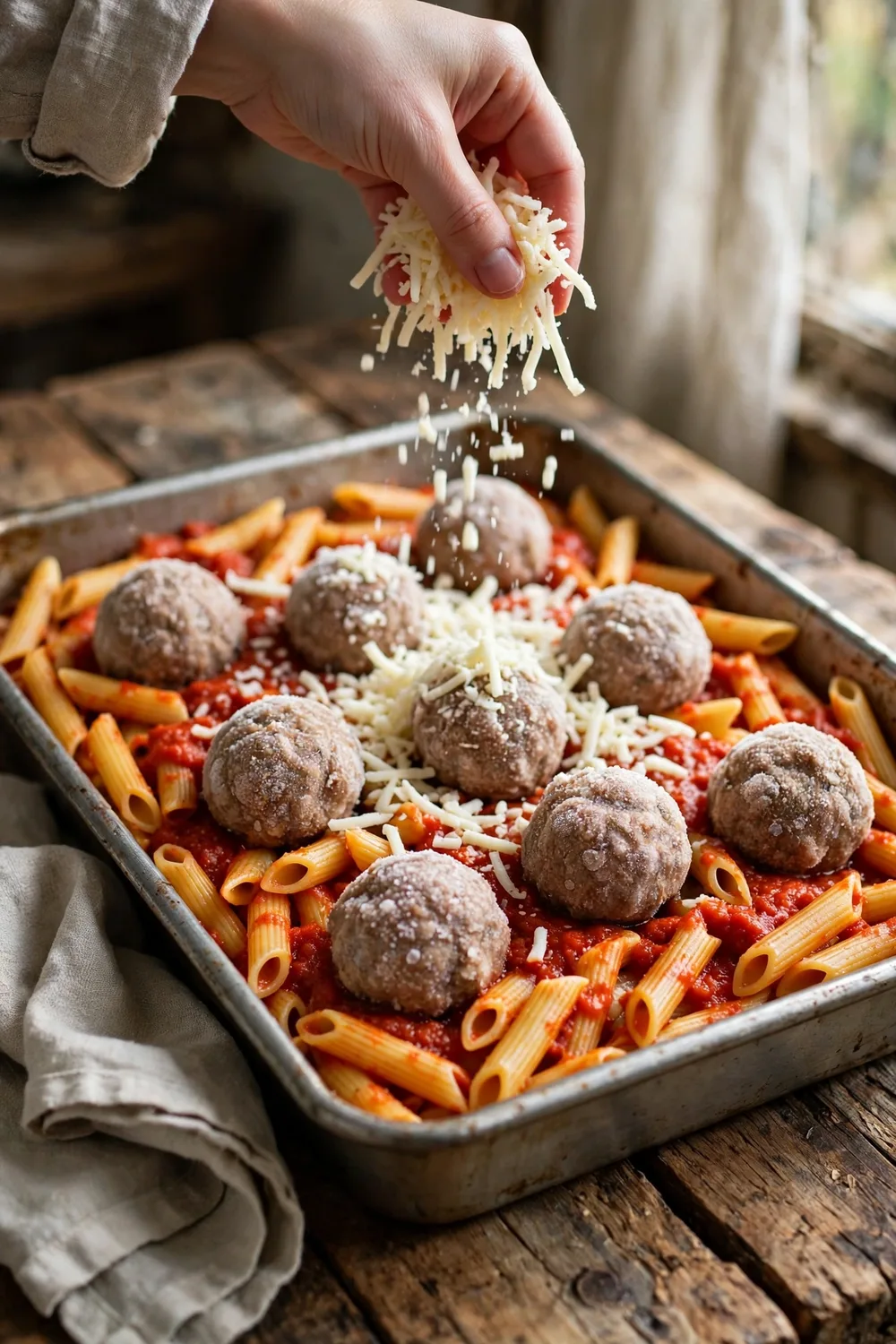
How to make a dump and bake meatball casserole, the short version: uncooked pasta, frozen meatballs, two jars of sauce, two cups of water — dump, stir, cover, bake, cheese, broil, rest. That is how to make a meatball casserole in one dish, and it is the same method every page on the search results uses, because there is only one method that works: the foil traps the steam, the steam cooks the pasta, and the cheese finishes it.
How Much Liquid? (The Ratio That Decides Everything)
Five different liquid amounts on the search results, and nobody explains the ratio. The pasta is the thing that decides it: 1 pound of dry pasta absorbs roughly 2 to 2½ cups of water as it cooks, and the sauce supplies the rest. The Kitchn’s 1 jar (2½ cups) + 3 cups of water = 5½ cups total for 1 pound of pasta. Midwest’s 2 jars (6 cups) + 3 cups of water = 9 cups total — very saucy, and her nutrition shows it (sugar 25.7g per serving, the highest on the search results — two jars of sweet sauce). Winding Creek’s 2 jars + 2 cups of broth = 8 cups total for 1 pound of pasta, 60 minutes. SalamBlog’s 1 jar + 2 cups of water = 4½ cups total for 12 ounces of pasta — the leanest, and the page itself warns “too little and the pasta stays chalky in the middle. Too much and you get soup.”
| Pasta weight | Sauce | Water | Total liquid |
|---|---|---|---|
| 12 oz | 1 jar (24 oz) | 2 cups | 4½ cups — the lean end; works, but the margin is thin |
| 1 lb (16 oz) — ours | 2 jars (48 oz) | 2 cups | 8 cups — the safe middle; saucy without being soupy |
| 1 lb (16 oz) — the soupy end | 2 jars (48 oz) | 3 cups | 9 cups — Midwest’s load; very saucy, and the sugar shows it |
The rule: for 1 pound of pasta, use 2 jars of sauce + 2 cups of water (8 cups total) at 375°F for 40–45 minutes covered — the Midwest/Winding Creek liquid load with the Winding Creek water amount, which avoids both failure modes. Too little liquid and the pasta stays chalky in the middle — the dry, white-centred bite that means the pasta never got enough water. Too much and you get soup — a casserole that swims instead of setting. The mid-bake stir is the safety net: stir at 35 minutes, and if the pasta is still hard, add ½ cup of water and re-cover for 10 more minutes. It is easier to add water than to take it away — once the water is in, the only fix is more uncovered baking, and that dries the top out.
One page on the search results disagrees with all of this — Recipes From A Pantry uses cooked pasta and warns “we don’t recommend making this with uncooked pasta as it will not cook all the way through while baking.” They are right about their own recipe, which has too little liquid for raw pasta. They are wrong about the method: uncooked pasta works when the liquid is right, and the table above is what “right” looks like. The warning exists because a cook who uses one jar and no water will get chalky pasta — and will blame the method instead of the ratio.
Which Pasta Shape?
Every page names a shape and nobody explains why corkscrews win or which shapes fail. Here is the guide, because the shape decides whether the sauce and the cheese end up on the pasta or at the bottom of the dish.
| Shape | Why it works — or why it fails |
|---|---|
| Rotini / fusilli / cavatappi — the corkscrews | The best shapes. The sauce and the cheese get trapped in the spring-like shape, so every bite has sauce on it — The Kitchn’s note, and the reason our recipe names penne or rotini first. |
| Penne / rigatoni — the tubes | Good. The tubes hold sauce inside them, and they submerge easily in the dish. Penne is the most common shape on the search results for a reason. |
| Mezzi rigatoni | Good. The Seasoned Mom’s pick — a shorter tube with a 9-minute package cook time, which is the sweet spot for a dump-and-bake (see the rule below). |
| Ziti | Fine. A plain tube, no ridges, no trap — it works, it just holds less sauce than the corkscrews. |
| Long pasta (spaghetti, linguine, fettuccine) | Fails. Long strands will not submerge in a 9×13 dish — the ends stick up out of the sauce, dry out in the oven, and snap when you serve it. Break them in half and they are still the wrong shape for the job. |
| Tiny pasta (orzo, ditalini) | Overcooks. Small shapes absorb liquid fast and go mushy in a 40-minute bake — Live Eat Learn’s orzo version is a different dish with a 20-minute covered bake, not this one. |
| Shells | Traps water and goes soggy. The cups hold liquid instead of sauce, and the pasta inside them turns soft while the rest is still firm. |
The cook-time rule: pick a shape with an 8–10 minute package cook time — the Seasoned Mom’s rule, and the one that keeps the pasta from going mushy in a 40–45 minute bake. A shape that cooks in 7 minutes on the packet will be soft by the time the meatballs are hot through; a shape that needs 12 minutes will still be hard when the cheese is done. Pasta and meatball casserole is the same dish with a shorter name, and the shape table above is the answer to it — the pasta bake with meatballs recipe is the same question again, and the answer is the same: corkscrews first, tubes second, long pasta never.
The Cheese — Mozzarella, Parmesan, and the Broil Finish
Whole-milk mozzarella, shredded by hand, melts better than pre-shredded. Pre-shredded mozzarella is coated in anti-caking starch so it does not clump in the bag — and that starch is what keeps it from melting smoothly in the oven. A block of whole-milk mozzarella, shredded on a box grater, melts into a smooth, stretchy blanket. It costs two minutes and it is the single biggest upgrade in this whole recipe.
Half stirred in, half on top — the two-stage cheese. The Kitchn is the only page on the search results that does this, and it is the move that makes the casserole taste cheesy all the way through instead of just on the surface. Half the mozzarella goes in at the mid-bake stir, so it melts into the sauce and coats the pasta; the other half goes on top for the uncovered bake, so it browns. One stage of cheese is a topping. Two stages is a casserole.
Parmesan is the salty edge. One ounce, finely grated — ½ cup — and it does a job the mozzarella cannot: it adds the salty, sharp note that makes the whole dish taste seasoned instead of just rich. Mozzarella is mild; Parmesan is the flavour. Without it, the casserole tastes like cheese. With it, the casserole tastes like dinner.
The broil finish: 1–2 minutes, and watch it. Midwest’s step, and the golden top. Broil until the cheese is golden and bubbling — then stop. It goes from golden to burnt fast, and a burnt top is the one mistake in this recipe you cannot undo. Stand at the oven for the broil; do not walk away.
The buttered-breadcrumbs option. The Seasoned Mom’s crunch: toss ½ cup of panko breadcrumbs with 2 tablespoons of melted butter and sprinkle them over the cheese before the uncovered bake. It adds a crisp top that the soft cheese does not have — worth doing when the casserole is the whole meal and you want texture.
What Temperature? 375°F vs 425°F
375°F is gentler and longer. Forty to sixty minutes covered, depending on the page — and the safer temperature for a glass or ceramic dish, which holds heat differently from metal and can crack under a sudden high blast. It is the temperature that gives the pasta the most time to absorb the liquid evenly, and the one that forgives a loose foil seal. It is our temperature, because the casserole has 40–45 minutes of covered baking to do and there is no reason to rush it.
425°F is faster and hotter. Thirty-five minutes covered, and better browning on the cheese — but a hotter oven dries the top out faster, and the pasta has less time to absorb the liquid before the cheese is done. It is the temperature for a cook who wants dinner in 55 minutes instead of 60, and it is the temperature that needs the tightest foil seal of all, because the steam escapes faster at higher heat.
400°F is the middle. SalamBlog’s temperature — 35 minutes covered, 15 uncovered — and a reasonable compromise, but a compromise that nobody else on the search results uses, which means nobody else has tested it against the others.
Our 375°F + broil finish is the best of both. The gentle bake cooks the pasta evenly, and the 1–2 minute broil at the end gives the cheese the browning that 425°F would have given it — without the dry top. And the pan note, expanded from the Seasoned Mom: glass and ceramic dishes take longer than metal, because they heat more slowly. If your dish is glass, add 5 minutes to the covered bake and check the centre piece before you uncover it.
How to Tell It’s Done
“Until the pasta is al dente and the edges bubble” is the only signal on the target page, and it is not enough — the edges lie. The edges of a casserole are the hottest part of the dish, so they bubble and cook first while the centre is still catching up. Here are the four checks, in order, and the casserole is done when all four pass.
Taste a piece of pasta from the centre. Winding Creek’s check, and the only one that matters. Pull a piece of pasta from the middle of the dish — not the edge, not the corner — and taste it. It should be al dente: firm in the centre, not chalky, not mushy. If it is still hard, the casserole needs more time, not more cheese.
Most of the liquid is absorbed. The Seasoned Mom’s signal. When you stir at 35 minutes, the sauce should be thick and clinging to the pasta, not pooling at the bottom of the dish. If there is a puddle of thin liquid, the pasta has not finished absorbing it — re-cover and bake 10 more minutes.
The edges are bubbling. Midwest’s signal, and the weakest of the four — but a useful one. Bubbling edges mean the dish is hot all the way through, and the sauce is at a simmer. No bubbles means the oven has not done its job yet, or the foil seal was loose and the steam escaped.
Cut a meatball in half — hot all the way through. SalamBlog’s check, and the food-safety one. A meatball that is hot on the outside and cold in the centre is not done, no matter what the pasta tastes like. Cut one in half at the mid-bake stir: steaming and hot through means done; cool in the middle means 10 more minutes covered.
Then rest it 10 minutes — Midwest’s tip, and the step that makes the casserole cut cleanly. The liquid redistributes back into the pasta as it cools, so the casserole sets instead of running. A casserole served straight from the oven is watery; the same casserole after a 10-minute rest is the one you meant to make.
Variations — Turkey, Chicken, Veggie, Spicy, Small Batch
One base casserole, six versions — because the dish earns its place in the rotation by being the one casserole that fits every household, not just one.
| Version | Swap | What changes |
|---|---|---|
| Turkey or chicken meatballs | Swap the beef meatballs 1:1 for turkey or chicken | Leaner, same bake time — the meatball type changes the fat, not the method. Turkey meatballs are the lightest version; chicken is the mildest. |
| Veggie-loaded | Add 1 small grated zucchini + 1 (8 oz) container sliced mushrooms + ½ cup chopped sun-dried tomatoes | The Seasoned Mom’s version — the vegetables cook in the sauce and the kids probably will not even detect them. The liquid stays the same; the vegetables give up their own moisture. |
| Spicy | 1 tsp red pepper flakes + hot Italian meatballs | Real heat — the flakes carry the burn and the hot Italian meatballs add sausage-level spice. The mild version is the default; this is the Friday-night version. |
| Small batch | Half everything, 8-inch square pan, check at 35 min | The Seasoned Mom’s only-on-the-SERP guide, taken properly: half the pasta, half the meatballs, 1 jar of sauce, 1 cup of water, half the cheese — and check the centre piece at 35 minutes, because a smaller dish cooks faster. |
| Vegetarian | Omit the meatballs, add extra mushrooms + a can of white beans | The meat disappears and the dish still works — the mushrooms and beans are the protein, and the sauce and cheese do the rest. Live Eat Learn’s Mediterranean version (orzo + feta) is the furthest version of this idea. |
| Meatball subs | Spoon the finished casserole into toasted rolls with extra mozzarella | The sandwich lane as a method angle, never a keyword target: the casserole becomes the filling, the roll becomes the plate, and the extra cheese goes on top before a 2-minute broil. |
The turkey and chicken versions are the leanest, the veggie version is the one that hides the vegetables, the spicy version is the one that earns its name, the small batch is the one for two people, the vegetarian version is the one for the meat-free night, and the meatball subs are what you do with the leftovers on day two.
What to Serve With It
The target page has no sides H2 at all. The Seasoned Mom has the best sides list on the search results, and here it is, adapted — because a casserole is a main dish, and a main dish needs something beside it.
- Garlic bread. The obvious partner, and the right one — it soaks up the sauce, and it is the thing the table reaches for first. A loaf of Italian bread, buttered and garlicked, baked while the casserole rests.
- Green salad. The fresh counterpoint. A simple green salad with a sharp vinaigrette cuts through the richness of the cheese and the sauce — the plate needs something green and cold.
- Roasted broccoli or cauliflower. The roasted vegetable that holds up to the casserole’s richness. Parmesan roasted cauliflower is the Seasoned Mom’s pick, and it is the right one — the cauliflower roasts while the casserole bakes.
- Green beans. The quickest side on this list. Steamed or sautéed with garlic, they are done in the time the casserole rests — and they are the green thing the plate needs.
- Glazed carrots. The sweet note. Carrots glazed in butter and a little honey are the side that makes the meal feel like Sunday dinner instead of Tuesday.
- Breadsticks. The dippable option. Warm breadsticks beside the plate are the thing the kids fight over, and they do the same job as the garlic bread with less work.
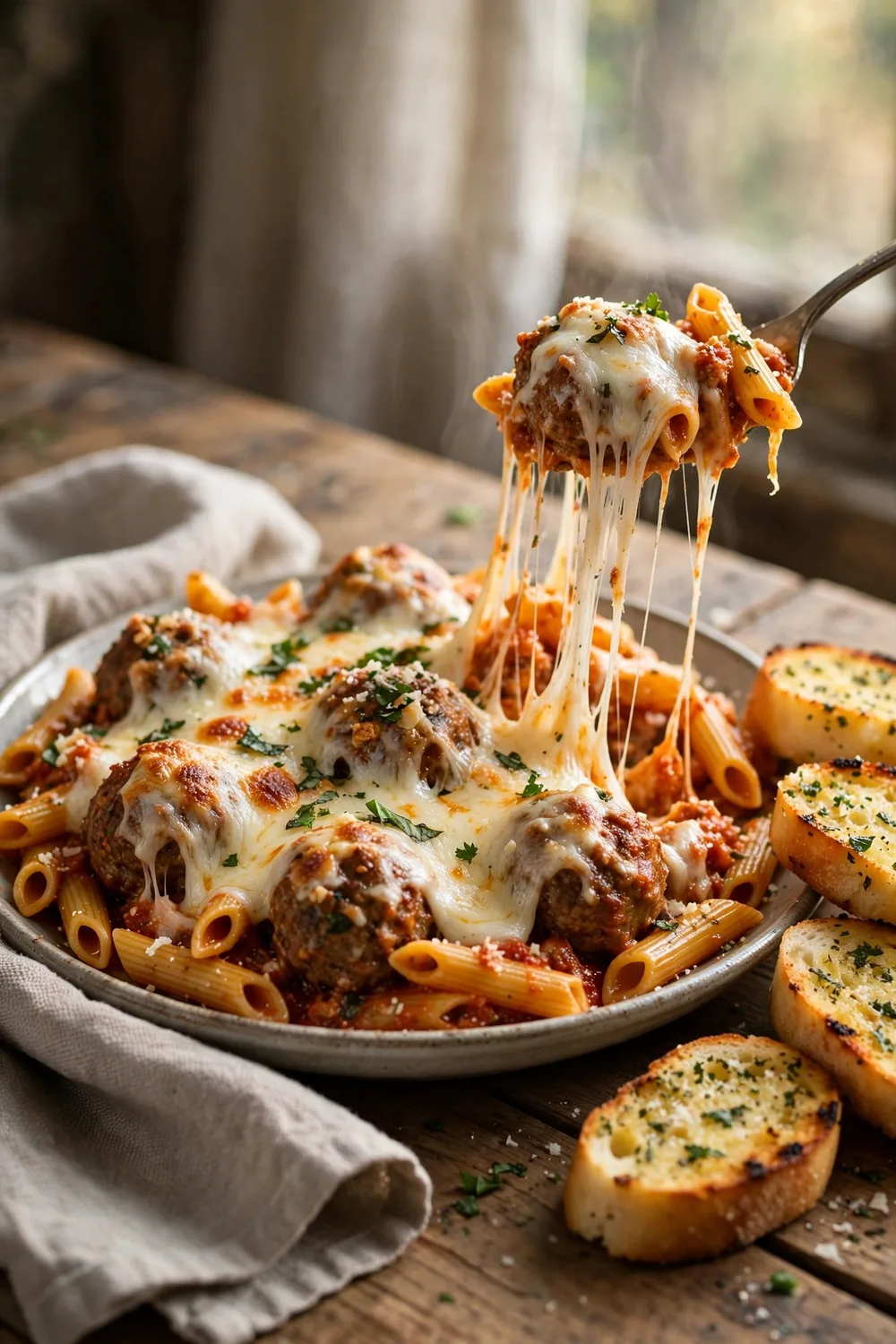
Six sides, and the rule is the same for all of them: something fresh or green beside something rich and cheesy, and nothing that needs the oven at the same time as the casserole — the oven is busy.
Make Ahead, Storage & Freezing
Make ahead: assemble the casserole up to 24 hours before baking, cover it tightly, and refrigerate it. BUT the pasta absorbs liquid as it sits — so when you bake a made-ahead casserole, either decrease the bake time slightly or add a splash of water or marinara before it goes in the oven. The pasta has been drinking the sauce all night, and it needs less time, not more. If you assemble it in the morning and bake it at night, add ½ cup of water to the dish before the foil goes on.
Storage: the casserole keeps 3–4 days in the fridge for the best texture (the Seasoned Mom, the Kitchn), and up to a week if you are only counting food safety (Midwest) — but after day four the pasta dries out and the cheese goes rubbery, and no amount of reheating brings it back. Store it airtight, in the dish it baked in or in containers, and reheat it covered at 350°F or in the microwave for 30–60 seconds per serving. Stir in a spoonful of extra marinara on reheat if it looks dry — the sauce is the moisture, and the microwave takes it away.
Freezing, resolved honestly: the Seasoned Mom says do NOT freeze (“pasta has a tendency to get gummy and mushy when thawed”). Savory Experiments says you CAN freeze the casserole (with the caveat that pasta and cheese never defrost as well). Both are right about different things: frozen-then-thawed pasta IS softer than fresh-baked pasta — the Seasoned Mom is describing the texture honestly. Savory Experiments is describing that it is still safe and edible. Our answer: freeze the sauce + meatballs without the pasta (up to 3 months), and bake with fresh pasta on the day — the sauce and the meatballs freeze perfectly, and the pasta is fresh. Or freeze the whole casserole and accept softer pasta, thawed overnight in the fridge and reheated covered at 350°F. The honest answer, not a pick-a-side.
Troubleshooting — 5 Fixes
Nobody on the search results has this section. Every page is the same dump with the liquid amount changed; none of them explains what happens when it goes wrong. Here are the five failures, why they happen, and how to fix them.
Pasta still hard or chalky
Why: too little liquid, or the foil was not tight enough and the steam escaped. Fix it now: add ½ cup of water, re-cover tightly, and bake 10 more minutes. Next time: 2 jars + 2 cups of water for 1 pound of pasta (the ratio table above), and press the foil down hard around the rim of the dish — a loose seal is the number-one cause of chalky pasta.
Too watery or soupy
Why: too much liquid, or the casserole did not rest. Fix it now: rest it 10 minutes — the liquid redistributes back into the pasta as it cools, and a casserole that looks soupy straight from the oven is often fine after the rest. If it is still swimming, bake it uncovered for 10 more minutes. Next time: 2 cups of water, not 3, for 1 pound of pasta — and do not skip the rest.
Pasta mushy
Why: overbaked, or made ahead too long. Fix it now: there is no way to un-mush pasta — serve it as it is, and call it a baked pasta instead of a casserole. Next time: check the centre piece at 35 minutes, and do not bake a made-ahead casserole for the full time — the pasta has been absorbing liquid all night, so it needs less time in the oven.
Cheese didn’t brown
Why: the broil was skipped, or the cheese went on too early. Fix it now: broil 1–2 minutes, and watch it — it goes from golden to burnt fast. Next time: put the cheese on only after the covered bake, and broil at the end, not the beginning. Cheese that goes in at the start of the bake is pale by the end.
Bland
Why: the jarred sauce needs help — it was seasoned for a jar, not for a whole casserole. Fix it now: more salt first, then more Italian seasoning — salt alone will not fix a dull sauce, because the seasoning is the flavour. Next time: the full 2 teaspoons of Italian seasoning and 1 teaspoon of garlic powder in the dump, and a better sauce — Rao’s over Prego, one line, because the sauce is half the dish.
The Meatball, in 150 Words
The meatball is older than the casserole, and older than Italy. The ancient Roman cookbook Apicius included many meatball-type recipes. Early Arabic cookbooks feature seasoned lamb rolled into orange-sized balls, glazed with egg yolk and sometimes saffron. Poume d’oranges is a gilded meatball dish from the Middle Ages — meatballs made to look like oranges, and served as if they were. The Italian polpette is beef and/or pork with Romano cheese, eggs, bread crumbs and parsley, rolled golf-ball size. The Swedish köttbullar is the national dish, popular since the mid-1800s — the term first appeared in 1755 in Cajsa Warg’s cookbook — and IKEA introduced them to its cafeterias in 1985, serving over one billion meatballs a year worldwide. The Turkish köfte and the Spanish albóndigas (from the Arabic al-bunduq, hazelnut — a small round object) are the same idea in different kitchens. The casserole is new. The meatball is not.
Frequently Asked Questions
Do I have to thaw the frozen meatballs first? No — mini meatballs (½–¾ oz) cook through from frozen in the 40–45 minute covered bake. Full-size meatballs (1 oz+) need thawing overnight or 10 extra minutes covered. The thaw H2 above has the full table.
Do I have to cook the pasta first? No — that is the point of dump-and-bake. The extra liquid cooks the pasta in the oven, and the foil traps the steam that does the work. The liquid ratio is 2 jars of sauce + 2 cups of water for 1 pound of pasta.
How much water do I add? Two cups for 1 pound of pasta, with 2 jars of sauce — 8 cups of total liquid. For 12 ounces of pasta, 1 jar + 2 cups of water (4½ cups total). The liquid table above has the full ratio.
What pasta shape is best? Corkscrews — rotini, fusilli or cavatappi — because the sauce and the cheese get trapped in the spring-like shape. Penne and rigatoni are the next best. Long pasta fails (it will not submerge) and tiny pasta overcooks.
Can I use homemade meatballs? Yes — but only if they are fully cooked first. Raw meatballs need browning to hold their shape, and the browning is the prep this recipe is designed to skip. Brown them, cool them, and use them the same way.
Can I make it ahead? Yes — assemble it up to 24 hours before baking and refrigerate it covered. But the pasta absorbs liquid as it sits, so add a splash of water or marinara before it goes in the oven, or decrease the bake time slightly.
Can I freeze it? The honest answer: freeze the sauce + meatballs without the pasta (up to 3 months) and bake with fresh pasta on the day — or freeze the whole casserole and accept softer pasta, thawed overnight and reheated covered at 350°F. The freezing H2 above has the full resolution.
How long does it keep? Three to four days in the fridge for the best texture, and up to a week if you are only counting food safety. After day four the pasta dries out. Reheat it covered at 350°F or in the microwave, with a spoonful of extra marinara if it looks dry.
What if I don’t have a 9×13 dish? Make a half batch in an 8-inch square pan — half the pasta, half the meatballs, 1 jar of sauce, 1 cup of water, half the cheese — and check the centre piece at 35 minutes, because a smaller dish cooks faster.
Is it gluten-free? No — the pasta is wheat, and most frozen meatballs contain breadcrumbs. Gluten-free pasta works, but check the package cook time (the 8–10 minute rule still applies), and check the meatball label for breadcrumbs.
Conclusion
Dump and bake meatball casserole is exactly what it sounds like — pasta, frozen meatballs, and sauce in one dish, baked cheesy in about an hour, with no boiling first. Dump it, bake it, and let the oven do the work tonight.
More Recipes to Serve It With
- Baked Ziti — sausage baked ziti, 55 minutes.
- Cheeseburger Pasta — one-pot cheeseburger pasta, 30 minutes.
- Ground Beef Stroganoff — creamy ground beef stroganoff, 30 minutes.
- Crockpot Chicken Tacos — 10 minutes of prep, 6 hours of waiting.
- Taco Seasoning (Old El Paso style) — 5 minutes, 10 spices, 3 tablespoons seasons a pound of meat.
- Greek Pasta Bake — a real bake plus the 15-minute stovetop version, 45 minutes.
- Gigi Hadid Pasta — the 30-minute vodka pasta, with a no-vodka version.
- Vegetarian Lasagna Soup — one pot, 35 minutes, broken lasagna noodles and herbed ricotta.
- Olive Garden Chicken Gnocchi Soup — creamy, one-pot, 35 minutes, with a cream blend that never splits.
- Avocado Sauce for Tacos — creamy avocado sauce, 5 minutes, no cooking.
Dump and Bake Meatball Casserole (Cheesy, 45 Minutes)
Ingredients
Equipment
Method
- Heat the oven to 375°F; grease or brush a deep 9×13 dish with olive oil.
- Pour in the pasta, both jars of sauce and the water; add the Italian seasoning, garlic powder and red pepper flakes; stir until the pasta is submerged. Swirl a little of the water around inside each empty sauce jar first to loosen the sauce left on the glass.
- Nestle the frozen meatballs on top in a single layer; cover TIGHTLY with foil.
- Bake 40–45 minutes; uncover, STIR, taste a piece of pasta from the centre and cut a meatball in half to check it is hot through; if the pasta is still hard, add 1/2 cup of water, re-cover and bake 10 more minutes.
- Top with the mozzarella and Parmesan; bake uncovered 10–15 minutes until bubbly, then broil 1–2 minutes for a golden top. Rest 10 minutes before serving.
Notes
Nutrition information
| Nutrient | Per serving (1/8 of the casserole) |
|---|---|
| Calories | ~555 kcal |
| Sodium | ~1,310mg |
| Carbohydrates | ~62g (sugars ~10g) |
| Fat | ~24g (saturated ~9g) |
| Protein | ~26g |
| Fiber | ~6g |
| Cholesterol | ~50mg |
The inputs, shown plainly (USDA FoodData Central values for the exact ingredients listed): 1 lb dry penne ≈ 454g ≈ 1,652 kcal, ~57g protein, ~339g carbs, ~7g fat, ~14.5g fiber (USDA “Pasta, dry, enriched, penne”: 364 kcal, 12.5g protein, 74.6g carbs, 1.5g fat, 3.2g fiber per 100g) · 1 lb frozen Italian-style meatballs ≈ 454g ≈ 1,298 kcal, ~65g protein, ~37g carbs, ~101g fat (saturated ~29g), ~2,570mg sodium (USDA “Meatballs, frozen, Italian style”: 286 kcal, 14.4g protein, 8.06g carbs, 22.21g fat, 566mg sodium per 100g) · 2 jars marinara (48 oz ≈ 1,361g) ≈ 599 kcal, ~19g protein, ~110g carbs, ~20g fat, ~5,703mg sodium (USDA “Sauce, pasta, spaghetti/marinara, ready-to-serve”: 44 kcal, 1.4g protein, 8.1g carbs, 1.5g fat, 419mg sodium per 100g) · 2 cups whole-milk mozzarella ≈ 226g ≈ 676 kcal, ~50g protein, ~5g carbs, ~50g fat (saturated ~30g), ~1,417mg sodium (USDA “Cheese, mozzarella, whole milk”: 299 kcal, 22.2g protein, 2.2g carbs, 22.1g fat, 627mg sodium per 100g) · ½ cup grated Parmesan ≈ 50g ≈ 216 kcal, ~19g protein, ~2g carbs, ~15g fat (saturated ~9g), ~765mg sodium (USDA “Cheese, parmesan, grated”: 431 kcal, 38.5g protein, 3.2g carbs, 29.6g fat, 1,529mg sodium per 100g) · Water, Italian seasoning, garlic powder, red pepper flakes: ~15 kcal total, negligible sodium. Batch total ≈ 4,456 kcal and ~10,464mg sodium — divided by 8 servings, about 555 kcal and about 1,310mg sodium per serving.
The SERP comparison, honestly: the published cards on the search results claim 412 kcal and 7.9g fat per serving (Midwest, per 1/12) and 463 kcal and 18g fat per serving (Seasoned Mom, per 1/8). Midwest’s numbers are internally inconsistent for this dish — 7.9g of fat and 16mg of cholesterol per serving cannot be right for a casserole with 1 pound of meatballs + cheese, and her sugar (25.7g) is four times the Seasoned Mom’s (6g), which fits two jars of sweet sauce but not the fat number. The Seasoned Mom’s numbers are the most believable on the search results (1 jar of sauce, 1 cup of mozzarella, 8 servings). Ours sits above both on calories and fat — the honest estimate for 2 jars of sauce + 2 cups of whole-milk mozzarella + 1 pound of beef meatballs — and the serving size is stated plainly (1/8 of the casserole) so the number can be checked instead of trusted.
The sodium is high, and the H2 says so honestly: the jarred sauce is the driver — two jars ≈ 5,700mg of sodium per batch, more than half the total. A low-sodium marinara cuts ~1,500–2,000mg from the batch, which is the single biggest sodium saving on this page. The meatballs are the second driver (~2,570mg per pound); a low-sodium meatball, if you can find one, cuts a few hundred more.
Nutrition is an estimate calculated from USDA FoodData Central values for the exact ingredients listed. Values will vary with brands and substitutions.
Pin this recipe