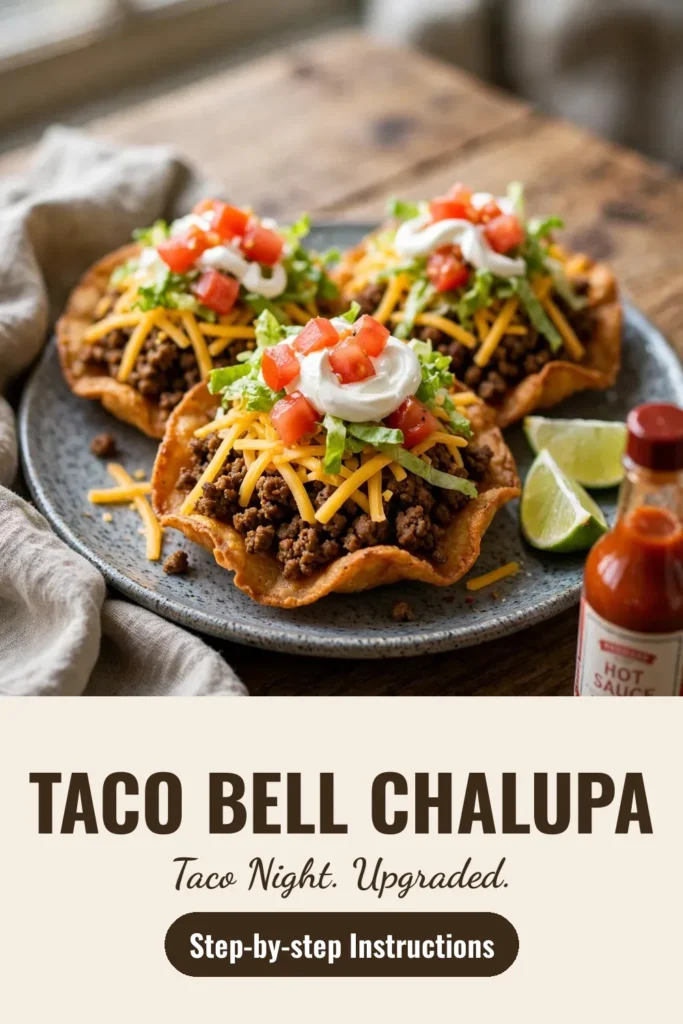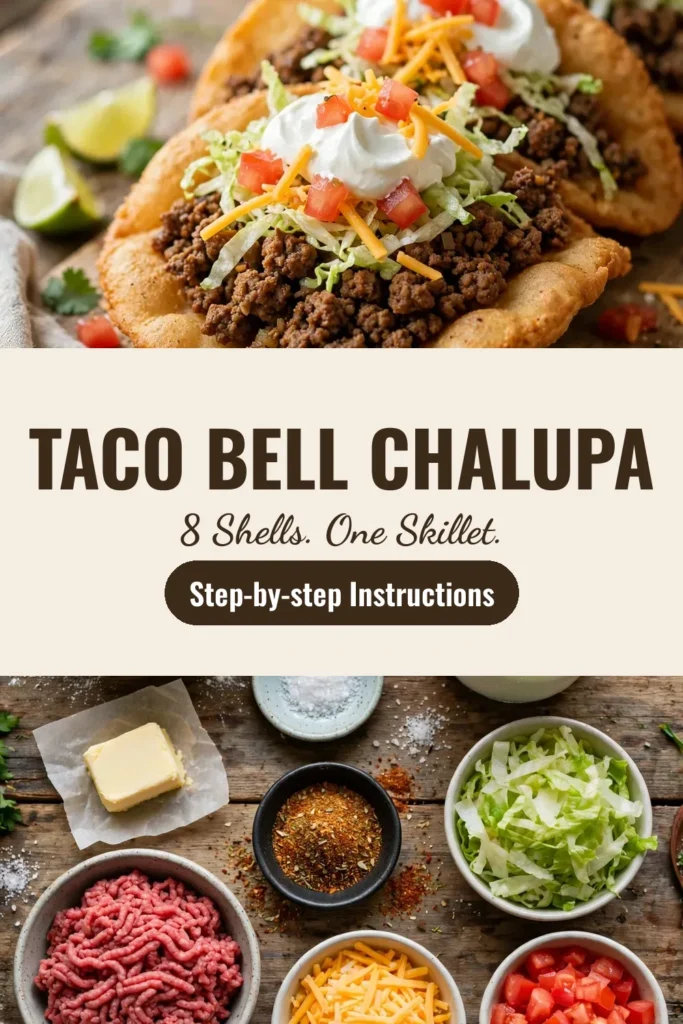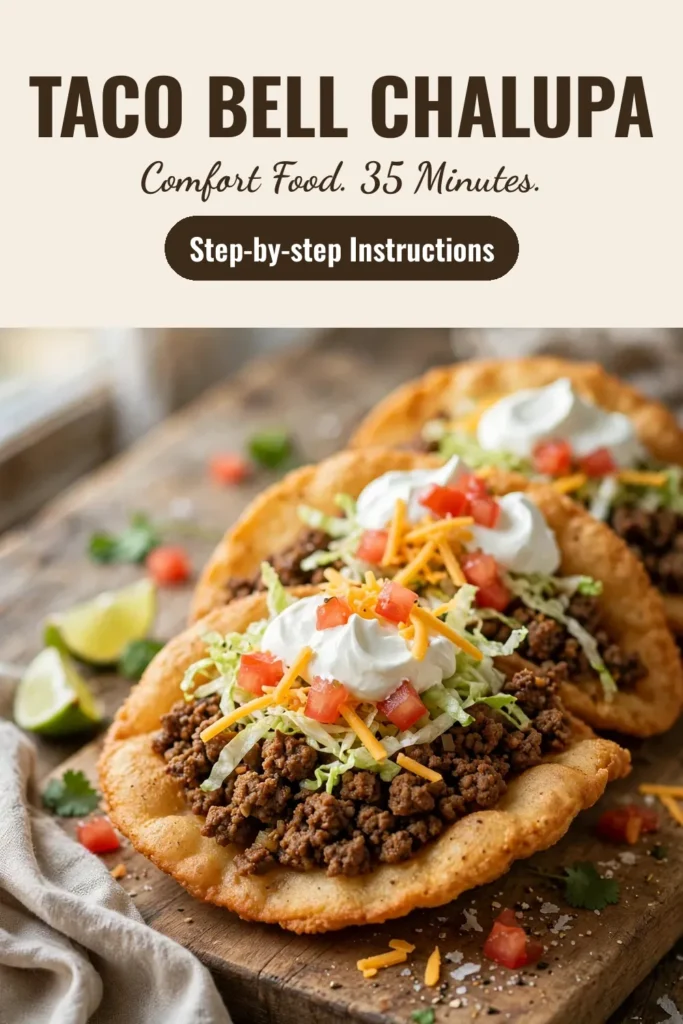
Copycat Taco Bell Chalupa Supreme (Homemade Fried Shells)
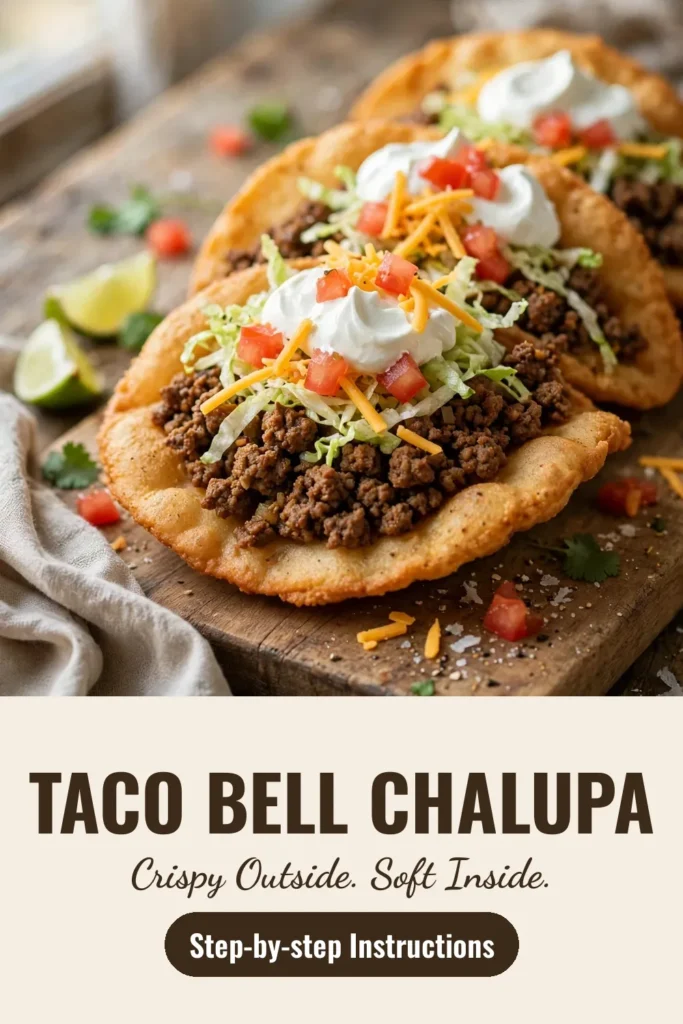
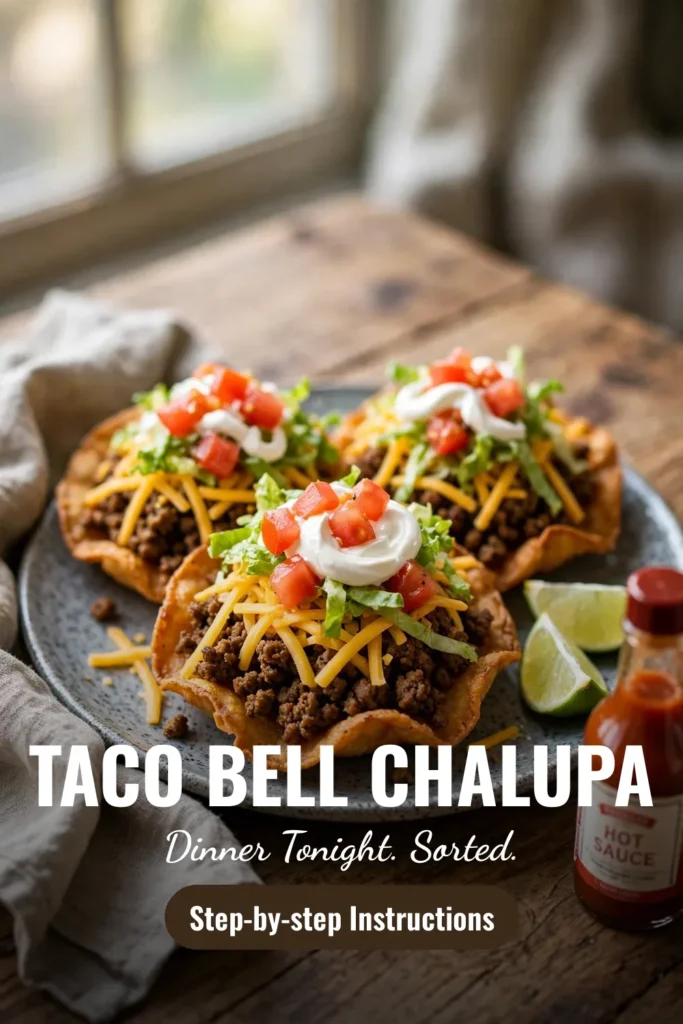
This copycat Taco Bell chalupa takes 35 minutes from the counter to the table, and the shell is the whole point: a homemade fried chalupa bread — flour, baking powder, warm milk and butter — rolled into disks, fried at 350°F until golden, and folded while it is still soft. The dough is five ingredients: 2½ cups of all-purpose flour, 1 tablespoon of baking powder, 1 teaspoon of table salt, 1 cup of warm whole milk, and 2 tablespoons of melted butter. Knead it 2–4 minutes, rest it 15 minutes, roll it into 6-inch disks, poke a few fork holes, and fry one disk at a time in oil heated to exactly 350°F. That is the recipe in one paragraph — and it is a copycat in the style of Taco Bell, never the exact Taco Bell chalupa. Taco Bell is a trademark of Yum! Brands, and our dough and our taco seasoning are our own recipes, not Taco Bell’s — this is a homemade version inspired by the drive-thru favorite, not the restaurant’s formula. The rest of this page is everything the search results never tell you: what temperature the oil actually needs to be, whether the dough needs to rest, what makes it “supreme”, why the shells puff or crack or go greasy, and how to feed four people with one batch.
You will love this:
- 35 minutes, one pot of oil. Fifteen minutes of prep (most of it the dough resting), twenty minutes of cooking — and no oven, no special equipment, nothing you don’t already own.
- 5-ingredient dough, pantry staples. Flour, baking powder, salt, milk, butter — the shell is bread, not a tortilla, and it tastes like it.
- Crispy outside, soft inside, better than the drive-thru. A golden shell that shatters when you bite it and stays pillowy in the middle, filled with seasoned beef and the full five toppings — made at home, with ingredients you can actually pronounce.
What Is a Chalupa?
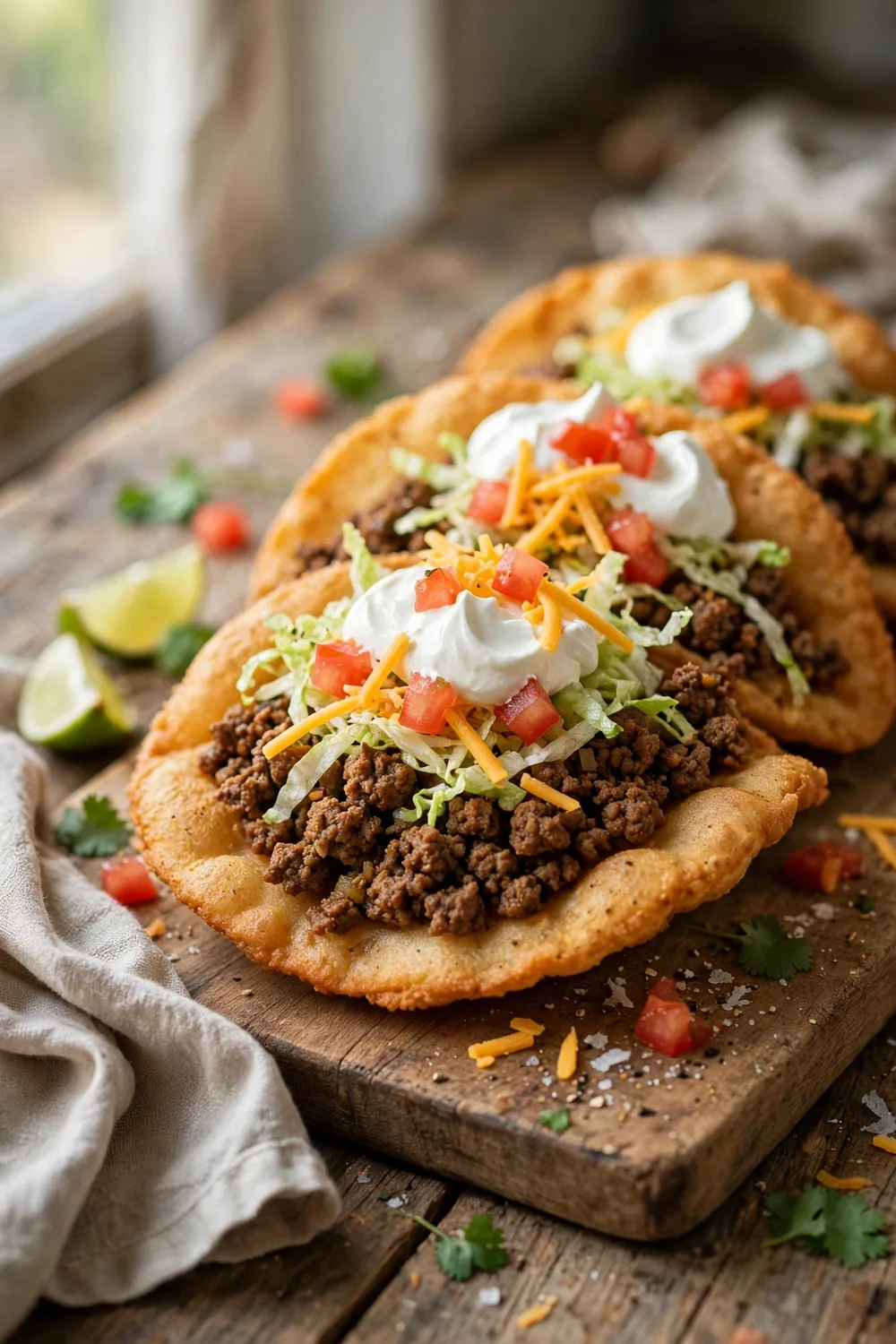
A chalupa is a fried shell filled with taco fillings — and the name is the first thing to know, because it tells you what the dish is supposed to look like. Chalupa is Spanish for “small boat”, and the shell is pressed into a concave shape that looks like a little boat. That is the traditional dish: a specialty of south-central Mexico — Hidalgo, Puebla, Guerrero, Oaxaca — where the chalupa is a small, thick, boat-shaped fried masa topped with only salsa, cheese and shredded lettuce. In Cholula, Puebla, the chalupas poblanas are exactly that: small fried masa rounds with salsa, cheese and lettuce, nothing else. In Hidalgo, the version is a flat fried corn tortilla topped with green chili sauce, potato purée, white cheese, pulled chicken, lettuce and radish. In Puebla, a “chalupa poblana” is a small flat tortilla served soft.
The version this page makes is the American one — the fast-food chalupa, and specifically a copycat of the Taco Bell Chalupa Supreme. It is a fried wheat-flour shell, thicker than a tortilla, filled with seasoned ground beef, sour cream, lettuce, tomato and cheese. It has more in common with Navajo frybread than with the traditional chalupa from Puebla — the shell is wheat flour, not masa, and it is folded in half like a taco instead of served flat like a boat. That is not a flaw in the recipe; it is what the dish became in the United States. Del Taco, in Rancho Cucamonga, California, is credited with bringing the chalupa to the United States in the early 1980s, and Taco Bell put chalupas on the national menu in 1999. This post is honest about that: it is a copycat of the fast-food style, not a traditional Mexican chalupa — and the history H2 below says so in full, because the distinction is the difference between a trustworthy recipe and a misleading one.
What Is Chalupa Bread?
Chalupa bread is the dough — and the dough is bread, not a tortilla, which is the whole reason the shell eats the way it does. The dough is flour, baking powder, warm milk and butter, mixed and kneaded and rolled into disks, then fried. The baking powder is the difference: it releases gas as the shell fries, which is what makes the shell puff up pillowy inside instead of going flat and crisp like a fried tortilla. A fried tortilla goes crisp all the way through. Chalupa bread stays thicker, puffier and softer in the center — almost like a cross between a taco shell and Indian fry bread, which is the closest cousin on the table (Belly’s H2 makes the same comparison: similar dough, but fry bread is served flat, never folded).
That is also why the shell is the keyword this page is built on. “Chalupa bread” is the question people type when they want to make the shell at home — and almost nobody on the search results answers it directly. Krystal’s Cooking has the only “chalupa bread” H2 on the SERP, and it is the best one there: the baking powder gives it lift, the shell stays soft inside, and a fried tortilla never will. Midwest’s page never has a chalupa-bread H2 at all — her dough is in the card and nowhere else. This page answers the question in this H2 and again in the dough guide below: chalupa bread is a quick bread, fried, with baking powder doing the lifting, butter doing the flavoring, and a 15-minute rest doing the relaxing. If you can make biscuit dough, you can make chalupa bread — and if you have ever wondered why a fried tortilla doesn’t taste like a chalupa, this is why.
The Ingredients, With Amounts
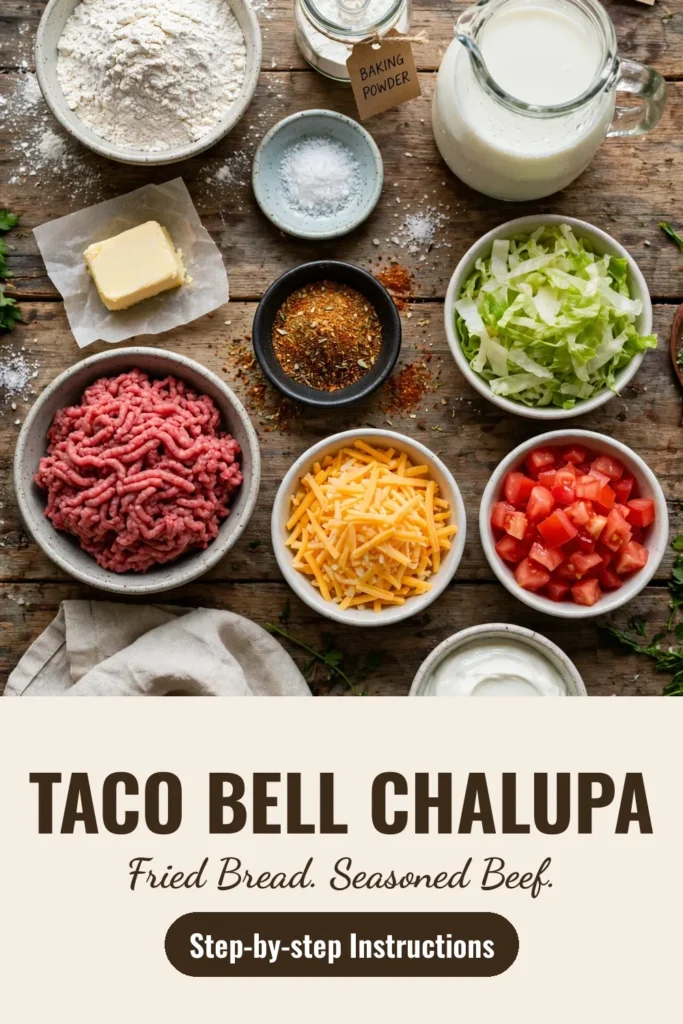
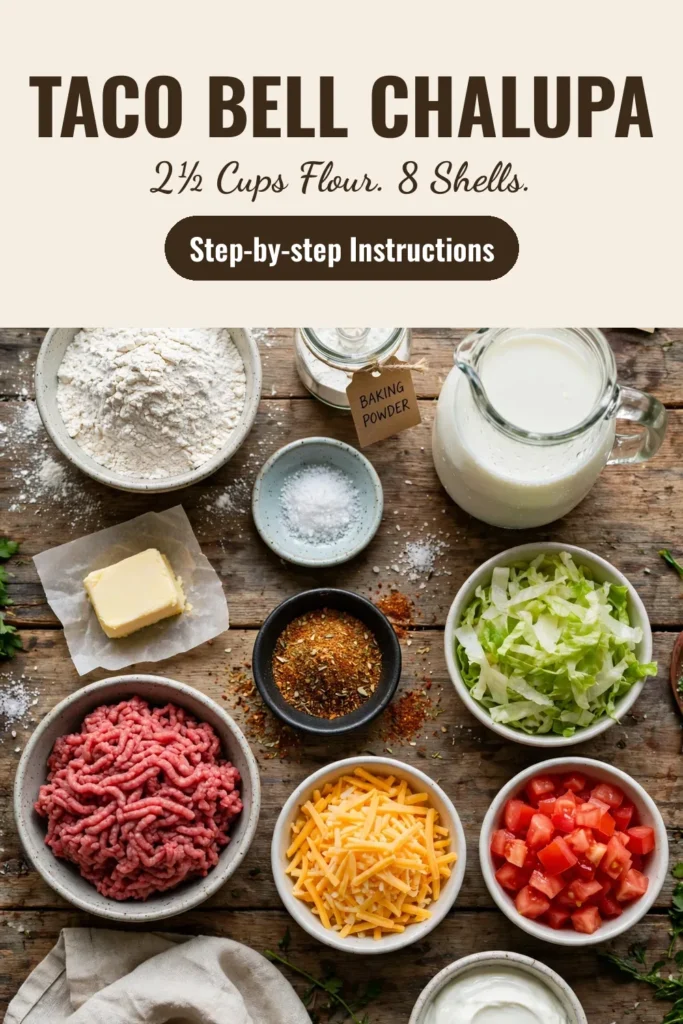
Midwest’s page lists the dough ingredients with NO amounts in the body text — a reader skimming the article cannot make the shell without scrolling to the recipe card. Here is every ingredient WITH its amount, and what each one is doing in the dish — because once you know the job of each ingredient, you can adjust the chalupa instead of guessing. This is also the answer to the question “what’s in a chalupa”: a five-ingredient dough, a five-ingredient filling, and the supreme five toppings.
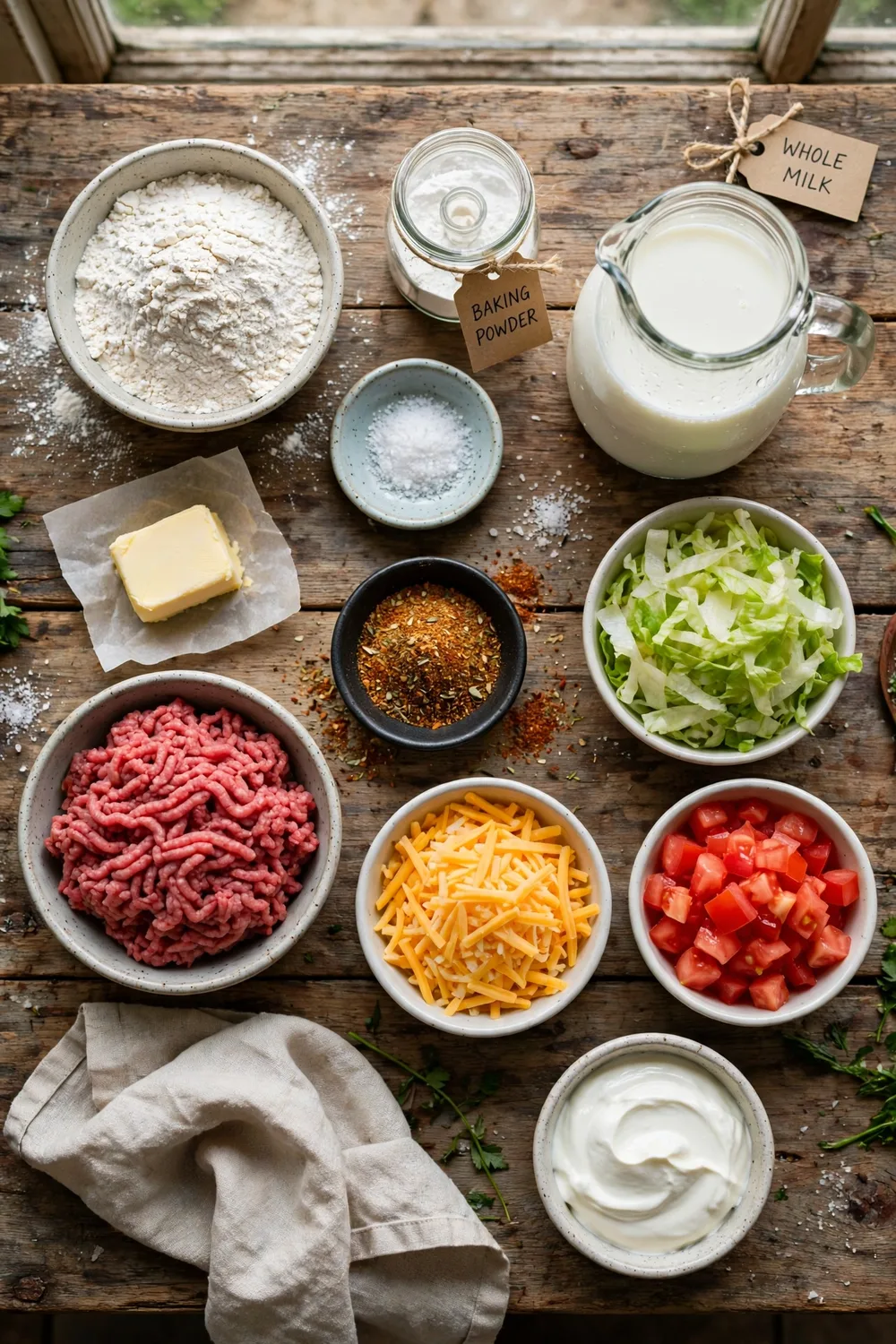
| Ingredient | Amount in our batch | What it does |
|---|---|---|
| All-purpose flour | 2½ cups | The structure. Flour is the body of the shell — the thing that fries into a golden, sturdy boat. Five of the seven pages on the SERP use exactly 2½ cups for 8 shells (see the dough guide below). |
| Baking powder | 1 Tbsp | The puff. Baking powder releases gas as the shell fries, which is what makes it pillowy inside instead of flat like a fried tortilla. The amount matters — too much tastes bitter and over-puffs the shell into a balloon (see the dough guide). |
| Table salt | 1 tsp | The seasoning. Table salt, not kosher — the smaller granules distribute evenly through the dough (Midwest’s tip, and it holds). One teaspoon seasons the whole batch; the shells get a second pinch of salt while they are still hot from the oil. |
| Whole milk, warmed | 1 cup | The binder. Warm milk brings the dough together — and it must be warm, because cold milk makes the melted butter seize into chunks (Midwest’s tip, and the one that saves the dough). Whole milk, not skim: the fat is part of the tenderness. |
| Unsalted butter, melted | 2 Tbsp | The flavor. Butter is the flavor fat — the golden, rich taste in the shell. Two tablespoons is Sabor’s amount, the richest dough on the SERP (see the fat split in the dough guide). |
| Canola or vegetable oil | ~2 inches deep, for frying | The fry medium. A neutral oil with a high smoke point, heated to exactly 350°F (see the frying H2). Not a card ingredient line in the usual sense — the method states it, and the card lists “canola oil, for frying” as Midwest does. |
| Ground beef (80/20) | 1 lb | The protein. One pound of 80/20 ground beef, browned and drained, seasoned with our taco seasoning. The 80/20 split is the right one: lean enough to drain cleanly, fatty enough to stay juicy. |
| Taco seasoning | 3 Tbsp | The flavor. Our own M11 Old El Paso-style blend — chili powder, cumin, smoked paprika, garlic, onion, oregano, salt, pepper, cornstarch, cayenne — 3 tablespoons + ½ cup water per pound of meat, simmered 3–4 minutes until thickened. Never a packet, never a link-out: the seasoning is in the card with its amount. |
| Water | ½ cup | The simmer. Half a cup of water with the seasoning, simmered until the sauce thickens and coats the beef. |
| Shredded cheddar cheese | 1 cup | The melt. One cup of shredded cheddar, sprinkled over the hot beef so it melts into the filling. Sharp cheddar for flavor; Monterey Jack if you want a longer pull. |
| Shredded lettuce | 1 cup | The crunch. The first of the supreme five toppings — cool, crisp, and the thing that keeps the chalupa from being all rich and warm. |
| Diced tomato | 1 large | The fresh note. The second of the supreme five — a large tomato, diced, for the sharp, juicy contrast. |
| Sour cream | ½ cup | The cool cream. The third of the supreme five — a dollop on top, or a drizzle, the cool counterpoint to the hot beef and the fried shell. |
| Refried beans (optional) | ½ cup | The base layer. Belly’s move: spread a thin layer of refried beans inside the shell first, before the beef. It makes the chalupa heartier and adds a creamy texture under the meat. Optional, not core — the base chalupa needs nothing else. |
| White sugar (optional) | 1 Tbsp | The browning helper. Krystal’s only — a tablespoon of white sugar in the dough, which helps the shells brown. Nobody else uses it, and Midwest browns fine without it. Optional, not required. |
That is the whole list — five dough items, five filling items, three toppings, and two optional lines, every one of them in the recipe card below with its amount. The dough is the recipe; the filling is the meal; the toppings are what makes it supreme. Nothing is linked out, nothing is left to another page.
The Chalupa Shell (The Dough Guide)
Every page on the SERP is the same fried-dough formula with only the fat, the rest, and one trick changing — and nobody resolves the splits. Here they are, resolved, because the dough is the whole question this page exists to answer.
| Split | What the pages say | Our rule |
|---|---|---|
| Baking powder | 1 Tbsp per 2½ cups (Midwest, Belly, FlavorFusion, Nerdalicious, ImHungryForThat) vs 2½ tsp per 2½ cups (Krystal’s) vs 1.5 Tbsp per 3 cups = 1¼ Tbsp per 2½ cups (Sabor) | 1 Tbsp per 2½ cups flour. Five of seven pages use it — that is the consensus. More is not better: too much baking powder tastes bitter and metallic, and it over-puffs the shell into a balloon (see troubleshooting). Krystal’s 2½ tsp is the light end (her shells are the least puffy on the SERP); Sabor’s 1¼ Tbsp is the heavy end (hers puff the most). |
| Fat in the dough | Butter (Midwest 1 Tbsp, Sabor 2 Tbsp, FlavorFusion 1 Tbsp, ImHungryForThat 1 oz) vs oil (Krystal’s 2 Tbsp vegetable oil, Belly 1 Tbsp oil) vs shortening (Nerdalicious 1 Tbsp vegetable shortening) | 2 Tbsp melted unsalted butter. The split is really about flavor vs tenderness: butter brings flavor (the golden, rich taste — Sabor’s “I love the rich flavor this adds”), oil brings a neutral tenderness (no flavor to burn), shortening brings flakiness (Nerdalicious’ fry-bread framing). Ours is Sabor’s amount — the richest dough on the SERP. Oil is the substitute (1–2 Tbsp) if you want a neutral shell or a dairy-free dough. Never shortening for a first-timer: it needs a pastry cutter’s touch and adds nothing butter doesn’t. |
| Dough rest | NO rest (Midwest — knead 1 minute, fry immediately) vs none mentioned (Belly) vs 15 min covered (Krystal’s) vs 15 min towel-covered (Sabor) vs 15–20 min (The Foodie Blogger) | Rest 15 minutes, covered. Three of the four freshest pages rest; the target doesn’t. The reason, stated plainly (Sabor’s line): resting lets the gluten relax, which makes the dough way easier to roll out — and the Foodie Blogger’s line: it helps the chalupas puff up nicely. Midwest’s no-rest is the outlier, and it is the reason her dough is the hardest to roll on the SERP (she kneads only 1 minute and goes straight to the pin — the dough fights back). |
| Knead time | ~1 min (Midwest) vs 2–4 min (Krystal’s) vs until soft (Belly) vs 1–2 min (Sabor) | Knead 2–4 minutes, until smooth and tacky, not sticky — and don’t overwork it. Belly’s rule: over-kneaded dough turns tough and chewy. One minute (Midwest) is not enough to bring the dough together; four minutes is the top end. Stop when it is smooth. |
| Sugar | None (Midwest, Belly, Sabor, FlavorFusion, Nerdalicious, ImHungryForThat) vs 1 Tbsp white sugar (Krystal’s) | Optional, 1 Tbsp. Krystal’s only, and she never says why. The honest answer: sugar helps browning, and it is not required — Midwest browns fine without it. Use it if you like a deeper golden shell; skip it if you don’t. |
Warm milk, always. Midwest’s tip, and the one that saves the dough: the milk must be warm (not hot — warm to the touch, about 100–110°F), because cold milk makes the melted butter seize into chunks the moment it hits the bowl. Warm the milk in the microwave for 30 seconds, or in a small pan until it steams lightly. If the butter does seize, the dough still works — knead it a minute longer and the chunks work themselves in — but warm milk from the start is the cleaner path.
Measure the flour right. Spoon the flour into the measuring cup and level it off with a knife — don’t scoop straight from the bag, which packs the flour down and adds as much as a quarter cup extra. Too much flour makes a stiff dough that won’t roll thin and won’t puff; too little makes a sticky dough that tears. The dough should be soft and tacky, not sticky: it holds together, it doesn’t cling to your hands, and it feels “pliable, kind of like an earlobe” (Sabor’s line, and the best dough-feel description on the SERP).
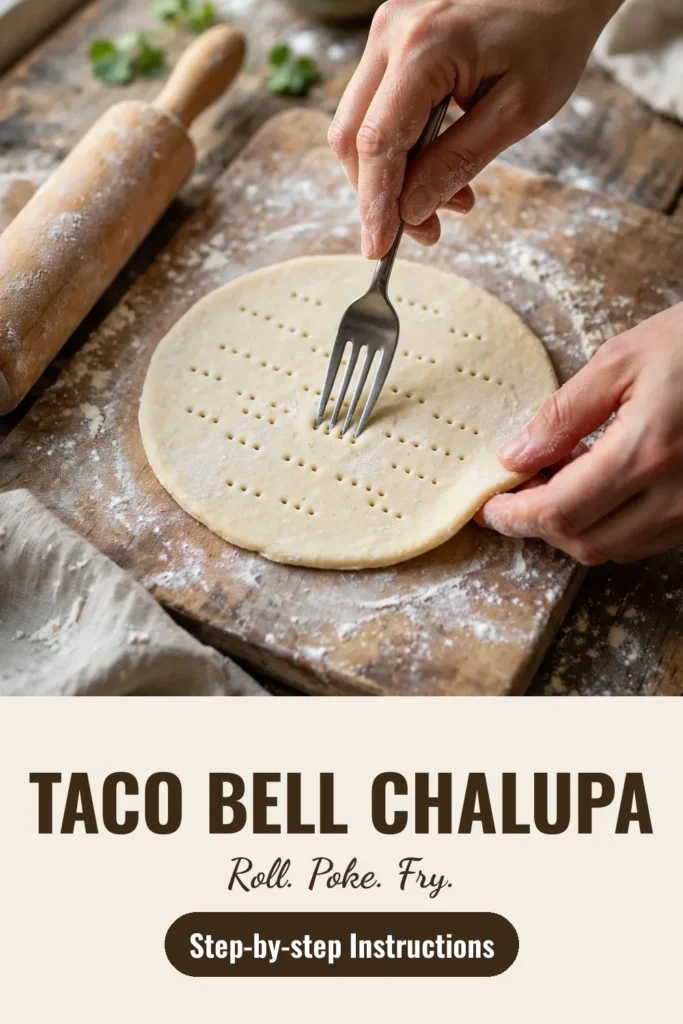
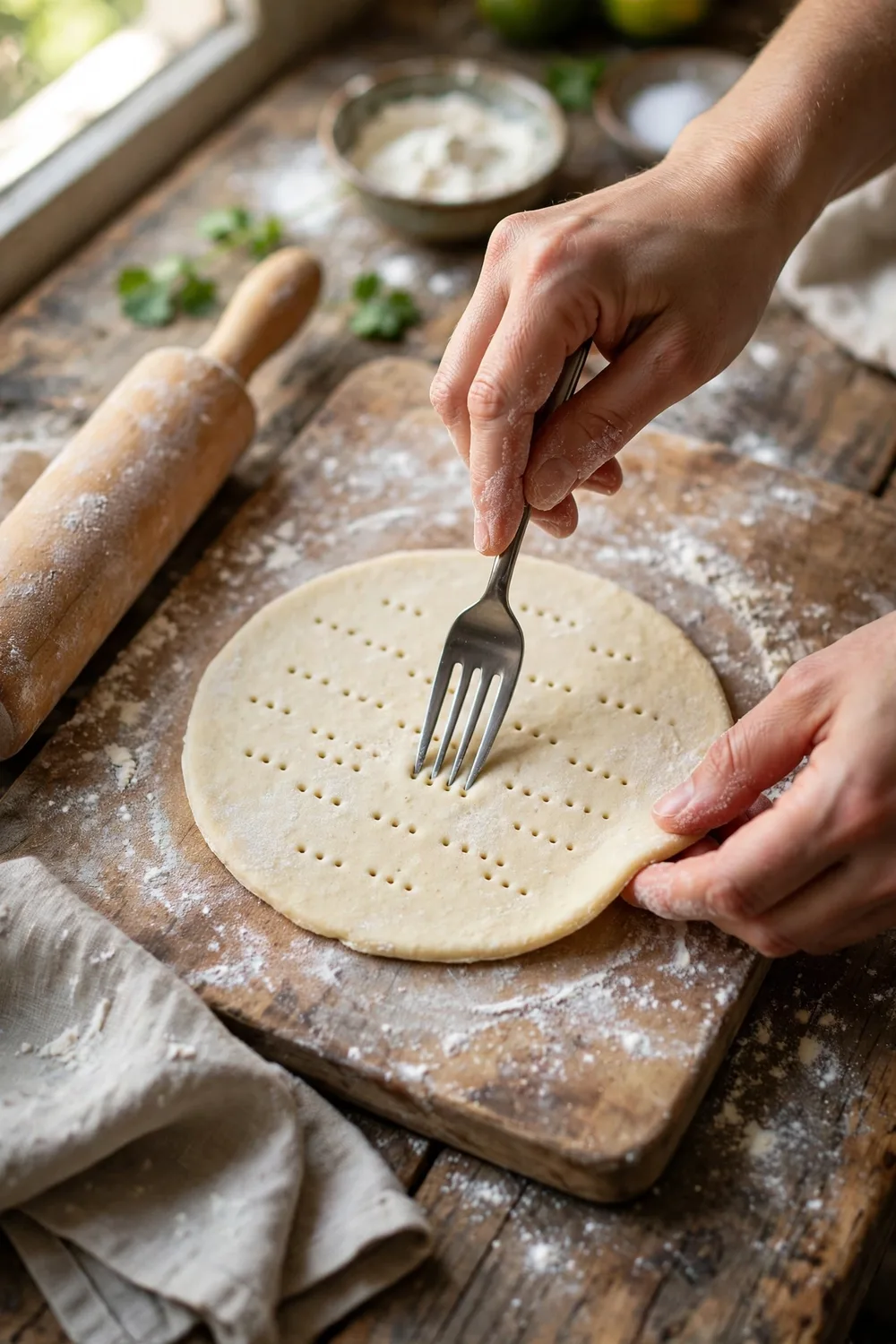
The fork holes. Four of the five pages that address it poke holes; Midwest is the only one that doesn’t. The rule: poke a few fork holes in each disk before frying. The holes let steam escape in small amounts instead of one big bubble, so the shell puffs evenly into a pocket instead of ballooning into a ball. The frying H2 below has the full sequence.
The Recipe — Our Chalupa Supreme (8 Chalupas, 35 Minutes)
This is a chalupa recipe in the truest sense: five minutes of mixing, fifteen minutes of resting, twenty minutes of frying and filling — and the batch makes 8 chalupas, which is 4 servings of 2 each, the most useful batch size on the search results, because every page on the SERP yields 8 and nobody explains how to scale it. The dough is the five items from the ingredients H2 above, in the same proportions. The filling is the full one: a pound of ground beef, our own taco seasoning, water, cheddar, and the supreme five toppings. Nothing is linked out — the beef, the seasoning and the cheese are all in the card with their amounts, which is the one thing Midwest’s page never does.
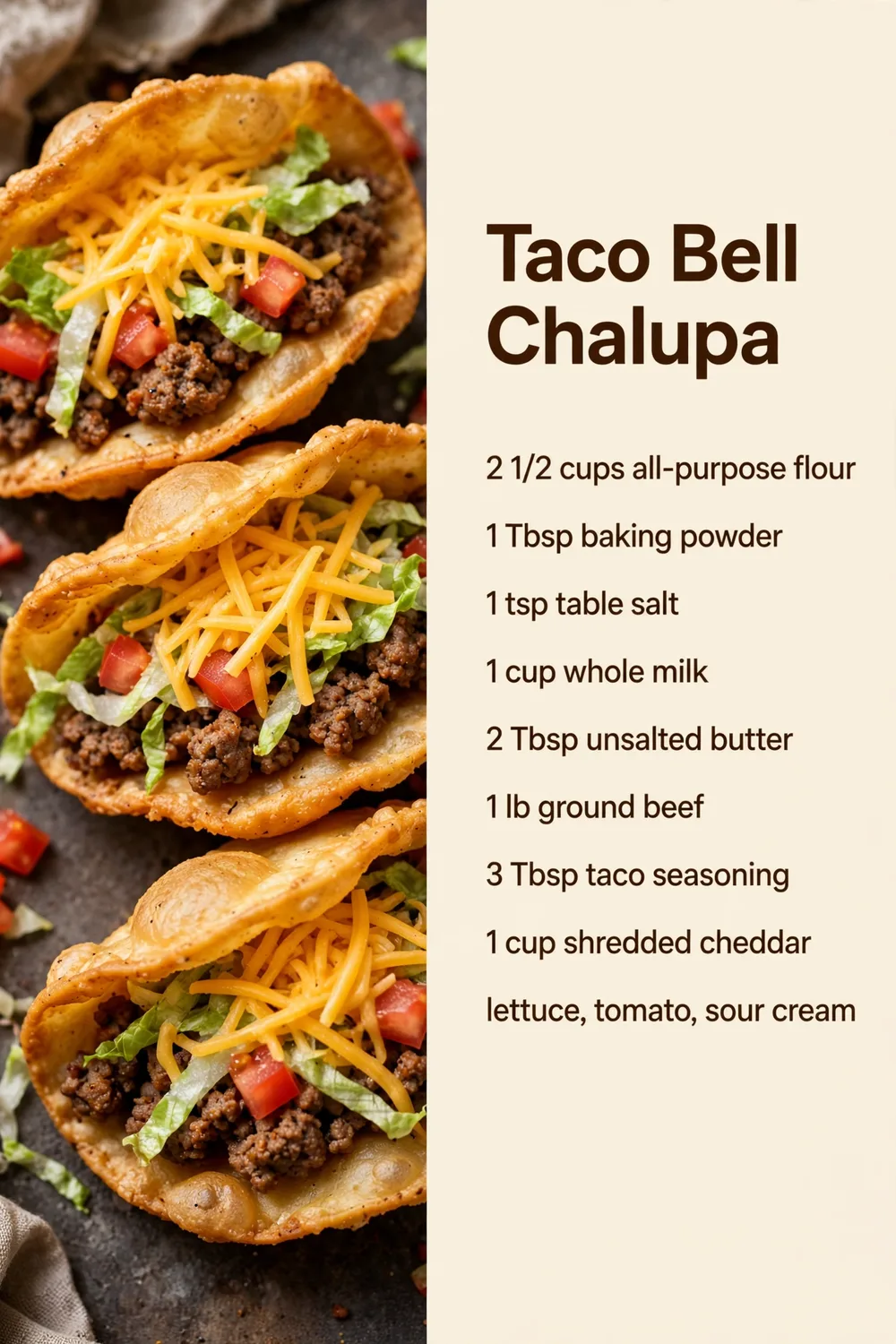
- 2½ cups all-purpose flour
- 1 Tbsp baking powder
- 1 tsp table salt
- 1 cup whole milk, warmed
- 2 Tbsp unsalted butter, melted
- Optional: 1 Tbsp white sugar (helps browning, not required)
- Canola or vegetable oil, about 2 inches deep, for frying
- 1 lb ground beef (80/20)
- 3 Tbsp taco seasoning (our M11 Old El Paso-style blend)
- ½ cup water
- 1 cup shredded cheddar cheese
- 1 cup shredded lettuce
- 1 large tomato, diced
- ½ cup sour cream
- Optional: ½ cup refried beans (spread thin inside the shell first)
How to make it: (1) Whisk the flour, baking powder and salt (and the sugar, if using) in a large bowl. (2) Stir in the warm milk and melted butter; knead 2–4 minutes on a lightly floured surface until smooth and tacky, not sticky — don’t overwork it (Belly’s rule: over-kneaded dough turns tough and chewy). (3) Cover the dough and rest it 15 minutes — the gluten relaxes, so the dough rolls without springing back. (4) Divide into 8 balls; roll each into a 6-inch disk, ⅛-inch thick; poke a few fork holes in each disk. (5) Heat about 2 inches of oil to 350°F; fry ONE disk at a time — 15 seconds to puff, fold in half with tongs, hold the folded shape 30 seconds so it sets, fry about 2 minutes total until golden; drain on a wire rack and salt lightly while hot; shape over a wooden spoon handle if needed (Midwest’s trick — hang the shell over a spoon handle draped over a bowl while you fry the next one). (6) Brown the beef in a skillet, drain the fat, add the taco seasoning and ½ cup water, simmer 3–4 minutes until thickened. (7) Fill each warm shell with beef, then cheddar, lettuce, tomato, sour cream — in that order (Nerdalicious’ order: the cheese goes on the hot beef so it melts, the lettuce and tomato go on top so they stay cool and crisp); serve immediately while the shells are warm.
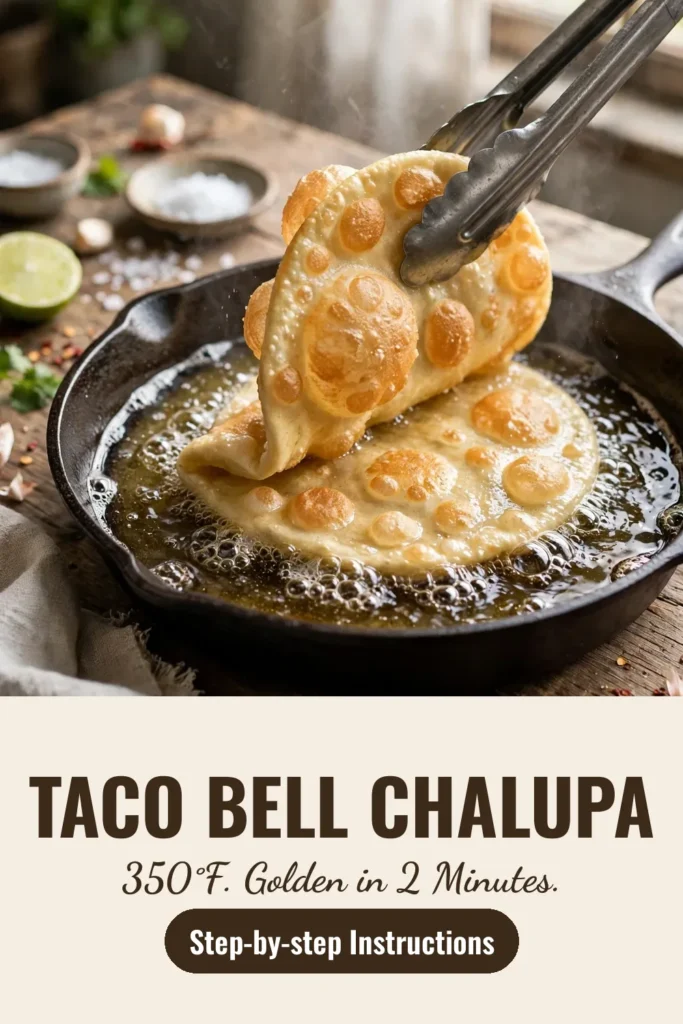
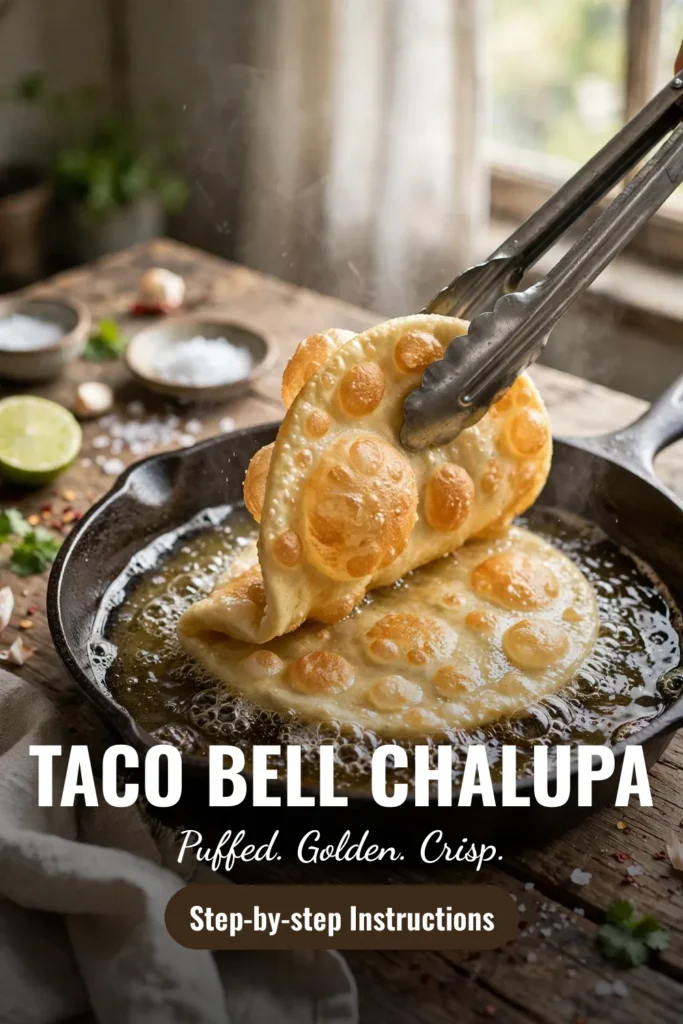
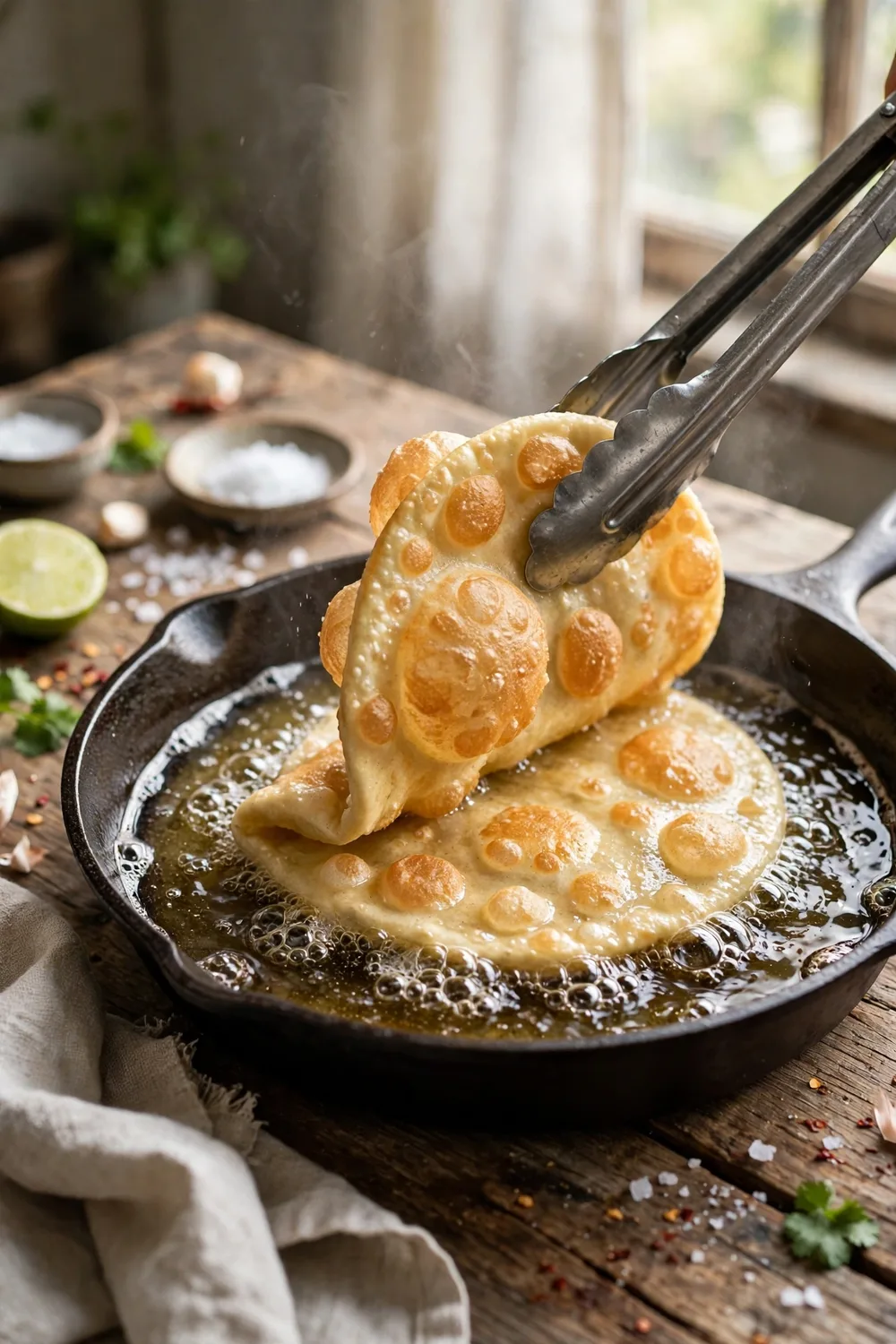
The fold, while the shell is soft. This is the one move that decides whether the chalupa holds its shape: fold in the first 15–30 seconds, while the shell is still soft and pliable. Once it is crisp, it cracks — Krystal’s warning, and the one that matters most on the whole page. Slide the disk into the oil, wait for the puff (about 15 seconds), fold it in half with tongs, and hold the folded shape for 30 seconds so it sets. If the fold is hard, the shell is already too crisp — cook it flat like a tostada instead (Midwest’s fallback, and a good one: a flat fried shell with the same filling is a tostada, and nobody at the table will complain).
Scaling the batch. Midwest yields 8 with no scaling note. Sabor has the only scaling table on the SERP (8/15/30). Here it is, in our proportions — the amounts scale straight, and the fry time per shell stays the same (about 2 minutes each), so a bigger batch just takes longer at the stove.
| Shells | Flour | Baking powder | Table salt | Butter | Warm milk | Ground beef |
|---|---|---|---|---|---|---|
| 8 (this recipe) | 2½ cups | 1 Tbsp | 1 tsp | 2 Tbsp | 1 cup | 1 lb |
| 15 | 4¾ cups | 2 Tbsp | 2 tsp | 3¾ Tbsp | 1⅞ cups | 2 lb |
| 30 | 9½ cups | 4 Tbsp | 1 Tbsp + 1 tsp | 7½ Tbsp | 3¾ cups | 4 lb |
The copycat framing, honestly. It tastes like the drive-thru version, made at home in 35 minutes, with ingredients you can actually pronounce — and it is a copycat in the style of Taco Bell, never the exact Taco Bell chalupa. Taco Bell is a trademark of Yum! Brands, and our dough and our taco seasoning are our own recipes, not Taco Bell’s — the dough is flour, baking powder, salt, warm milk and butter in our own proportions, and the seasoning is our own Old El Paso-style blend from the M11 post, not Taco Bell’s formula. The variation is a homemade version inspired by the drive-thru favorite. No logo, no packet photo, no trade dress anywhere — the shells are on our own plate, and the sauce is in a plain bowl.
Frying the Shells (The 350°F Rule)
Midwest says “medium heat” and never gives a number. Belly and Sabor do the same. Krystal’s, Nerdalicious, Razzle Dazzle and Amigo Foods give 350°F — and that number is the whole H2, because it is the one thing the target page never tells you.
350°F, measured with a thermometer. The rule: heat about 2 inches of canola or vegetable oil to 350°F and hold it there, measured with a frying thermometer (Amigo Foods’ line — a thermometer is the only way to know). “Medium heat” is not a temperature: medium on one stove is 300°F and on another is 400°F, and the shell knows the difference even if you don’t. A candy or frying thermometer clipped to the pot is the cheapest insurance on this page — and the oil temperature will drop every time a cold disk goes in, so check it between shells and let it come back up to 350°F before the next one goes in.
The shimmer/sizzle test (no thermometer). Sabor’s fallback, and the only one on the SERP: the oil is ready when it shimmers, or when a tiny piece of dough dropped in sizzles right away and floats to the top. If the dough sinks and sits there, the oil is too cool. If it darkens in seconds, the oil is too hot. The test works — but a thermometer works better, and it costs less than the beef in this recipe.
Too cool = greasy shells. Krystal’s failure mode, stated plainly: oil below 350°F doesn’t seal the outside of the shell fast enough, so the dough drinks oil instead of frying in it. A greasy shell is heavy, soggy, and tastes like the oil — and no amount of draining fixes it, because the oil is inside the dough, not on it. If your shells come out greasy, the oil was too cool. Turn the heat up, wait for 350°F, and fry the next one.
Too hot = dark outside, raw inside. Krystal’s other failure mode: oil above 350°F browns the outside before the inside cooks through, so the shell is dark and bitter on the outside and doughy in the middle. Belly’s version of the same rule: medium heat only — too much hotter and they burn. If your shells are dark in under a minute, the oil is too hot. Turn the heat down, wait for 350°F, and fry the next one.
One shell at a time. Midwest and Belly both say it, and the reason is the temperature: every cold disk drops the oil temperature, and two disks at once drop it twice as far. One at a time keeps the oil at 350°F and every shell the same golden color. It is slower — about 2 minutes a shell, 16 minutes for the batch — but it is the difference between eight matching shells and eight different ones.
The fry sequence, start to finish. Slide one disk into the 350°F oil — it floats and puffs almost instantly. Wait 15 seconds for the puff. Fold it in half with tongs and hold the folded shape for 30 seconds so it sets. Fry about 2 minutes total, flipping once, until golden all over. Lift it out with the tongs, drain it on a wire rack (not a plate — a plate pools the oil underneath and the bottom goes soggy), and salt it lightly while it is still hot (Krystal’s step — the salt sticks to the hot oil and seasons the shell). Shape it over a wooden spoon handle if it needs help holding the fold (Midwest’s trick). Then the next disk, same way, same temperature.
Chalupa vs Taco vs Tostada vs Fry Bread
Midwest’s taco comparison is one paragraph. Belly has the only fry-bread H2. The tostada is never compared anywhere. Here is the table, because the four dishes look alike in a photo and eat nothing alike — and because “chalupa shells” (2,900/mo) and “chalupa shell” (4,400/mo) are the volume lanes this H2 catches.
| Dish | Shell | Texture | Shape | Toppings |
|---|---|---|---|---|
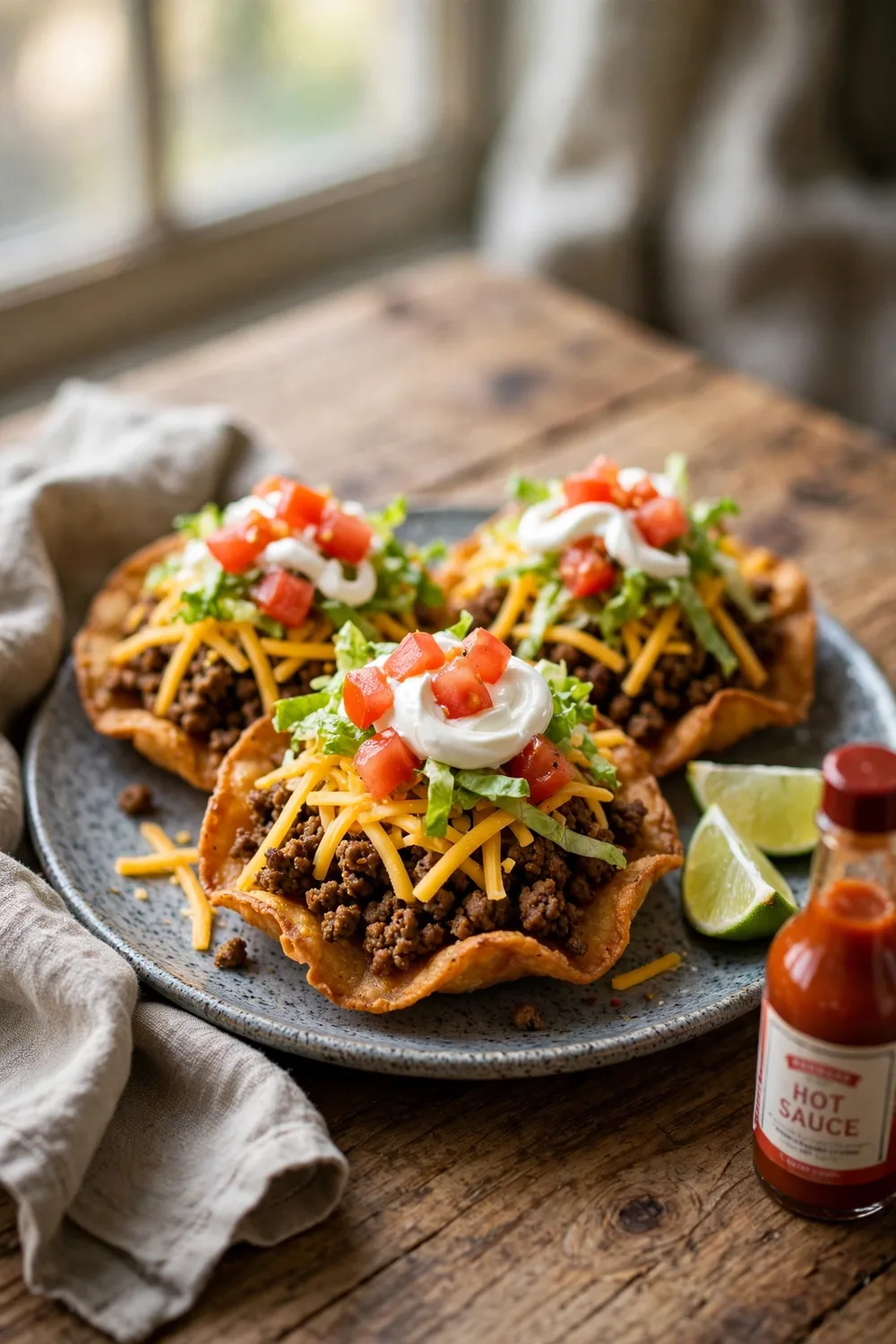
| Chalupa | Thick fried wheat-flour bread — flour, baking powder, warm milk, butter | Crispy outside, soft and pillowy inside | Boat-shaped, folded in half while frying | Seasoned beef, sour cream, lettuce, tomato, cheese (the supreme five) |
| Taco | Thin corn or flour tortilla, soft or crisp | Soft and pliable, or crisp throughout | Folded in half, flat | Seasoned meat, lettuce, tomato, cheese, salsa |
| Tostada | Flat fried corn tortilla | Crisp all the way through, never soft | Flat, never folded | Beans, meat, lettuce, cheese, salsa — piled on top |
| Navajo fry bread | Fried dough — flour, baking powder, salt, water or milk | Crispy outside, chewy inside | Served flat, never folded | Honey, powdered sugar (sweet) or taco toppings (savory) |
The chalupa is the only one of the four that is a bread: the baking powder is what makes it puff and stay soft inside, and that is the difference a fried tortilla can never copy. A taco shell is a tortilla. A tostada is a fried tortilla, flat. Fry bread is the chalupa’s closest cousin — similar dough, similar fry — but it is served flat, never folded, and the chalupa is folded while it is still soft in the oil. If your shell comes out flat and crisp all the way through, you made a tostada. If it comes out thick and pillowy inside, you made a chalupa.
The Filling — Seasoned Ground Beef (What Makes It “Supreme”)
“Supreme” means the full five. A regular chalupa — the Taco Bell menu’s plain chalupa, or the traditional one from Puebla — has fewer toppings. A Chalupa Supreme has all five: seasoned ground beef, sour cream, shredded lettuce, diced tomato, and shredded cheese. That is the whole definition, and it is the reason the title says “Supreme”: the five toppings together, in that order, on a warm shell. Leave one off and it is still a chalupa — but it is not supreme.
The beef, in the card, with amounts. Midwest’s card lists “the best taco meat” with no amounts and links out to a separate page. Belly’s card has no meat at all. Sabor’s meat is a one-line variation. Our card is self-contained: 1 lb of ground beef (80/20), 3 tablespoons of our own taco seasoning (the M11 Old El Paso-style blend — chili powder, cumin, smoked paprika, garlic, onion, oregano, salt, pepper, cornstarch, cayenne), and ½ cup of water. Brown the beef in a skillet over medium-high heat, breaking it up as it cooks; drain the fat; add the seasoning and the water; simmer 3–4 minutes until the sauce thickens and coats the beef. That is the whole filling — and the seasoning is our own recipe, linked to the M11 post, not a packet and not a link-out to someone else’s page.
The topping order. Nerdalicious’ order, and the one that works: beef first, then cheddar, then lettuce, then tomato, then sour cream. The cheese goes on the hot beef so it melts into the filling. The lettuce and tomato go on top so they stay cool and crisp. The sour cream goes on last, as a dollop or a drizzle, so it doesn’t slide off. Fill just before serving — a filled chalupa waits for nobody, and the shell goes soggy if it sits (see troubleshooting).
The refried-beans base layer. Belly’s move, and the one that makes the chalupa heartier: spread a thin layer of refried beans inside the shell first, before the beef. The beans are the creamy texture under the meat, and they glue the filling to the shell so nothing slides out when you bite it. Optional, not core — the base chalupa needs nothing else — but if you want the heartiest version on this page, this is it.
Variations — Chicken, Steak, Veggie, Breakfast, Spicy, Bean
One base shell, six versions — because the shell earns its place in the rotation by being the one dinner that fits every household, not just one. The dough stays the same in every version; the filling is the only thing that changes, and the filling goes INSIDE the warm shell, in the same order, before the toppings.
| Version | Swap | Notes |
|---|---|---|
| Chicken supreme | 2 chicken breasts, cooked in a skillet with olive oil 5–7 min a side to 165°F, then shredded | ImHungryForThat’s lane — the only chicken variation on the SERP. Shred the chicken, season it with the same taco seasoning, and fill the shell the same way. |
| Steak | Sliced cooked steak + sautéed peppers and onions | The steak wants a bolder cheese — cheddar + pepper Jack instead of plain cheddar. “Steak chalupa recipe” is a small lane (50/mo); this H2 catches it as an angle, not a target. |
| Veggie | Black beans + queso, Sabor’s base | 2 cups black beans, ¾ cup queso sauce, ¾ cup shredded cheese (Pepper Jack). The beans are the protein; the queso is the melt. No meat, no compromise. |
| Breakfast | Scrambled eggs + crumbled bacon + cheddar | The morning chalupa: eggs and bacon in the shell, cheddar on top, sour cream and salsa on the side. The shell is the same; the filling is breakfast. |
| Spicy | Pepper Jack + sliced jalapeños + hot sauce | Pepper Jack instead of cheddar, jalapeños in the filling, hot sauce on top. The shell doesn’t change — the heat does. |
| Bean | Refried beans as the protein | The beans ARE the filling, not the base layer: a thick spread of refried beans, then cheese, lettuce, tomato, sour cream. The vegetarian version that eats like a meal. |
| Pork carnitas | Shredded pork + salsa verde + cotija | Krystal’s lane: slow-cooked pork, salsa verde instead of sour cream, cotija instead of cheddar. The shell is the same; the toppings go Mexican, not Tex-Mex. |
What to Serve With It
Midwest lists seven dips with no amounts or notes. Krystal’s and Sabor have better lists. Here is the full H2, with our Avocado Sauce post as the lead — the same dish Midwest links to as her own avocado sauce, and the same dish as our M12 post — plus the build-your-own chalupa bar, which is Sabor’s idea and the best way to serve this dish to a crowd.
- Avocado sauce. The lead dip, and the right one — our Avocado Sauce for Tacos, creamy and 5 minutes, no cooking. It is the dip Midwest herself links to as her own avocado sauce, and it is the dip this chalupa was built for. A spoonful on the side, or spread inside the shell before the beef.
- Sour cream. Already on the chalupa, but a bowl on the table too — the cool counterpoint, and the thing the table reaches for first.
- Salsa or pico de gallo. The fresh counterpoint. A spoonful of salsa or pico de gallo is the fresh, sharp note the rich beef and the fried shell need.
- Guacamole. The rich dip. Guacamole beside the plate does the same job as the avocado sauce with more texture — and it is the thing the kids fight over.
- Hot sauce. The heat. A few drops of hot sauce on the finished chalupa is the Friday-night version — the heat that sits on top of the filling instead of inside it.
- Mexican rice. The side that makes it dinner. A scoop of Mexican rice beside the plate turns two chalupas into a meal, and it is the side Krystal’s lists first.
- Refried beans or black beans. The protein side. A spoonful of refried beans or black beans is the side that makes the plate filling without a third chalupa.
- Street corn (elote). The sweet side. Grilled corn with lime and chili — elote — is the side Sabor lists, and it is the right one: sweet, smoky, and the thing that balances the fried shell.
- Chips + salsa + queso. The table snack. Tortilla chips with salsa and queso while the shells fry — the shells take 16 minutes, and the table needs something to eat while it waits.
The build-your-own chalupa bar. Sabor’s idea, and the best way to serve chalupas to a crowd: fry the shells, put them in a basket lined with a towel, and set out the beef, the cheese, the lettuce, the tomato, the sour cream, the beans, the salsa and the hot sauce in separate bowls. Everyone builds their own — and the fun of the dish is the customization, not the assembly. The shells stay crisp in the basket, the toppings stay cold in their bowls, and nobody’s chalupa goes soggy while they wait.
Baked + Air-Fryer Shells (The No-Fry Option)
Midwest is fry-only. The baked method exists on the SERP — FlavorFusion bakes at 400°F for 10–12 minutes, flipping halfway; ImHungryForThat bakes at 375°F for 10–12 minutes, flipping halfway — but the target page never mentions it. Here it is, with the honest trade-off stated plainly.
Baked shells: 400°F, 10–12 minutes, flip halfway. Roll the disks the same way (6-inch, ⅛-inch thick, fork holes), brush them lightly with oil, and bake on a sheet pan at 400°F for 10–12 minutes, flipping halfway through. They come out golden and crisp — but FlavorFusion’s line is the honest one, and it goes in this H2 verbatim in spirit: baking won’t achieve the same crispiness. A baked shell is lighter, drier, and less pillowy than a fried one, because the oil is what makes the shell puff and crisp at the same time. If you don’t want to fry, baked is the best alternative — and it is still a good chalupa. It is just not the same chalupa.
Air fryer: for reheating, not for making. The air fryer is the best way to reheat a shell (350°F, a few minutes, until crispy again — Sabor’s + Krystal’s rule), and it is a workable way to crisp a baked shell. It is not the way to make a raw shell from scratch: the dough needs the oil to puff, and the air fryer dries it out before it puffs. Use the air fryer for leftovers, not for the first batch.
The canned-biscuit-dough shortcut. ImHungryForThat’s lane, and the only shortcut on the SERP: canned biscuit dough, rolled out and fried the same way, “works surprisingly well”. It does — and it is the fastest path to a chalupa on a weeknight. But their line is the honest one too: the homemade fried shell is what makes this recipe a true copycat. The biscuit dough is a shortcut to a shell; the five-ingredient dough is the shell. Use the shortcut when you need dinner in 15 minutes; make the dough when you want the real thing.
Make Ahead, Storage, Freezing & Reheating
Midwest says don’t make the shells ahead — best fresh. Belly says the dough keeps in the fridge for a week. Sabor says the dough keeps 24 hours. Krystal’s says the shells keep at room temperature short-term and the beef keeps 3–4 days in the fridge. Four pages, four answers — and the honest middle is the one this H2 gives, with the reason for each number.
Make ahead: the dough, not the shells. The dough is the make-ahead part: wrap it tightly and keep it in the fridge for up to 3 days (Belly says a week; Sabor says 24 hours — 3 days is the honest middle, and the dough is still easy to roll after 3 days). Bring it to room temperature before rolling — cold dough fights the pin, warm dough rolls. The shells are NOT the make-ahead part: they are best fresh and warm, and a shell made an hour ago is a shell that has gone soft. If you must make them ahead, fry them, cool them on a wire rack, and reheat them in a 350°F oven or air fryer for a few minutes until crispy again (Sabor’s + Krystal’s rule).
Storage: components separately, always. Krystal’s rule, and the one that saves the leftovers: store the shells, the beef and the toppings in separate containers, so the shells don’t go soggy. Shells keep on the counter for 1 day in an airtight container, or in the fridge for 3 days (Belly says 5–7 days in the fridge; 3 days is the honest number for a fried shell that stays crisp). Beef keeps in the fridge for 3–4 days. Toppings keep in their own containers — salsa and sour cream never on the shell, or the shell goes soggy in the fridge.
Freezing: the dough, not the shells. Midwest’s rule: freeze dough balls OR rolled disks with parchment between them, up to 3 months. The parchment is the trick: without it, the disks freeze together into a block, and you cannot take one out without thawing them all. Krystal’s version: wrap the dough tightly, thaw it in the fridge, and bring it to room temperature before rolling. Freeze the dough, never the filled chalupa — a filled chalupa does not survive the freezer, and a frozen shell reheats soft no matter what you do.
Reheating: oven or air fryer, never the microwave. Sabor’s line, stated with emphasis because it is the one rule every page agrees on: whatever you do, don’t microwave them — they will just get soft and chewy. Reheat the shells in a 350°F oven or air fryer for a few minutes until crispy again (Sabor + Krystal’s). Belly’s version: a 200°F oven for about 5 minutes. Reheat filled chalupas in a 350°F oven until warmed through (Midwest). The microwave melts the cheese and leaves the shell soft, and a microwaved chalupa is soggy in a way no reheat fixes.
Troubleshooting — 5 Fixes
Nobody on the search results has this section. Every page is the same fried-dough dump with the filling changed; none of them explains what happens when it goes wrong. Here are the five failures, why they happen, and how to fix them.
Shells won’t puff
Why: the oil is too cool — below 350°F the dough doesn’t seal and puff fast enough; or the baking powder is old — it loses power over time, so check the date on the tin; or the dough was rolled too thin, so there is nothing to puff. Fix it now: turn the heat up to 350°F and fry the next shell — the one in the pan won’t recover, so eat it flat like a tostada and move on. Next time: check the oil with a thermometer (350°F, not “medium heat”), check the baking powder date, and roll the disks ⅛-inch thick, not thinner.
Shells puff too much / balloon
Why: no fork holes — the steam has nowhere to go, so it blows the shell up into one big bubble. Fix it now: press the balloon down gently with the tongs while it is still in the oil — it will deflate into a pocket. Next time: poke a few fork holes in each disk before frying (Krystal’s, Belly’s and Sabor’s rule — the holes let steam escape in small amounts instead of one big bubble). Too much baking powder does the same thing: 1 tablespoon per 2½ cups is the rule, and more is not better.
Greasy shells
Why: the oil was below 350°F — the shells drank oil instead of frying in it. Fix it now: drain the greasy shells on a wire rack, not a plate, so the oil drips off instead of pooling underneath — and eat them warm, because a greasy shell only gets worse as it cools. Next time: wait for 350°F before the first disk goes in, and let the oil come back up to 350°F between shells. One shell at a time keeps the temperature up; two at once drops it twice as far.
Shells crack when folding
Why: folded too late — the shell was already crisp, and a crisp shell cracks instead of bending. Fix it now: there is no way to un-crack a shell — serve it flat like a tostada, or fold it the other way and call it a melt. Next time: fold in the first 15–30 seconds, while the shell is still soft and pliable (Krystal’s warning — once crisp it cracks). If the fold is hard, the shell is already too far gone.
Shells go soggy
Why: filled too early, or the toppings were stored on the shell, or the shells were stacked while warm — steam makes them soggy, and a filled chalupa waits for nobody. Fix it now: put the soggy shell back in a 350°F oven or air fryer for a few minutes until it crisps again — the oven is the only fix that works, and the microwave is not (it goes soft and chewy). Next time: fill just before serving, store the components separately (Krystal’s rule), and cool the shells on a wire rack, never stacked on a plate.
The Chalupa, in 150 Words
The chalupa is older than Taco Bell and younger than the tortilla press. The name is Spanish for “small boat”, because the fried masa is pressed into a concave container resembling a boat. It comes from south-central Mexico — Hidalgo, Puebla, Guerrero, Oaxaca — where the traditional chalupa is a small, thick, boat-shaped fried masa topped with only salsa, cheese and shredded lettuce. In Cholula, Puebla, the chalupas poblanas are exactly that. In Hidalgo, the version is a flat fried corn tortilla with green chili sauce, potato purée, white cheese, pulled chicken, lettuce and radish. In Puebla, a “chalupa poblana” is a small flat tortilla, served soft. In the United States, the chalupa is a fried wheat-flour shell with more in common with Navajo frybread than with the traditional dish. Del Taco brought it to the US in the early 1980s; Taco Bell put it on the national menu in 1999. The shell is new. The boat is not.
Frequently Asked Questions
What is chalupa bread?
Fried dough — flour, baking powder, warm milk and butter, rolled into disks and fried at 350°F. It is bread, not a tortilla: the baking powder gives it lift as it fries, so the shell stays thicker, puffier and softer in the center. The chalupa-bread H2 above has the full answer.
What is a chalupa shell made of?
Flour, baking powder, salt, warm milk and butter — 2½ cups of flour, 1 tablespoon of baking powder, 1 teaspoon of table salt, 1 cup of warm whole milk, 2 tablespoons of melted butter. The ingredients H2 above lists every ingredient with its amount.
What is the difference between a taco and a chalupa?
The shell. A taco is a thin corn or flour tortilla, soft or crisp, folded flat. A chalupa is a thick fried wheat-flour bread, crispy outside and soft inside, folded while it fries. The comparison H2 above has the full table.
Is a chalupa the same as fry bread?
Close cousins, not the same thing. The dough is similar — flour, baking powder, salt, liquid, fried in oil — but fry bread is served flat, never folded, and the chalupa is folded in half while it is still soft in the oil. Belly’s H2 makes the same comparison.
Why does the dough need baking powder?
The puff. Baking powder releases gas as the shell fries, which is what makes it pillowy inside instead of flat like a fried tortilla. Without it, the shell is a fried disk — crisp, thin, and nothing like a chalupa. The dough guide H2 above has the full split, resolved.
Why do I poke holes in the dough?
To control the puff. The holes let steam escape in small amounts instead of one big bubble, so the shell puffs evenly into a pocket instead of ballooning into a ball. Krystal’s, Belly’s and Sabor’s rule — Midwest is the only page that doesn’t do it, and her shells are the ones that balloon.
Can I use flour tortillas instead?
You can fry them, but they won’t have the thick, fluffy texture — Krystal’s FAQ, and it holds. A fried tortilla goes crisp all the way through; chalupa bread stays soft inside. If you use a tortilla, you made a tostada, not a chalupa.
Can I bake the shells instead of frying?
Yes — 400°F for 10–12 minutes, flipping halfway (or 375°F for 10–12 minutes). But baking won’t achieve the same crispiness: a baked shell is lighter, drier and less pillowy than a fried one. The baked H2 above has the honest trade-off.
Can I freeze the dough?
Yes — dough balls or rolled disks with parchment between them, up to 3 months. Thaw in the fridge, bring to room temperature before rolling. Freeze the dough, never the filled chalupa — a filled chalupa does not survive the freezer.
What makes it “supreme”?
The full five toppings: seasoned ground beef, sour cream, shredded lettuce, diced tomato, and shredded cheese. A regular chalupa has fewer toppings; a Chalupa Supreme has all five, in that order, on a warm shell. The filling H2 above defines it — nobody on the SERP does.
Conclusion
A copycat Taco Bell chalupa supreme starts with homemade fried shells — puffed at 350°F, filled with seasoned beef — and the whole plate comes together in 35 minutes. Try the fried shells this weekend — the 350°F rule makes all the difference.
More Recipes to Serve It With
- Taco Seasoning (Old El Paso style) — 5 minutes, 10 spices, 3 tablespoons seasons a pound of meat. The seasoning in this chalupa IS this post.
- Avocado Sauce for Tacos — creamy avocado sauce, 5 minutes, no cooking. The lead dip for this chalupa.
- Best Cheese Quesadilla — crispy, 10 minutes, the 2:1 cheddar and Jack blend. The same skillet, the same cheese thinking.
- Crockpot Chicken Tacos — 10 minutes of prep, 6 hours of waiting. The other taco night on this site.
- Ground Beef Stroganoff — creamy ground beef stroganoff, 30 minutes.
- Cheeseburger Soup — the potato camp, 45 minutes, 8 servings.
- Kings Hawaiian Sliders — ham and cheese sliders on sweet rolls.
- Cheeseburger Pasta — one-pot cheeseburger pasta, 30 minutes.
- Greek Pasta Bake — a real bake plus the 15-minute stovetop version, 45 minutes.
- Gigi Hadid Pasta — the 30-minute vodka pasta, with a no-vodka version.
Ingredients
Equipment
Method
- Whisk the flour, baking powder and salt (and the sugar, if using) in a large bowl.
- Stir in the warm milk and melted butter; knead 2–4 minutes on a lightly floured surface until smooth and tacky, not sticky — don’t overwork it.
- Cover the dough and rest it 15 minutes (the gluten relaxes — the dough rolls without springing back).
- Divide into 8 balls; roll each into a 6-inch disk, ⅛-inch thick; poke a few fork holes in each disk.
- Heat about 2 inches of oil to 350°F; fry ONE disk at a time — 15 seconds to puff, fold in half with tongs, hold the folded shape 30 seconds so it sets, fry about 2 minutes total until golden; drain on a wire rack and salt lightly while hot; shape over a wooden spoon handle if needed.
- Brown the beef in a skillet, drain the fat, add the taco seasoning and ½ cup water, simmer 3–4 minutes until thickened.
- Fill each warm shell with beef, then cheddar, lettuce, tomato, sour cream — in that order; serve immediately while the shells are warm.
Notes
Nutrition information
| Nutrient | Per serving (1 filled chalupa of 8) |
|---|---|
| Calories | ~440 kcal |
| Sodium | ~750mg |
| Carbohydrates | ~33g (sugars ~2g) |
| Fat | ~24g (saturated ~10g) |
| Protein | ~20g |
| Fiber | ~1.5g |
| Cholesterol | ~70mg |
The inputs, shown plainly (USDA FoodData Central values for the exact ingredients listed): the dough batch (8 shells) — 2½ cups all-purpose flour ≈ 300g ≈ 1,092 kcal, ~31g protein, ~229g carbs, ~8g fiber, ~3g fat, ~6mg sodium (USDA “Flour, white, all-purpose, enriched”: 364 kcal, 10.33g protein, 76.31g carbs, 2.7g fiber, 0.98g fat, 2mg sodium per 100g) · 1 Tbsp baking powder ≈ 12g ≈ 6 kcal, ~3g carbs, ~1,300mg sodium (USDA “Baking powder, double acting”: ~53 kcal, ~10,800mg sodium per 100g — about 480–590mg sodium per teaspoon) · 1 tsp table salt ≈ 6g ≈ 0 kcal, ~2,325mg sodium (1 teaspoon of table salt = ~2,300mg sodium) · 1 cup whole milk ≈ 244g ≈ 149 kcal, ~7.7g protein, ~11.7g carbs, ~7.9g fat, ~105mg sodium, ~24mg cholesterol (USDA “Milk, whole”: 61 kcal, 3.15g protein, 4.8g carbs, 3.25g fat, 43mg sodium, 10mg cholesterol per 100g) · 2 Tbsp unsalted butter ≈ 28g ≈ 201 kcal, ~22.7g fat (saturated ~14.4g), ~60mg cholesterol, ~0mg sodium (USDA “Butter, without salt”: 717 kcal, 81.1g fat, 51.4g saturated fat, 215mg cholesterol per 100g). Dough batch ≈ 1,448 kcal and ~3,736mg sodium — per shell ≈ 181 kcal and ~467mg sodium. Add the absorbed frying oil, ~45 kcal and ~5g fat per shell (the estimate that makes our shell match the published ones: 181 + 45 = 226 kcal). Shell total ≈ 226 kcal per shell — which is why Midwest’s published 227 kcal and Belly’s 216 kcal both check out on calories, and why their sodium numbers do not: Midwest’s own dough (½ tsp salt + 1 Tbsp baking powder + 1 cup milk) computes to ~320mg sodium per shell by the same USDA values, not the 160.8mg her card claims. The filling per chalupa (÷8) — 1 lb ground beef (80/20), browned and drained: ~340g cooked crumbles ≈ 925 kcal, ~92g protein, ~59g fat (saturated ~24g), ~309mg sodium, ~303mg cholesterol (USDA “Beef, ground, 80% lean / 20% fat, crumbles, cooked, pan-browned”: 272 kcal, 27g protein, 17.36g fat, 91mg sodium, 89mg cholesterol per 100g) · 3 Tbsp taco seasoning (our M11 blend) ≈ 75 kcal, ~1,200mg sodium (per Tbsp ~25 kcal, ~400mg sodium — the M11 verified figures) · 1 cup shredded cheddar ≈ 113g ≈ 455 kcal, ~25.9g protein, ~37.6g fat (saturated ~21.4g), ~702mg sodium, ~119mg cholesterol (USDA “Cheese, cheddar”: 403 kcal, 22.9g protein, 33.3g fat, 18.9g saturated fat, 621mg sodium, 105mg cholesterol per 100g) · ½ cup sour cream ≈ 115g ≈ 222 kcal, ~2.4g protein, ~3.8g carbs, ~22.2g fat (saturated ~13.7g), ~40mg sodium, ~62mg cholesterol (USDA “Sour cream, cultured”: 193 kcal, 2.1g protein, 3.3g carbs, 19.3g fat, 11.9g saturated fat, ~35mg sodium, 54mg cholesterol per 100g) · 1 cup shredded lettuce + 1 large tomato, diced ≈ 39 kcal, ~2g protein, ~8g carbs, ~2.7g fiber, ~22mg sodium. Per filled chalupa ≈ 441 kcal and ~752mg sodium — rounded to about 440 kcal and about 750mg sodium per serving.
The SERP comparison, honestly: the published cards on the search results claim 227 kcal per serving (Midwest) and 216 kcal (Belly) — and both numbers are SHELL ONLY, with no filling, and neither page says so plainly. Midwest’s 227 kcal fits her dough (2½ cups flour, 1 Tbsp butter, 1 cup milk) and Belly’s 216 kcal fits her lighter dough (2 cups flour, 1 Tbsp oil) — and our shell alone is ~226 kcal, right between them, which is the check that the working is honest. Ours (~440 kcal) is the first filled number on the SERP — the honest estimate for a shell + 2 oz of seasoned beef + cheese + sour cream + lettuce + tomato, with the serving size stated plainly (1 filled chalupa of 8) so the number can be checked instead of trusted. A reader comparing Midwest’s 227 to our 440 is comparing a shell to a meal, and this H2 says so.
The sodium is high, and the H2 says so honestly: the SHELL is the driver — ~467mg of ~750mg per chalupa, nearly two-thirds of the total. The salt and the baking powder together carry ~3,600mg of sodium per batch (1 tsp table salt ≈ 2,325mg + 1 Tbsp baking powder ≈ 1,300mg), and that is before the beef, the seasoning or the cheese. The seasoned beef is the second driver (~190mg: ~39mg from the beef itself, ~150mg from the 3 tablespoons of seasoning), and the cheese is the third (~88mg). The saving is a smaller salt hand, not one swap: use ½ tsp of table salt instead of 1 tsp and you save ~145mg per chalupa; use a low-sodium baking powder and you save ~80mg more; use a lighter hand with the cheese and you save ~45mg more. The analysis’s claim that “no single driver dominates” was wrong — it took Midwest’s published shell sodium of ~160mg at face value, and the USDA values say the shell alone is ~467mg. This table corrects it.
Nutrition is an estimate calculated from USDA FoodData Central values for the exact ingredients listed. Values will vary with brands and substitutions.
Pin this recipe