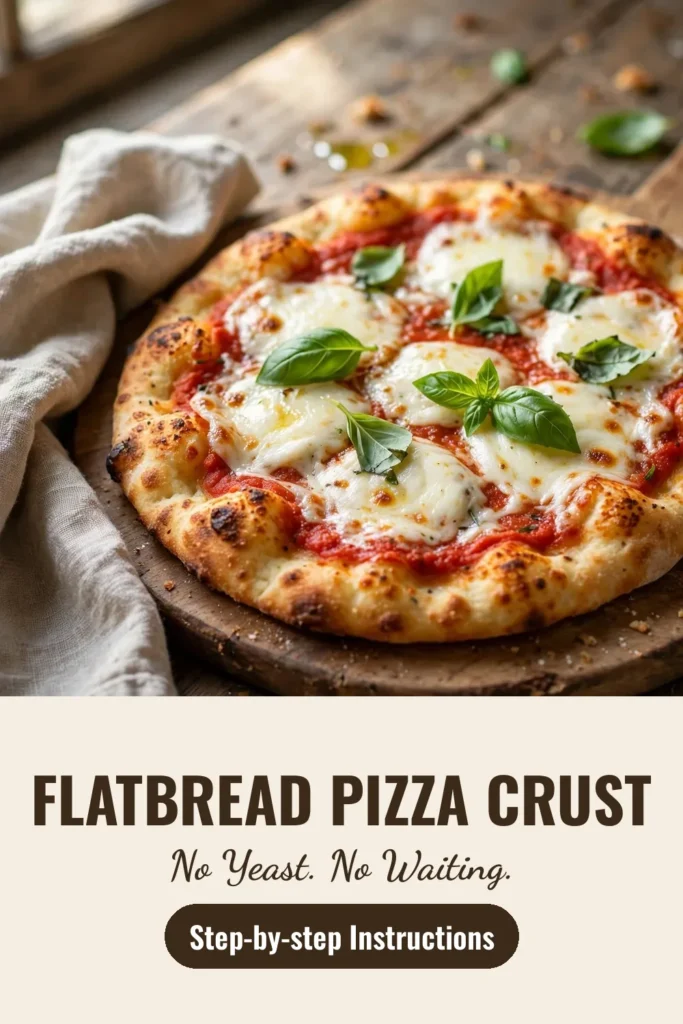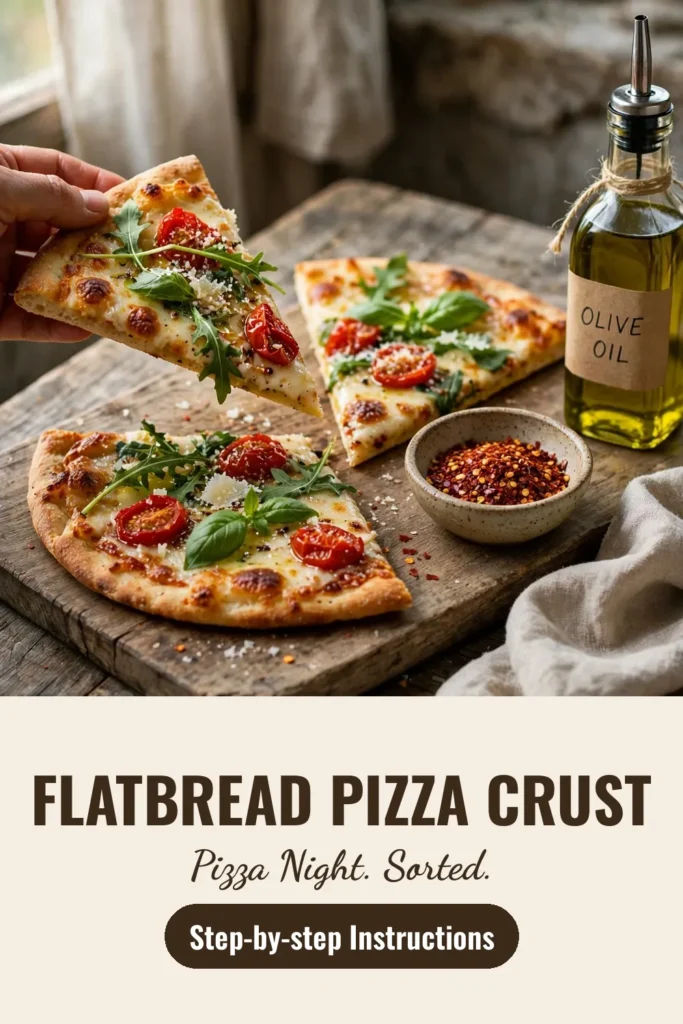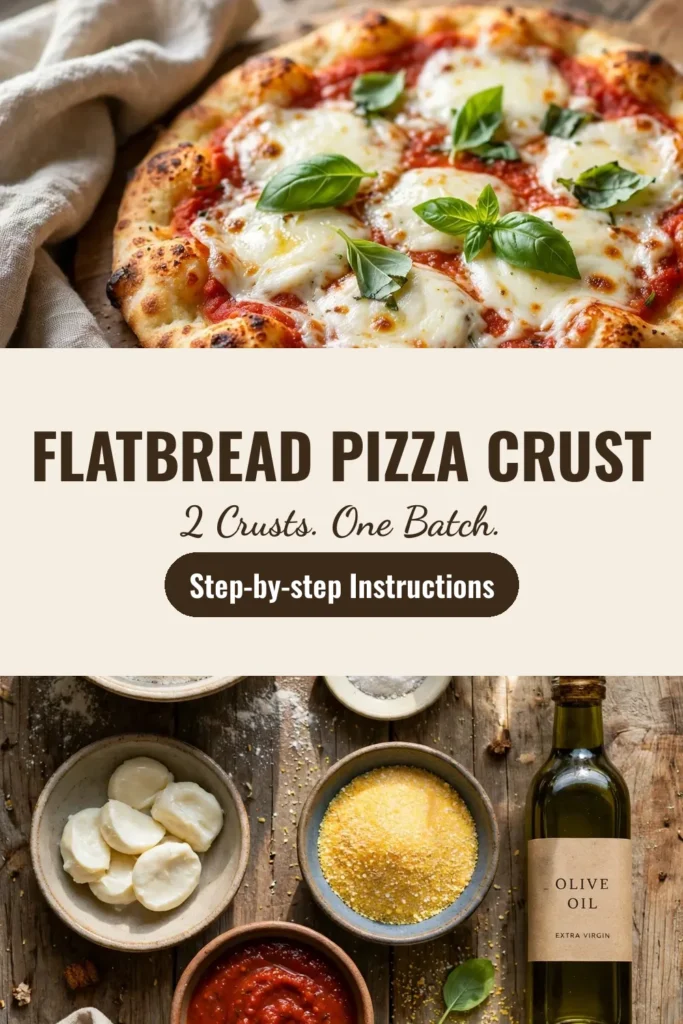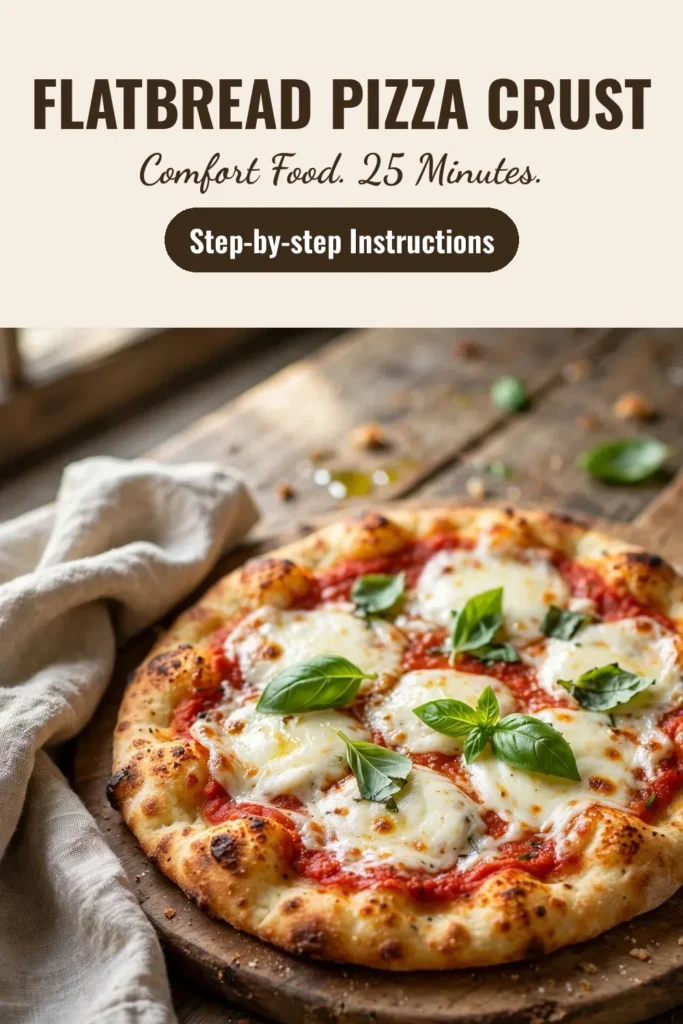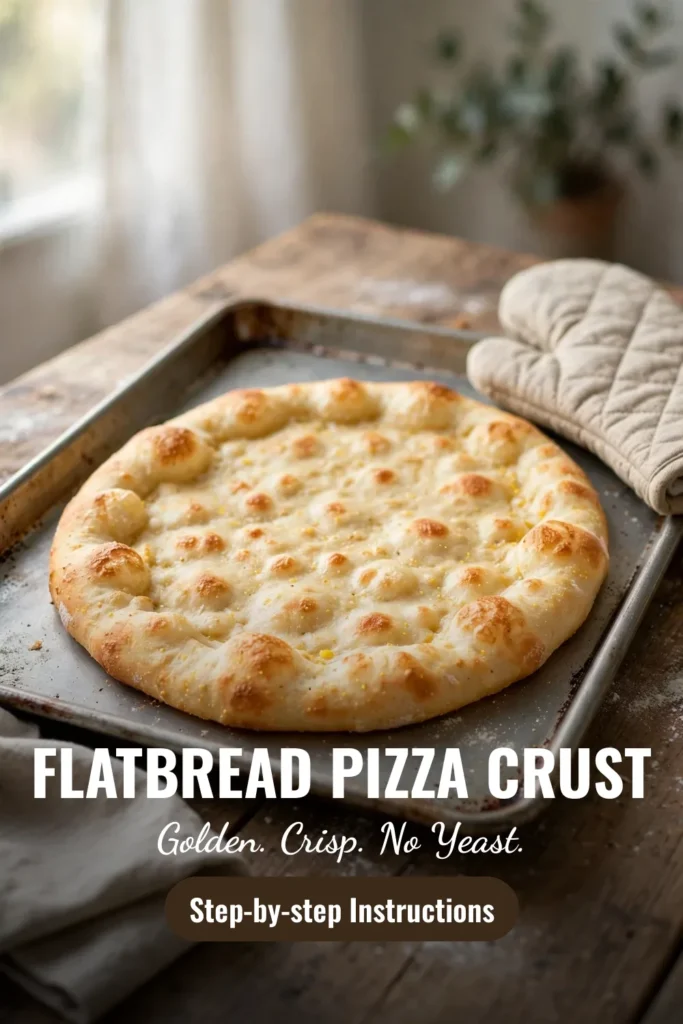
Flatbread Pizza Crust (5 Minutes, No Yeast)
Pizza night, minus the wait. This flatbread pizza crust takes 5 minutes of hands-on work and 25 minutes total — no yeast, no rise, no waiting for dough to double. The dough is five things: 3 cups of all-purpose flour, 2 teaspoons of baking powder, 1 teaspoon of table salt, 1 cup of warm water and 3 tablespoons of olive oil. Mix it, knead it for a minute, rest it for 10, roll it thin, and par-bake it at 475°F until the edges turn golden. That is the whole recipe in one paragraph — and it is a flatbread pizza dough recipe that actually answers the questions the search results never do: whether it needs baking powder at all, whether the dough needs to rest, how thin to roll it, and why par-baking matters. The rest of this page is everything a cook needs to make a crust that is crispy outside, chewy inside, and strong enough to hold real toppings — in 25 minutes, on a weeknight, with a bag of flour you already own.
You will love this:
- 5 minutes of hands-on work, 25 minutes total. No yeast, no rise, no waiting — the dough is mixed, rested and rolled while the oven heats.
- Thick or thin, your call. Roll it ⅛-inch for cracker-crisp or ¼-inch for chewy — the rule is in the rolling H2, with the measurement Midwest never gives.
- Kids can help roll it out. No hot oil, no yeast to kill, no dough that fights back once it has rested 10 minutes.
What Is Flatbread Pizza?
A flatbread pizza is a pizza built on a flatbread — and the word flatbread is doing more work than it looks like. A flatbread is a bread typically made with flour, water and salt, with or without leavening, mixed and rolled into flattened dough, then baked quickly at high temperatures. It is the oldest bread there is: over 20,000 years old, from the Fertile Crescent, with archaeological findings dating back more than 14,000 years. The family is enormous — naan, pita, tortilla, chapati, focaccia, lavash — and every one of them is the same idea in a different shape: flour, water, salt, rolled flat, baked hot and fast.
That is why a flatbread pizza is not quite a pizza and not quite a flatbread. A regular pizza dough has yeast, rises, and bakes thick and doughy. A flatbread pizza crust has no yeast, no rise, rolls thin, and bakes fast — it is a flatbread that happens to carry pizza toppings. The distinction matters in the kitchen, not just in the dictionary: a flatbread is distinguished from a loaf bread by its crust-to-crumb ratio (more crust, less crumb), from a pancake by being a firm dough instead of a liquid batter, and from a cracker by being pliable instead of dry and crisp. Ours is a single-layered, thin, unleavened flatbread — the kind that stays soft inside and crisps at the edges, instead of puffing up into a pocket the way a double-layered flatbread does.
And the honest trade-off, stated up front: a flatbread is typically pliable but quickly stale — it is eaten fresh, usually within hours. That is why this page has a make-ahead H2 and a freezer section instead of pretending the crust keeps for days. Make it, top it, eat it the day you make it — or freeze the par-baked crust, which is the storage that actually works.
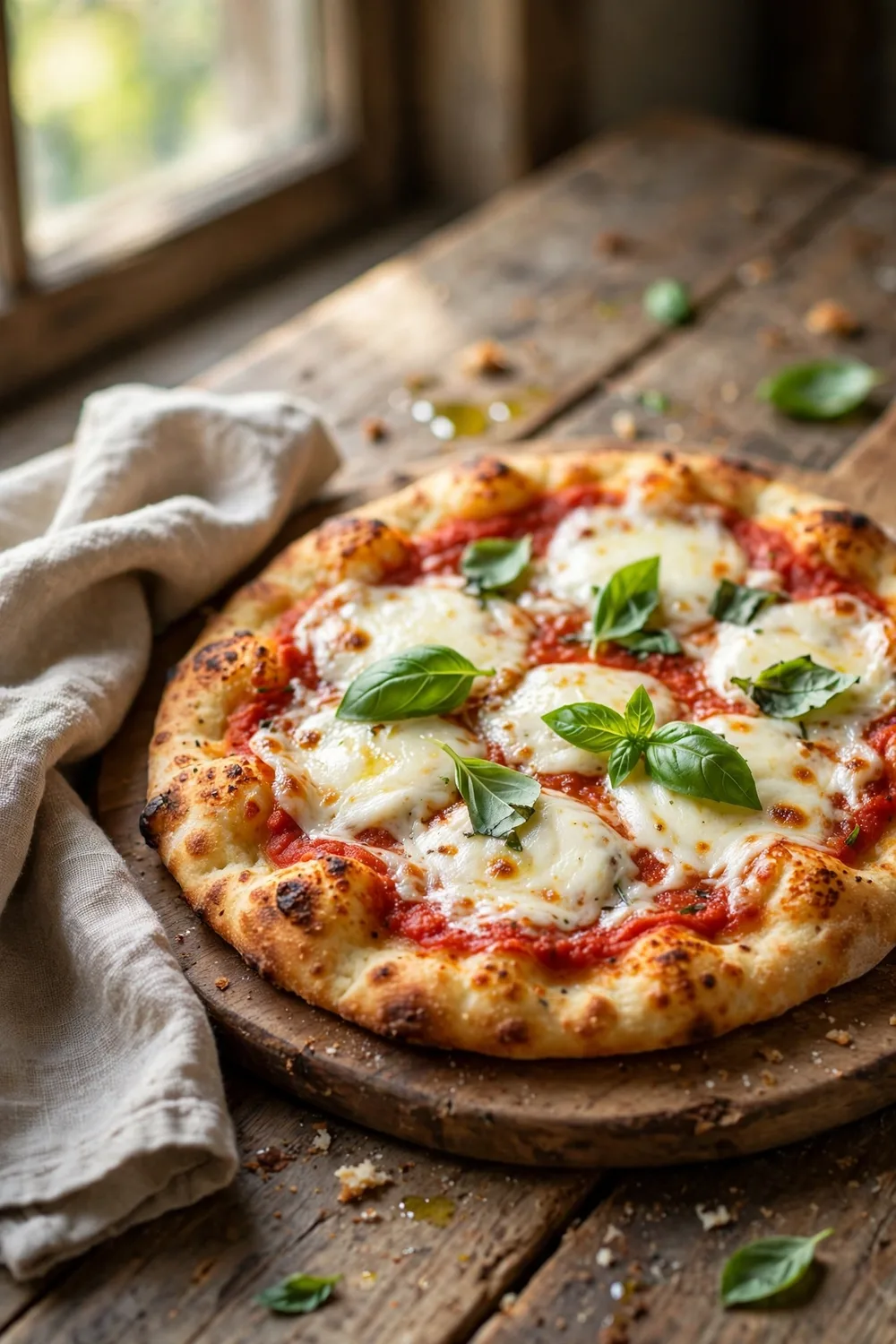
What Is Flatbread Pizza Crust?
The crust is the base — and on this page it is a flatbread pizza crust in the fullest sense: no yeast, no rise, rolled thin, par-baked crisp. Five ingredients, five minutes of hands-on work, and a crust that holds toppings instead of collapsing under them. The baking powder gives it a little lift as it bakes, so the crumb is tender instead of dead-flat and dense. The 10-minute rest lets the gluten relax, so the dough rolls without springing back. The par-bake cooks the crust through before the toppings wet it, so the middle stays crisp instead of going soggy. Each of those three moves has its own H2 below, with the split resolved and the reason stated — because the target page gives none of them, and the cook is the one who pays for the gap.
How is it different from regular pizza dough? Yeast, rise, thickness and time. Pizza dough has yeast, rises for an hour or more, and bakes thicker and doughier. Flatbread dough has no yeast, no rise, rolls thinner, and bakes faster. That is the whole difference, and it is also the whole appeal: pizza night without the planning, without the proofing, without the hour of waiting. If you want a thick, doughy, chewy crust with a big airy rim, make a yeasted pizza dough — this recipe is not that, and it does not pretend to be. If you want a thin, crisp, golden base that is ready to top in 25 minutes, this is the crust.
Two questions from Midwest’s own FAQ, answered here because they are the two questions every cook asks first. Is flatbread dough the same as pizza dough? No — flatbread has no yeast, no rise, rolls thinner and bakes faster; pizza dough has yeast, rises, and bakes thicker and doughier. Why is my flatbread dough so sticky? Too much water, or cold water. Warm water brings the dough together fast and keeps it from sticking — Midwest’s tip, and it holds — and if the dough is still sticky, add flour one tablespoon at a time until it is soft and smooth, not tacky (Little Family’s rule, with the amount). The troubleshooting H2 has the full five fixes.
The Ingredients, With Amounts
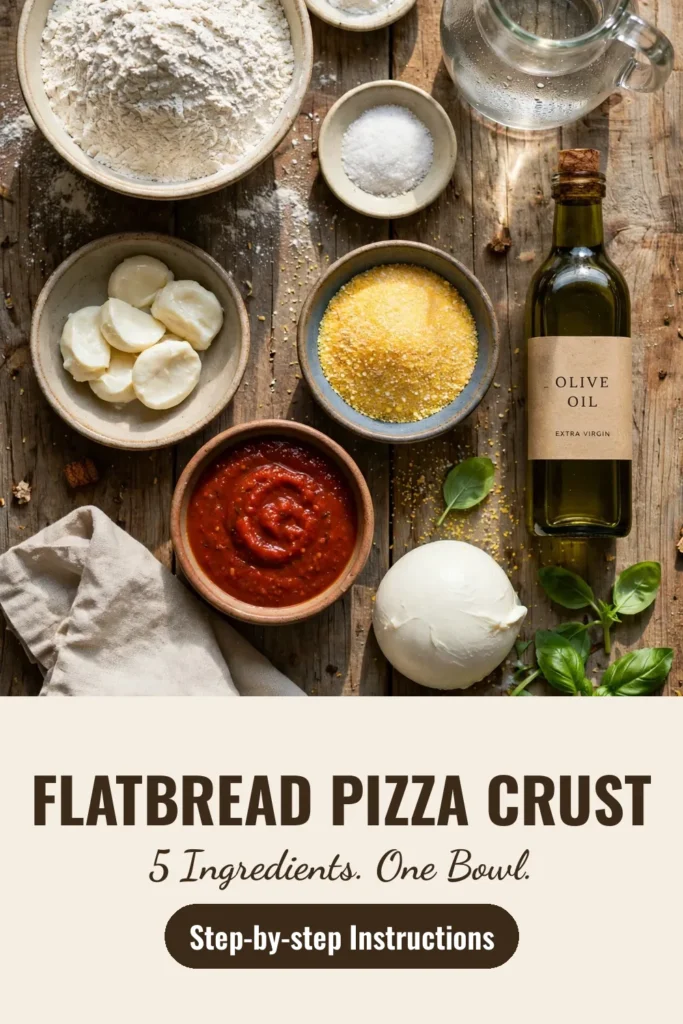
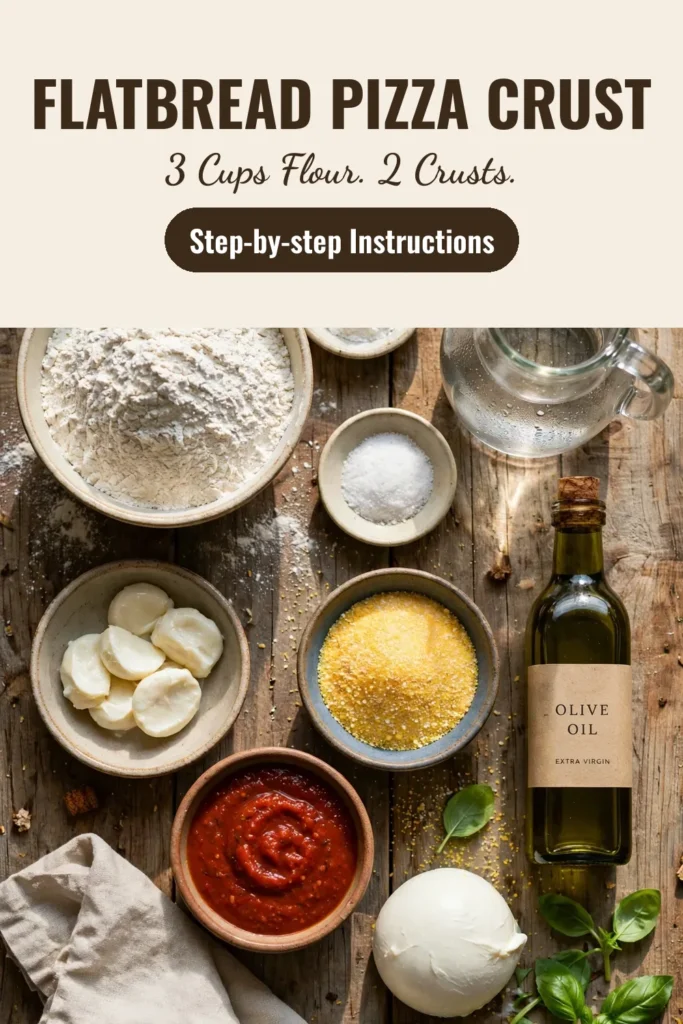
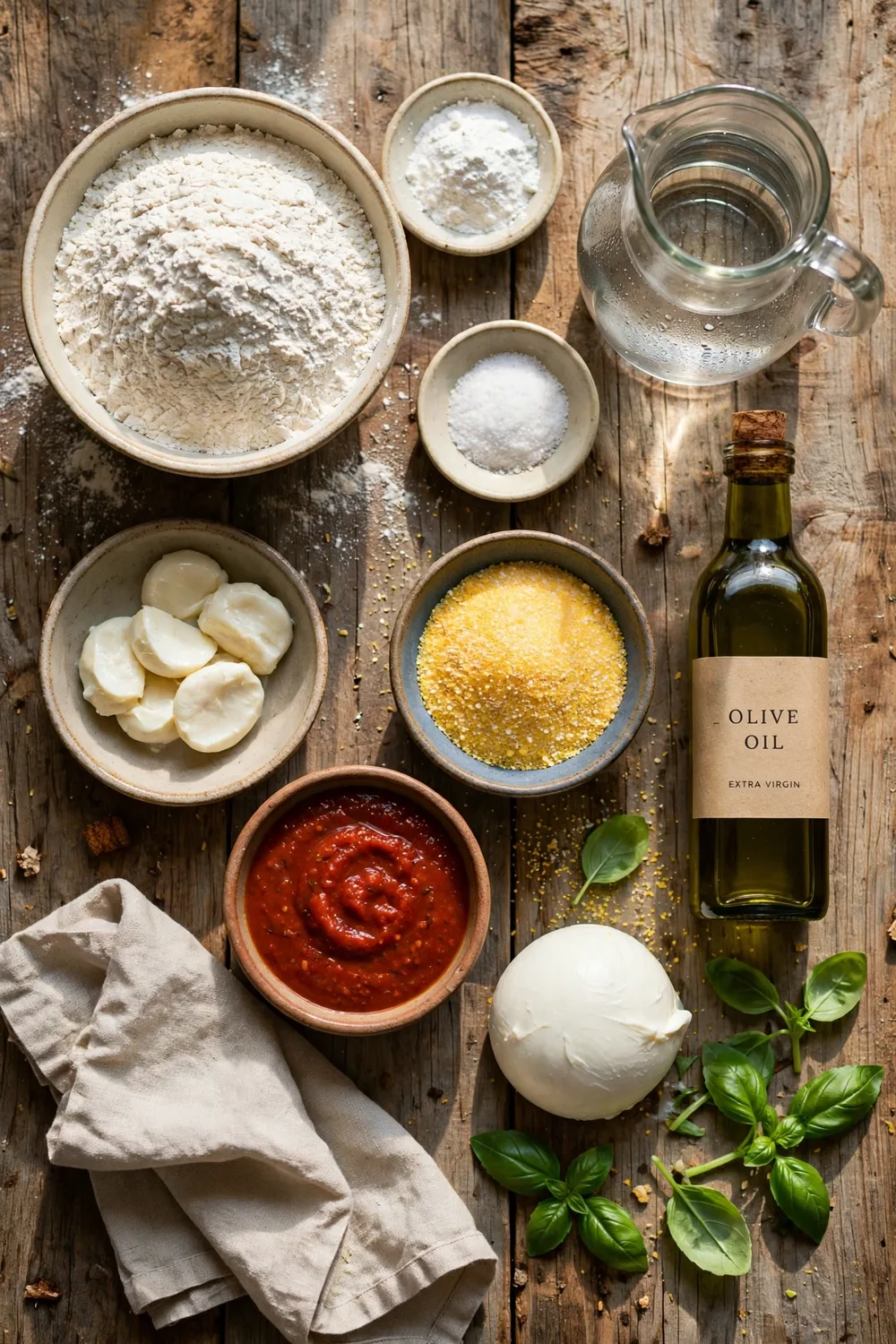
Every page on the SERP is the same four-ingredient formula with only the flour, the leavener, the rest and the bake temperature changing — and the difference between a good crust and a dense one is knowing what each ingredient is doing. Here is every ingredient WITH its amount, and its job — because once you know the job, you can adjust the crust instead of guessing. This is also the answer to the question “what’s in a flatbread pizza crust”: a five-ingredient dough, a dusting of cornmeal, and the toppings.
| Ingredient | Amount in our batch | What it does |
|---|---|---|
| All-purpose flour | 3 cups | The structure. Flour is the body of the crust — the thing that rolls thin and bakes golden. Three cups is the standard: Midwest, Kayla and four of the five snippet pages use it. Spoon it into the measuring cup and level it off — don’t scoop from the bag, which packs it down and adds as much as a quarter cup extra. |
| Baking powder | 2 tsp | The lift. Baking powder releases gas as the crust bakes, which makes it lighter and more tender instead of dead-flat and dense. Two teaspoons per 3 cups is the ratio Little Family and Kayla agree on exactly — and it is optional: leave it out and the crust is denser and chewier, which is Midwest’s version, not a failure. |
| Table salt | 1 tsp | The seasoning — and the strength. Table salt’s smaller grains mix more evenly than kosher salt (Midwest’s tip — and she “rarely uses anything but kosher salt”, which makes the tip credible). One teaspoon seasons the whole batch. If you only have kosher salt, use 1½ teaspoons by volume for the same salinity. |
| Warm water | 1 cup | The binder. Warm water brings the dough together fast — and it must be warm, because cold water makes a sticky dough (Midwest’s tip, and the one that saves the dough). Warm to the touch, about 100–110°F. Cold water is the skillet-method exception only (Kayla’s rule — see the skillet H2). |
| Olive oil | 3 Tbsp | The stretch and the tenderness. Pizza dough needs oil to help it stretch, and the oil is what makes the crust tender instead of tough (Midwest’s reason — the only one on the SERP). Three tablespoons per 3 cups is the consensus: Midwest and Kayla use it; Sue Bee’s ¼ cup is the rich end; Little Family’s 2 tablespoons is the lean end. |
| Cornmeal | For dusting the baking sheets | The crunch and the anti-stick. Cornmeal dusts the pan so the dough doesn’t stick — and at 475°F it toasts into a crunchy base that flour alone never gives. Flour is the fallback (Midwest’s), but cornmeal wins at this temperature. |
That is the whole list — five dough items and a dusting of cornmeal, every one of them in the recipe card below with its amount. The toppings are a separate question, and the topping H2 gives all seven combinations with amounts. The flour swaps — bread flour up to half, whole wheat up to 50%, a 1-to-1 gluten-free blend — live in the variations H2, not here, because the base dough is the recipe and the swaps are the options.
The Dough Guide — Flour, Water, Oil & the Baking-Powder Question
Every page on the SERP is the same fried-dough formula with only the fat, the rest and one trick changing — and nobody resolves the splits. Here they are, resolved, because the dough is the whole question this page exists to answer.
| Split | What the pages say | Our rule |
|---|---|---|
| Flour | All-purpose (Midwest, Little Family, Kayla, Mimi’s, Debra, Scarlati, Delicious on a Dime) vs bread-flour blend (Sue Bee: 2½ cups bread + ½ cup AP) | 3 cups all-purpose flour. The standard — what Midwest, Kayla and four of the five snippet pages use. Swap up to half for bread flour if you want a chewier, crisper crust (Sue Bee’s blend); whole wheat up to 50% (Little Family’s FAQ — denser, not as light/fluffy). |
| Baking powder | NONE (Midwest, Sue Bee) vs 2 tsp per 3 cups (Little Family: 1 tsp per 1½ cups; Kayla: 2 tsp per 3 cups — the two baking-powder pages agree exactly on the ratio) | 2 tsp per 3 cups flour. The lift: the dough puffs slightly as it bakes, which makes the crust lighter and more tender instead of dead-flat and dense. Optional — leave it out and the crust is denser and chewier, which is Midwest’s version, not a failure. |
| Salt | 1 tsp TABLE per 3 cups (Midwest; Little Family’s ½ tsp per 1½ cups = the same ratio) vs 1½ tsp per 3 cups (Sue Bee’s kosher; Kayla’s — salt type unstated) | 1 tsp table salt per 3 cups flour. Table salt’s smaller grains mix more evenly (Midwest’s tip). If using kosher salt, use 1½ tsp (Sue Bee’s amount). The Wikipedia anchor: salt is typically 0.5–3% of the flour — 1 tsp table salt in 3 cups flour is ~0.6%, at the light end, which is why the crust tastes clean rather than salty. |
| Water | 1 cup WARM (Midwest, Sue Bee, Delicious on a Dime, Scarlati) vs 1 cup COLD (Kayla: “ice water”) vs unstated (Little Family, Mimi’s, Debra) | Warm water for the oven method (Midwest’s + Sue Bee’s rule — the consensus). Cold water only if cooking in a skillet (Kayla’s exception, with the reason: slower gluten development = a tender, slightly chewy texture in a pan-fried flatbread). |
| Oil | 3 Tbsp per 3 cups (Midwest, Kayla) vs ¼ cup per 3 cups (Sue Bee) vs 2 Tbsp per 3 cups (Little Family) vs 1 Tbsp per 2 cups (Scarlati) | 3 Tbsp olive oil per 3 cups flour (Midwest’s + Kayla’s amount — the consensus). The reason (Midwest’s — the only one on the SERP): pizza dough needs oil to help it stretch, and the oil is what makes the crust tender instead of tough. The Wikipedia anchor: fat as shortening increases shelf life, eases dough handling and makes the bread softer. |
| Dough rest | NO rest (Midwest — knead 1 minute, roll immediately) vs 10–15 min (Sue Bee) vs 10 min under an inverted bowl (Little Family) vs 5–10 min (Mimi’s) vs none required, 10–15 min if hard to roll (Kayla) | Rest 10 minutes, covered. Three of the four full pages rest in some form; the target doesn’t. The reason, stated plainly: resting lets the gluten relax, which makes the dough way easier to roll out — and the crust stays tender. The 5-minute claim survives because the rest is hands-off: Prep 5 + rest 10 + Cook 20 = Total 25, the same total as Midwest’s. |
| Knead time | ~1 min (Midwest) vs 30 sec–1 min (Sue Bee) vs 10 times (Little Family) vs a few minutes (Kayla) | Knead ~1 minute, until smooth — don’t overwork it. One minute is enough to bring the dough together; over-kneaded dough turns tough and springs back when you roll it. Stop when it is smooth. |
| Bake temp | 475°F (Midwest) vs 475–500°F (Sue Bee) vs 450°F on a preheated stone (Little Family, Mimi’s) vs 425°F (Delicious on a Dime) | 475°F on a cornmeal-dusted baking sheet (Midwest’s + Sue Bee’s standard — the consensus). 450°F on a preheated pizza stone (Little Family’s + Mimi’s — the stone holds the heat, so a lower oven temperature still crisps the base). 425°F is the low end (Delicious on a Dime — thin crust only, and the bake takes longer). |
| Par-bake | 5–8 min (Midwest), 7–8 min with a pan rotation (Sue Bee), 13–15 min alone until dry (Mimi’s), 5 min then 5–8 min (Debra) vs NO par-bake (Little Family, Kayla, Delicious on a Dime) | Par-bake 5–8 minutes at 475°F until the edges turn golden, then brush with olive oil, top lightly, and bake 5–10 minutes more (Midwest’s + Sue Bee’s sequence). The reason (ours — nobody on the SERP states it): the crust cooks through before the toppings wet it, which is the soggy-middle fix. |
The baking-powder split, in plain language. The split is really about lift versus purity. Midwest’s four-ingredient dough is the purest version — flour, salt, water and oil, the Wikipedia formula — and it works. The baking-powder doughs puff slightly as they bake, which makes the crust lighter and more tender instead of dead-flat and dense. The number-one complaint about unleavened dough is density, and the baking powder is the answer to it — and nobody on the SERP says so. Our rule is 2 teaspoons per 3 cups of flour, and it is optional: leave it out and the crust is denser and chewier, which is Midwest’s version, not a failure.
The warm-vs-cold-water split, in plain language. The split is really about method. Warm water brings the dough together fast and avoids stickiness in the food-processor and oven method (Midwest’s tip — cold water makes a sticky dough). Kayla’s cold water is the skillet-method exception: slower gluten development gives a tender, slightly chewy texture in a pan-fried flatbread — her stated reason, and the only page that explains why. Warm for the oven, cold for the skillet, and never unstated: the water temperature is the one line Little Family never gives, and the cook is left guessing.
The flour split, in plain language. The split is about chew versus convenience. Bread flour has more protein, so it gives a chewier, crisper crust (Sue Bee’s reason — her 2½ cups bread + ½ cup AP blend is the only bread-flour blend on the SERP). All-purpose is what most people have, and it works. Our rule is 3 cups of all-purpose flour, with up to half swapped for bread flour if you want the chewier, crisper version. Whole wheat up to 50% (Little Family’s FAQ — denser, not as light and fluffy) and a 1-to-1 gluten-free blend (Debra tested four — all light and crispy) live in the variations H2.
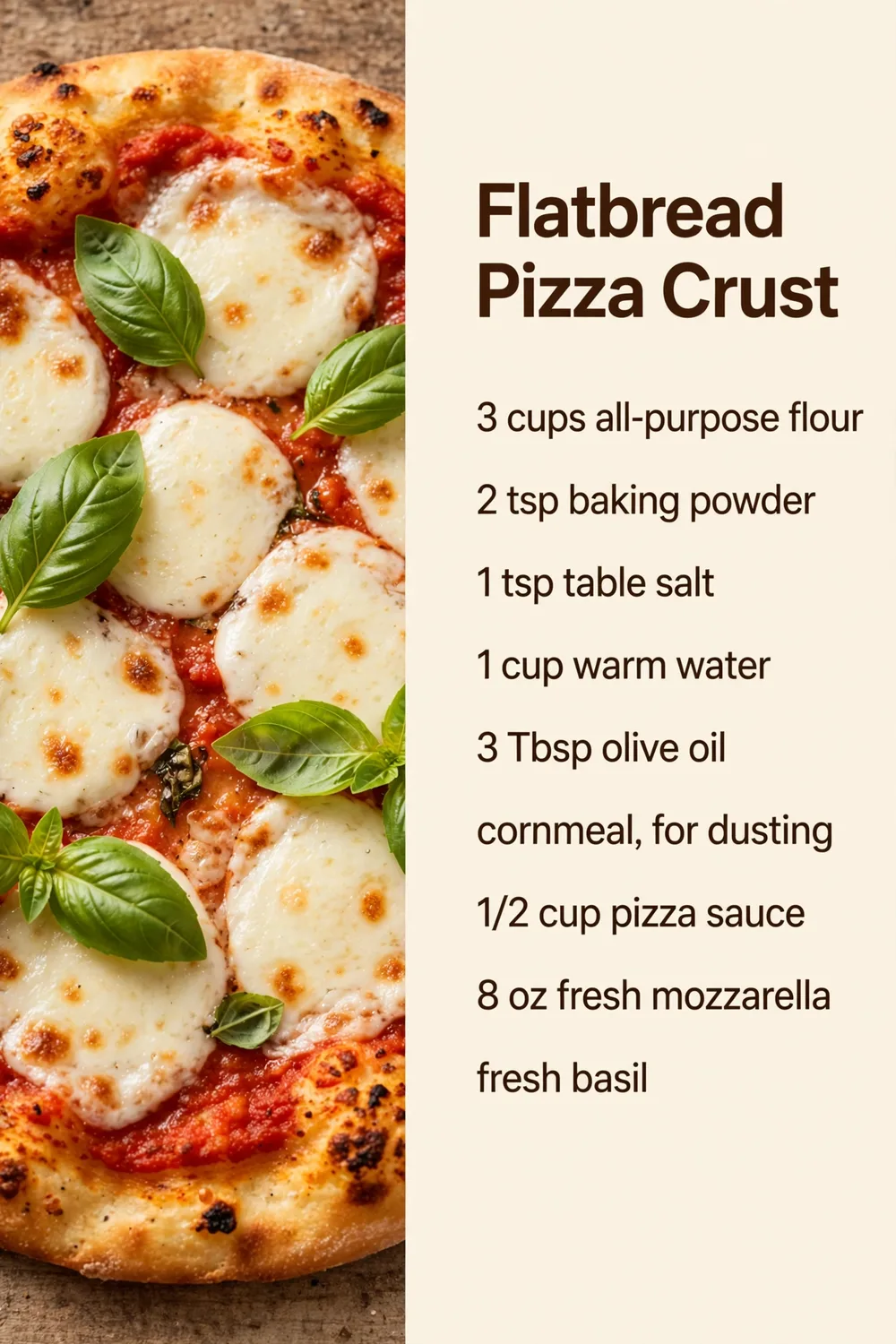
The Recipe — Our Flatbread Pizza Crust (2 Crusts, 25 Minutes)
This is a flatbread pizza dough recipe in the truest sense: five minutes of mixing, ten minutes of resting, twenty minutes of baking — and the batch makes 2 large crusts, which is 8 servings of 4 slices each, the most useful batch size on the search results, because the two fullest pages on the SERP both yield 2 crusts and nobody explains how to scale it. The dough is the five items from the ingredients H2 above, in the same proportions. The topping is the Margherita — the simplest one on the SERP, and the one that lets the crust speak for itself. Nothing is linked out — the sauce, the mozzarella and the basil are all in the card with their amounts, which is the one thing Midwest’s topping list never does.
- 3 cups all-purpose flour
- 2 tsp baking powder
- 1 tsp table salt
- 1 cup warm water
- 3 Tbsp olive oil
- Cornmeal, for dusting the baking sheets
- Optional: up to 1½ cups bread flour in place of half the AP flour (chewier, crisper — Sue Bee’s blend)
- Optional: up to 50% whole wheat flour (denser, not as light/fluffy — Little Family’s FAQ)
- Optional: a 1-to-1 gluten-free flour blend (Debra tested four — all light and crispy)
- ½ cup pizza sauce
- 8 oz fresh mozzarella, torn
- ¼ cup fresh basil leaves
- 1 Tbsp olive oil, for drizzling
How to make it: (1) Whisk the flour, baking powder and salt in a large bowl — or pulse them in a food processor, Midwest’s method. (2) Stir in the warm water and olive oil; knead about 1 minute on a lightly floured surface until smooth — don’t overwork it (over-kneaded dough turns tough and springs back). (3) Cover the dough and rest it 10 minutes — the gluten relaxes, so the dough rolls without springing back. (4) Divide into 2 balls; roll each into a long oval, ⅛–¼ inch thick (⅛-inch = cracker-crisp, ¼-inch = chewy — Mimi’s + Kayla’s rule). (5) Dust 2 baking sheets with cornmeal; transfer the crusts; poke all over with a fork (steam escapes in small amounts instead of one big bubble — Midwest’s + Sue Bee’s rule). (6) Par-bake 5–8 minutes at 475°F until the edges turn golden and the crust is nearly cooked through. (7) Brush with olive oil; top lightly — ¼ cup sauce + 4 oz mozzarella per crust, basil after the bake. (8) Bake 5–10 minutes more until the cheese is melty and the crust is golden; slice into 4 wedges per crust and serve immediately.
The topping order, and why it matters. Sauce first, then cheese, then basil after the bake — in that order, and the basil goes on last because fresh basil blackens in a 475°F oven. The cheese goes on the hot par-baked crust so it melts into the base. The sauce goes on thin — ¼ cup per crust, not a ladleful — because a thin unleavened crust will not hold a mountain of sauce, and the soggy middle is the one failure this recipe is built to prevent (see troubleshooting). Fill it lightly, bake it hot, and serve it the moment it comes out of the oven: a flatbread pizza waits for nobody, and the crust goes soft if it sits.
The food processor, or the bowl. Midwest’s method is the food processor: flour + salt in the bowl, pulse to combine, add the warm water + olive oil, pulse about 1 minute until a dough ball forms. It works — and it is the fastest path to a dough ball. But the bowl works just as well, and Little Family is the proof: mix the dry ingredients, stir in the wet until a soft dough forms, knead 10 times, shape into a ball. No food processor needed, no stand mixer needed. Use the processor if you have one; use the bowl if you don’t. The dough does not care.
Rolling It Thin (The Crispiness System, Part 1)
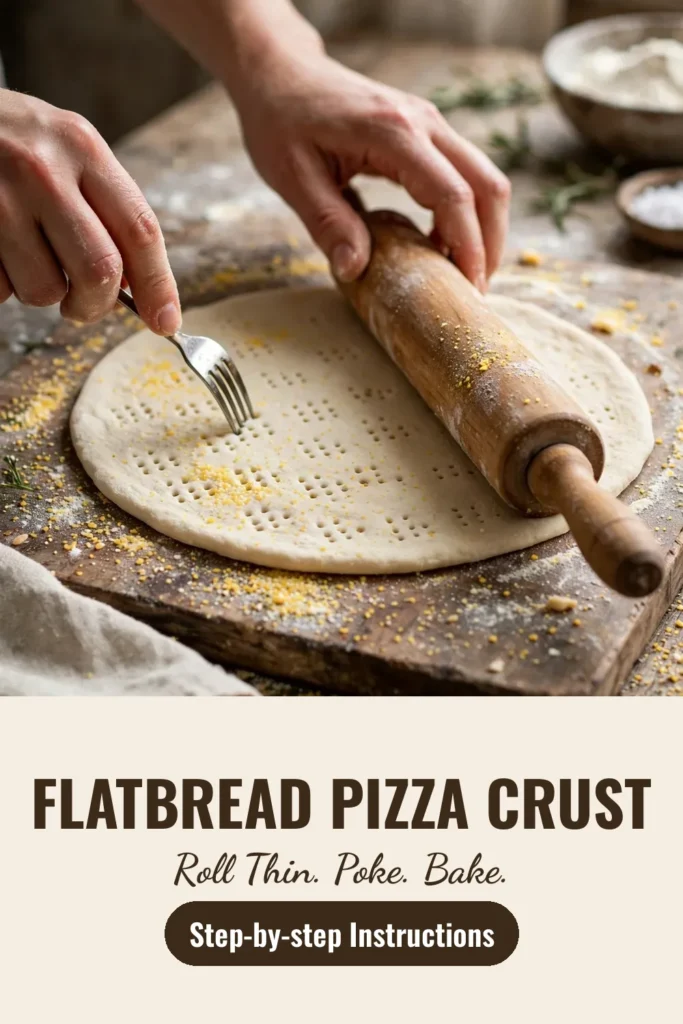
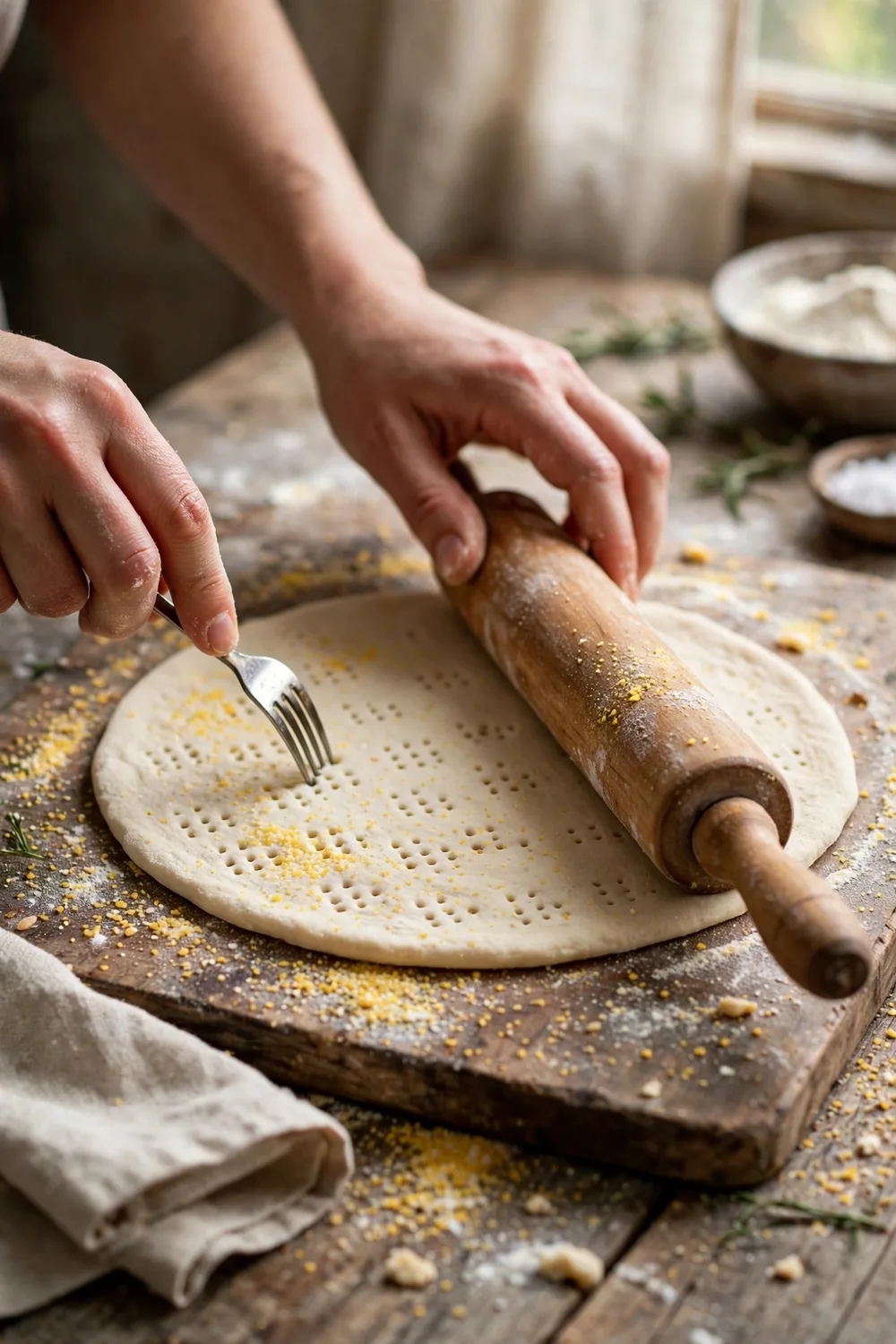
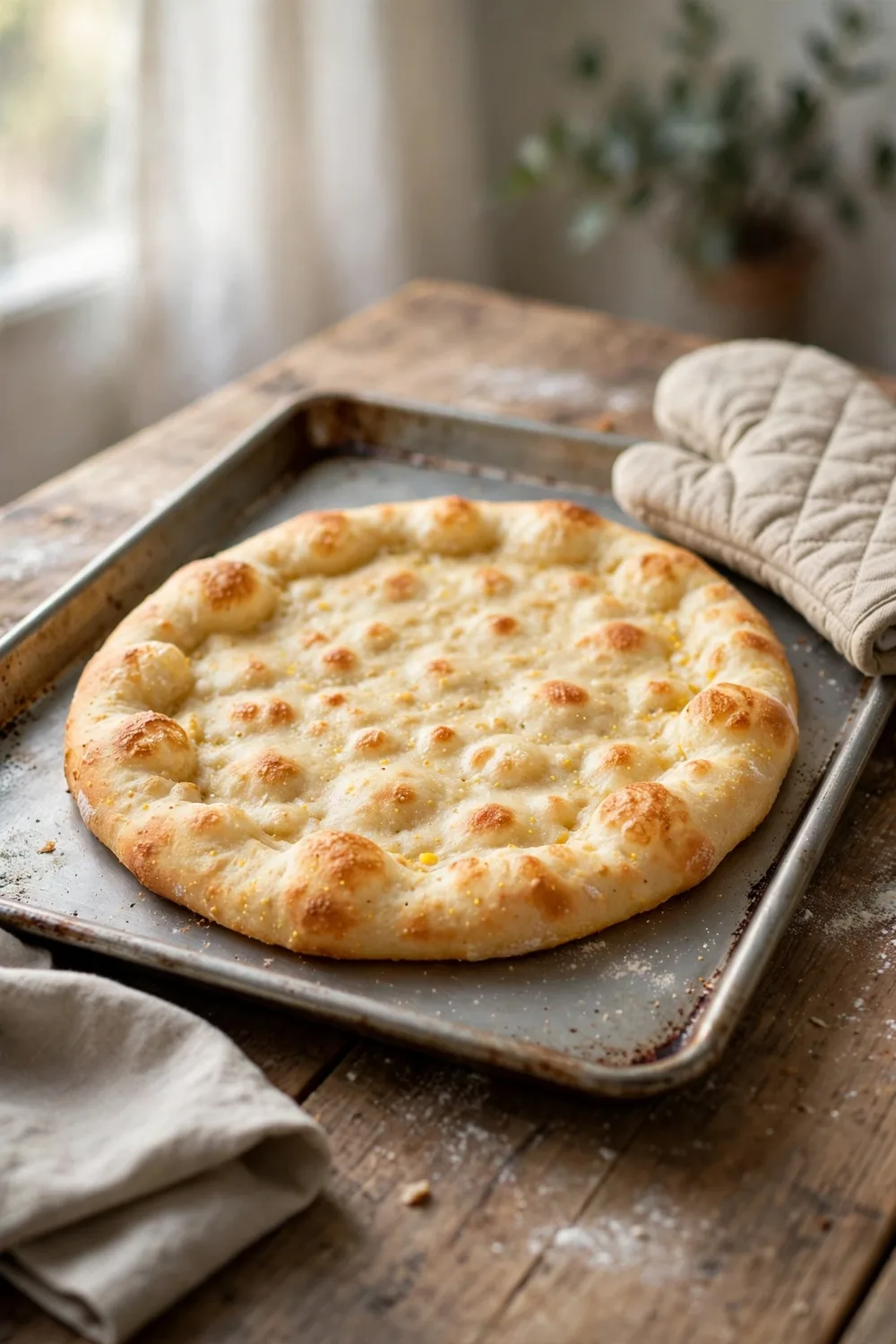
Midwest says “as thick or thin as you want” — and that is the whole instruction. It is also the whole problem, because thickness is the difference between a cracker-crisp crust and a doughy one, and “as thick or thin as you want” tells the cook nothing. Here is the rule, with the measurement: ⅛-inch for cracker-crisp, ¼-inch for chewy. Mimi’s and Kayla agree on ¼ inch as the maximum, and Mimi’s gives the ⅛–¼ inch range outright. Roll it thinner than ⅛ inch and the crust burns at the edges before the middle cooks; roll it thicker than ¼ inch and the middle stays doughy while the edges brown. The rolling pin is the tool — roll from the centre out, turn the dough a quarter-turn between passes, and stop when you can almost see the board through it.
The spring-back problem. The dough that won’t stay rolled is the dough whose gluten hasn’t relaxed — and the fix is the rest, not force. If the dough springs back when you roll it, stop, cover it, and rest it 10 minutes (Kayla’s rule: no rising or resting required, but if it is hard to roll, rest 10–15 minutes and try again). The gluten relaxes, the dough rolls without fighting back, and the crust stays tender. Pushing harder on un-rested dough only makes it tougher — and the crust that fights the pin is the crust that shrinks in the oven.
Fork holes. Midwest and Sue Bee both poke holes, and the rule is simple: poke all over with a fork before the crust goes in the oven. The holes let steam escape in small amounts instead of one big bubble, so the crust stays flat instead of ballooning into a pocket. Little Family and Kayla never mention fork holes — and their crusts are the ones that puff unevenly. Poke the holes, every time, on every crust. It takes ten seconds and it is the difference between a flat crust and a balloon.
Cornmeal vs parchment. Cornmeal wins at 475°F. Sue Bee’s reason: parchment can scorch at 500°F, and the cornmeal toasts into a crunchy base that flour alone never gives. Flour is the fallback (Midwest’s — dust the pan with flour if you have no cornmeal), and parchment is the third option (Little Family’s — a baking sheet + parchment works, but the crust steams instead of crisping). Dust the sheets with cornmeal, transfer the rolled crusts, and the base crisps from below while the top bakes from above. That is the whole system, part one: thickness + fork holes + cornmeal, measured and in one place for the first time on this SERP.
Par-Baking (The Crispiness System, Part 2)
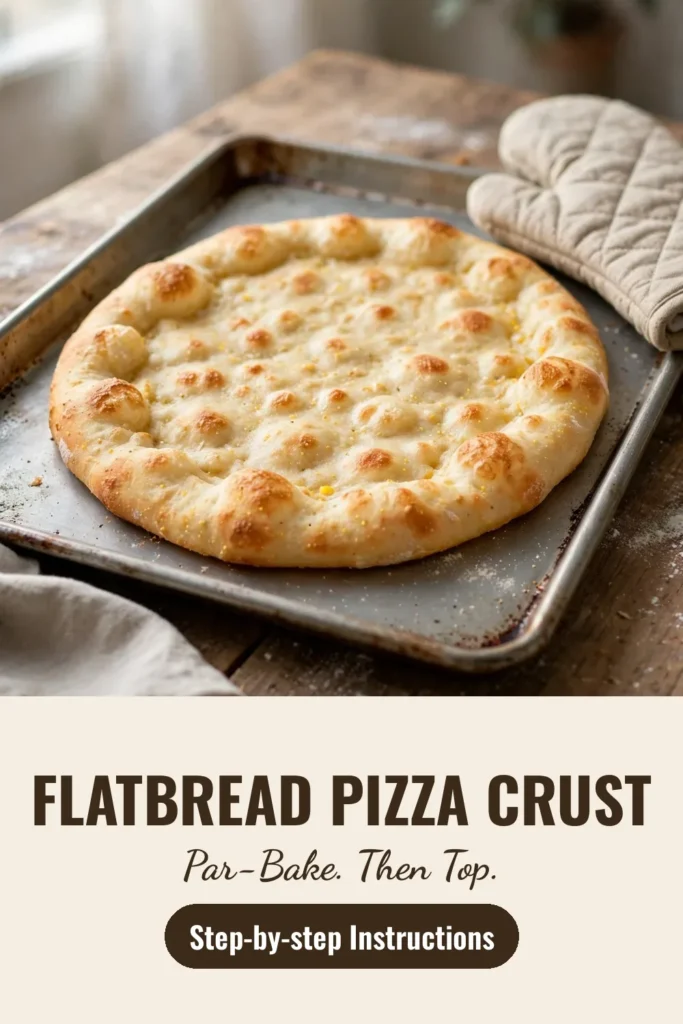
Midwest says “par-baking is a must” — and never says why. Little Family skips it entirely and bakes topped. Here is the rule and the reason, together: par-bake 5–8 minutes at 475°F until the edges turn golden, then brush with olive oil, top lightly, and bake 5–10 minutes more. The reason (ours — nobody on the SERP states it): the crust cooks through before the toppings wet it, which is the soggy-middle fix. A raw crust under wet toppings steams from below while the toppings cook from above, and the middle never crisps. A par-baked crust is already cooked through when the toppings go on, so the second bake is about melting the cheese and browning the edges — not about rescuing a raw middle.
The oil brush. After the par-bake, brush the crust with olive oil — Midwest’s + Sue Bee’s step, and the one that does two jobs at once: the oil is a barrier (it keeps the sauce from soaking into the crust) and the flavour (it is the golden, rich taste in the finished slice). Brush it on thin and even, edge to edge, before the sauce goes on. Skip it and the sauce soaks straight into the par-baked crust, and the soggy middle comes back.
Don’t overload. Midwest’s “less is more” — and it is the rule that saves the crust: a thin unleavened crust won’t hold 3 cups of mozzarella or a mountain of meat. Sue Bee’s version is the same: the crust takes longer and may not crisp. Our rule: ¼ cup of sauce + 4 oz of mozzarella per crust, and the toppings in the topping H2 are measured per crust, not per batch. If the topping list looks light, it is light on purpose — a flatbread pizza is a crust with toppings, not a casserole with a crust underneath.
The temperature split. 475°F on a baking sheet is the standard (Midwest’s + Sue Bee’s — the consensus). 450°F on a preheated pizza stone is the alternative (Little Family’s + Mimi’s — the stone holds the heat, so a lower oven temperature still crisps the base; preheat the stone for 30 minutes, or it is just a cold slab). 425°F is the low end (Delicious on a Dime — thin crust only, and the bake takes longer). Hotter is crisper — the Wikipedia anchor is that flatbreads are “baked quickly at high temperatures” — and 475°F is the temperature that crisps the base in 5–8 minutes without burning the edges.
Topping It — 7 Flatbread Pizzas
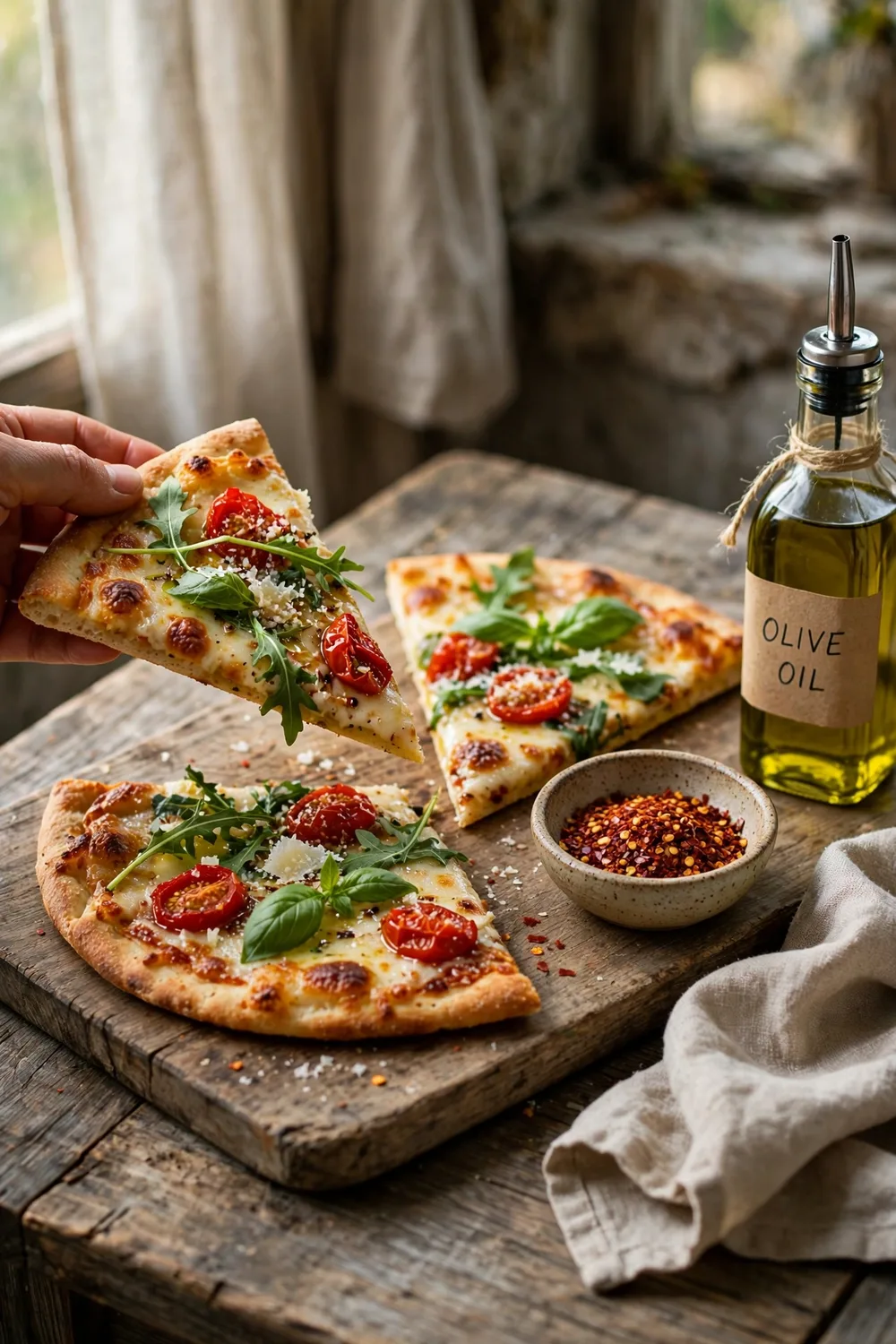
Midwest lists seven topping ideas with NO amounts on any of them — a reader who wants to make one has to guess every quantity. Here are the same seven combinations, WITH amounts, per crust — because a topping list without amounts is a wish list, not a recipe. The Margherita is the card’s example (the simplest one, and the one that lets the crust speak for itself). The other six are the same dough, the same par-bake, a different top.
| Combination | Per crust (amounts) | Notes |
|---|---|---|
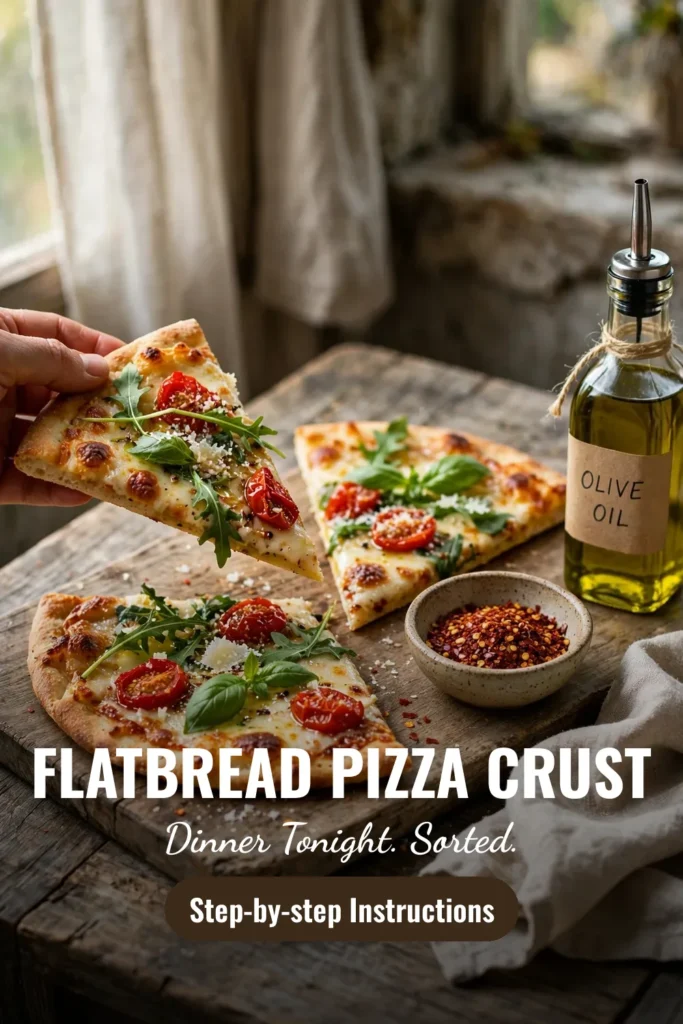
| Margherita | ¼ cup pizza sauce · 4 oz fresh mozzarella, torn · ¼ cup fresh basil leaves (after the bake) · 1 Tbsp olive oil, for drizzling | The card’s example. Basil goes on AFTER the bake — fresh basil blackens at 475°F. |
| Mexican Street Corn | ¼ cup street-corn spread (mayonnaise + lime + chili powder) · ¼ cup crumbled cotija · 2 Tbsp chopped cilantro · lime wedges | The elote flatbread. Our Avocado Sauce for Tacos is the dip on the side — creamy, 5 minutes, no cooking. |
| Mediterranean | 2 Tbsp olive oil · ¼ cup crumbled feta · ½ cup halved cherry tomatoes · ¼ cup sliced Kalamata olives · 2 Tbsp sliced red onion | The Greek flatbread — olive oil instead of sauce, feta instead of mozzarella, and the tomatoes go on raw so they stay bright. |
| Salami + Green Olives | ¼ cup pizza sauce · 4 oz shredded mozzarella · 8 slices salami · ¼ cup sliced green olives · black pepper | The salty one. The salami crisps at the edges in the second bake — that is the point. |
| Olive Tapenade + Burrata + Arugula | 3 Tbsp olive tapenade · 4 oz burrata, torn · 1 cup arugula (after the bake) · 1 tsp lemon zest | The fancy one. Tapenade instead of sauce, burrata instead of mozzarella, arugula on after the bake so it stays green and peppery. |
| Pepperoni | ¼ cup pizza sauce · 4 oz shredded mozzarella · 12 slices pepperoni · ½ tsp dried oregano | The classic. Pepperoni cups in the heat and crisps at the edges — the oregano goes on with the cheese, not after. |
| Sausage + Mushrooms | ¼ cup pizza sauce · 4 oz shredded mozzarella · ¼ lb cooked Italian sausage, crumbled · ½ cup sliced mushrooms · ¼ cup sliced bell peppers · 2 Tbsp sliced red onion | The loaded one — and the one that tests the “less is more” rule hardest. The sausage must be cooked first (never raw on a thin crust), and the mushrooms must be sliced thin so they cook through in 5–10 minutes. |
The bonus eighth: taco pizza. Sue Bee’s topping — the only taco pizza on the SERP, and the one that earns its place here: taco sauce instead of pizza sauce, taco meat with our homemade taco seasoning, diced tomato, sliced jalapeño and shredded cheddar. The seasoning is our own M11 Old El Paso-style blend — 3 tablespoons seasons a pound of meat — and the taco flatbread is the M11 post in flatbread form. It is not in the table because it is a bonus, not one of Midwest’s seven — but it is the topping this site’s readers will actually make first.
The topping rule, once more. Every combination above is measured per crust, and every one of them is light on purpose. A thin unleavened crust will not hold a mountain of toppings — and the toppings that look generous in the bowl look like a landslide on a ⅛-inch crust. Less is more, every time, on every combination. If the flatbread looks bare before it goes in the oven, it is right: the cheese melts, the toppings spread, and the crust stays crisp underneath.
Skillet + Grill (The No-Oven Methods)
Midwest is oven-only. Kayla is the only skillet page on the SERP; Sue Bee and Little Family have the only grill options. Here are both methods, with the honest trade-offs stated plainly — because the oven is the standard, not the only way, and the cook without an oven (or with a grill already hot) deserves a real method, not a footnote.
The skillet method. Kayla’s — the only no-oven method on the SERP, and a real one: heat a cast-iron skillet or griddle over medium heat with about 1 tablespoon of oil; cook each rolled flatbread 2–3 minutes per side until puffed and golden brown; cool slightly; add the pizza toppings and broil until bubbly — or serve as-is for dipping or wrapping. The dough is the same five ingredients, with one change: cold water instead of warm (Kayla’s rule — cold water gives a slightly chewy, tender texture in a pan-fried flatbread, because slower gluten development suits the skillet). The skillet crust is soft and golden, not cracker-crisp — the pan cooks the base directly, and there is no par-bake, no 475°F oven, no cornmeal-dusted sheet. It is the fastest path to a flatbread on a weeknight, and the only method that works when the oven is busy. The trade-off, honestly: a skillet flatbread is a pan bread, not an oven crust — softer, chewier, less crisp at the edges. Use it when you need dinner in 15 minutes; use the oven when you want the real thing.
The grill method. Sue Bee’s Big Green Egg version is the best-documented grill on the SERP: pizza stone, at least 500°F, 6–7 minutes until crispy. Little Family’s is the simpler one: preheat the grill to medium-high, roll out, top, grill about 5 minutes until crisp and the cheese is melted. The grill is the crispiest of all the methods — the stone holds the heat, the open flame browns the edges, and the crust comes out with a char no oven can copy. The trade-off, honestly: it needs the setup (a pizza stone, a grill that holds 500°F, and a cook who is comfortable sliding a raw crust onto a hot stone). If you have the setup, the grill is the best flatbread on this page. If you don’t, the oven at 475°F is the standard for a reason.
The oven, restated. The oven method is the card’s method and the post’s standard: 475°F on a cornmeal-dusted baking sheet, par-bake 5–8 minutes, brush with oil, top lightly, bake 5–10 minutes more. It is the method with the most margin for error, the most even heat, and the most room for two crusts at once. The skillet is the weeknight shortcut. The grill is the weekend showpiece. All three use the same dough — and the dough is the recipe, not the appliance.
Whole Wheat, Gluten-Free & Other Flours
Midwest is all-purpose flour only — no variations at all. Debra tested four gluten-free flours; Little Family’s FAQ covers whole wheat. Here are the swaps, with the honest trade-offs, because the flour is the one ingredient a reader will actually change, and the page that tells them what happens is the page they trust.
All-purpose is the standard. Three cups of all-purpose flour, spooned and levelled, is the recipe — what Midwest, Kayla and four of the five snippet pages use. Any brand works (Midwest names King Arthur unbleached AP in her body; our post uses generic all-purpose flour, any brand). If you have AP flour, you have the recipe.
Bread flour, up to half. Sue Bee’s blend: 2½ cups bread flour + ½ cup AP — or, in our proportions, up to 1½ cups of bread flour in place of half the AP. Bread flour has more protein, so it gives a chewier, crisper crust (Sue Bee’s reason). The dough is a little stiffer to roll and a little springier — rest it the full 10 minutes, and roll it thin. This is the swap for the cook who wants the chewiest crust on the page.
Whole wheat, up to 50%. Little Family’s FAQ: yes, whole wheat works — denser, not as light and fluffy. Up to half the flour (1½ cups) swapped for whole wheat gives a nuttier, heartier crust with the same method; go past half and the crust turns dense and heavy, because whole wheat absorbs more water and the dough stiffens. If you swap in whole wheat, add water one tablespoon at a time until the dough is soft again — the flour drinks more than AP does.
Gluten-free, 1-to-1 blends. Debra Klein’s page is the only tested gluten-free page on the SERP — and she tested four: Bob’s Red Mill 1-to-1, Cup4Cup, Jovial Einkorn, Mighty Mill whole wheat — all light and crispy. Use a 1-to-1 blend cup-for-cup in place of the AP flour, and expect a slightly more delicate crust (handle it gently on the transfer to the sheet — it tears more easily than a wheat dough). The baking powder matters more here, not less: a gluten-free dough has no gluten to give it structure, so the lift is doing real work.
Self-rising flour. Skip the baking powder and the salt — self-rising flour already has both. Use 3 cups of self-rising flour, 1 cup of warm water and 3 tablespoons of olive oil, and the dough is the same five-minute mix. The crust is a little saltier and a little softer than the AP version — the same principle as the baking-powder rule, applied to the flour itself.
Sourdough discard, the flank. Fig Jar’s lane — “sourdough discard pizza dough no yeast” (390/mo, KD 19, Fig Jar #1) — is a different no-yeast approach: the discard is the leavener, not the baking powder. It is an angle, not a target, and it is mentioned here because the cook with a sourdough starter will ask: yes, discard works as the lift (replace the baking powder with ½ cup of discard and cut the water by ¼ cup), and the crust gets a faint tang that the baking-powder version never has. Never a target, never copied from Fig Jar’s recipe — just the option, stated plainly.
Make Ahead, Storage, Freezing & Reheating
Midwest says nothing about making the dough ahead — her page is silent on storage beyond freezing. Little Family says the dough keeps in the fridge for up to 2 days. Kayla says 1–2 days. Scarlati says the dough can be made up to 8 hours ahead. Four pages, four answers — and the honest middle is the one this H2 gives, with the reason for each number.
Make ahead: the dough, not the crust. The dough is the make-ahead part: wrap it tightly and keep it in the fridge for up to 2 days (Little Family’s rule — bring it to room temperature before rolling; Scarlati’s version is 8 hours ahead, Kayla’s is 1–2 days). Cold dough fights the pin; warm dough rolls. The crust is NOT the make-ahead part: it is best fresh and warm, and a crust made an hour ago is a crust that has gone soft. If you must make the crusts ahead, par-bake them, cool them on a wire rack, and finish them with toppings in a 475°F oven for 5–10 minutes when dinner is ready.
Storage: components separately, always. Store the dough, the par-baked crusts and the toppings in separate containers, so the crusts don’t go soggy. Par-baked crusts keep on the counter for 1 day in an airtight container, or in the fridge for 3 days (Sue Bee’s leftover number). Toppings keep in their own containers — sauce and mozzarella never on the crust, or the crust goes soggy in the fridge. A filled flatbread waits for nobody, and the crust goes soft if it sits.
Freezing: the dough or the par-baked crust. Midwest’s rule: freeze the dough OR the par-baked crust; thaw 1–2 hours at room temperature. Little Family’s version: freeze the dough up to 3 months, thaw overnight in the fridge. Sue Bee’s version: freeze the par-baked crust for about 1 month, thaw fully before topping. Kayla’s version: freeze the cooked flatbreads with parchment between the layers, in an airtight bag. The parchment is the trick in every version: without it, the crusts freeze together into a block, and you cannot take one out without thawing them all. Freeze the dough or the par-baked crust — never the topped flatbread. A topped flatbread does not survive the freezer, and a frozen crust reheats soft no matter what you do.
Reheating: oven or toaster oven, never the microwave. Little Family’s rule, stated with emphasis because it is the one rule every page agrees on: reheat in a toaster or regular oven at 350°F for 5–10 minutes — the microwave won’t keep it crisp. The microwave melts the cheese and leaves the crust soft, and a microwaved flatbread is soggy in a way no reheat fixes. Reheat the par-baked crusts in a 475°F oven for 5 minutes, then top and bake — or reheat a finished flatbread in a 350°F oven until warmed through.
Scaling — 1, 2 or 4 Crusts
Midwest yields 2 crusts with no scaling note. Nobody on the SERP has a scaling table. Here it is, in our proportions — the amounts scale straight, and the bake time per crust stays the same (5–8 minutes par-bake + 5–10 minutes topped), so a bigger batch just takes more sheets, not more time per crust.
| Crusts | Flour | Baking powder | Table salt | Warm water | Olive oil |
|---|---|---|---|---|---|
| 1 (half batch) | 1½ cups | 1 tsp | ½ tsp | ½ cup | 1½ Tbsp |
| 2 (this recipe) | 3 cups | 2 tsp | 1 tsp | 1 cup | 3 Tbsp |
| 4 (double batch) | 6 cups | 4 tsp (1 Tbsp + 1 tsp) | 2 tsp | 2 cups | 6 Tbsp |
The freezer is the scaling strategy. Make 2 crusts and freeze one par-baked — that is the scaling that actually works on a weeknight, because a par-baked crust thaws in an hour and finishes in 5–10 minutes, and the dough you freeze today is the pizza night you don’t have to plan next week. A double batch (4 crusts) needs two baking sheets and a hot oven, and the par-bake goes in two rounds — the bake time per crust doesn’t change, only the sheet count. The topping amounts scale the same way: ¼ cup of sauce + 4 oz of mozzarella per crust, whatever the batch size.
Troubleshooting — 5 Fixes
Nobody on the search results has this section. Every page is the same four-ingredient dump with the flour changed; none of them explains what happens when it goes wrong. Here are the five failures, why they happen, and how to fix them.
Dough too sticky
Why: too much water, or cold water — Midwest’s tip is that cold water makes a sticky dough, and Little Family’s rule is that a sticky dough needs more flour. Fix it now: add flour one tablespoon at a time until the dough is soft and smooth, not tacky (Little Family’s rule, with the amount). Next time: use warm water (about 100–110°F), spoon the flour into the measuring cup and level it off instead of scooping from the bag, and knead on a lightly floured surface.
Dough springs back when rolling
Why: the gluten hasn’t relaxed — the dough was rolled too soon after kneading, and the gluten is still tight. Fix it now: stop, cover the dough, and rest it 10 minutes, then roll again (Kayla’s rule: no rising or resting required, but if it is hard to roll, rest 10–15 minutes and try again). Next time: rest the dough 10 minutes covered after kneading, every time — the rest is hands-off, and the dough rolls without fighting back.
Crust too thick / doughy in the middle
Why: rolled too thick — thicker than ¼ inch — or the par-bake was skipped, so the middle never cooked through before the toppings went on. Fix it now: there is no way to un-thicken a baked crust — slice it thinner and serve it as flatbread strips for dipping, or cut it into squares and call it focaccia. Next time: roll to ⅛–¼ inch (⅛-inch = cracker-crisp, ¼-inch = chewy), and par-bake 5–8 minutes at 475°F before topping.
Crust soggy under the toppings
Why: the toppings were too wet or too heavy — a thin unleavened crust will not hold a mountain of sauce or a pile of wet vegetables — or the par-bake was skipped, or the oil brush was skipped and the sauce soaked straight into the crust. Fix it now: put the soggy flatbread back in a 475°F oven for a few minutes until the base crisps again — the oven is the only fix that works, and the microwave is not (it goes soft and chewy). Next time: par-bake first, brush with oil after par-baking, top lightly (¼ cup sauce + 4 oz mozzarella per crust), and drain wet toppings before they go on.
Crust won’t crisp
Why: the oven was too cool — below 475°F the crust steams instead of crisping — or the sheet wasn’t cornmeal-dusted, so the base steamed on a bare pan, or the toppings went on too early and wet the crust before it set. Fix it now: turn the oven up to 475°F and give the next crust the full par-bake — the one in the oven won’t recover, so eat it soft and move on. Next time: preheat to 475°F (check it with an oven thermometer — “medium heat” is not a temperature, and neither is a dial you haven’t checked), dust the sheets with cornmeal, and par-bake 5–8 minutes until the edges turn golden before topping.
Flatbread Pizza Dough, in 150 Words
The flatbread is older than the pizza and younger than the fire. The name is the recipe: flour, water and salt, rolled flat, baked quickly at high temperatures — the oldest bread there is, over 20,000 years old, from the Fertile Crescent, with archaeological findings dating back more than 14,000 years. The family is everywhere: naan in India, pita in the Levant, tortilla in Mexico, chapati in South Asia, focaccia in Italy, lavash in Armenia. Some flatbreads puff up as steam forms inside them; others are pressed or stamped to stay flat. Double-layered flatbreads contain leavening and puff into pockets; single-layered flatbreads are thick and leavened, or thin and unleavened — ours is the thin, unleavened kind. A flatbread is pliable when fresh and stale within hours, which is why it is eaten the day it is made, and why the freezer is the storage. The dough is new. The bread is not.
Frequently Asked Questions
Is flatbread dough the same as pizza dough? No. Flatbread dough has no yeast, no rise, rolls thinner and bakes faster; pizza dough has yeast, rises for an hour or more, and bakes thicker and doughier. The crust H2 above has the full comparison.
Why is my flatbread dough so sticky? Too much water, or cold water. Warm water brings the dough together fast and keeps it from sticking — Midwest’s tip — and if the dough is still sticky, add flour one tablespoon at a time until it is soft and smooth (Little Family’s rule). The troubleshooting H2 has the full fix.
Do I need baking powder? No — Midwest and Sue Bee skip it, and their crusts work. But 2 teaspoons per 3 cups of flour gives a little lift and a tenderer crumb, and the number-one complaint about unleavened dough is density. Ours includes it; leave it out and the crust is denser and chewier, which is Midwest’s version, not a failure. The dough-guide H2 has the full split, resolved.
Do I need to rest the dough? No rising or resting is required — but 10 minutes makes it much easier to roll. Sue Bee, Little Family and Mimi’s all rest; Midwest doesn’t. The rest lets the gluten relax, so the dough rolls without springing back. The dough-guide H2 has the full split, resolved.
Can I make this gluten-free? Yes — a 1-to-1 gluten-free flour blend, cup for cup, though the texture may vary. Debra Klein tested four blends (Bob’s Red Mill 1-to-1, Cup4Cup, Jovial Einkorn, Mighty Mill whole wheat) and all came out light and crispy. The variations H2 has the full list.
Can I make it ahead? Yes — the dough keeps in the fridge for up to 2 days, wrapped tightly (bring it to room temperature before rolling), and freezes for up to 3 months (thaw overnight in the fridge). The make-ahead H2 has the full storage guide.
Can I bake it without a pizza stone? Yes — a baking sheet + parchment or cornmeal is the standard here, at 475°F. The stone is the 450°F option (Little Family’s + Mimi’s — preheat it for 30 minutes), not a requirement. The par-baking H2 has the full temperature split.
Can I use it for regular pizza? Yes — but it stays thin and crisp, not thick and doughy. It is a flatbread pizza, not a yeasted pizza dough, and the crust is the difference. The crust H2 above has the full comparison.
Can I cook it in a skillet? Yes — cast iron, medium heat, about 1 tablespoon of oil, 2–3 minutes per side until puffed and golden, then top and broil. Use cold water in the dough for the skillet method (Kayla’s exception). The skillet H2 has the full method.
How do I reheat leftover flatbread pizza? In a toaster or regular oven at 350°F for 5–10 minutes — the microwave won’t keep it crisp (Little Family’s rule). The make-ahead H2 has the full reheating guide.
More Recipes to Serve It With
- Greek Pasta Bake — a real bake plus the 15-minute stovetop version, 45 minutes. The pasta-cluster neighbour — the same oven, the same feta thinking.
- Gigi Hadid Pasta — the 30-minute vodka pasta, with a no-vodka version. The other pasta night on this site.
- Best Cheese Quesadilla — crispy, 10 minutes, the 2:1 cheddar and Jack blend. The same skillet, the same cheese thinking.
- Taco Bell Chalupa — copycat supreme, 35 minutes, homemade fried chalupa bread. The other bread on this site — and the taco pizza topping comes from its seasoning.
- Cheeseburger Pasta — one-pot cheeseburger pasta, 30 minutes.
- Avocado Sauce for Tacos — creamy avocado sauce, 5 minutes, no cooking. The dip for the Mexican street corn flatbread.
- Taco Seasoning (Old El Paso style) — 5 minutes, 10 spices, 3 tablespoons seasons a pound of meat. The seasoning in the taco pizza topping.
- Crockpot Chicken Tacos — 10 minutes of prep, 6 hours of waiting. The other taco night on this site.
- Crack Green Beans — bacon and brown sugar glaze, 30 minutes. The side that goes with everything.
- Baked Ziti — easy, cheesy, never dry. The other baked pasta on this site.
Ingredients
Equipment
Method
- Whisk the flour, baking powder and salt in a large bowl (or pulse in a food processor).
- Stir in the warm water and olive oil; knead about 1 minute on a lightly floured surface until smooth — don’t overwork it.
- Cover the dough and rest it 10 minutes (the gluten relaxes — the dough rolls without springing back).
- Divide into 2 balls; roll each into a long oval, ⅛–¼ inch thick.
- Dust 2 baking sheets with cornmeal; transfer the crusts; poke all over with a fork.
- Par-bake 5–8 minutes at 475°F until the edges turn golden and the crust is nearly cooked through.
- Brush with olive oil; top lightly — ¼ cup sauce + 4 oz mozzarella per crust, basil after the bake.
- Bake 5–10 minutes more until the cheese is melty and the crust is golden; slice into 4 wedges per crust and serve immediately.
Notes
- Rest the dough 10 minutes, covered — the gluten relaxes, so the dough rolls without springing back.
- Keep the oven at 475°F and dust the sheets with cornmeal — the crust crisps from below while the top bakes from above.
- Par-bake 5–8 minutes, brush with oil, top lightly — a thin unleavened crust won’t hold a mountain of toppings.
- Eat the day you make it, or freeze the par-baked crust.
- To serve: flaky sea salt; red pepper flakes; our Avocado Sauce for Tacos as a dip.
Nutrition information
| Nutrient | Per slice (1 of 8, crust only) | Per Margherita slice (1 of 8, topped) |
|---|---|---|
| Calories | ~215 kcal | ~315 kcal |
| Sodium | ~415mg | ~660mg |
| Carbohydrates | ~36g (sugars ~0g) | ~38g (sugars ~1g) |
| Fat | ~5.5g (saturated ~1g) | ~12g (saturated ~4g) |
| Protein | ~5g | ~11g |
| Fiber | ~1g | ~1g |
| Cholesterol | 0mg | ~23mg |
The inputs, shown plainly (USDA FoodData Central values for the exact ingredients listed): the dough batch (2 crusts, 8 slices) — 3 cups all-purpose flour ≈ 375g ≈ 1,365 kcal, ~39g protein, ~286g carbs, ~3.7g fat, ~10g fiber, ~1g sugars, ~8mg sodium (USDA “Flour, white, all-purpose, enriched, unbleached”: 364 kcal, 10.33g protein, 76.31g carbs, 0.98g fat, 2.7g fiber, 0.27g sugars, 2mg sodium per 100g; USDA cup weight 125g) · 2 tsp baking powder ≈ 9.2g ≈ 5 kcal, ~2.5g carbs, ~975mg sodium (USDA “Baking powder, double acting”: 53 kcal, 27.7g carbs, ~10,600mg sodium per 100g — about 488mg sodium per teaspoon) · 1 tsp table salt ≈ 6g ≈ 0 kcal, ~2,325mg sodium (1 teaspoon of table salt = ~2,300mg sodium) · 1 cup warm water ≈ 0 kcal · 3 Tbsp olive oil ≈ 40.5g ≈ 358 kcal, ~40.5g fat (saturated ~5.6g), ~0mg sodium (USDA “Oil, olive”: 884 kcal, 100g fat, 13.8g saturated fat per 100g). The cornmeal dusting is excluded from the working — a dusting (about 1 tablespoon per batch, ~33 kcal) that mostly stays on the pan. Dough batch ≈ 1,728 kcal and ~3,308mg sodium — per slice ≈ 216 kcal and ~413mg sodium, rounded to about 215 kcal and about 415mg sodium per slice. The Margherita topping per slice (÷8) — ½ cup pizza sauce ≈ 125g ≈ 44 kcal, ~560mg sodium, ~9g carbs, ~5g sugars (USDA “Sauce, pizza”: ~35 kcal, ~450mg sodium, ~7g carbs, ~4g sugars per 100g) · 8 oz fresh mozzarella ≈ 227g ≈ 636 kcal, ~50g protein, ~39g fat (saturated ~25g), ~1,430mg sodium, ~7g carbs, ~182mg cholesterol (USDA fresh mozzarella: ~280 kcal, 22g protein, 17g fat, 11g saturated fat, 630mg sodium, 3g carbs, ~80mg cholesterol per 100g) · ¼ cup fresh basil ≈ 5g ≈ 1 kcal · 1 Tbsp olive oil ≈ 13.5g ≈ 119 kcal, ~13.5g fat. Margherita slice ≈ 315 kcal and ~660mg sodium — rounded to about 315 kcal and about 660mg sodium per slice.
The SERP comparison, honestly: the published numbers on the search results are ALL crust-only, and only Midwest’s is per-slice — and hers is per 1/10 of the batch (161 kcal) while ours is per 1/8 (~215 kcal), which is why the numbers differ even though the doughs are nearly identical (3 cups flour + 3 tablespoons oil on both). Sue Bee’s 916 kcal is per whole crust with the serving size unstated — a reader comparing it to Midwest’s 161 kcal is comparing a whole crust to a tenth of one. Little Family’s serving size is internally inconsistent (“1 large crust” against a yield of 4 — the numbers fit ¼ of the batch, ~201 kcal). Kayla’s 435 kcal is per 1 of 4 flatbreads (batch ≈ 1,728 ÷ 4 ≈ 432 — the check that the working is honest). Ours (~215 kcal) states the serving size plainly (1 slice of 8) and shows the USDA working so the number can be checked instead of trusted — and it is the first page on the SERP to give a topped-slice number (~315 kcal for a Margherita slice).
The sodium is worth telling honestly: the SALT is the driver — ~290mg of ~415mg per crust-only slice, nearly two-thirds of the total — and the baking powder is second (~120mg per slice), which is the number the analysis missed (it counted only the table salt). The flour contributes almost nothing (~1mg per slice) and the oil nothing at all. The saving, if a reader wants one, is a lighter salt hand, not one swap: use ¾ tsp of table salt instead of 1 tsp and you save ~70mg per slice; skip the baking powder and you save ~120mg more (and lose the lift); use a lighter hand with the mozzarella and you save ~45mg more on a topped slice. The analysis’s claim that the sodium is “~290mg” was wrong — it took only the salt into account, and the USDA values say the baking powder adds nearly a gram of sodium per batch on its own. This table corrects it.
Nutrition is an estimate calculated from USDA FoodData Central values for the exact ingredients listed. Values will vary with brands and substitutions.
Pin this recipe