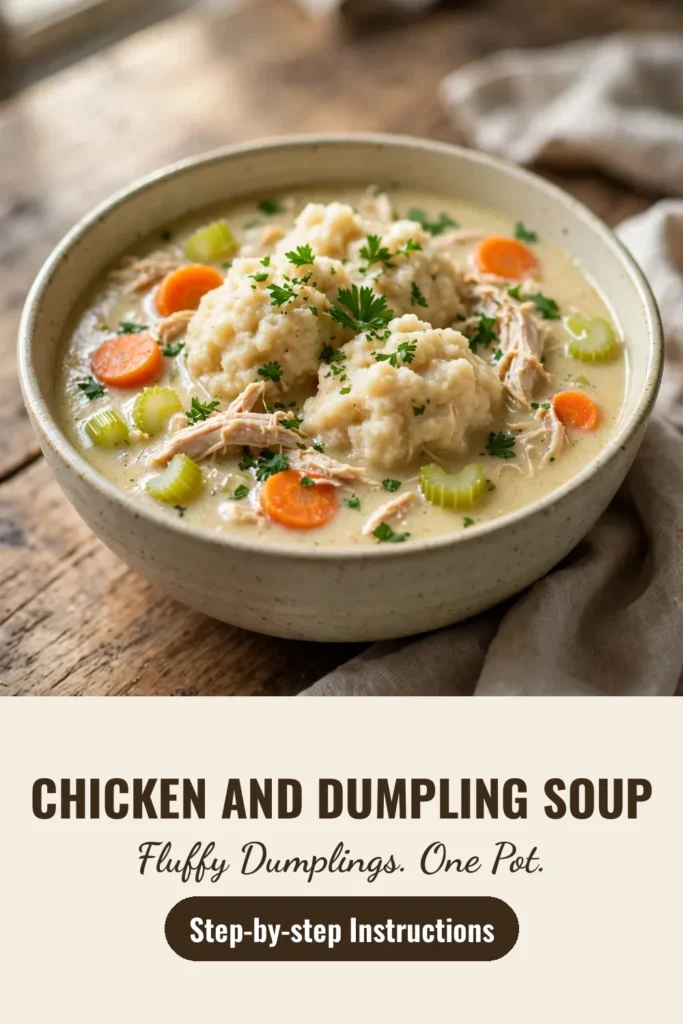
Chicken and Dumpling Soup (One Pot, 50 Minutes)
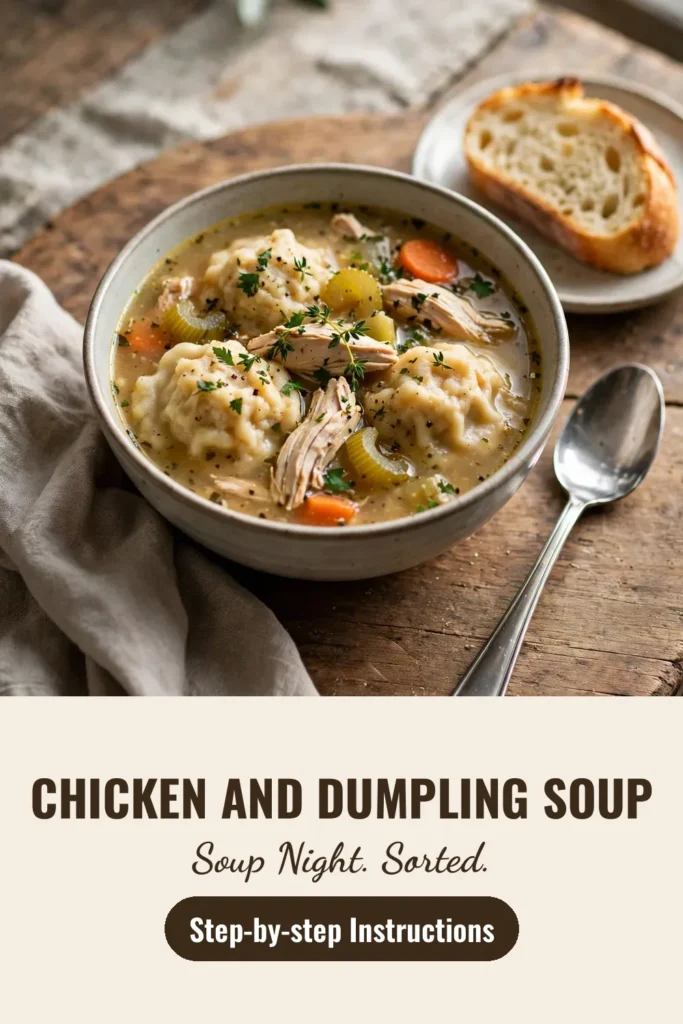
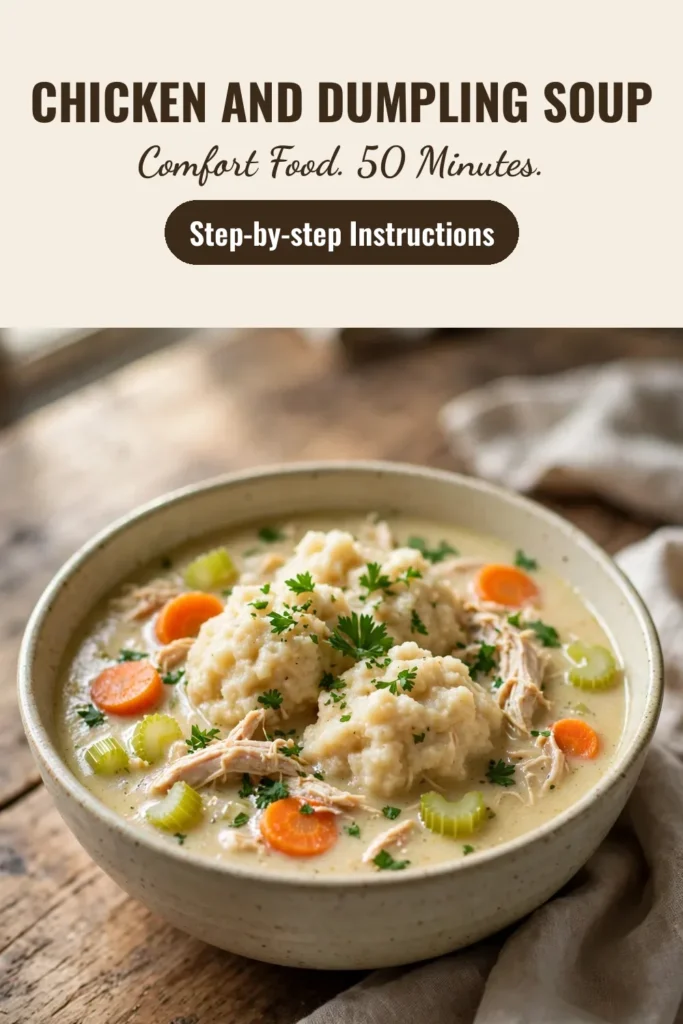
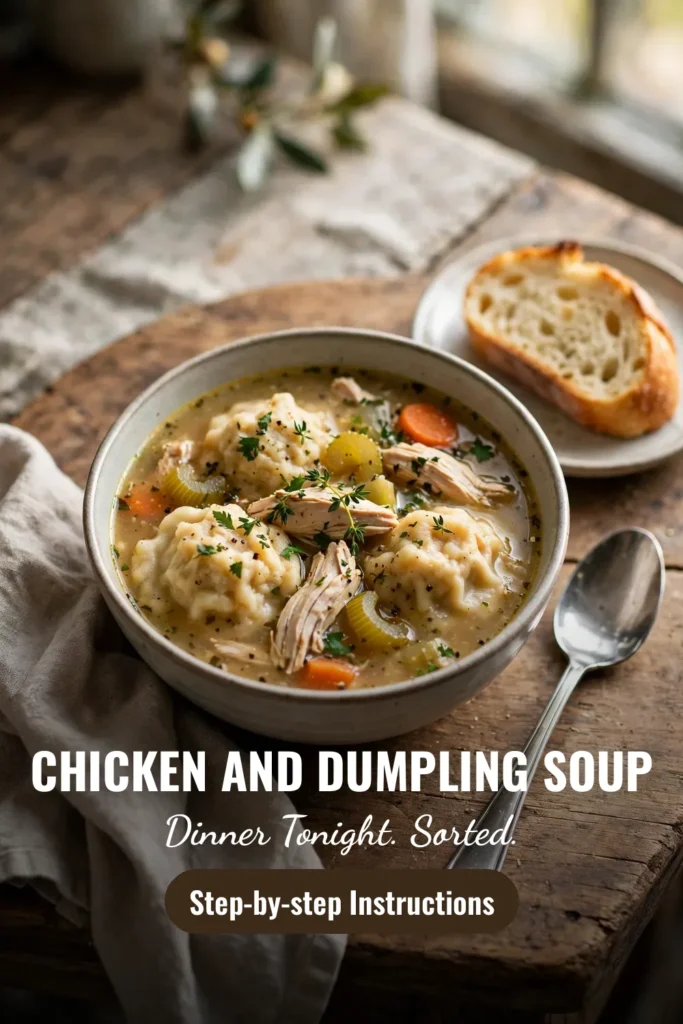
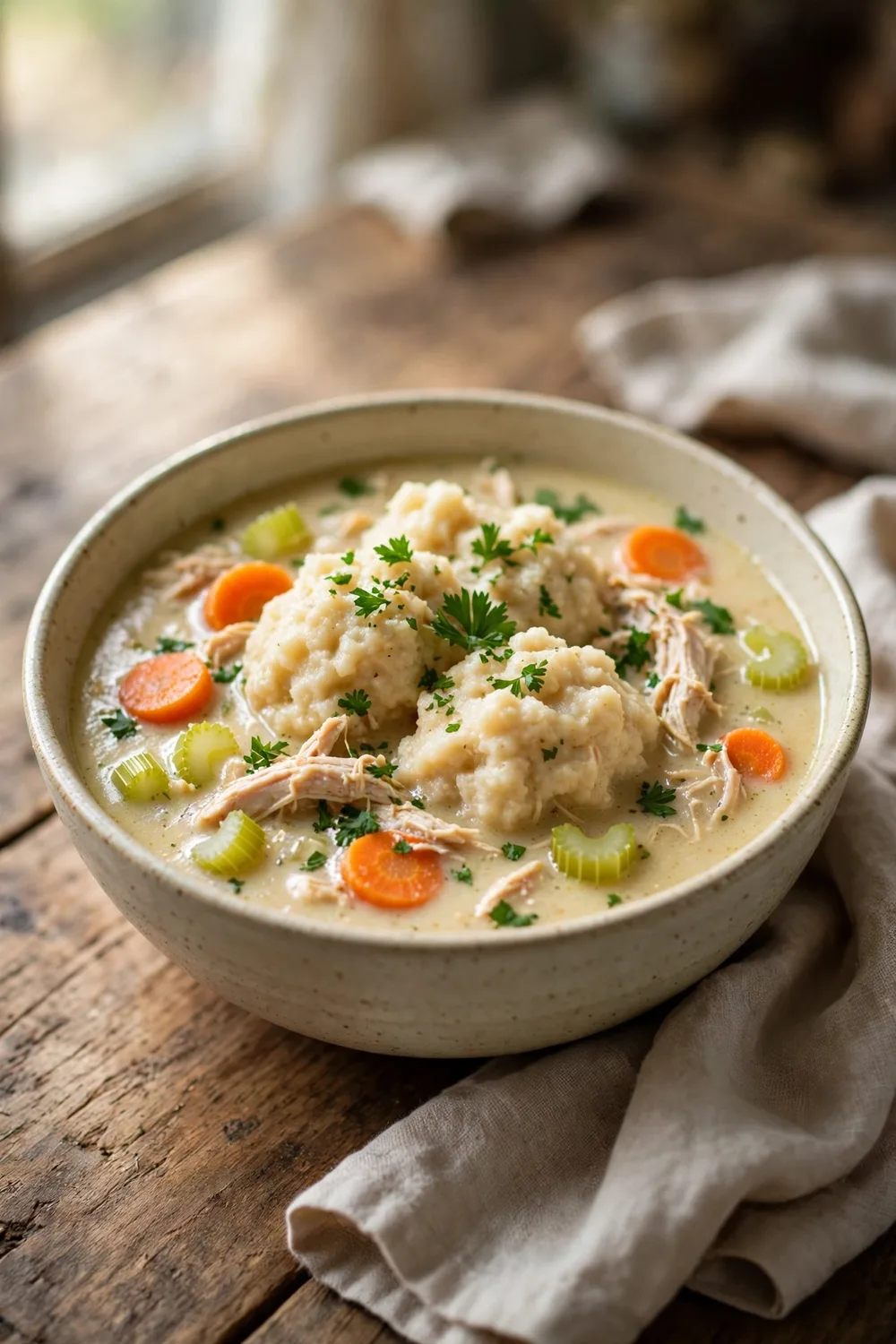
Chicken and dumpling soup is the bowl that ends the argument about what comfort food is. One pot, 50 minutes, rotisserie chicken, a rich broth thickened with a roux and finished with evaporated milk, and dumplings that puff up into soft clouds while the lid stays on. This post gives you both ways to make the dumplings: fluffy homemade drop dumplings in the recipe card, and the refrigerated biscuit shortcut written out in full for the nights when 50 minutes is already more time than you have. The target page this post beats gives you the biscuit shortcut only — its entire traffic comes from biscuit queries, yet it never explains the dumpling itself, never compares the three kinds of dumplings, and never says a word about how the soup gets thick. This post answers all three, with the amounts, the times and the reasons stated plainly.
You will love this:
- One pot, 50 minutes, no heavy cream. The broth gets its richness from a roux and evaporated milk — the Novice Chef angle — instead of Midwest’s 2 cups of heavy cream, which nobody on the search results ever discusses.
- Two dumpling paths, one post. Homemade drop dumplings in the card, the biscuit shortcut in its own H2 with every step written out — shears, six pieces, flour toss, one by one.
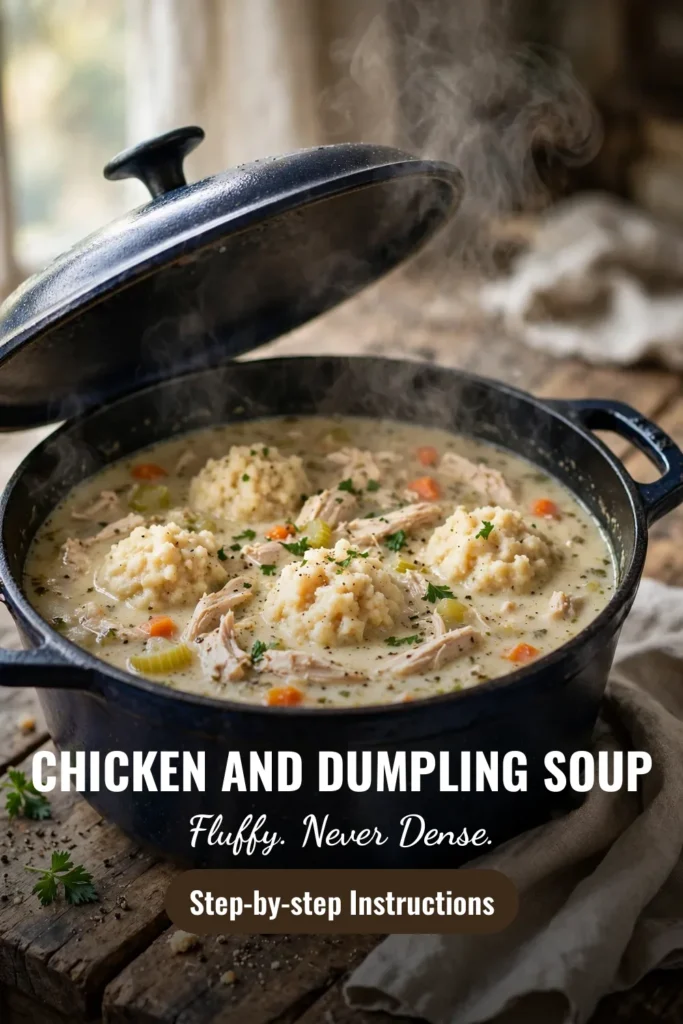
- The lid stays on for 15 minutes and you do not peek. Four pages on the search results agree on the number, and the troubleshooting H2 explains exactly what goes wrong when you do.
Why This Chicken and Dumpling Soup Works
It works because the three decisions that make or break this soup are made for you, in the open, before you start cooking. The dumplings are homemade drop dumplings — fluffy, Northern-style, scooped into the broth — because the whole search results page agrees that is the best version, and the page this post beats is the only one that never offers it. The broth is thickened with a roux first and finished with evaporated milk, because a roux gives the soup body and the evaporated milk gives it richness without the heaviness of 2 cups of heavy cream. And the chicken is rotisserie, stirred in near the end, because rotisserie chicken is already cooked and already seasoned, and the 50-minute promise only holds if the chicken does not need another 20 minutes in the pot.
What we tried, and what failed: the first version of this soup used Midwest’s 2 cups of heavy cream, and it was too rich — the kind of rich where one bowl is enough and the second bowl never happens. The evaporated milk version is the one that lets you eat a full serving and want more. We also tried skipping the flour toss on the biscuit dumplings, the way a hurried cook would, and they stuck together into one long dumpling snake — the flour toss is not optional, and the biscuit H2 says so. And we tried lifting the lid at ten minutes to check on the dumplings, the way every cook wants to, and the batch came out dense in the middle — the steam is doing the cooking, and the lid discipline is the whole recipe. Those three failures are why this post has a troubleshooting H2 instead of a testing-notes footnote.
The structure of this page is the structure of the gaps: the three dumplings compared in one table, the thickening decision in one table, the doneness test as its own H2, the biscuit shortcut written in full, the rotisserie-versus-raw split resolved, and the make-ahead and freezing answers the target page never gives. Midwest’s page is about 700–800 words of prose with no FAQ block and no question-H2s; Novice Chef’s is the FAQ bar at 10 questions and ~2,500–3,000 words. This page matches the FAQ bar and goes further on the dumplings, the thickening and the troubleshooting — that is the depth that beats a page whose only real strength is that it ranks #1 for the biscuit long-tails.
What Is Chicken and Dumpling Soup?
Chicken and dumpling soup is a chicken soup with dumplings cooked in the broth — and the word “soup” is doing more work than it looks like. Chicken and dumplings, the dish, is a Southern United States, Midwestern and French Canadian comfort food: a chicken boiled in water, the resulting broth used to cook dumplings by boiling. A dumpling here is a biscuit dough — flour, shortening and liquid (water, milk, buttermilk or chicken stock) — rolled out flat, dropped, or formed into a ball. The soup version is the Midwestern variation: the same idea, but the broth stays a soup, the chicken is shredded back in, and the dumplings float on top instead of turning the pot into a casserole. Wikipedia says it plainly — “Chicken and dumpling soup is another variation, and is very popular in the Midwest” — and that is exactly the framing of this post.
The dish is old, and its age is part of the story. Some sources trace it to the Southern United States during the Antebellum South, where it was a mainstay during harsh economic times; others attribute it as a French Canadian meal from the Great Depression. One of the earliest versions was cornmeal dumplings cooked with turnip greens. The preparation rule has not changed since: the chicken would dry out if it were boiled long enough to cook the dumplings and thicken the broth, so the chicken comes out of the broth before the dumplings go in, the meat is separated from the bones while the dumplings cook, and the chicken goes back in when the dumplings are done and the broth is seasoned and thickened. That is the rule this recipe follows — rotisserie chicken goes in near the end, raw chicken comes out to shred before the dumplings go in — and it is the reason the chicken in this soup is tender instead of stringy.
The variations have names worth knowing, because they are the entities Google expects on a complete page about this dish. “Chicken and pastry” (or “chicken pastry”) is the wide, flat noodle version, rolled from biscuit dough — where the distinction is made, it is considered a different dish from chicken and dumplings, which is known for small balls of dough rather than flat strips. In Appalachia the flat version is called “chicken and slicks”. The Pennsylvania Dutch version is called “bott boi” — large square noodles and a meat (chicken, ham or beef) simmered in stock, sometimes with saffron, potatoes, carrots and celery. And the rolled, flat, chewy dumpling is the style associated with Cracker Barrel — the comparison point for the rolled dumpling in the table below, in the style of, not a copy of their recipe. The consistency of the dish varies from a thin soup to a very thick casserole-like dish, easily eaten with a fork; thicker preparations come from simmering the dumplings longer, or from adding flour or another thickening agent directly to the broth. Ours sits in the middle: a creamy soup, thick enough to coat a spoon, thin enough to eat with one.
The Three Dumplings: Drop, Rolled, and Biscuit
Every page on the search results makes one kind of dumpling and pretends the others do not exist. Midwest makes biscuit dumplings only. Novice Chef, Cozy Cook and Inspired Taste make drop dumplings only. Nobody compares them — and the cook who wants to know which one to make is left to guess. Here are all three, in one table, with the texture, the method, the time and the best use for each — because the dumpling is the whole question this page exists to answer, and the target page’s entire traffic comes from biscuit queries while it never explains the dumpling itself.
| Dumpling type | Texture | How it is made | Time in the soup | Best for |
|---|---|---|---|---|
| Drop (Northern) | Fluffy, pillowy, soft clouds | Scooped with a cookie scoop or two spoons, dropped onto the surface of the simmering soup | 15 min, lid on, don’t peek | The default — the card’s dumpling, the quality bars’ consensus, the fluffiest result. |
| Rolled (Southern) | Chewy, noodle-like, almost like thick homemade pasta | Rolled thin on a floured surface, cut into strips or squares | 15–20 min, lid on | The chewy version — the Appalachian “chicken and slicks” / Pennsylvania Dutch “bott boi” family. |
| Biscuit | Dense, bready, substantial | Refrigerated biscuit dough, each biscuit cut into 6 pieces with kitchen shears, tossed in flour, added one by one | 15 min, lid on, don’t peek | The fastest — when time is short and the can is already in the fridge. |
The card uses drop dumplings, because drop is the default: the fluffiest, the most forgiving, and the version all three quality bars agree on. The rolled dumpling is the chewy alternative — if you want a dumpling you can bite through with resistance, roll the same dough thin, cut it into strips, and give it a few extra minutes. The biscuit dumpling is the shortcut — denser and breadier than a homemade drop, and the honest trade-off is stated in its own H2 below, not hidden. One more distinction, because it matters in the kitchen: a drop dumpling doubles or even triples in size as it cooks, which is why it is scooped small; a rolled dumpling barely grows, which is why it is cut thin; a biscuit dumpling puffs up like the biscuit it is, which is why it is cut into six pieces instead of dropped whole.
The Ingredients, With Amounts
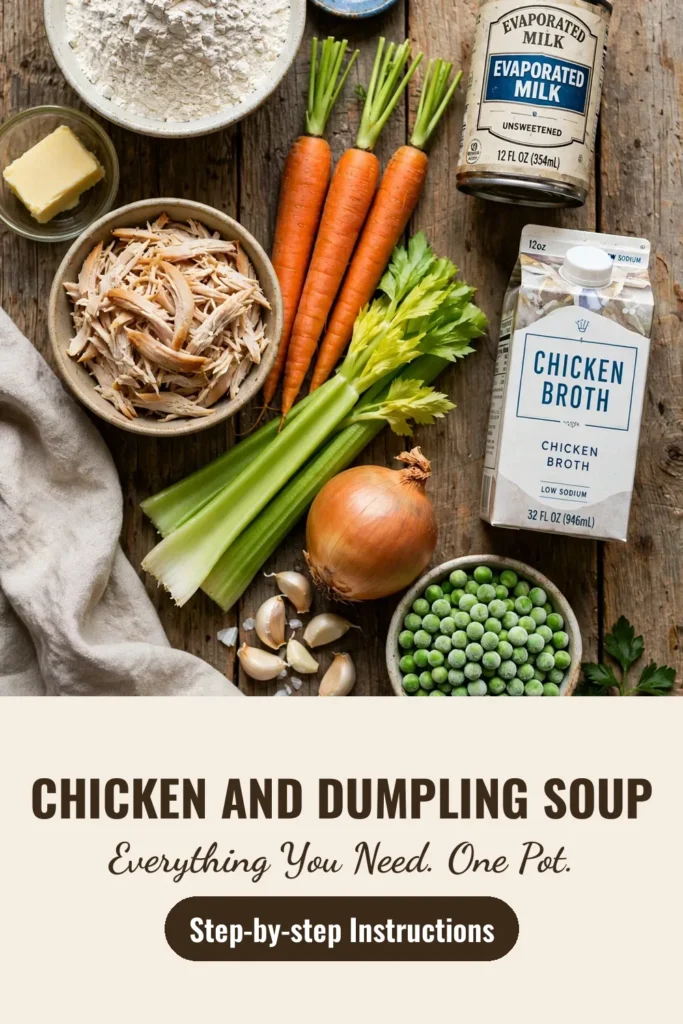
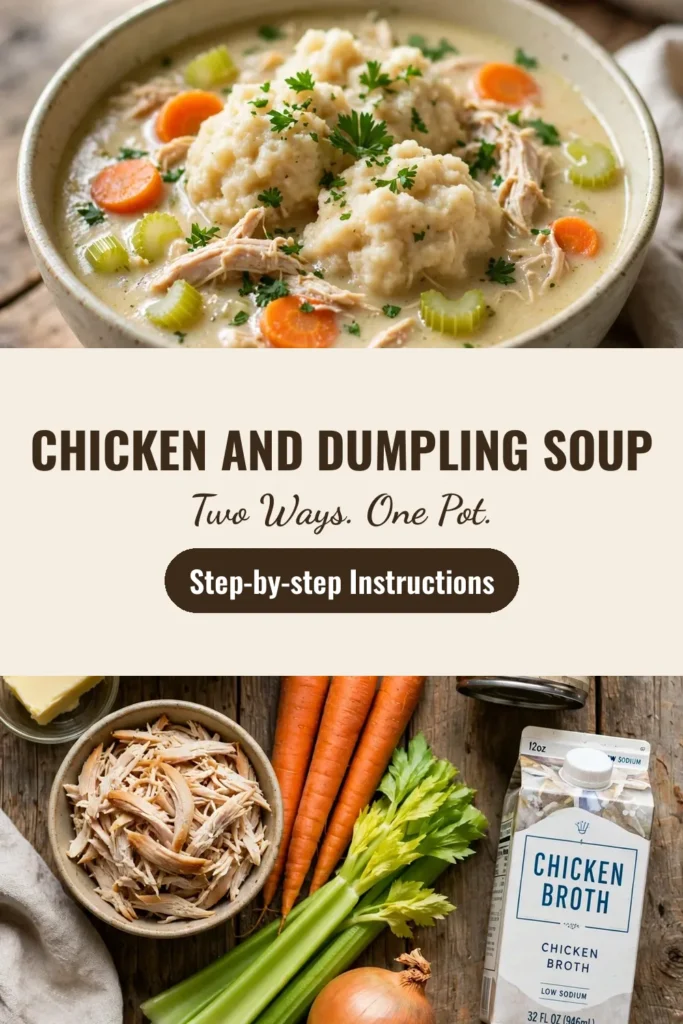
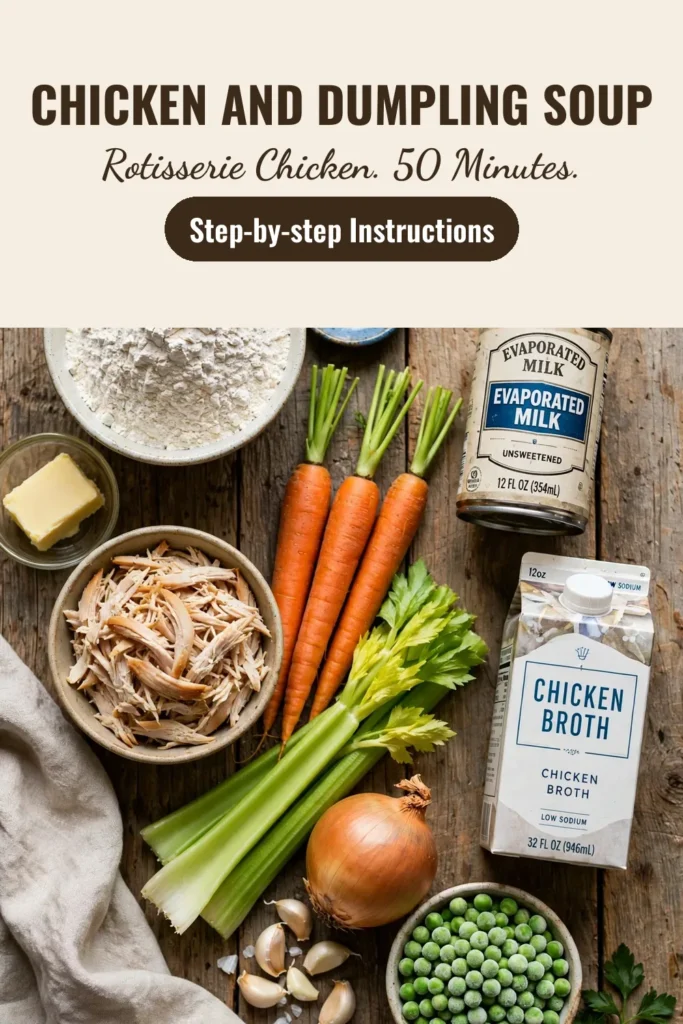
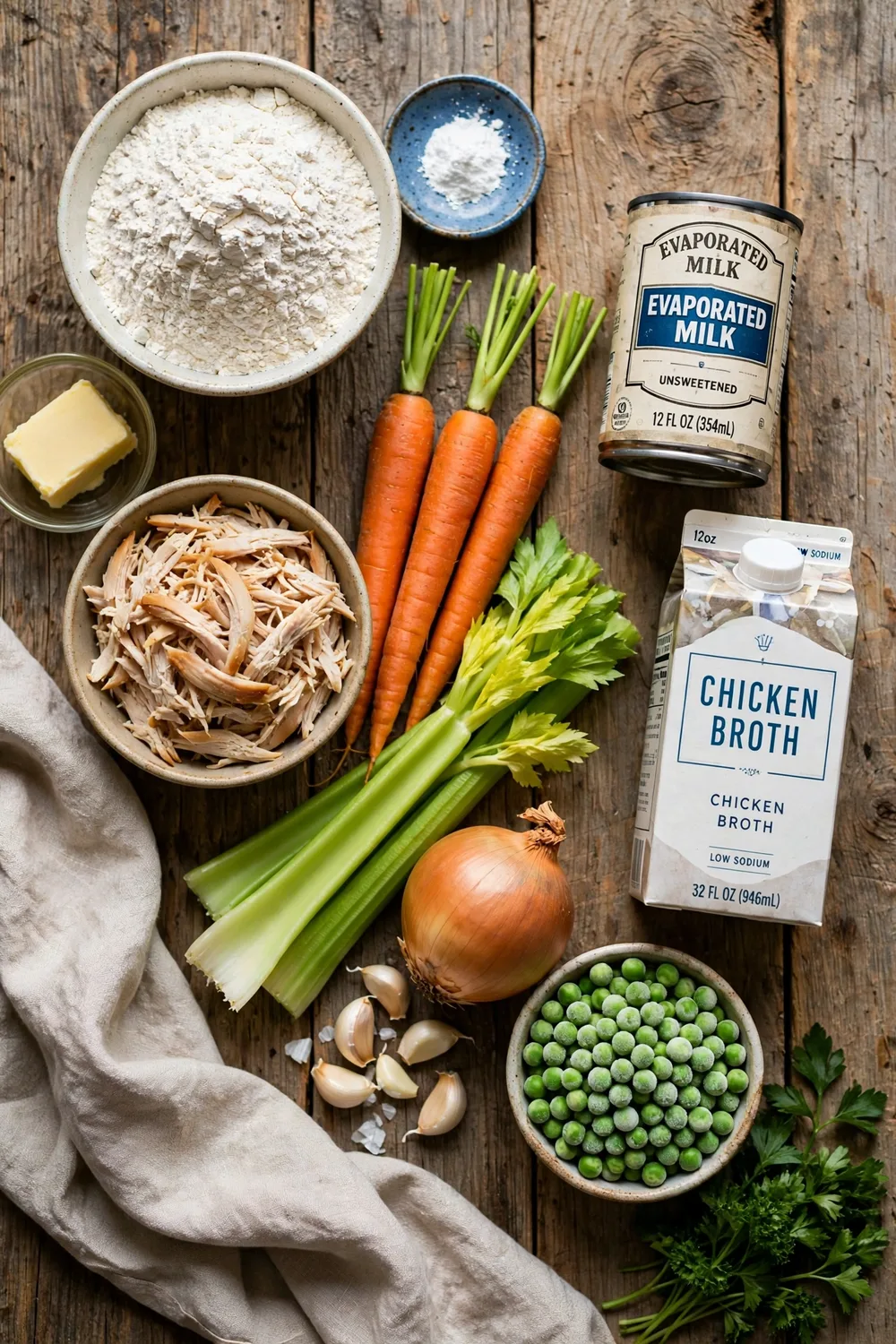
Every page on the search results lists its ingredients, and the lists are close enough that the differences are the interesting part. Midwest uses 2 cups of heavy cream and 4 cups of broth; Novice Chef uses evaporated milk and 5 cups of stock; Cozy Cook uses half and half; Inspired Taste uses no cream at all and a from-scratch broth. Here is every ingredient WITH its amount, and its job — because once you know the job, you can adjust the soup instead of guessing. This is also the answer to the question “what’s in a chicken and dumpling soup”: a butter-and-vegetable base, a flour roux, broth, chicken, evaporated milk, peas, and the dumpling dough.
| Ingredient | Amount in our batch | What it does |
|---|---|---|
| Butter | 4 Tbsp (soup) + 4 Tbsp (dumplings) | The fat. Butter is the base the aromatics cook in and the richness in the dumpling dough. Salted butter is what the nutrition working assumes — unsalted works, and the sodium note in the Nutrition H2 tells you what changes. |
| Yellow onion | 1 small, diced | The aromatic base. One small onion is enough — the soup is about the chicken and the dumplings, and the onion is the background, not the lead. Dice it small and even so it softens in 5 minutes. |
| Carrots | 1 cup, sliced | The sweetness and the colour. Slice them thin and even — thick coins stay crunchy while the dumplings cook, and the soup is done when the dumplings are done, so the vegetables have to be ready by then. |
| Celery | 1 cup, sliced | The savoury note in the base. Same rule as the carrots: small and even, or it stays raw in the middle. |
| Garlic | 4 cloves, minced | The depth. Four cloves, added after the vegetables have softened, cooked 1 minute — long enough to lose the raw edge, short enough not to burn. |
| Italian seasoning | 1 Tbsp | The herb blend. One tablespoon seasons the whole pot — oregano, basil, thyme and rosemary in one shake, which is why the soup tastes like more than its parts. |
| Dried sage | 2 tsp | The poultry herb. Sage is the flavour that says “chicken soup” before the chicken does — two teaspoons, not a tablespoon, because sage turns bitter when it dominates. |
| Fresh thyme | 1 tsp leaves (or ½ tsp dried) | The second herb. Thyme goes in the soup and in the dumpling dough, so the dumplings taste like the soup they cook in. Dried thyme is stronger by volume — half the amount if that is what you have. |
| All-purpose flour | 3 Tbsp (roux) + 2 cups (dumplings) | The thickener and the dumpling. Three tablespoons cooked in butter is the roux that gives the broth its body; two cups is the dumpling dough. Spoon it into the measuring cup and level it off — scooping packs it down, and too much flour is the #1 reason dumplings sink. |
| Low-sodium chicken broth | 6 cups | The liquid. Low-sodium, because the salt is added by hand and the sodium is already the highest number on this page — the Nutrition H2 shows the working. If you use regular broth, cut the added salt in half. |
| Rotisserie chicken | 2 cups, shredded | The chicken. Already cooked, already seasoned, shredded — the 50-minute version. Raw chicken is the option, not the card: 1½ lbs boneless skinless breasts or thighs, simmered 20 minutes to 165°F, then shredded (see the rotisserie-vs-raw H2). |
| Evaporated milk | 1 cup (12 oz can) | The richness, without heavy cream. Evaporated milk is milk with about 60% of the water removed — rich and slightly caramelised, and it does not split the way cream can. Half and half is the middle swap; ½ cup heavy cream is the richest swap. |
| Frozen peas | 1 cup | The green and the sweetness. Frozen peas go in near the end — they need 2 minutes, not 20, and they stay bright green if they are not boiled to grey. |
| Bay leaves | 2 | The background bitterness that makes the broth taste finished. Two leaves, fished out before serving — they are not eaten. |
| Kosher salt + black pepper | To taste (about 1 tsp salt in the soup) | The seasoning. About a teaspoon of kosher salt in the soup, plus pepper — and the dumpling dough has its own teaspoon, which is why the sodium note in the Nutrition H2 names the dumplings as nearly half the batch sodium. |
| Fresh parsley | Chopped, to serve | The finish. Parsley goes on at the table, not in the pot — it stays green and fresh, and it is the only garnish this soup needs. |
That is the whole list — sixteen soup lines and seven dumpling lines, every one of them in the recipe card below with its amount. The biscuit shortcut is a separate question, and its H2 gives the method in full. The flour swaps and the from-scratch broth live in their own H2s, not here, because the base soup is the recipe and the options are the options.
How to Make Chicken and Dumpling Soup
This is a chicken and dumpling soup in the truest sense: fifteen minutes of prep, thirty-five minutes of cooking, one pot, and the batch makes 6 servings of about 1½ cups each — the most useful batch size on the search results, because the two fullest pages both yield 6 and nobody explains how to scale it. The soup is the five steps below, in order, and the dumplings are the last step — because the dumplings cook in the soup, not beside it, and the soup has to be ready before they go in.
Sauté the aromatics — Melt 4 tablespoons of butter in a wide Dutch oven over medium heat — wide, not tall, so the dumplings spread in one layer later and steam evenly instead of stacking. Add the diced onion, the sliced carrots and the sliced celery, and cook 5 minutes, stirring, until the onion is soft and the carrots have started to give. Then add the minced garlic, the Italian seasoning, the dried sage and the fresh thyme, and cook 1 minute more — the garlic loses its raw edge, the herbs bloom in the butter, and the pot smells like the soup already. Do not let the garlic brown: browned garlic is bitter, and there is no fixing it once it is in the broth.
Build the roux — Sprinkle 3 tablespoons of flour over the vegetables and stir to coat, then cook 1 minute, stirring constantly. This is the roux, and the minute matters: raw flour tastes like paste, and a roux that is cooked for a minute tastes like nothing at all, which is the point — it thickens the broth without flavouring it. Midwest, Novice Chef and Cozy Cook all start with a roux, and all three cook it for about a minute; the one thing none of them says is why, and the reason is the raw-flour taste. If the flour clumps, keep stirring — it will loosen as it cooks, and the broth will smooth it out.
Add the chicken and broth — Pour in the 6 cups of low-sodium chicken broth in small splashes, scraping the bottom of the pot as you go — the splashes dissolve the roux without lumps, and the scraping lifts the browned bits off the bottom, which is flavour. Then stir in the evaporated milk the same way, slowly, so it does not curdle. Add the shredded rotisserie chicken, the frozen peas and the bay leaves, and bring the pot to a gentle simmer — a few bubbles breaking the surface, not a rolling boil. A rolling boil scorches the bottom and agitates the dumplings later; a gentle simmer is the heat this soup lives at. Taste and season with salt and pepper now, before the dumplings go in — the dumplings will absorb salt from the broth, and a broth that tastes right before the dumplings will taste right after them.
Mix the dumpling dough — While the soup simmers, make the dumplings. Whisk the 2 cups of flour, the 1 tablespoon plus 1 teaspoon of baking powder, the teaspoon of salt, the teaspoon of black pepper and the tablespoon of fresh thyme in a bowl. Make a well in the centre, pour in the ¾ cup of whole milk and the 4 tablespoons of melted butter, and stir just until a dough ball forms — and stop. Do NOT over-mix. Over-mixed dumpling dough is dense dumpling dough, and there is no fixing it once the gluten has tightened. The dough should be soft and slightly sticky, not smooth and not dry; if it is dry, add milk a tablespoon at a time. The baking powder amount is exact for a reason: 1 tablespoon plus 1 teaspoon per 2 cups of flour is the Novice Chef amount, and expired or mis-measured baking powder is the #1 reason dumplings are dense and sinking. Check the date on the can before you start.
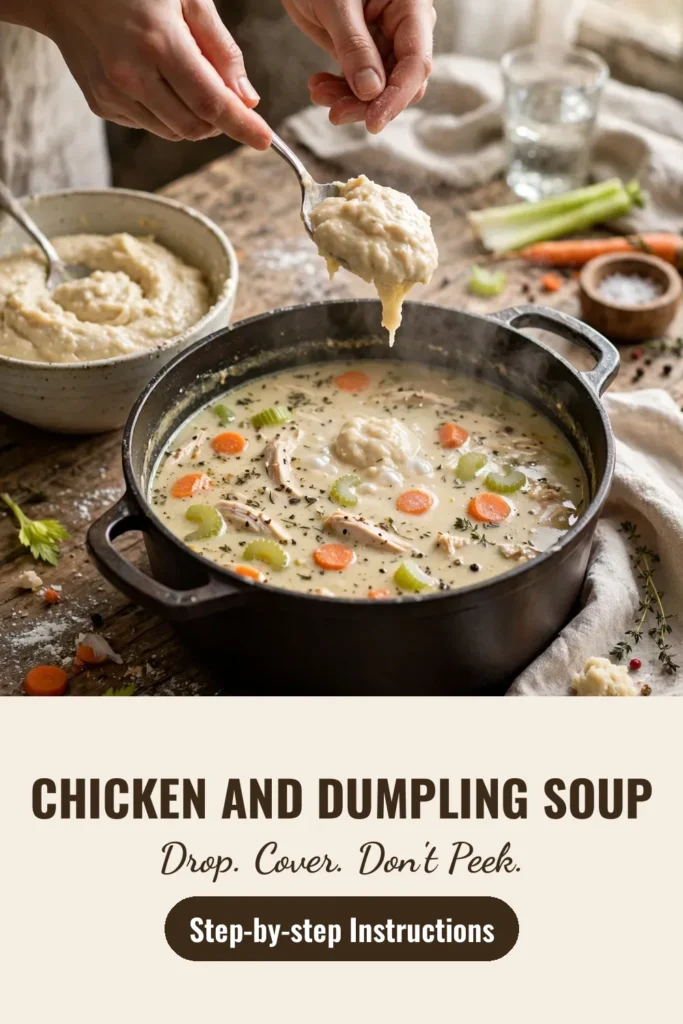
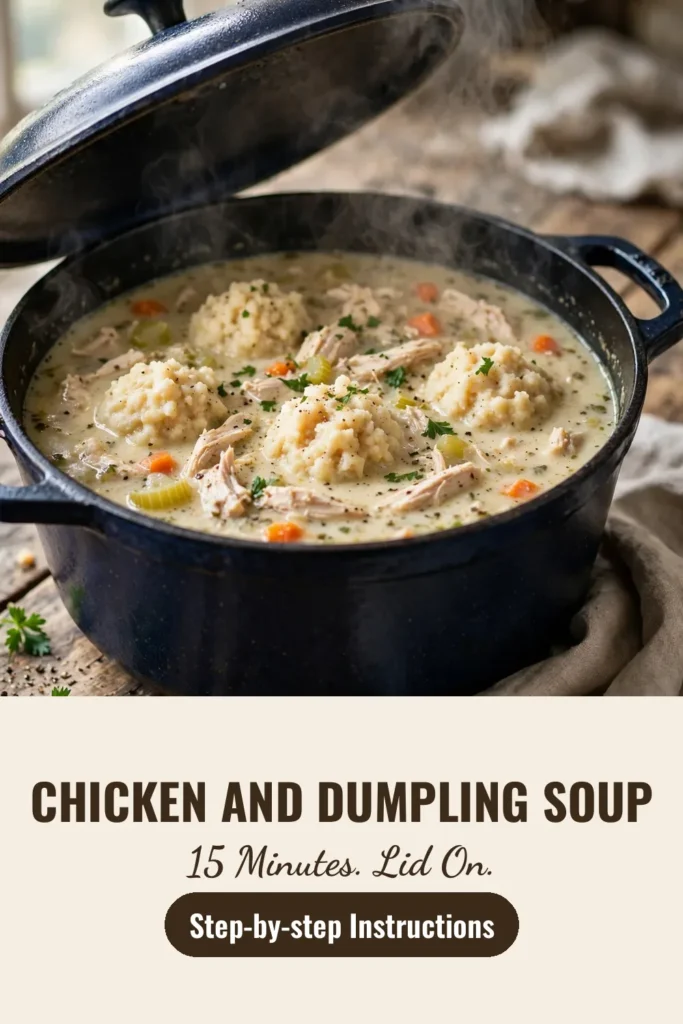
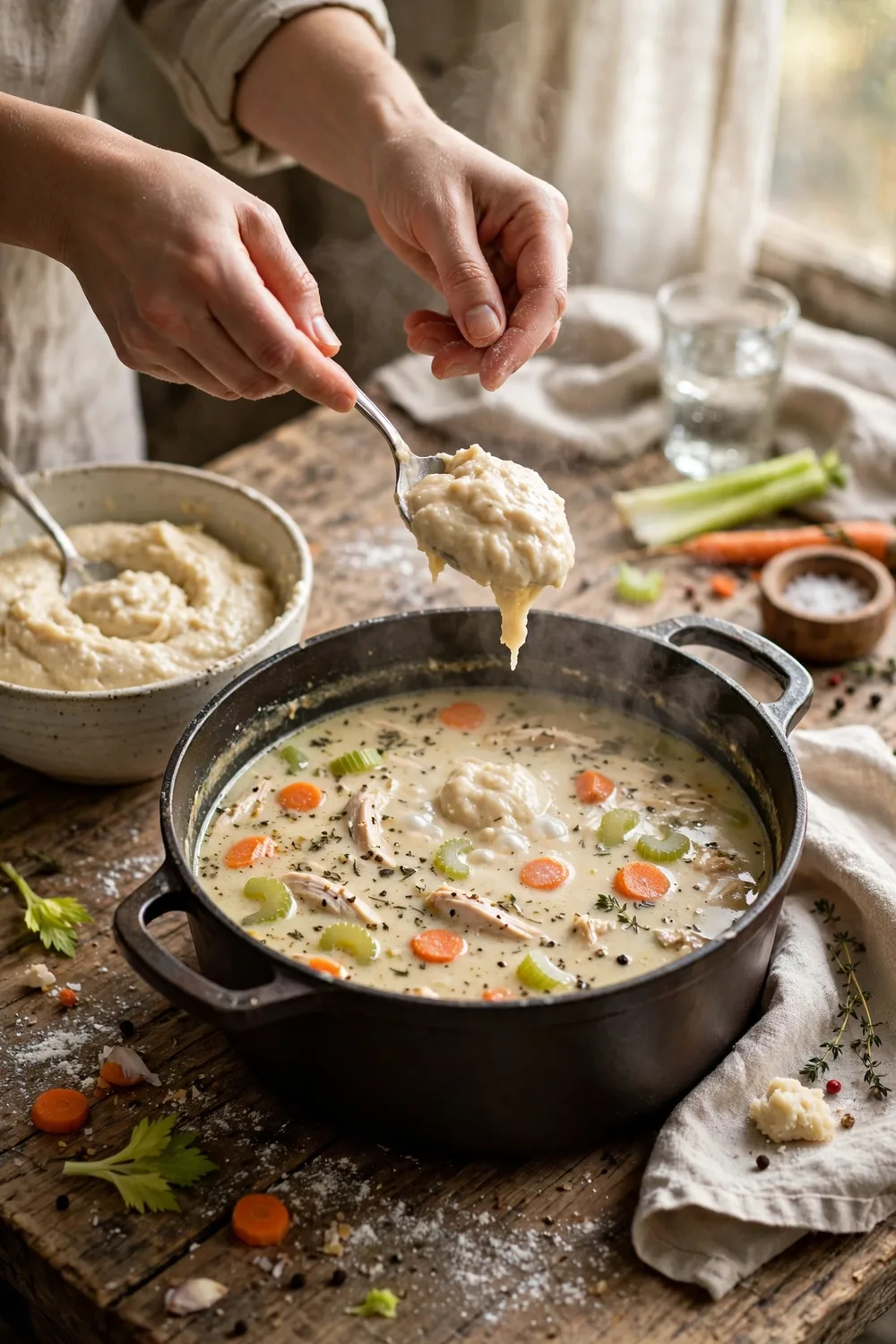
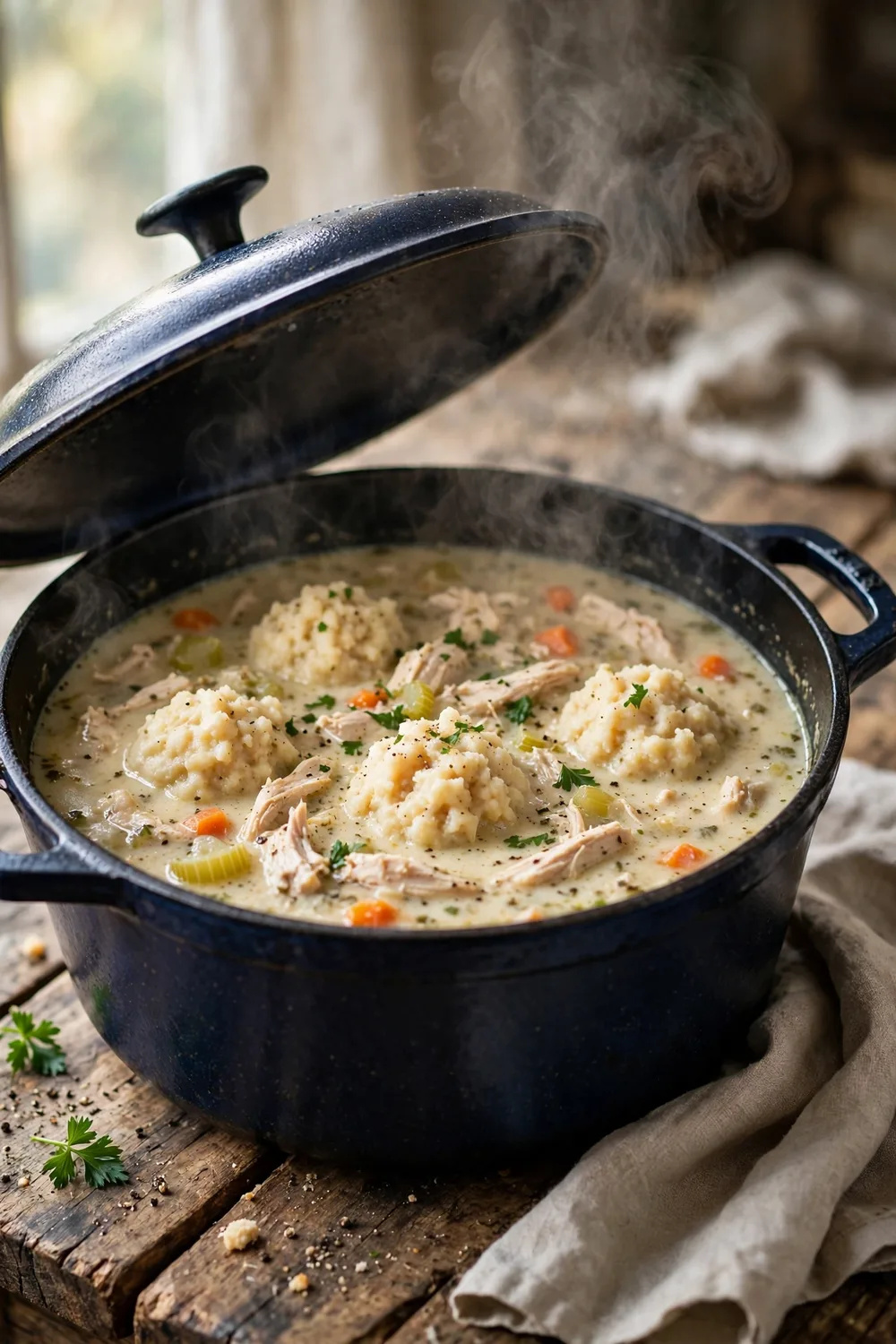
Drop, cover, and don’t peek — Use a cookie scoop, or two spoons, to drop the dough onto the surface of the simmering soup — about 2 tablespoons per dumpling, all roughly the same size so they cook evenly. Spread them around the pot in one layer and gently press each one down so the soup runs over just the tops; spoon a little liquid over each one if it helps. Then put the lid ON, turn the heat down to a gentle simmer, set a timer for 15 minutes, and DO NOT PEEK. The dumplings need steam to cook, and lifting the lid drops the temperature and makes them dense in the middle. Four pages on the search results agree on the 15 minutes — Midwest, Novice Chef, Cozy Cook and the Best Crafts and Recipes snippet — and every one of them says the same thing about the lid. When the timer goes off, test one dumpling with a toothpick (clean means done) or cut one in half (cook 3–4 minutes more if the centre is doughy). Fish out the bay leaves, sprinkle with parsley, and serve.
How to Thicken Chicken and Dumpling Soup
Midwest uses 2 cups of heavy cream and never discusses it. Nobody on the search results gives the roux-versus-cream-versus-slurry decision — the soup just gets thick, or it doesn’t, and the cook is left to guess which lever to pull. Here is the decision, in one table, because thickening is the second question this page exists to answer, and the answer is not “add more cream”.
| Method | What it does | When to use it |
|---|---|---|
| Roux (flour + butter, cooked 1 min) | Thickens the broth from the start, with no flavour of its own | Always — it is the base of this recipe, 3 Tbsp flour in 4 Tbsp butter, and the reason the soup has body before the dumplings go in. |
| Evaporated milk (1 cup) | Adds richness and a little body, without the heaviness of cream | The card’s choice — rich without heavy cream, and it does not split the way cream can. |
| Half and half | The middle — richer than evaporated milk, lighter than heavy cream | The swap if evaporated milk is not in the cupboard; use the same 1 cup. |
| Heavy cream (½ cup as a swap, not 2 cups) | The richest finish, the heaviest result | Only as a richness dial — ½ cup stirred in at the end, never 2 cups from the start, or the soup is too rich for a second bowl. |
| Flour slurry (flour + cold water) | Thickens a thin broth after the fact | Only as a rescue — whisk 2 Tbsp flour into ¼ cup cold water, stir it in, simmer 2 minutes; never needed when the roux is right. |
| The dumplings themselves | Release starch as they cook and thicken the soup | Automatic — the soup is noticeably thicker after the 15-minute dumpling simmer than before it, which is why the broth should start a touch thinner than you want it to finish. |
The richness dial, stated plainly: evaporated milk is the card, half and half is the middle, heavy cream is the richest — and the amount matters as much as the choice. Midwest’s 2 cups of heavy cream is the heaviest version on the search results, and it is the one we tested and rejected, because a soup that rich is a soup you eat once. Half a cup of heavy cream stirred in at the end gives the same richness in the first spoonful without the weight in the second bowl. And the rule nobody states: the dumplings thicken the soup as they cook. The starch they release is why a broth that looks thin at the dumpling step tastes right at the serving step — so do not thicken the soup before the dumplings go in, or it will be glue by the time they come out.
How to Tell When the Dumplings Are Done
The dumplings are done when the toothpick comes out clean — that is the test Midwest gives, and it is the right one. Push a toothpick into the centre of the largest dumpling; if it comes out clean, the dumpling is cooked through; if it comes out with wet dough on it, put the lid back on and give it a few more minutes. The second test is the cut-in-half test, from Novice Chef: cut one dumpling in half and look at the centre — it should be cooked through and fluffy, not doughy. If it is doughy, cook 3–4 minutes more, lid on. The third sign is the size: dumplings double or even triple in size as they cook, which is why they are scooped small — a dumpling that has not grown has not cooked.
There is a second technique worth knowing by name, from Inspired Taste: the flip method. Instead of 15 minutes lid-on, you cover the pot for 5–7 minutes until the bottoms of the dumplings are firm, flip each one with two spoons, cover again, and cook 8–10 minutes more until the centres are cooked through and fluffy. It is the same 13–17 minute window, differently divided — and it is the method to use if your dumplings are large, or if your pot is wide and the steam is uneven. One more trick from the same page: if there is no space for the liquid to bubble past the dumplings, make a small hole in the middle of the dumpling layer for the steam. And the rule that applies to both methods: keep the heat low. A rolling boil agitates the dumplings and they fall apart; a gentle simmer cooks them evenly and keeps them whole.
Troubleshooting: 5 Fixes
Midwest has “things I learned while testing this recipe” — four bullets — but no failure-mode section. Nobody on the search results explains what happens when the soup goes wrong. Here are the five failures, why they happen, and how to fix them.
Dumplings dense or sinking — Why: the baking powder was expired or mis-measured, or the flour was scooped instead of spooned, or the lid was lifted, or the soup was boiling too hard. Fix it now: there is no way to un-sink a dumpling — serve the soup as it is, and call the dumplings “rustic”. Next time: check the baking powder date and measure exactly 1 tablespoon plus 1 teaspoon per 2 cups of flour; fluff the flour, spoon it into the measuring cup and level it off instead of scooping from the bag; keep the lid on for the full 15 minutes; and keep the soup at a gentle simmer, not a boil.
Dumplings gummy — Why: the dough was over-mixed, so the gluten tightened and the dumpling turned gummy instead of fluffy. Fix it now: nothing fixes a gummy dumpling once it is cooked — but a gummy dumpling in a good broth is still a good bowl of soup, so serve it and move on. Next time: stir the dumpling dough just until it comes together and stop; the dough should look rough and slightly sticky, not smooth. A cookie scoop helps here, because it portions the dough without handling it.
Dumplings falling apart — Why: the soup was boiling too hard, so the dumplings were agitated until they broke up — or they were overcooked past the 15 minutes, and overcooked dumplings fall apart and disappear into the soup. Fix it now: fish out what is left, stir the broken pieces back in as thickener (they will thicken the broth, which is not nothing), and serve. Next time: a gentle simmer, a few bubbles, never a rolling boil; and set a timer — 15 minutes, lid on, toothpick test, done.
Raw middles — Why: the dumplings were too big, or they were stacked instead of spread in one layer, or the lid was lifted and the steam escaped. Fix it now: put the lid back on and cook 3–4 minutes more — a raw middle is the one failure that time fixes. Next time: scoop the dumplings about 2 tablespoons each, all the same size; spread them in one layer in a wide pot, not stacked in a tall one; and do not lift the lid until the timer goes off.
Broth too thin or too thick — Why: too thin — the roux was skipped or undercooked, or the broth was added too fast and the roux never dissolved; too thick — the soup was thickened before the dumplings went in, and the dumplings’ starch pushed it over the edge. Fix it now: too thin — whisk 2 tablespoons of flour into ¼ cup of cold water, stir it in, simmer 2 minutes; too thick — stir in broth a splash at a time until it loosens. Next time: cook the roux a full minute and add the broth in small splashes; and start the broth a touch thinner than you want it to finish, because the dumplings thicken it as they cook.
The Biscuit Shortcut, Done Right
Midwest’s whole page is this shortcut, and it is a good one — but it is written as a testing note, not a method, and the cook who has never cut a biscuit into six pieces is left to work it out. Here is the method in full, because the shortcut is only a shortcut if you know how to do it. Start with one 16.3 oz can of refrigerated biscuit dough. Open the can, separate the biscuits, and cut each biscuit into 6 pieces with clean kitchen shears — cut it in half, then each half into thirds, which gives 6 triangles. Toss the pieces in flour, shaking off the excess, and add them to the simmering soup one by one. The flour toss is not optional: without it, the pieces stick together into one long dumpling snake, which is the failure we found in testing. The one-by-one addition is not optional either: dropped in a clump, they fuse. Cover, simmer 15 minutes, lid on, don’t peek — the same 15 minutes as the homemade drop, the same toothpick test at the end.
The honest trade-off, stated plainly: biscuit dumplings are denser and breadier than homemade drop dumplings. They are not fluffy clouds; they are substantial, bready, and a little chewy — and that is fine, because they are also the fastest dumpling on this page, and the fastest dumpling on the search results. The table below is the comparison to make before you choose.
| Homemade drop dumplings (the card) | Biscuit dumplings (the shortcut) | |
|---|---|---|
| Time | 5 minutes to mix, 15 minutes to cook | 2 minutes to cut and toss, 15 minutes to cook. |
| Texture | Fluffy, pillowy, soft | Dense, bready, substantial. |
| What you need | Flour, baking powder, milk, butter, thyme | One can of refrigerated biscuit dough, flour for tossing, kitchen shears. |
| Cost | Pantry staples, pennies a batch | About the price of a can of biscuits. |
| Best for | The best bowl of soup on this page | The weeknight when 50 minutes is already more time than you have. |
One more note, because the search results are full of the question: yes, you can use canned biscuits for dumplings, and yes, any refrigerated biscuit dough works — the brand on the can does not matter, and this post does not endorse one. The phrases that bring people to this page are the biscuit long-tails — chicken and dumpling soup with biscuits, chicken dumpling soup with biscuits, chicken and biscuit soup, chicken biscuit soup, chicken dumpling soup with canned biscuits, chicken soup with biscuit dumplings — and every one of them is answered here, in the method above, instead of assumed.
Rotisserie vs Raw Chicken
The card uses rotisserie chicken, and the reason is the clock: rotisserie chicken is already cooked and already seasoned, so the soup takes 50 minutes. Raw chicken is the option, and it is a real one — but it costs 20 minutes, and the method is different, so here is the split resolved. Rotisserie: 2 cups, shredded, stirred in near the end, after the broth is simmering and before the dumplings go in. Stirring it in near the end matters, because rotisserie chicken that boils for 35 minutes dries out — it is already cooked, and the soup only needs to heat it through. Raw: 1½ lbs boneless skinless breasts or thighs, simmered in the broth for 20 minutes until they reach 165°F, then lifted out, shredded, and returned to the pot before the dumplings go in. The thighs are juicier and more forgiving; the breasts are leaner and shred cleanly. That is the whole difference, and it is also the whole choice: rotisserie for speed, raw for the cook who wants to control the seasoning from the start.
Two cautions, both from the search results. First, Midwest’s own card contradicts itself here — step 7 says “add chicken breast” while the ingredient list says “2 cups shredded rotisserie chicken” — and this post does not repeat the mistake: the card says rotisserie, the body says raw is the option, and the two are never mixed in one sentence. Second, searing is optional, not required: Cozy Cook sears the chicken first — season it, brown it 3 minutes a side in olive oil, rest 10 minutes, cut it into bite-sized pieces — and the sear adds flavour, but the soup does not need it. Skip the sear on a weeknight; do it on a Sunday. And the rule from Wikipedia, which has not changed since the dish was invented: the chicken comes out of the broth before the dumplings go in, because chicken boiled long enough to cook dumplings and thicken broth would dry out. Rotisserie goes in near the end; raw comes out to shred. Either way, the chicken is tender when the soup is served.
Make Ahead, Storage, and Freezing
Midwest’s page says the soup keeps in the fridge for up to a week and the biscuits should be stored separately — and nothing else. No make-ahead, no freezing, no reheating rules. Here is the full answer, because a soup that takes 50 minutes is a soup worth making ahead, and the dumplings are the part that does not keep.
The soup base — everything except the dumplings — keeps in the fridge for up to 2 days, and freezes for up to 3 months. Make the base, cool it, and put it in the fridge or the freezer; when dinner is ready, reheat it to a simmer and drop fresh dumplings in, and dinner is 20 minutes away. The dumplings themselves do not freeze and do not keep: they soak up broth overnight and get mushy, and frozen dumplings come back softer and mushier still. Make them fresh on the reheat, every time — that is the rule Novice Chef and Inspired Taste agree on, and it is the rule this post follows. Store the dumplings and the soup separately if there are leftovers, for the same reason: together in one container, the dumplings drink the broth overnight and turn to mush by morning.
| Storage method | How long | How to reheat |
|---|---|---|
| Soup base, fridge | Up to 2 days | Reheat to a simmer on the stove, drop fresh dumplings, 15 min lid on. |
| Soup base, freezer | Up to 3 months | Thaw overnight in the fridge, reheat to a simmer, drop fresh dumplings. |
| Finished soup (with dumplings), fridge | 3–4 days, dumplings stored separately | Reheat on medium-low on the stove, or microwave in 30-second bursts; add a splash of broth or cream, because the broth thickens as it cools. |
| Dumplings, on their own | Do not store — make fresh | N/A — dumplings are always made fresh, on the reheat or on the night. |
Reheating rules, because the search results agree on them and the target page never states them: reheat on the stove over medium-low heat, not a boil; add a splash of broth or evaporated milk, because the broth thickens as it cools and the soup will be thicker the second day than the first; do not stir much, because the dumplings break apart if they are stirred; and if you are reheating a finished bowl in the microwave, do it in 30-second bursts. The broth thickens as it sits — that is the dumpling starch, still working — so a second-day bowl needs the splash more than the first-day bowl does.
Slow Cooker and Instant Pot
The card is stovetop, and the stovetop is the standard — but the slow cooker and the Instant Pot are real options, and the target page has neither. Novice Chef links separate Crockpot and Instant Pot versions rather than writing them into the page; this post writes them in, as outlines, because the cook who owns a slow cooker deserves a method, not a link. No volume is claimed for these method phrases — the Semrush files have no rows for the slow-cooker or Instant Pot versions of this soup, and this H2 is a usefulness section, not a keyword target.
Slow cooker. Build the soup base in the slow cooker: butter, onion, carrots, celery, garlic and seasonings in the pot, then the flour, then the broth, the chicken and the peas. Cook on low 4–5 hours or high 2–3 hours, until the vegetables are tender. Stir in the evaporated milk in the last 30 minutes. Then drop the dumplings — homemade or biscuit — onto the surface, cover, and cook on high for 45–60 minutes, lid on, don’t peek. The dumplings take longer in a slow cooker than on the stove, because the heat is gentler; give them the full hour and test with a toothpick. The raw-chicken version works well here: the chicken simmers in the pot for the whole cook time, then comes out to shred before the dumplings go in.
Instant Pot. Sauté the aromatics in butter on the sauté setting, 5 minutes; add the garlic and seasonings, 1 minute; sprinkle in the flour and cook 1 minute; pour in the broth in splashes, scraping the bottom; add the chicken, peas and bay leaves. Pressure cook on high for 10 minutes, then quick-release. Stir in the evaporated milk, switch back to sauté, and bring the soup to a gentle simmer. Drop the dumplings, cover with the lid (not sealed — just resting on top, or use a glass lid), and simmer 15 minutes, don’t peek. The pressure cook does the soup’s work in 10 minutes; the dumplings still need their 15, because steam is steam and the lid discipline does not change.
What to Serve with Chicken and Dumpling Soup
This is a full meal in one pot — chicken, vegetables, dumplings, broth — and the search results agree that it does not need much beside it. Midwest serves it with a simple house salad, air fryer green beans, crispy garlic bread, cornbread casserole and cheesy olive garlic bread. Novice Chef says the same thing more plainly: it is a full meal in one pot, maybe a simple green salad. This post agrees, with two serve-with picks from this site and one rule: the side should be something the soup does not already have — crunch, or green, or bread for dunking.
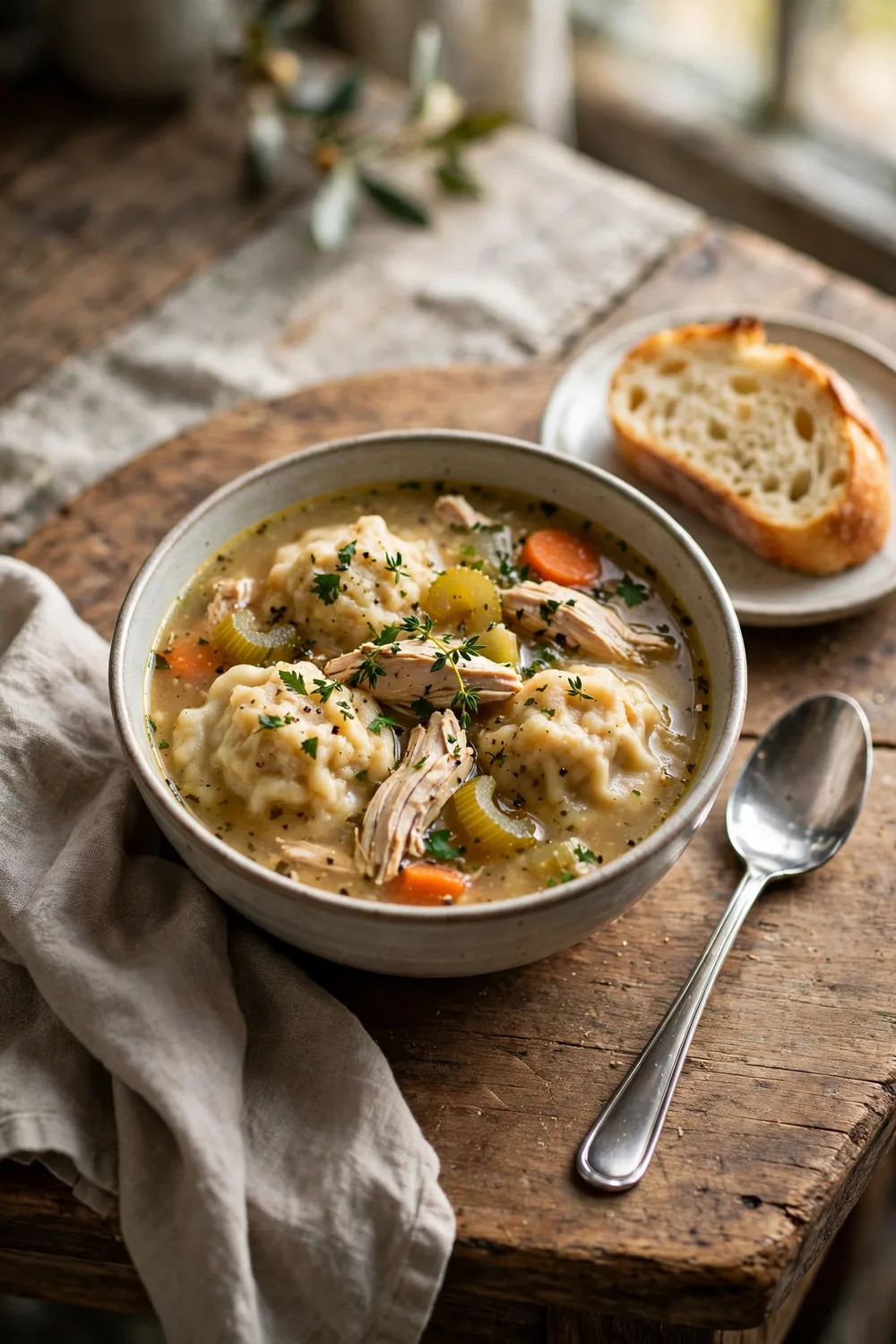
- Flatbread Pizza Crust — the bread for dunking. A thin, crisp flatbread, torn into pieces, is the thing the soup’s broth was made for — and the flatbread’s 25-minute total means it can be in the oven while the dumplings simmer.
- Crack Green Beans — bacon and brown sugar glaze, 30 minutes. Midwest serves her soup with air fryer green beans; this is the site’s green-bean side, and the sweet-salty glaze is the contrast a creamy soup wants.
A simple green salad is the third option, and it needs no recipe: mixed greens, a sharp vinaigrette, nothing more. The soup is rich and the salad is sharp, and the two balance each other. What not to serve: another starch, another creamy dish, or anything that competes with the dumplings for the cook’s attention. The dumplings are the point of the bowl; the side is the supporting act.
Frequently Asked Questions
Can I use canned biscuits for dumplings?
Yes — the shortcut H2 has the full method: one 16.3 oz can of refrigerated biscuit dough, each biscuit cut into 6 pieces with kitchen shears, tossed in flour, added one by one, 15 minutes lid on. They are denser and breadier than homemade drop dumplings, and that is the honest trade-off.
Can you use Pillsbury biscuits for dumplings?
Yes — any refrigerated biscuit dough works, and the brand on the can does not matter. Cut each biscuit into 6, toss in flour, add one by one. The biscuit H2 has the full method.
How long do you cook biscuits for dumplings?
15 minutes, lid on, don’t peek — the same 15 minutes as the homemade drop. Test with a toothpick (clean means done) or cut one in half. The doneness H2 has the full test.
Why are my dumplings dense and sinking?
The baking powder was expired or mis-measured, or the flour was scooped instead of spooned, or the lid was lifted, or the soup was boiling too hard. The troubleshooting H2 has the full fix — and the baking powder amount is exact for a reason: 1 tablespoon plus 1 teaspoon per 2 cups of flour.
Can you overcook dumplings?
Yes — overcooked dumplings fall apart and disappear into the soup. Set a timer for 15 minutes, test with a toothpick, and take them off the heat when they are done. The troubleshooting H2 has the full fix.
Can I freeze chicken and dumpling soup?
The base only, up to 3 months — never the dumplings, which come back softer and mushier. Thaw the base overnight in the fridge, reheat to a simmer, and drop fresh dumplings. The make-ahead H2 has the full storage table.
What’s the difference between Northern and Southern chicken and dumplings?
Northern dumplings are fluffy drop dumplings, scooped into the broth, that puff into pillowy clouds. Southern dumplings are flat rolled dumplings, rolled thin and cut into strips, chewy and noodle-like, almost like thick homemade pasta. The three-dumplings H2 has the full comparison table.
What is the best chicken for chicken and dumpling soup?
Rotisserie for speed — it is already cooked and already seasoned, and it goes in near the end so it does not dry out. Thighs are juicier and more forgiving; breasts are leaner and shred cleanly. The rotisserie-vs-raw H2 has the full split.
Can I make chicken and dumpling soup in advance?
Yes — the soup base keeps in the fridge for up to 2 days and freezes for up to 3 months. Reheat it to a simmer, drop fresh dumplings, and dinner is 20 minutes away. The make-ahead H2 has the full storage table.
How do I keep dumplings from getting gummy?
Don’t overmix the dough — stir just until it comes together and stop. Keep the soup at a gentle simmer, not a boil, and keep the lid on for the full 15 minutes. The troubleshooting H2 has the full fix.
More Easy Soups
- Olive Garden Chicken Gnocchi Soup — creamy, one-pot, 35 minutes. The soup-cluster neighbour — seared chicken, potato gnocchi, spinach, and a cream blend that never splits.
- Vegetarian Lasagna Soup — one pot, 35 minutes. Broken lasagna noodles, red lentils, mushrooms and herbed ricotta in a rich tomato broth.
- Cheeseburger Soup — 45 minutes, 8 servings. The potato-camp cheeseburger soup — creamy, cheesy, and the one that links back to the cheeseburger pasta.
- Crockpot Beef Stew — 8 hours 25 minutes, 6 servings. The slow-cooker H2’s companion — the same low-and-slow patience, applied to beef.
- Broccoli Cheddar Soup — 35 minutes, 6 servings. The other creamy soup on this site — broccoli, cheddar, and the same roux-first thickening.
- Ground Beef Stroganoff — the creamy, beefy one-pot neighbour, 30 minutes.
- Greek Pasta Bake — a real bake plus the 15-minute stovetop version, 45 minutes. The other one-dish dinner on this site.
- Cheeseburger Pasta — one-pot cheeseburger pasta, 30 minutes. The pasta version of the cheeseburger soup above.
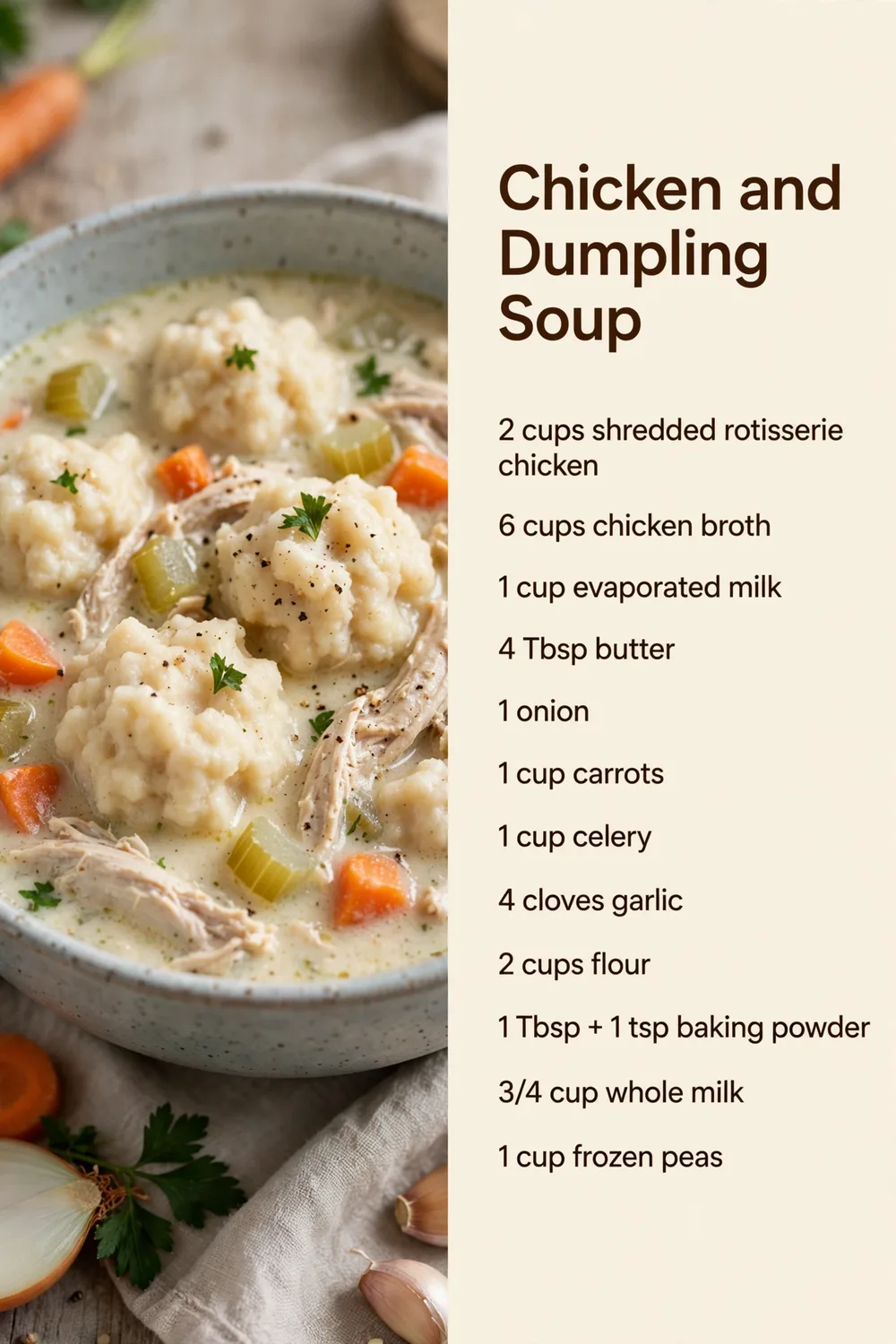
Ingredients
Equipment
Method
- Melt 4 Tbsp butter in a wide Dutch oven over medium heat; sauté the onion, carrots and celery 5 minutes until soft.
- Add the garlic, Italian seasoning, sage and thyme; cook 1 minute.
- Sprinkle in 3 Tbsp flour, stir to coat, and cook 1 minute (the roux).
- Pour in the broth in small splashes, scraping the bottom, then stir in the evaporated milk; add the chicken, peas and bay leaves and bring to a gentle simmer.
- Whisk the dumpling dry ingredients in a bowl; make a well, pour in the milk and melted butter, and stir just until a dough ball forms — do NOT over-mix.
- Cookie-scoop the dumplings onto the surface of the simmering soup, about 2 Tbsp each, spread in one layer; gently press each one down so the soup runs over just the tops.
- Put the lid ON and simmer gently for 15 minutes — DO NOT PEEK.
- Test one dumpling with a toothpick (clean = done) or cut one in half; fish out the bay leaves, sprinkle with parsley, and serve.
Notes
Nutrition information
| Nutrient | Per serving, 1 of 6, ~1½ cups |
|---|---|
| Calories | ~510 kcal |
| Sodium | ~1,490mg |
| Carbohydrates | ~50g (sugars ~10g) |
| Fat | ~24g (saturated ~14g) |
| Protein | ~23g |
| Fiber | ~4g |
| Cholesterol | ~95mg |
The inputs, shown plainly (USDA FoodData Central values for the exact ingredients listed): the batch (6 servings, ~1½ cups each) — 8 Tbsp butter total (4 in the soup, 4 in the dumplings) ≈ 114g ≈ 817 kcal, ~93g fat (saturated ~59g), ~733mg sodium (USDA “Butter, salted”: 717 kcal, 81.11g fat, 51.37g saturated fat, 643mg sodium per 100g) · all-purpose flour 2 cups + 3 Tbsp ≈ 274g ≈ 997 kcal, ~28g protein, ~209g carbs, ~7g fiber, ~1g sugars, ~5mg sodium (USDA “Flour, white, all-purpose, enriched, unbleached”: 364 kcal, 10.33g protein, 76.31g carbs, 0.98g fat, 2.7g fiber, 0.27g sugars, 2mg sodium per 100g; USDA cup weight 125g) · ¾ cup whole milk ≈ 183g ≈ 112 kcal, ~6g protein, ~9g carbs, ~9g sugars, ~6g fat, ~79mg sodium (USDA “Milk, whole”: 61 kcal, 3.15g protein, 4.8g carbs, 5.05g sugars, 3.25g fat, 43mg sodium per 100g) · 1 cup evaporated milk ≈ 252g ≈ 338 kcal, ~17g protein, ~25g carbs, ~25g sugars, ~19g fat, ~267mg sodium (USDA “Milk, canned, evaporated”: 134 kcal, 6.81g protein, 10.04g carbs, 10.04g sugars, 7.56g fat, 106mg sodium per 100g) · 2 cups shredded rotisserie chicken ≈ 280g ≈ 504 kcal, ~69g protein, ~24g fat, ~1,064mg sodium (USDA “Chicken, broilers or fryers, rotisserie, meat only”: ~180 kcal, 24.5g protein, 8.5g fat, ~380mg sodium per 100g) · 6 cups low-sodium chicken broth ≈ 58 kcal, ~6g protein, ~835mg sodium (~140mg per cup) · 1 cup frozen peas ≈ 134g ≈ 109 kcal, ~7g protein, ~19g carbs, ~8g sugars, ~7g fiber, ~7mg sodium (USDA “Peas, green, frozen”: 81 kcal, 5.42g protein, 14.46g carbs, 5.87g sugars, 5.1g fiber, 5mg sodium per 100g) · onion + carrots + celery + garlic ≈ 114 kcal, ~3g protein, ~32g carbs, ~15g sugars, ~7g fiber, ~174mg sodium · baking powder 1 Tbsp + 1 tsp ≈ 18.4g ≈ 10 kcal, ~5g carbs, ~1,950mg sodium (USDA “Baking powder, double acting”: 53 kcal, 27.7g carbs, ~10,600mg sodium per 100g — about 488mg sodium per teaspoon) · kosher salt 2 tsp (1 in the soup, 1 in the dumplings) ≈ 0 kcal, ~3,800mg sodium (Morton kosher: ~1,900mg per teaspoon) · herbs and seasonings ≈ 19 kcal, negligible sodium. Batch ≈ 3,078 kcal and ~8,920mg sodium — per serving ≈ 513 kcal and ~1,487mg sodium, rounded to about 510 kcal and about 1,490mg sodium per serving.
The SERP comparison, honestly: the published numbers on the search results range from 371 to 667 kcal, and the serving sizes are the reason they disagree. Midwest’s 371 kcal is per 1/10 of her batch (batch ≈ 3,710 — 2 cups heavy cream + biscuit dough); Novice Chef’s 667 kcal is per 1 of 6; Cozy Cook’s 657 kcal is per serving with the serving size unstated on the print page; Inspired Taste’s 501 kcal is per ⅙ of the recipe and the lightest on the SERP; The Cookie Rookie’s 609 kcal is per serving. Ours (~510 kcal per 1 serving of 6, ~1½ cups each) sits near Inspired Taste’s number — which makes sense, because Inspired Taste also skips the heavy cream — and it states the serving size plainly and shows the USDA working so the number can be checked instead of trusted. Midwest’s published 1,020.7mg sodium is taken at face value here; her own dough recomputes higher (same note as M15: published numbers are not recomputed by us, only flagged). The sodium range on the SERP is 889mg (Cookie Rookie, the lowest) to 1,599.2mg (Inspired Taste, the highest); ours (~1,490mg) sits near the top of that range, and the sodium note below says why, honestly.
The sodium is worth telling honestly: the DUMPLINGS carry nearly half the batch sodium — salt + baking powder ≈ 3,850mg of ~8,920mg, about 43% — and that is the number the analysis got right. The rest is the rotisserie chicken (~1,064mg per batch, the second-biggest single contributor), the soup salt (~1,900mg), and the broth (~835mg). The low-sodium lever is the broth, the butter and the soup salt — NOT the dumplings’ baking powder, because cutting the baking powder makes the dumplings sink. The savings, if a reader wants them: use unsalted butter and save ~120mg per serving; use ¾ tsp of salt in the soup instead of 1 tsp and save ~80mg more; and know that regular broth instead of low-sodium would ADD about 330mg per serving (regular broth is ~470mg per cup against low-sodium’s ~140mg), which would push this soup to ~1,820mg. The analysis’s claim that the sodium is “~1,350mg” was wrong on three counts — it undercounted the rotisserie chicken by ~360mg per batch, the evaporated milk by ~127mg, and omitted the vegetables’ and milk’s sodium entirely (~250mg). This table corrects it.
Nutrition is an estimate calculated from USDA FoodData Central values for the exact ingredients listed. Values will vary with brands and substitutions.
Pin this recipe