Best Way to Cook Smoked Sausage: Skillet vs Oven vs Grill
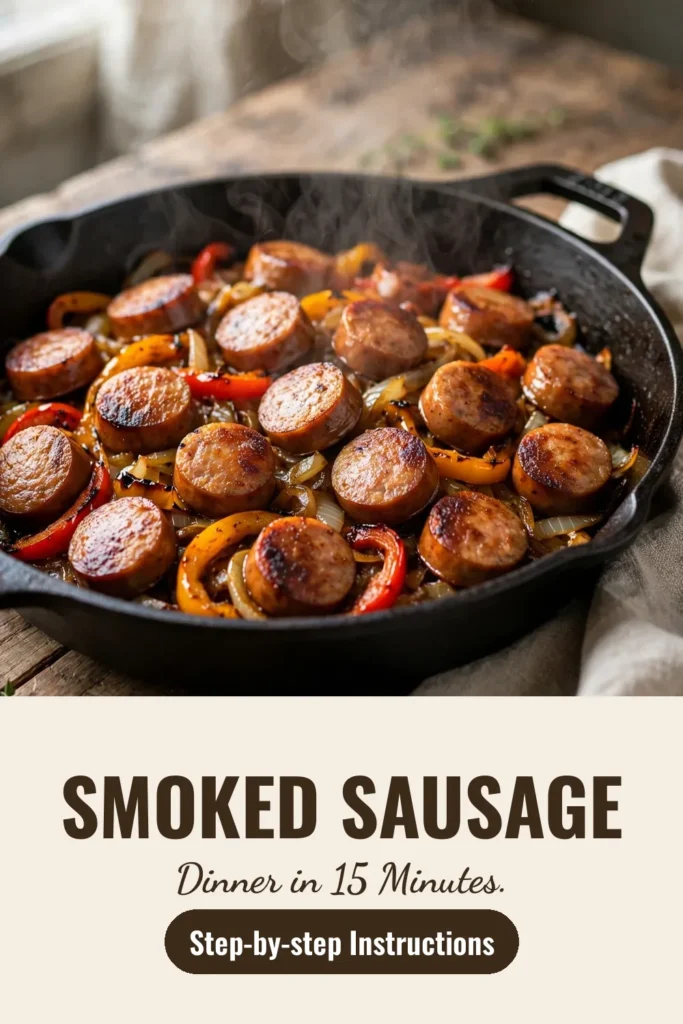
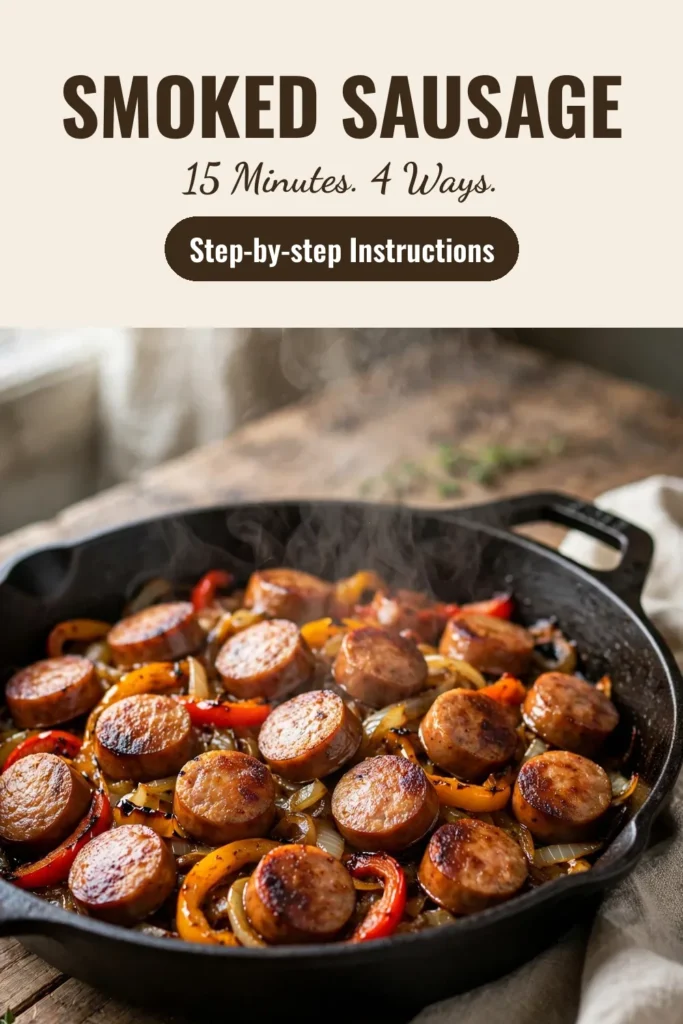
The best way to cook smoked sausage is in a skillet, in 15 minutes, sliced into coins with peppers and onions. One pan, medium heat, a little oil, the coins browned on both cut faces, the peppers and onions soft and lightly caramelised in the same pan, and dinner is on the table while the oven is still preheating. That is the whole answer — and it is the answer the page this post beats never gives. Midwest’s smoked sausage page is a two-to-three-hour pellet-smoker recipe for raw brats, and every one of its visitors who typed “best way to cook smoked sausage” is holding a store-bought, already-cooked link from the grocery store and wants dinner in ten minutes, not a smoker project. This page is written for that person: the four methods compared with exact times and temperatures, the done test, the three rules that keep a casing from splitting, and what to serve it with. It is the smoked sausage recipe for a weeknight — the skillet dish, with the oven, grill and air fryer versions beside it so you can pick the one that fits your kitchen tonight.
You will love this:
- 15 minutes, one pan. Slice, sear, add the peppers and onions, rest — and the skillet does the whole dinner. No grill to light, no oven to preheat, no smoker to babysit.
- Already cooked — just reheat and brown. The link in the package is fully cooked, so you are warming it through and getting colour on it, not cooking raw meat. That is why it is fast, and why the rules are different from raw sausage.
- One method, four ways. The skillet is the recommendation, but the oven, grill and air fryer all work — with the exact times and temperatures for whole links and for coins, so the method you pick is a choice, not a guess.
Why This Is the Best Way to Cook Smoked Sausage
It is the best way because it is the fastest way that still gives you browning — and browning is the whole point of cooking a link that is already cooked. A smoked sausage straight from the package is safe to eat cold, and it tastes like it: pale, soft, and a little flat. Three to four minutes a side in a hot skillet changes that completely. The cut faces caramelise, the casing tightens and snaps, the fat renders just enough to baste the peppers and onions, and the whole thing tastes like it came off a grill without a grill anywhere in sight. The oven takes about the same total time but gives you less colour. The grill gives you the best flavour and the most fuss. The air fryer is the most hands-off and the easiest to overshoot. The skillet wins on speed, on browning, and on the fact that the peppers and onions cook in the same pan, in the sausage fat, while the sausage rests.
What makes this page different from Midwest’s is the question it answers. Her page is a recipe for smoking raw sausages: sixteen ounces of raw jalapeño cheddar bratwurst, a wood pellet smoker at 225°F, two to three hours, an internal temperature of 165°F, a five-to-ten-minute rest. It is a fine recipe for making smoked sausage. It is not an answer to “best way to cook smoked sausage” — and the traffic proves it, because the searches that land on her page are from people holding a cooked link and asking how to heat it. The page this post beats serves only one of the two intents on the topic: the smoking camp, people who want to make smoked sausage from raw on a smoker. The cooking camp — people holding a store-bought link and asking how to cook it — is the bigger camp, and nobody on the search results answers it as a method comparison with exact times and temperatures. That is the gap this post fills: the skillet, the oven, the grill and the air fryer, whole links and coins, one clear recommendation.
What we tried, and what failed: the first version of this dish went into the skillet on high heat, the way a hurried cook would do it — and the casings split on two of the four links before the centres were warm, the fat running out into the pan and the links going slack. Medium heat, the way the sausage maker teaches it, browned them without a single split. We also tried the microwave, because it is the fastest option on paper — and the casing went rubbery and tough, exactly the way the maker’s guide warns it will, while every other method took ten minutes or less. We tried the air fryer at 375°F, the hottest number on the search results — and the outside scorched while the centre was still cool, the exact failure the lower temperature exists to prevent. And we tried scoring the casing before cooking, the way one generic guide advises — and the juices ran out through the cuts, the links dried out, and the snap was gone. Those four failures are why this post has a three-rules H2 and a troubleshooting H2 instead of a testing-notes footnote: the rules are the fixes, and they are stated before the methods so you never have to learn them the hard way.
The structure of this page is the structure of the gaps: the already-cooked fact stated plainly, the three rules before any method, the four methods compared in one table with exact times and temperatures for whole links and coins, the skillet dish as the recipe, the done test as its own H2, five troubleshooting fixes, the serve-with system, the frozen rules, and ten FAQs where the target has none. Midwest’s page is about 600 words of prose with no FAQ block and no question headings; the longest page on the search results is about 2,000 words and has no author, no dates, and no recipe card. This page matches the longest page’s depth and goes further on the method comparison, the already-cooked question, the coins method, the serve-with system and the troubleshooting — that is the depth that beats a page whose only real strength is that it ranks first for the no-cook long-tails while answering a different question entirely.
What Is Smoked Sausage?
Smoked sausage is a link sausage that has been cured and smoked — and the word “smoked” is doing more work than it looks like. There is no standalone Wikipedia article for “smoked sausage” at all: the title redirects to kielbasa, the Polish sausage that is the archetype of the whole category. Kielbasa, from the Polish kiełbasa, is any type of meat sausage from Poland and a staple of Polish cuisine, made in dozens of varieties, smoked or fresh, from pork, beef, turkey, lamb, chicken or veal. In American English it typically refers to a coarse, U-shaped smoked sausage of any kind of meat, which closely resembles the wiejska sausage — typically pork only. The smoked varieties include kiełbasa wędzona, Polish smoked sausage, used often in soups; biała kiełbasa, white sausage; kiełbasa krakowska; and the thin kabanos. Smoked kiełbasa can be served cold, hot, boiled, baked or grilled — and that last list is the whole point of this post, because the link in your fridge can be heated any of those ways, and the method you pick is a choice about time and browning, not about safety.
The link you buy in a grocery store is almost always a fully-cooked smoked sausage: pork, beef, turkey or chicken, ground and seasoned, stuffed into a natural casing, cured and smoked in a smokehouse until it is cooked through. The smoke gives it its colour and its flavour; the curing gives it its shelf life. That is why it keeps in the fridge for weeks, why it can be eaten cold, and why heating it is about warming it through and getting colour on it rather than cooking raw meat. The exceptions are the fresh sausages sold in the deli case — raw links that look like smoked sausage but are not cooked — and the already-cooked H2 below tells you how to tell them apart.
| Sausage | What it is | Best for |
|---|---|---|
| Kielbasa | The classic — a coarse, garlicky, slightly sweet smoked pork link, U-shaped, the archetype of the whole category | The default for this post — the skillet dish, the grill, any method here |
| Andouille | A bold, spicy smoked pork sausage, French in origin, the sausage of Cajun cooking | Gumbo nights, Cajun seasoning, the Southern variation — and the skillet dish with extra heat |
| Chorizo | A smoky, paprika-rich sausage, Spanish or Mexican style | Grilled peppers, Tex-Mex variations, the skillet dish with lime |
| Bratwurst | A mild, juicy German sausage, pork or veal, fresh or smoked — the smoked version is the one for this post | Beer-infused cooking, buns with mustard, the grill |
| Beef links | A smoked beef link — denser, holds up to deep smoke and high heat | The grill, the smoker, any method where a pork link would split |
| Turkey or chicken links | A leaner smoked link — less fat, less sodium, the same method | The lighter version of this dish, and the lower-sodium swap in the Nutrition H2 |
The rule that covers all of them: any smoked link works the same way in this post. The card uses a pork kielbasa-style link because it is the most common store-bought link, but beef, turkey and chicken links heat the same way, in the same times, with the same three rules. What changes is the flavour — kielbasa is garlicky and slightly sweet, andouille is bold and spicy, chorizo is smoky with paprika — and the fat: a lean turkey link browns a little less and dries out a little faster, so watch it and pull it a minute early. Buy tight casings, visible
marbling, and natural ingredients with no mystery fillers — that is the one buying rule every page on thesearchresults agrees on, and it is the only one you need.
Is Smoked Sausage Already Cooked?
Yes — almost always. Most store-bought smoked sausage is fully cooked in the smokehouse before it is packaged, and heating it is about warming it through, not cooking it. That is the single most confusing fact on this topic, and the page this post beats never says the words “already cooked” at all — which is why its own traffic is confused, and why the search results argue with each other about temperatures. Here is the answer, stated plainly, because the cook holding a package deserves to know what she is holding before she turns on the heat.
Check the label. A fully-cooked link says so on the package — “fully cooked” is printed on the label of the kind you buy in a 12–14 oz package, Johnsonville or store brand, and that label is the answer. If it says fully cooked, you are reheating and browning: heat it until it is steaming hot all the way through, browned on the outside, and the casing is tight and glossy. If you like using a thermometer, 165°F is the reheat check — the number the sausage maker and the target page agree on for a fully-cooked link.
The raw exception is real, and it is the reason the temperatures on the search results look like they contradict each other. A fresh sausage — the kind sold loose in the deli case, or a raw bratwurst, or the fresh sausage from a maker’s deli freezer — is NOT cooked, and it must be cooked thoroughly to 160°F minimum, the USDA safe temperature for fresh pork sausage, or 165°F to be safe across mixed meats. That is the number the generic guide quotes — 160°F — and it is correct for the raw case and wrong for the pre-cooked case, which is why the page that quotes it without separating the two cases confuses everyone. The split, stated once and plainly: store-bought fully-cooked link, heat until steaming hot through, 165°F if you check; raw or fresh sausage, cook to 160°F minimum, 165°F to be safe. The confusion is the search results’, not yours — and this post ends it here, in this H2 and again briefly in the done-test H2, so you never have to hold both numbers in your head at once.
The other half of the answer is what “fully cooked” does not mean. It does not mean ready to eat straight from the package at its best — a cold link is pale, soft and flat, and heating it is what makes it taste like smoked sausage. It does not mean you can ignore food safety — a link left at room temperature for hours is still a risk, and the fridge rule is the same as for any cooked meat: at or below 40°F, and no more than a couple of hours on the counter. And it does not mean every link in the store is cooked — the fresh sausage in the deli case is the exception, and the label is how you tell. Read it once, and the whole topic makes sense.
The Three Rules (Before You Touch the Heat)
Every method in this post follows three rules, and they are the same three rules the sausage maker teaches — because the maker is the one who knows what breaks a casing, and the rules are the difference between a link that snaps when you bite it and a link that splits in the pan. Learn them before you touch the heat, and every method below just works.
Medium heat, never high. High heat is the single most common mistake, and it is the one that splits casings: the outside of the link heats faster than the centre, the fat renders too fast, the pressure builds, and the casing bursts before the middle is warm. Medium heat warms the link evenly, browns it steadily, and gives the fat time to render without blowing the casing out. If your skillet is smoking, it is too hot. Turn it down and wait — the link will still brown, and it will brown without splitting.
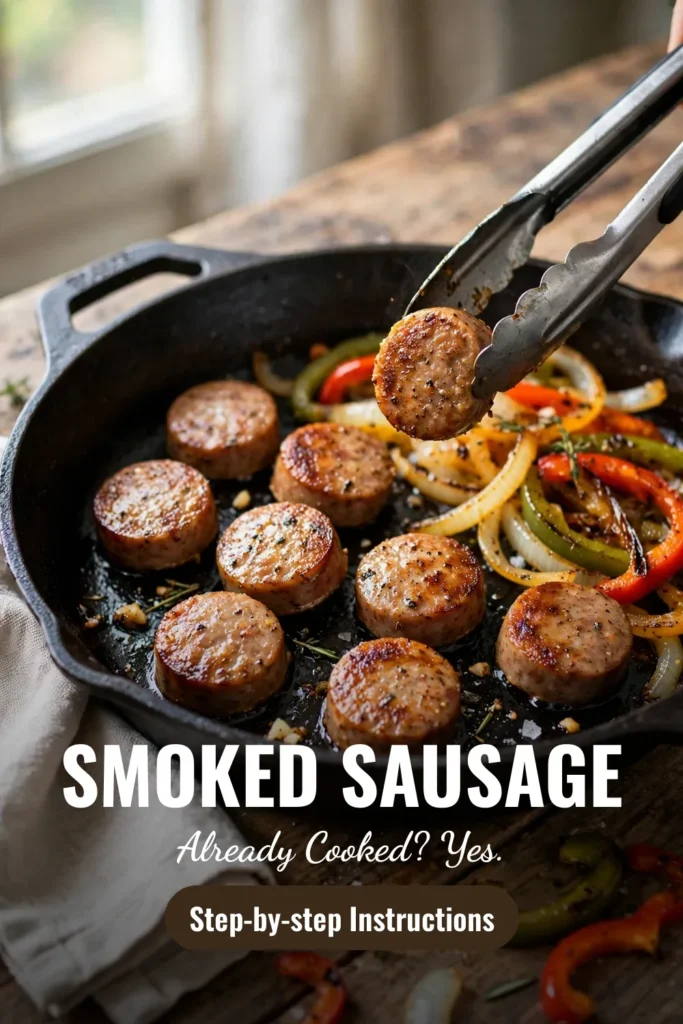
Turn it often. A link left on one side browns on one side and steams on the other, and the side facing the heat takes all the punishment. Turn it every couple of minutes — tongs, not a fork, so you never pierce the casing — and the heat reaches every side evenly, the colour is even, and no single spot gets hot enough to split. Turning often is also how you know it is done: the link that has been turned is browned all over, and the link that has not been turned is browned on one side and pale on the other.
Never prick the casing. Piercing a smoked link is a habit from raw brats, where a prick lets the steam out and keeps a raw sausage from bursting. On a fully-cooked smoked link it does the opposite of what you want: it lets the juices run out, costs you the snap of the natural casing, and dries the link out from the inside. One generic guide on the search results advises scoring the sausage lightly before cooking — twice, in its tips and in its troubleshooting — and it is wrong both times. The anti-burst rule is medium heat plus turning often, not scoring. Do not prick it, do not score it, do not cut slits in it. The casing is the package, and it stays sealed until the knife hits the cutting board after the rest.
Two free improvements, because they cost nothing and they work. First, let the sealed package sit on the counter for ten to fifteen minutes before it hits the heat — links straight from the fridge heat unevenly, the outside done long before the centre is warm, and ten minutes on the counter evens that out. Second, pat the links dry with paper towels before they go in the pan — a wet link steams instead of searing, and dry before you fry is the difference between crisp edges and a pale, soft link. Both are in the card steps, and both are the kind of small thing that separates a good link from a great one.
Skillet vs Oven vs Grill vs Air Fryer
Here is the whole comparison in one table, because the question in the title deserves an answer you can read in ten seconds — and then the four method headings below give you the full version of each one, with the exact times and temperatures for whole links and for coins.
| Method | Temp | Time — whole links | Time — coins | Best for | Risk |
|---|---|---|---|---|---|
| Skillet (recommended) | Medium heat | 2–3 min per side | 3–4 min per side | Fastest, best browning, one pan, year-round | High heat splits the casing — medium only |
| Oven | 375°F | ~10 min, turn halfway | ~6 min, turn halfway | A full package at once, hands-off | Too long dries it out — 20–30 min is far too much |
| Grill | Medium, indirect | 8–10 min + 1 min direct finish | 4–6 min on a tray | Best flavour, char lines, summer | Direct heat first risks splitting + flare-ups |
| Air fryer | 300°F, no preheat | 7 min, no turning | 4 min, no shaking | Most hands-off, no oil needed | 350–375°F scorches — the lower temp is the protection |
The verdict: the skillet wins. It is the fastest method that still gives you real browning, it works year-round with no grill to light and no oven to preheat, and the peppers and onions cook in the same pan, in the sausage fat, while the sausage rests. The oven is the best choice when you are heating a full package at once — a sheet pan, ten minutes, turn halfway, done. The grill is the best choice when you want flavour and char and the weather agrees — indirect heat first, a direct finish for marks, and the wood chips are a bonus. The air fryer is the best choice when you want to walk away — single layer, no turning, seven minutes — and the lower temperature is the whole point, because the hotter numbers on the search results are the ones that scorch a casing.
The one number that matters most in the table is the air-fryer temperature, because it is the one the search results disagree about most. The maker says 300°F, no preheat, seven minutes for whole links and four for coins, with a dedicated post explaining why the temperature is lower than most recipes say. The generic guide says 350°F for eight to twelve minutes, flipping halfway. The stalest page on the search results says 375°F for eight to ten minutes. The rule in this post is 300°F — the casing-split risk is the number-one failure mode, and the lower temperature is the protection; 350°F works if you watch it and turn halfway, and it is the majority option, noted honestly here — but 375°F is the scorch risk and is not recommended. The same logic applies to the oven: 375°F for about ten minutes is the fastest credible number, and the generic guide’s twenty to thirty minutes at 350°F would dry out a pre-cooked link. The temperatures and the times have to move together, and the table above is the version where they do.
What About the Smoker?
The smoker is the fifth method, and it deserves an honest paragraph, because a big chunk of the traffic on this topic is people who want to smoke sausage — and this post is not that recipe. Smoking is making smoked sausage, not cooking a store-bought link. The target page’s method, summarised in our own words: raw sausages on a wood pellet smoker at 225°F for two to three hours, until the internal temperature reaches 165°F, then a five-to-ten-minute rest — hickory or mesquite for the wood, hickory the maker’s pick. That is how you turn raw brats into smoked sausage, and it is a fine recipe for that job. It is not how you cook the link you bought in a package, and if you put a fully-cooked link on a smoker for two hours you will dry it out and waste an afternoon. If you own a smoker and you want to make your own, the target page is the recipe for it. If you are holding a package and want dinner in fifteen minutes, the skillet is the answer, and the rest of this post is yours.
How to Cook Smoked Sausage in a Skillet
This is the smoked sausage recipe for a weeknight: one pound of smoked sausage, one pan, fifteen minutes, and the peppers and onions in the same skillet. The card below has the full recipe; this H2 is the method in the body, with the ingredient list and amounts at the top so you can see the whole dish before you start.
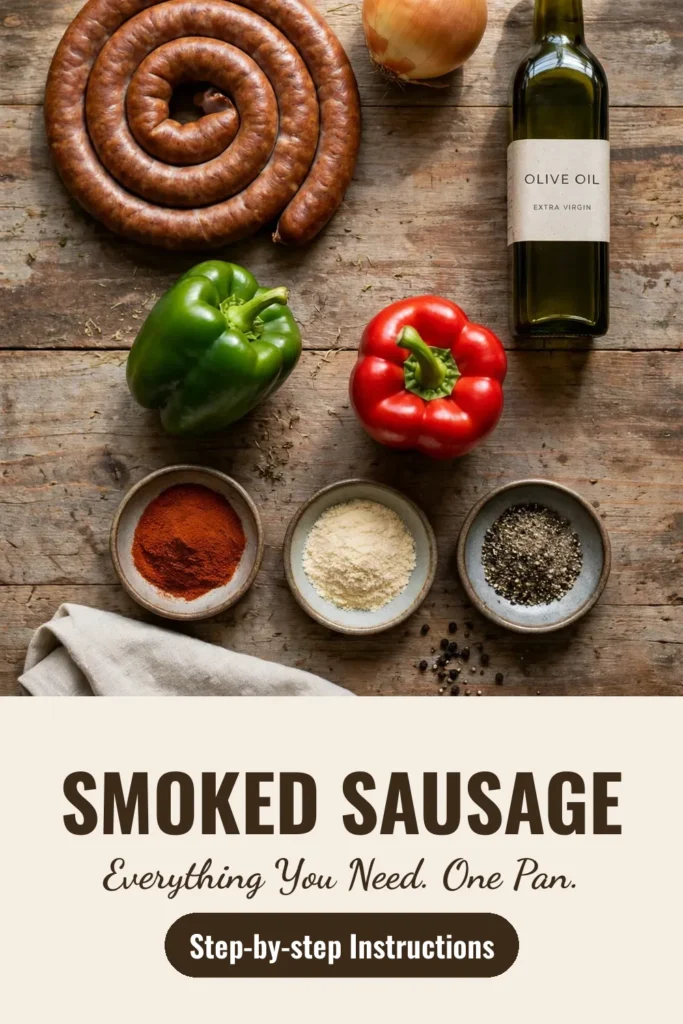
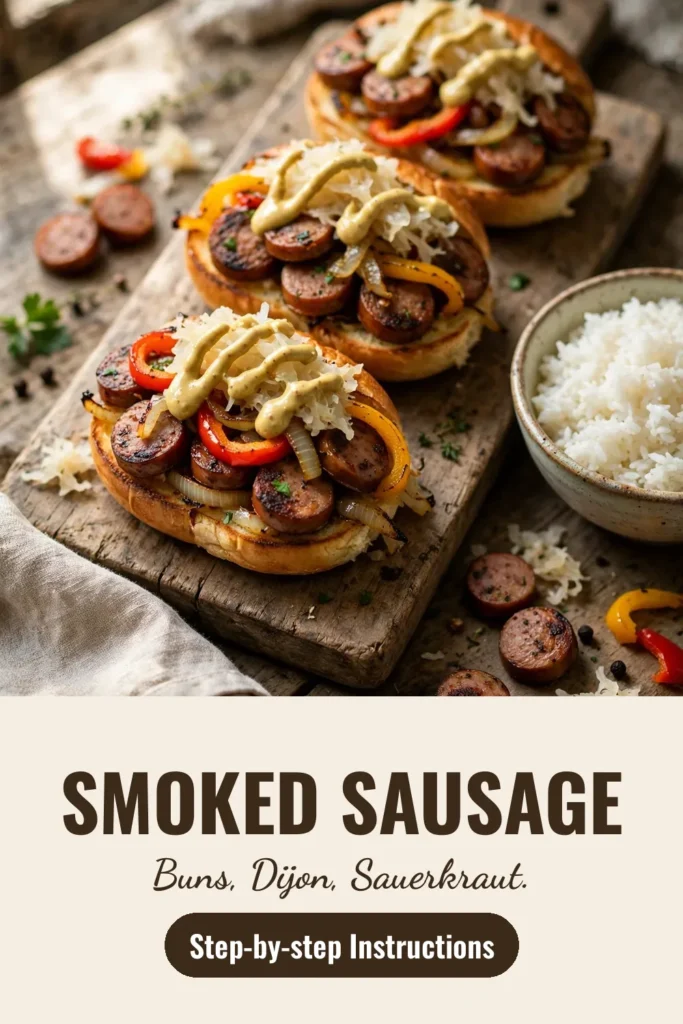
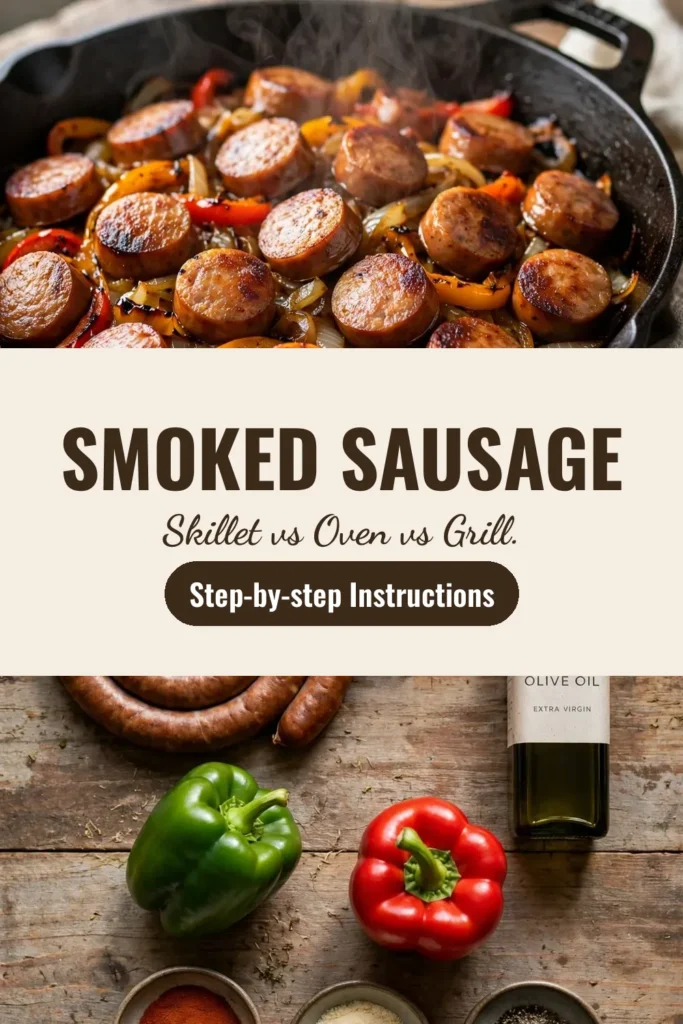
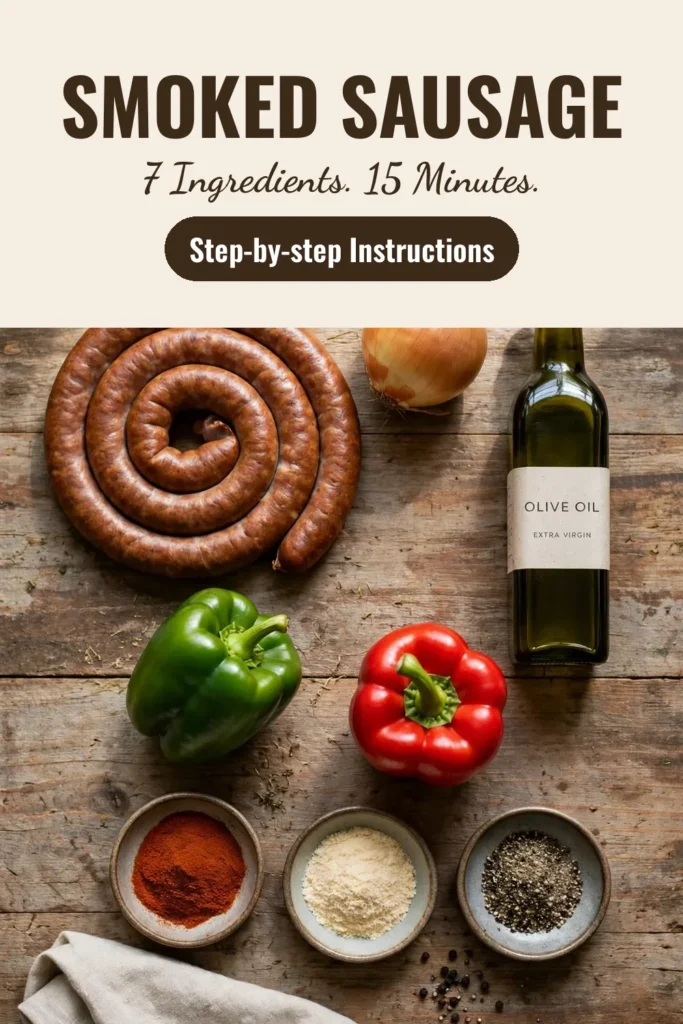
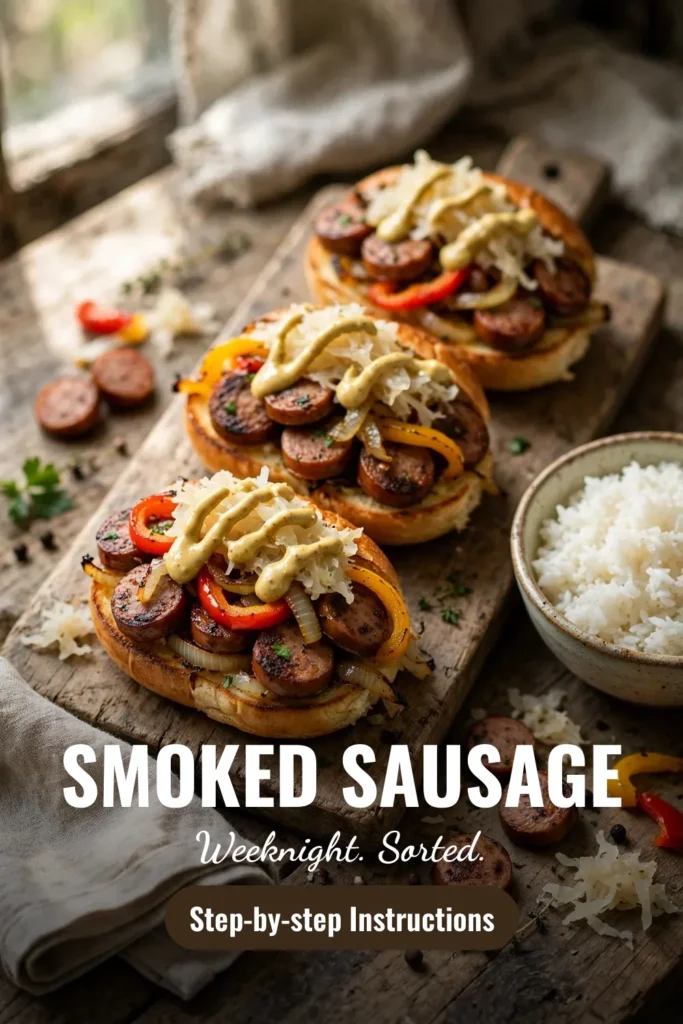
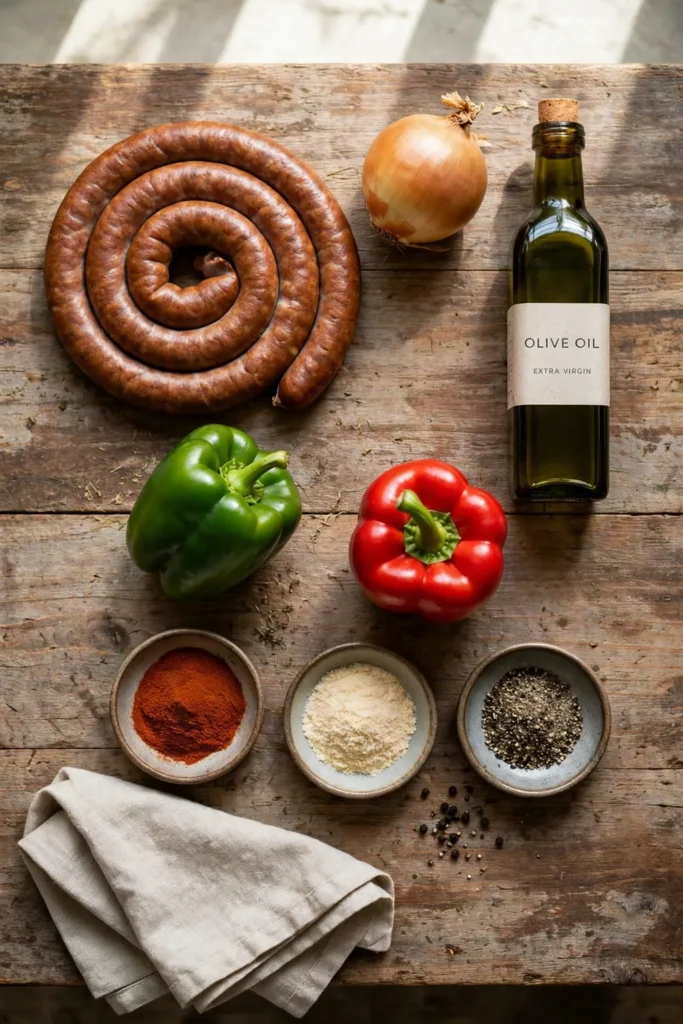
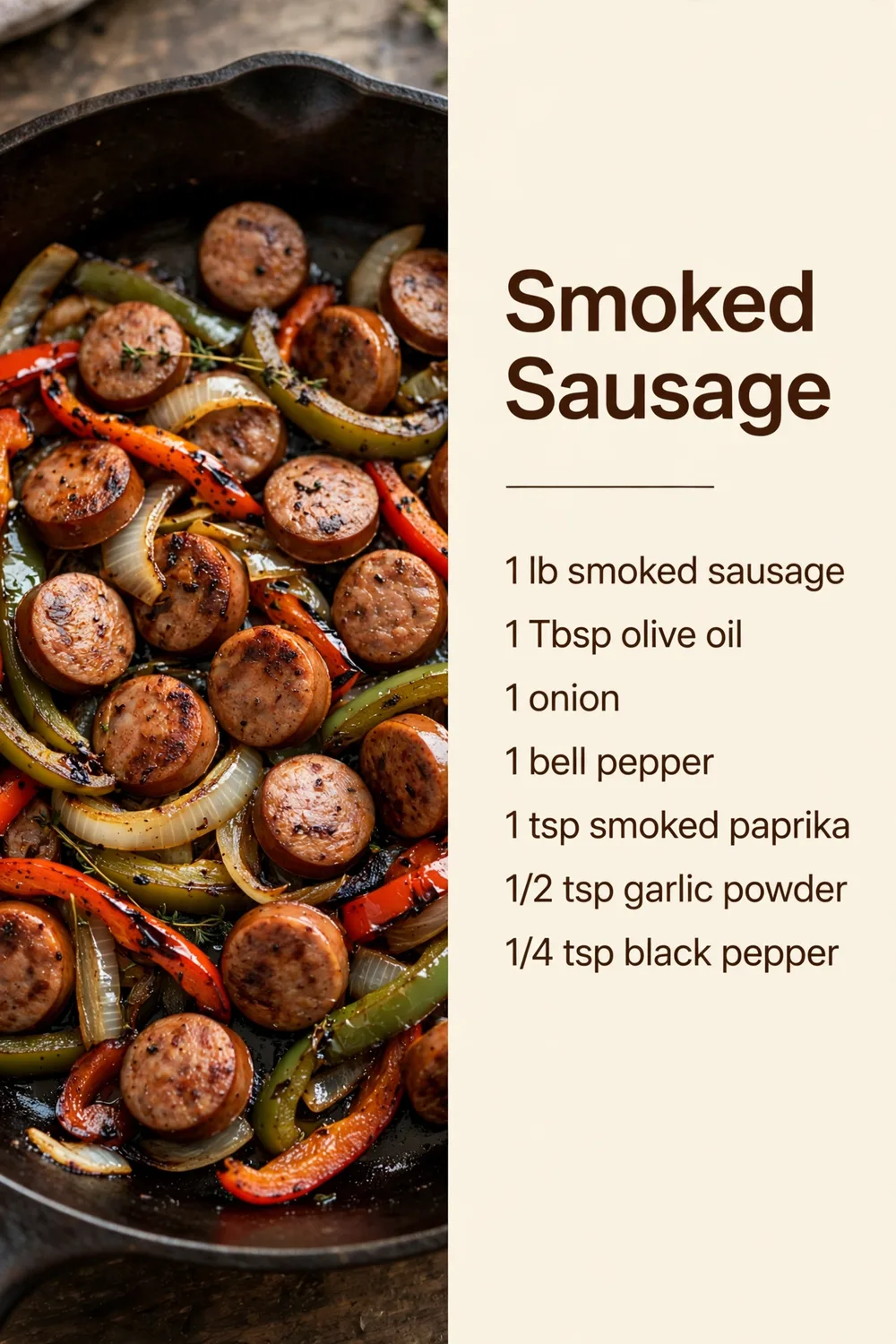
For the skillet: 1 lb (16 oz) smoked sausage (pork kielbasa-style) · 1 Tbsp olive oil · 1 medium onion, sliced · 1 bell pepper, sliced (any colour) · 1 tsp smoked paprika · ½ tsp garlic powder · ¼ tsp black pepper · no added salt. To serve: 4 toasted buns + Dijon mustard + sauerkraut, or over rice.
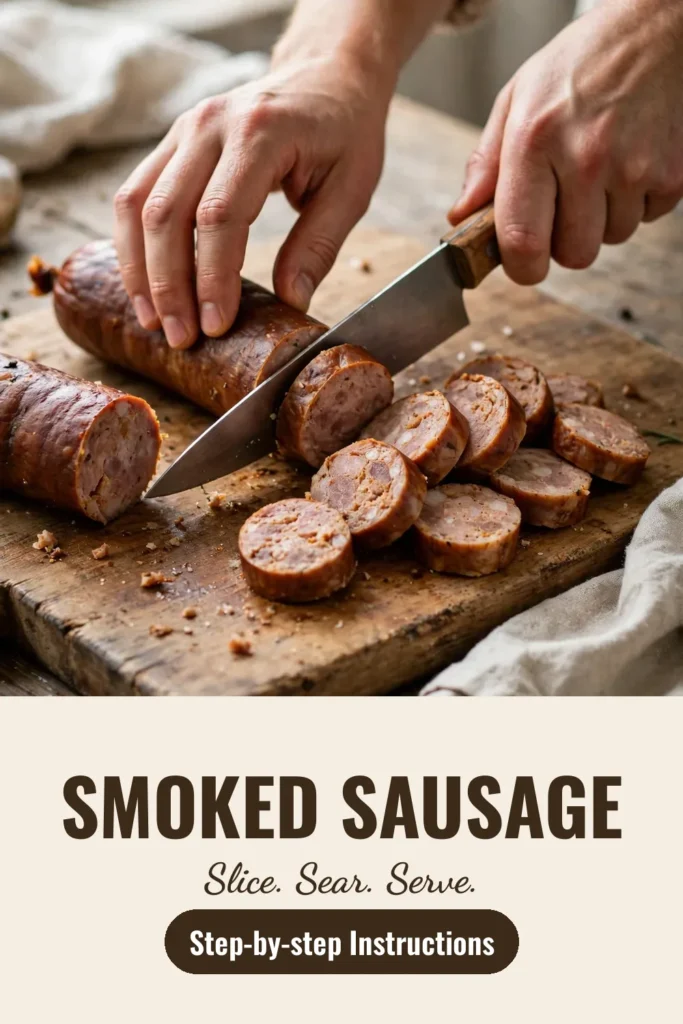
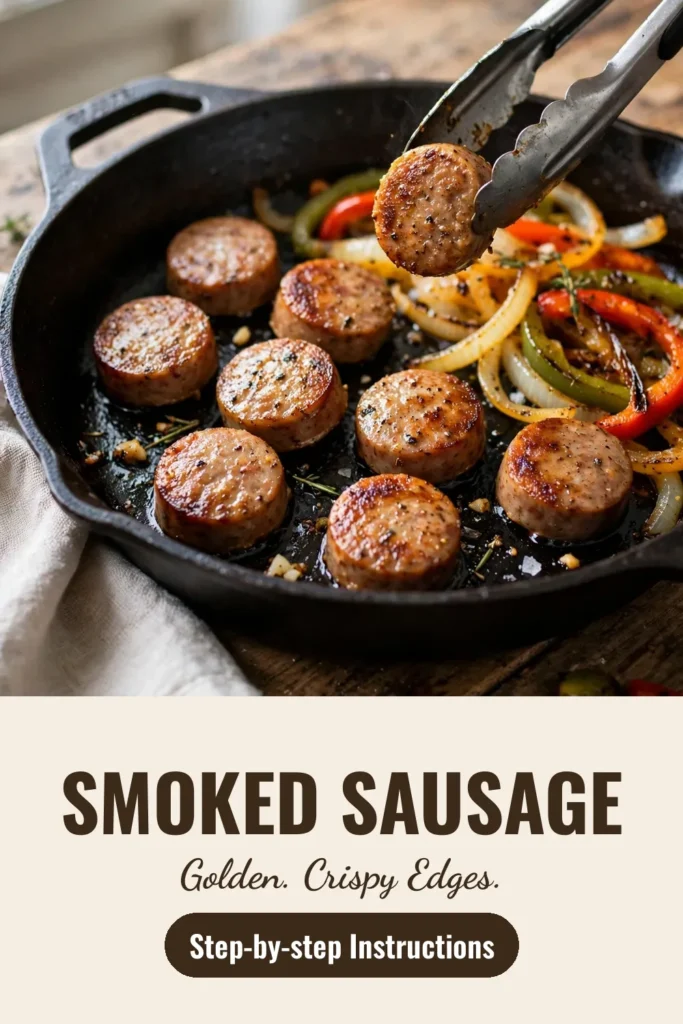
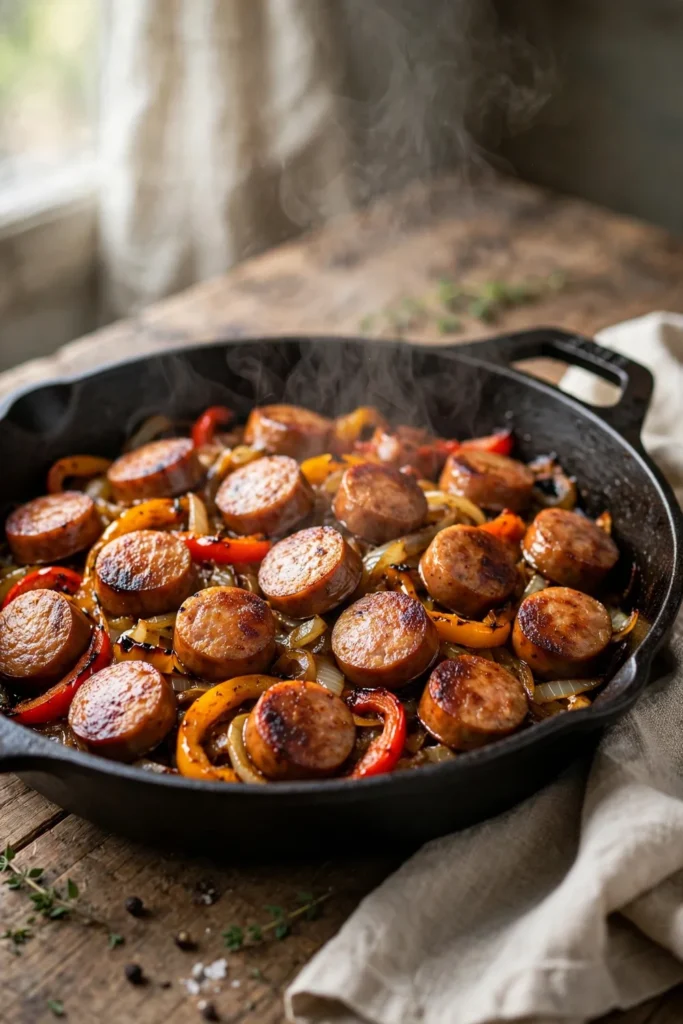
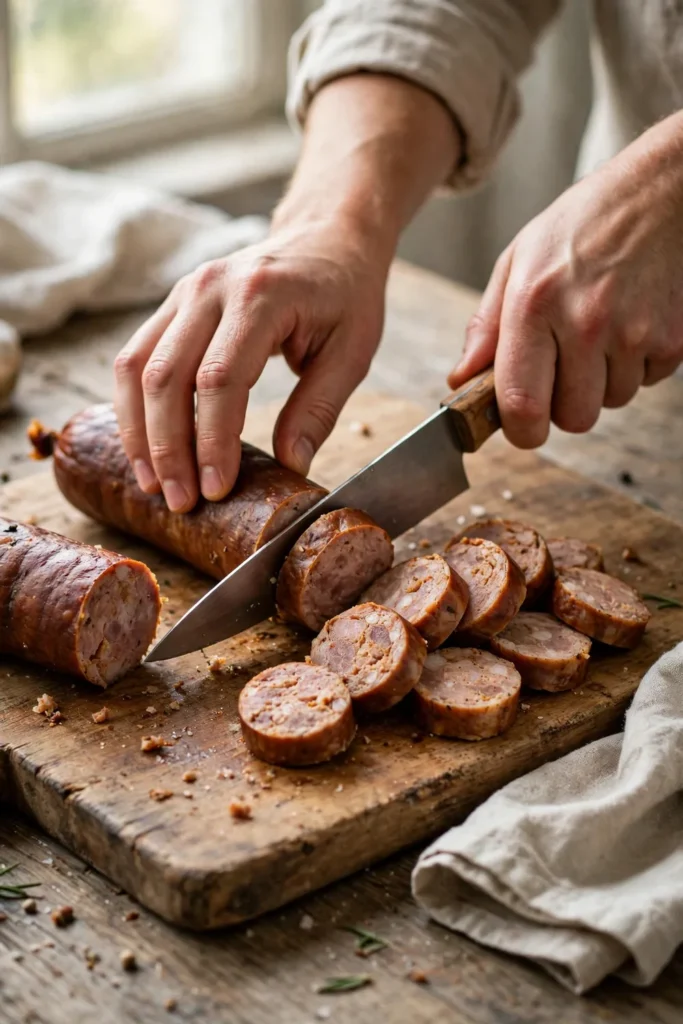
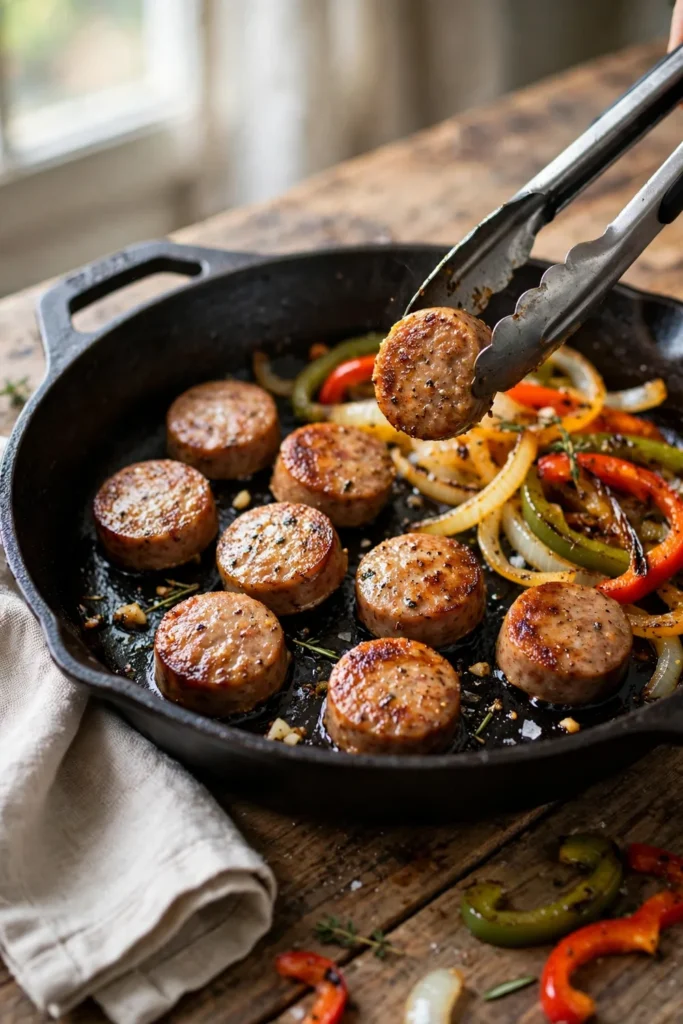
The five steps: (1) Slice the sausage into ½-inch coins — or leave the links whole, the whole-link times are below — and pat the coins dry with paper towels. (2) Heat the olive oil in a large cast-iron skillet over medium heat. (3) Add the coins in a single layer, don’t overcrowd, and sear 3–4 minutes per side until deeply browned on the cut faces and heated through. (4) Push the sausage to the edges, add the onion and bell pepper with the smoked paprika, garlic powder and black pepper, and cook 5–6 minutes until soft and lightly caramelised. (5) Rest 2–3 minutes before serving, then serve on toasted buns with Dijon and sauerkraut, or over rice.
| Cut | Time | Best for |
|---|---|---|
| Whole links | 2–3 min per side | Buns and sandwiches — the link stays intact, the casing snaps, the presentation is a whole link on a bun |
| Coins (½-inch slices) | 3–4 min per side | The fastest method, the most browning, and the weeknight answer — the cut faces are where the browning happens |
| Halved lengthwise | 3–4 min per side, cut side down | More surface area than a whole link, more caramelisation — the pitmaster’s cut, and the best version for the grill |
Whole links
Whole links go in the skillet over medium heat, a little oil, two to three minutes per side, turning often with tongs until browned all over and heated through. The whole link is the bun version: it stays intact, the casing snaps when you bite it, and it looks like a sausage on a bun is supposed to look. The rule that matters most for whole links is the turning — a link left on one side browns on one side and steams on the other, and the side facing the heat takes all the punishment. Turn it every couple of minutes, and the colour is even all the way around.
Coins — sliced
Coins are the fastest method of all, and the weeknight answer. Slice the links into ½-inch coins — about fourteen to sixteen per link — and the cut faces are where the browning happens: more surface area, more caramelisation, and the coins heat through in minutes because there is no thick centre to wait for. Three to four minutes per side in a single layer, don’t overcrowd, and the coins come out deeply browned on both faces. If the pan is crowded, the coins steam instead of searing — cook them in two batches rather than one crowded one, because a crowded pan is the one mistake that turns a sear into a steam. Coins are also the serving version: they go over rice, into pasta, onto a flatbread, or into a bowl with the peppers and onions, and they are the version the party uses, browned and held in barbecue sauce or queso.
The simmer method
The simmer is the gentler option, for a thick link or a link you are worried about splitting. Half an inch of water in the skillet, bring it to a simmer, links in for about twelve minutes turning frequently, pour the water off, then one to two minutes more in the dry pan. That dry finish is the step almost nobody teaches, and it is the difference between a pale, soft link and one with colour and snap: the simmer heats the link gently all the way through, and the dry finish gives it the browning the simmer cannot. The sear is faster and gives more colour, and it is the recommended method in this post — but the simmer is the one to use when the link is thick, when the casing has split on you before, or when you want the gentlest possible heat on a link you care about.
How to Cook Smoked Sausage in the Oven
The oven is the hands-off method, and the best choice when you are heating a full package at once. Preheat to 375°F, lay the links on a baking sheet in a single layer, and bake for about ten minutes, turning halfway — whole links, ten minutes; coins, about six, turning halfway. The oven gives you even heat from all sides and no splatter on the stovetop, and it is the easiest way to heat four or five links at once without standing over a pan.
The sheet-pan version is the oven method at its best: the vegetables set the temperature, and the sausage joins them for the final few minutes. Toss sliced peppers, onions and potatoes with a little oil on the sheet pan, roast them at 375°F until they are nearly done, then add the sausage coins for the final six minutes — no more than six, because past that the coins dry out and the cheese varieties start to bubble out. The vegetables take the long cook; the sausage takes the short one. That is the whole rule, and it is the same rule the maker’s guide gives for roasting vegetables with sausage: the vegetables set the temperature, the coins go in for the final few minutes.
The gentler option is 350°F, for a fridge-cold link or a deep dish — add five minutes, so fifteen for whole links, and turn halfway. And the number to avoid is the generic guide’s twenty to thirty minutes at 350°F: that is far too long for a pre-cooked link, and it would dry it out. A fully-cooked link needs ten minutes at 375°F, not half an hour — the oven is a reheating tool here, not a cooking tool, and the time should match the job.
How to Cook Smoked Sausage on the Grill
The grill is the best flavour and the most fuss, and the method that rewards the one rule the maker teaches: indirect heat first. Set up the grill for medium indirect heat — the coals or burners on one side, the sausage on the other, not directly over the flame — and cook the links for eight to ten minutes, turning frequently. Then slide them over direct heat for a brief finish, about a minute, for deeper grill marks. Indirect heat is the whole trick: it warms the centre without splitting the casing, and there are no flare-ups, because the fat is not dripping straight onto the flame.
The direct-first approach — medium-high heat, directly over the flame, four to five minutes per side — is the char-first option, and it is the one that risks splitting on a fatty link and flare-ups on a dirty grill. It works when the grill is clean and the links are lean, but the indirect method works every time, and this post recommends it. If you want the char, the direct finish gives it to you in a minute, without the risk of eight minutes over direct heat. The onions and peppers go on a grill tray or a foil pan beside the sausage, not straight on the grates — they would fall through, and the tray keeps them in the smoke where they belong.
Wood chips are the bonus, not the requirement: apple or hickory chips on the coals, or in a smoker box on a gas grill, give the links a little extra smoke while they heat. Hickory is the classic for pork sausage; apple is milder and sweeter; mesquite is the strongest and the easiest to overdo. And for the stovetop methods, where there is no grill and no smoke, the smoked paprika in the pan is the no-grill smoke boost — the pitmaster’s dusting rule, and the reason the skillet dish carries a teaspoon of it.
How to Cook Smoked Sausage in the Air Fryer
The air fryer is the most hands-off method: single layer on the crisper plate, no liner, 300°F, no preheat, seven minutes for whole links and four minutes for coins, no turning needed. That is the maker’s own number, from the freshest page on the search results, with a dedicated post explaining why the temperature is lower than most recipes say — and the reason is the casing. The lower temperature warms the link through without the outside scorching, and the single layer means the hot air reaches every side without turning.
The split on the search results is the temperature: the maker says 300°F, the generic guide says 350°F for eight to twelve minutes flipping halfway, and the stalest page says 375°F for eight to ten minutes. The rule in this post is 300°F, no preheat — the casing-split risk is the number-one failure mode, and the lower temperature is the protection. 350°F works if you watch it and turn halfway, and it is the majority option, noted honestly here — but 375°F is the scorch risk and is not recommended, because a fully-cooked link at 375°F scorches on the outside while the centre is still cool, the exact failure the lower temperature exists to prevent. No oil is needed in the air fryer — the link renders its own fat — and no liner, because the liner blocks the air flow that makes the method work.
How to Tell When It’s Done
The link was done before it was packaged, so you are not checking for doneness. You are looking for three things: hot all the way through, the casing tight and glossy, and browned without splitting. That is the maker’s done-test, and it is the right one — because the thermometer is a backup here, not the test, and your eyes and your hands tell you more than a number does.
First, hot all the way through. Pick the link up with tongs and feel the weight of it — a link that is hot through feels uniformly warm, and a link that is cold in the middle feels cool at its thickest point. The cold-centre check is the second test, and it is the one that saves a party: push a knife into the centre of the link and touch it to your lip — it should come out hot, not warm. A link with a browned outside and a cold centre went in cold and did not get its extra minutes, or was cooked on heat too high — and the fix is five more minutes at medium heat, not more heat.
Second, the casing tight and glossy. A properly heated link has a casing that is taut and shiny, the fat just starting to glisten at the surface. A casing that is slack and dull is a link that has not heated through yet. A casing that has split is a link that was heated too hot — and the split is the failure the three-rules H2 exists to prevent.
Third, browned without splitting. The cut faces of the coins should be deeply browned, the whole links golden all over, and the casing intact. If you like using a thermometer, 165°F is the reheat check for a fully-cooked link — the number the maker and the target page agree on — and 160°F is the USDA number for fresh pork sausage, the raw case, not this one. The two numbers are separated in the already-cooked H2 above, and they stay separated here: store-bought link, 165°F if you check; raw sausage, 160°F minimum. And rest the links for two to three minutes before slicing — the juices redistribute, the casing sets, and the slices stay juicy instead of running out onto the board.
Troubleshooting: 5 Fixes
The target page has “things I learned while testing this recipe” — five bullets — but no failure-mode section. Nobody on the search results explains what happens when the link goes wrong, except one generic guide whose bursting fix is the wrong advice. Here are the five failures, why they happen, and how to fix them.
Split casing
Why: the heat was too high, or the link went in fridge-cold and the outside cooked before the centre warmed. Fix it now: turn the heat down to medium and finish the link gently — a split link is still a good link, it just lost some juice, so serve it and move on. Next time: medium heat, never high; turn often; never prick the casing; and let the package sit on the counter for ten to fifteen minutes before it hits the heat. The anti-burst rule is medium heat plus turning, not scoring — scoring is a raw-brat habit and it is wrong here.
Dry or rubbery
Why: the link was overcooked, or it was microwaved. The microwave toughens the casing and turns the texture rubbery, and every other method takes ten minutes or less — there is no reason to use it. Fix it now: slice the link and toss it into a dish with sauce — pasta, fried rice, a stew — where the liquid brings it back. Next time: pull the link at the times in the method table, not after; use the skillet or the oven, never the microwave to serve; and rest it two to three minutes before slicing, so the juices stay inside.
Pale and soft
Why: the link was simmered and never got a dry finish, or the pan was crowded and the links steamed instead of searing. Fix it now: put the links back in a dry skillet over medium heat for one to two minutes per side — the dry finish gives the colour the simmer could not. Next time: if you simmer, always finish dry; if you sear, cook in a single layer and don’t overcrowd — two batches beat one crowded pan, every time.
Burnt outside, cold inside
Why: the heat was too high, or the link went in frozen and the outside cooked while the centre stayed cold. Fix it now: move the link to a cooler part of the grill or turn the skillet down to medium-low, cover loosely, and give it five more minutes — the cover traps the heat and lets the centre catch up without darkening the outside further. Next time: thaw first, in the fridge overnight; and use medium heat, never high — a burnt outside and a cold centre is always a heat problem, never a time problem.
Bland
Why: no browning, no seasoning — a pale link with nothing on it tastes like a pale link with nothing on it. Fix it now: dust the links with smoked paprika or BBQ rub and sear them again for a minute a side, or deglaze the pan with a splash of beer or apple cider — the deglaze is the difference between good and memorable. Next time: season before cooking (smoked paprika, garlic powder, black pepper — the card’s three), brown properly, and serve with something sharp — Dijon, sauerkraut, a squeeze of lemon — because the sharpness is the flavour that makes the sausage taste like more than its parts.
What to Serve with Smoked Sausage
This is a weeknight dinner, and the serve-with system is half the dish. The target page serves it on whole wheat buns with sauerkraut and Dijon mustard and stops there. This post gives you the whole system, because a link that cooks in fifteen minutes deserves more than one serving idea — and because the leftovers and the party versions are the reason you buy the second package.
- Flatbread Pizza Crust — the bread for the table. A thin, crisp flatbread, torn into pieces, is the thing a skillet of sausage and peppers was made for — and the flatbread’s 25-minute total means it can be in the oven while the sausage sears. Coins on a flatbread, with onions and cheese and a sweet-heat glaze, are the BBQ flatbread the pitmaster’s page suggests.
- Kings Hawaiian Sliders — the bun framing. The toasted-bun serve is the classic for a whole link, and the sliders’ ham-and-cheese lesson applies here too: a soft, sweet bun, a sharp mustard, and a link that snaps.
- Crockpot Beef Stew — the stew use. Sliced smoked sausage goes into soups and stews the way the target page’s leftovers list suggests — chili, potato soup, beer cheese soup, red beans and rice — and a slow cooker is the holding tool for a party, not the heating method.
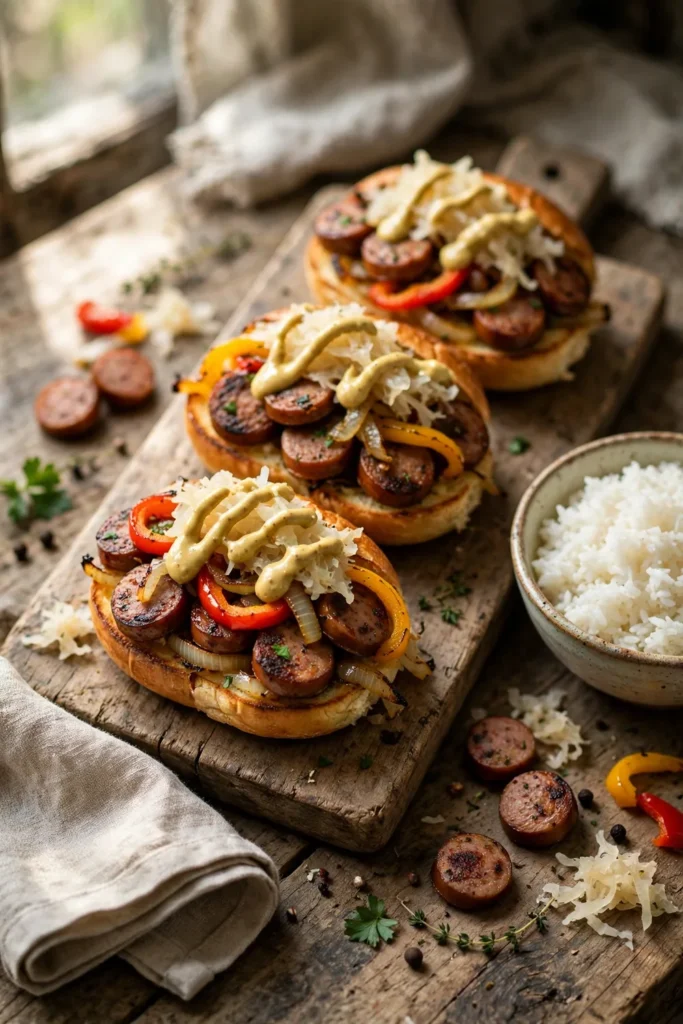
The classic is the bun: a toasted bun, a whole link, Dijon mustard, sauerkraut — the Midwest serve-with, kept as one option, because it is the right one for a summer night and a grill. The skillet meal is the weeknight version: the sausage coins with peppers and onions, over rice, or with roasted or mashed potatoes, or in mac and cheese — the starch that soaks up the sausage fat is the point, and rice is the fastest of them. The pasta version is the toss-in: sliced sausage into a creamy pasta, a baked ziti, a Greek pasta bake — the sausage is the protein, the pasta is the vehicle, and the dish is dinner in the time the pasta takes to boil. The soup and stew version is the cold-night version: the sausage sliced into chili, potato soup, beer cheese soup, or red beans and rice, where it gives the whole pot its smoky depth. And the party version is the coins: browned coins held in barbecue sauce or queso on low for an hour and a half to two hours, with toothpicks — the maker’s party rule, and the version that disappears first at every gathering.
Make Ahead, Storage, and Freezing
A smoked sausage link keeps well, because it is cured and smoked — and the rules for storing it are the same as for any cooked meat, with one extra rule that belongs to this topic alone: thaw first, always, because a frozen link heats unevenly and the outside is done long before the centre is warm.
| Storage method | How long | How to reheat |
|---|---|---|
| Cooked sausage, fridge | 3–4 days, airtight | Reheat gently in the skillet over medium heat, 3–4 minutes, turning — never microwave to serve |
| Unopened package, fridge | Until the use-by date on the package | Heat as directed in the method H2s — the package is the storage |
| Cooked sausage, freezer | 2–3 months | Thaw overnight in the fridge, then reheat gently in the skillet |
| Raw/fresh sausage, freezer | 2–3 months | Thaw overnight in the fridge, then cook thoroughly to 160°F minimum (165°F to be safe) |
The frozen rules, stated honestly, because the search results disagree about them: thaw first, in the refrigerator overnight — that is the maker’s rule, and it is the rule this post follows, because a frozen link heats unevenly, the outside done long before the centre is warm. The fallback, if you must cook from frozen, is the generic guide’s number: a little water in the skillet, medium-low heat, twenty to twenty-five minutes, and the uneven-heat warning stated honestly — the outside will be further along than the centre, and a thermometer is the only way to know the middle is hot. Do not thaw a link in the microwave and then serve it from the microwave — the microwave is a partial-thaw step at most, and the finish belongs in the skillet.
| Frozen sausage | Thaw first (recommended) | From frozen (fallback) |
|---|---|---|
| Fully-cooked link | Overnight in the fridge, then cook as directed in the method H2s | A little water in the skillet, medium-low heat, 20–25 min — outside will be further along than the centre, check with a thermometer |
| Raw/fresh sausage | Overnight in the fridge, then cook thoroughly to 160°F minimum (165°F to be safe) | Not recommended — thaw first; a raw link cooked from frozen heats even more unevenly than a cooked one |
Reheating rules: reheat gently in the skillet over medium heat, three to four minutes, turning — the same method that cooked it the first time, because it is the method that gives you browning without drying it out. A slow cooker is a holding tool, not a reheating method: brown the links first, then add them with a little liquid — beer and onions is the classic — for the last thirty minutes on low or fifteen minutes on high. Hours in liquid leave a link rubbery, and a link held in sauce for a party is a different job from a link reheated for dinner.
Leftovers are the reason to cook the whole package: the pitmaster’s four — smoked sausage fried rice, creamy pasta with garlic and chili flakes, breakfast burritos, and skillet hash — plus the BBQ flatbread with onions, cheese and a sweet-heat glaze. Sliced coins go into any of them cold from the fridge, and the dish takes the time the rice or the pasta takes, because the sausage is already cooked and only needs heating through.
Frequently Asked Questions
Is smoked sausage already cooked? Yes — most store-bought links are fully cooked in the smokehouse, and you are heating and browning, not cooking raw meat. Raw or fresh sausage from the deli case is the exception, and it must be cooked to 160°F minimum. The already-cooked H2 has the full answer, including the label check.
What is the best way to cook smoked sausage? In a skillet — the fastest method that still gives you real browning, one pan, year-round, with the peppers and onions in the same pan. The oven, grill and air fryer all work, and the method-comparison H2 has the exact times and temperatures for each.
How long does it take to cook smoked sausage? Whole links take eight to twelve minutes depending on the method; coins take four to eight minutes; the skillet is the fastest — two to three minutes per side for whole links, three to four for coins. The method-comparison table has every number.
What temperature should smoked sausage reach? 165°F if you check with a thermometer, for a fully-cooked store-bought link. 160°F is the USDA number for fresh pork sausage — the raw case, not this one. The already-cooked H2 and the done-test H2 separate the two cases plainly.
Can you cook smoked sausage from frozen? Thaw it overnight in the fridge first — that is the maker’s rule, because a frozen link heats unevenly. From frozen is the twenty-to-twenty-five-minute fallback, medium-low, a little water in the pan, with the uneven-heat warning. The storage H2 has the full frozen rules.
Can you microwave smoked sausage? Not recommended — it toughens the casing and turns the texture rubbery, and every other method takes ten minutes or less. The microwave is a partial-thaw step at most, and the finish belongs in the skillet.
Why did my smoked sausage split? The heat was too high. Medium heat, never high, turn it often, and never prick the casing — the anti-burst rule is medium heat plus turning, not scoring. The three-rules H2 and the troubleshooting H2 have the full fix.
Do you need to prick or score smoked sausage before cooking? No — never prick a fully-cooked smoked link. Scoring is a raw-brat habit: on a smoked link it lets the juices run out and costs you the snap. The three-rules H2 states the rule, and the troubleshooting H2 explains why the generic guide’s advice is wrong.
What do you serve with smoked sausage? Buns with sauerkraut and Dijon, peppers and onions from the same skillet, rice, roasted or mashed potatoes, mac and cheese — or sliced into soups, stews and pasta, or browned coins held in barbecue sauce or queso for a party. The serve-with H2 has the full system.
How long does cooked smoked sausage last in the fridge? Three to four days, airtight, and reheat it gently in the skillet — never microwave it to serve. The storage H2 has the full table, including the freezer rules.
More Easy Dinners
- Cheeseburger Pasta — creamy, cheesy, 30 minutes. The pasta toss-in — sliced sausage goes into a creamy pasta the way the cheeseburger pasta takes ground beef.
- Gigi Hadid Pasta — spicy vodka pasta, 30 minutes. The party pasta — the oil fix, the tomato-paste technique, the no-vodka substitutes ranked; coins folded through at the end.
- Baked Ziti — baked, cheesy, 55 minutes. The pasta bake — sausage layered in with the pasta and cheese, the oven doing the work.
- Greek Pasta Bake — a real bake plus the 15-minute stovetop version, 45 minutes. The party main — feta, beef and Mediterranean veggies, baked golden; coins in place of the beef for a smoky version.
- Flatbread Pizza Crust — 5 minutes, no yeast. The bread for the table — torn into pieces for dunking, or topped with coins, onions and cheese as a BBQ flatbread.
- Kings Hawaiian Sliders — ham and cheese, 35 minutes. The bun framing — a soft, sweet bun and a sharp mustard, the same combination a whole link wants.
- Crockpot Beef Stew — 8 hours, 6 servings. The stew use — sliced sausage into soups and stews, where it gives the whole pot its smoky depth.
- Baked Spinach Artichoke Dip — no mayo, 35 minutes. The party food — the dip that sits next to the coins at a gathering, with the same chips and crostini.
- Best Cheese Quesadilla — crispy, 10 minutes. The cheesy party food — coins as the quesadilla filling, the 2:1 cheddar-to-Jack blend, the cover trick.
- Ground Beef Stroganoff — creamy, 30 minutes. The skillet-dinner neighbour — one pan, a creamy sauce, the same weeknight shape as the sausage skillet.
Ingredients
Equipment
Method
- Slice the sausage into ½-inch coins (or leave the links whole — whole-link times are in the method H2s) and pat dry with paper towels.
- Heat the olive oil in a large cast-iron skillet over medium heat.
- Add the coins in a single layer — don’t overcrowd — and sear 3–4 minutes per side until deeply browned on the cut faces and heated through (whole links: 2–3 minutes per side).
- Push the sausage to the edges, add the onion and bell pepper with the smoked paprika, garlic powder and black pepper, and cook 5–6 minutes until soft and lightly caramelised.
- Rest 2–3 minutes before serving. Serve on toasted buns with Dijon and sauerkraut, or over rice.
Notes
- Medium heat, never high — high heat splits the casing before the centre is warm.
- Turn often with tongs, never a fork.
- Never prick or score the casing.
- Pat the coins dry before they go in the pan.
- Let the sealed package sit on the counter 10–15 minutes before cooking.
- No added salt — the sausage carries the salt; taste before adding any.
Nutrition information
| Nutrient | Per serving (1 of 4) |
|---|---|
| Calories | ~415 kcal |
| Sodium | ~1,035mg |
| Carbohydrates | ~7g (sugars ~3g) |
| Fat | ~36g (saturated ~12g) |
| Protein | ~14g |
| Fiber | ~1g |
| Cholesterol | ~66mg |
The inputs, shown plainly (USDA FoodData Central values for the exact ingredients listed): the batch (4 servings) — 1 lb smoked sausage ≈ 454g ≈ 1,453 kcal, ~54.5g protein, ~11.0g carbs (sugars ~4.1g), ~130.4g fat (saturated ~44.5g), ~263mg cholesterol, ~4,136mg sodium (USDA SR legacy ‘Sausage, smoked link sausage, pork and beef’: 320 kcal, 12.0g protein, 2.42g carbs, sugars 0.91g, 28.73g fat, 9.8g saturated fat, 58mg cholesterol, 911mg sodium per 100g) · 1 Tbsp olive oil ≈ 13.5g ≈ 119 kcal, ~13.5g fat (saturated ~1.9g) · 1 medium onion ≈ 110g ≈ 44 kcal, ~1.2g protein, ~10.3g carbs (sugars ~4.7g), ~1.9g fiber, ~4mg sodium · 1 medium green bell pepper ≈ 119g ≈ 24 kcal, ~1.0g protein, ~3.5g carbs (sugars ~2.9g), ~2.5g fiber, ~4mg sodium · spices (1 tsp smoked paprika + ½ tsp garlic powder + ¼ tsp black pepper) ≈ 11 kcal, ~2.3g carbs, ~1g fiber, negligible sodium. Batch ≈ 1,651 kcal and ~4,144mg sodium — per serving ≈ 413 kcal and ~1,036mg sodium, rounded to about 415 kcal and about 1,035mg sodium per serving. The buns, sauerkraut and Dijon are NOT in these numbers — they are serve-with items, and the skillet dish’s nutrition is the skillet dish alone. The sodium is worth telling honestly: the SAUSAGE is the driver — ~4,136mg of the ~4,144mg batch, about 99.8% — and there is no added salt in the card, and there is no salt to cut — the sausage carries the salt, and the only levers are portion and the swap. At ~1,035mg per serving, one serving is about 45% of the 2,300mg daily value. The savings, if a reader wants them: serve 3 oz of sausage instead of 4 and fill the plate with more peppers and onions, which saves roughly 260mg per serving; and know that a turkey or chicken smoked-sausage link runs lower on fat and sodium than pork.
Nutrition is an estimate calculated from USDA FoodData Central values for the exact ingredients listed. Values will vary with brands and substitutions.
Pin this recipe