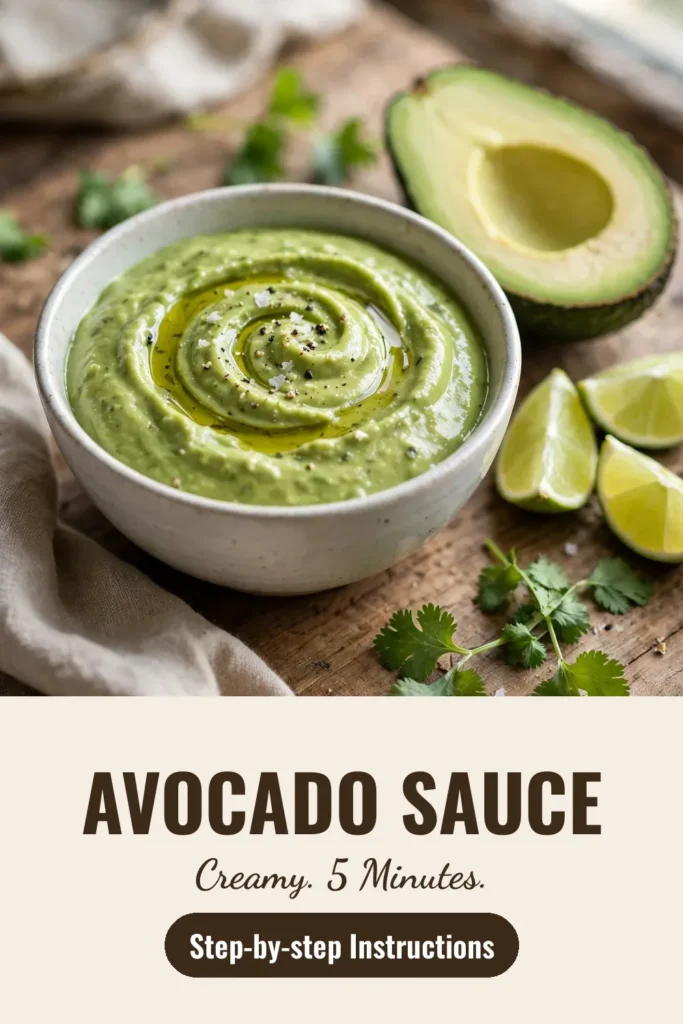
Avocado Sauce for Tacos (Creamy, 5 Minutes)
teaspoon kosher salt, 1/4 teaspoon black pepper, 2–3 tablespoons of cold water, and 1/2 small jalapeño if you want heat. Pulse it smooth, rest it 10 minutes, and you have about 1 cup — 8 servings of 2 tablespoons each — in three consistencies: thick enough to scoop with a chip, thin enough to drizzle over tacos, or thin enough for a squeeze bottle. That is the whole recipe. The rest of this page is everything the search results never tell you: what this sauce actually is (and what it is not — sauce, guacamole sauce, crema and salsa are four different things), how to pick an avocado that is actually ripe, why the sauce turns brown and how to stop it, how much to put on a taco, how the Taco Bell-style version differs, and how long each version keeps in the fridge.
You will love this:
- 5 minutes. One blender, no cooking at all — and a cup of sauce that covers 8 tacos.
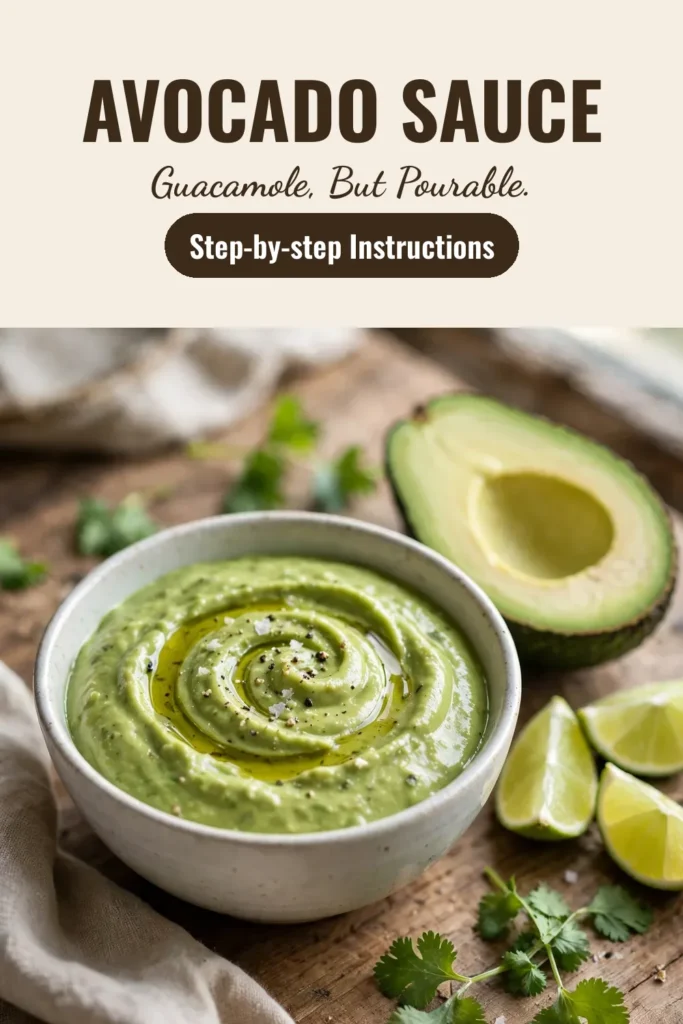
- Guacamole, but pourable. Everything you love about guacamole — ripe avocado, lime, cilantro, salt — blended smooth enough to drizzle instead of scoop.
- Keeps 4–5 days in the fridge. The sour-cream version holds the longest, and the plastic-wrap trick in the browning section is what buys the extra days.
What Is Avocado Sauce? (Sauce vs Guacamole vs Crema vs Salsa)
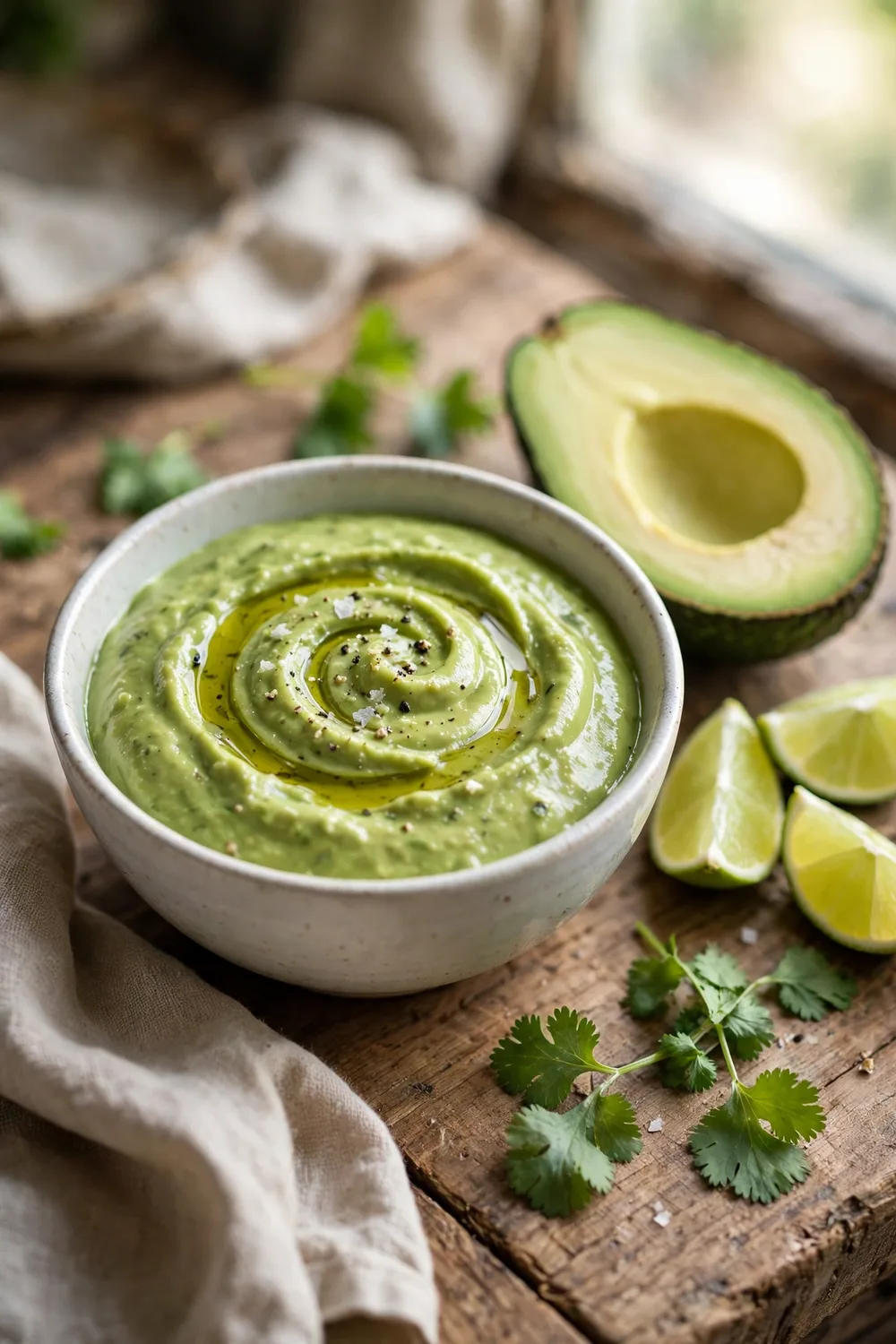
Four names, one green sauce — and nobody on the search results explains the differences. Midwest calls its sauce “like guacamole but a million times smoother and creamier” in one sentence and moves on. Well Seasoned calls its crema “a smarter guacamole” in one sentence. Feasting at Home calls the same sauce “avocado sauce” AND “avocado salsa” without explaining either. Here is the guide, because the name tells you how to use it — and because the naming question is where the second-biggest keyword on this page lives. “Guacamole sauce” is a real search term (1,000 searches a month), and it exists because people know guacamole and want it thinner. The word itself is older than all four names: guacamole comes from the Classical Nahuatl āhuacamōlli, which literally means “avocado sauce” — āhuacatl for avocado, mōlli for sauce. The sauce and the dip were the same word first.
| Name | Base | Texture | Best use |
|---|---|---|---|
| Avocado sauce (ours) | Avocado + sour cream, blended smooth | Pourable, silky | Drizzling over tacos |
| Guacamole sauce | Avocado + lime + cilantro, blended thin | Smooth and pourable, lighter than guacamole | Drizzling, dipping, dressing |
| Guacamole | Avocado mashed with salt, lime, onion, jalapeño | Chunky, spoonable | Scooping with chips |
| Avocado crema | Sour-cream-led, avocado second | Spoonable, cloud-like | Drizzling, dolloping |
| Avocado salsa | Avocado + more water or oil, less dairy | Chunkier, looser | Spooning over bowls and grilled food |
| Mexican green sauce / salsa verde | Avocado, no dairy, water + oil | Thin, bright | Drizzling, dipping |
The practical rule: if you can pour it, it is a sauce; if you have to scoop it, it is guacamole; if the sour cream leads and the avocado follows, it is a crema; if it is chunky and loose, it is a salsa. Our recipe is an avocado sauce — and because it is blended smooth from the same ingredients as guacamole, it is also a guacamole sauce in the sense the search term means. That is not a trick; it is the honest answer to the naming question, and it is why this page can serve both searches. The crema lane belongs to Fig Jar’s avocado lime crema page — a sour-cream-led crema with lemon and lime — and our naming table catches it as an angle without targeting it. A ranch is a different sauce entirely — buttermilk and herbs, not avocado-led — so it gets one line here and nothing more. And the cost comparison, honestly: two avocados plus pantry staples against a store-bought tub of green sauce. The homemade jar wins on price and on flavour, and you control the salt.
What’s in Avocado Sauce? (The 10 Ingredients, and What Each One Does)
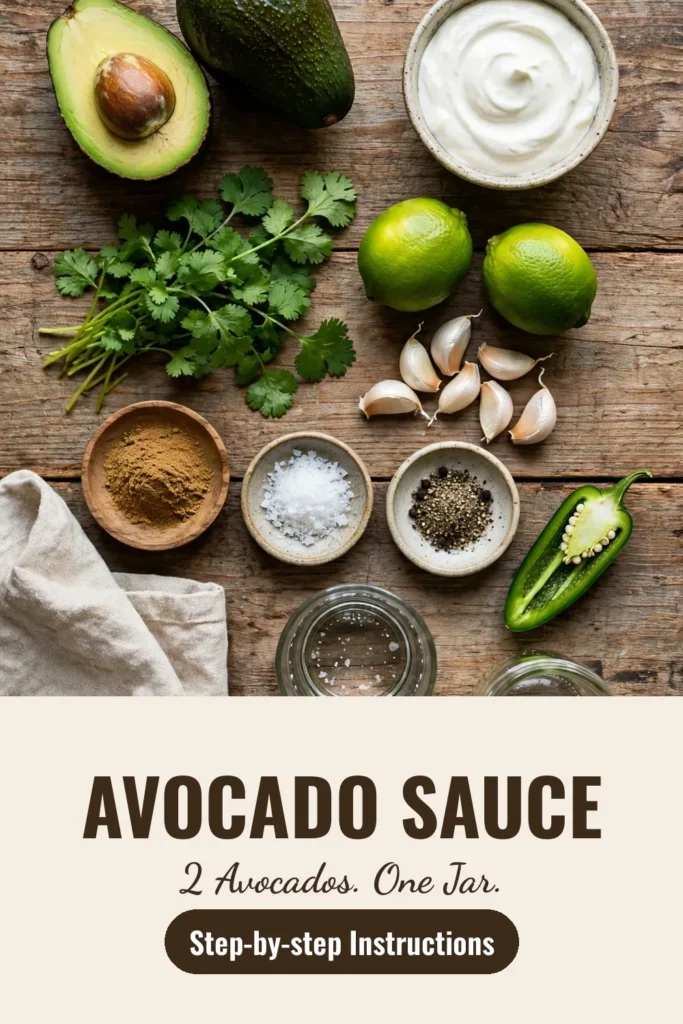
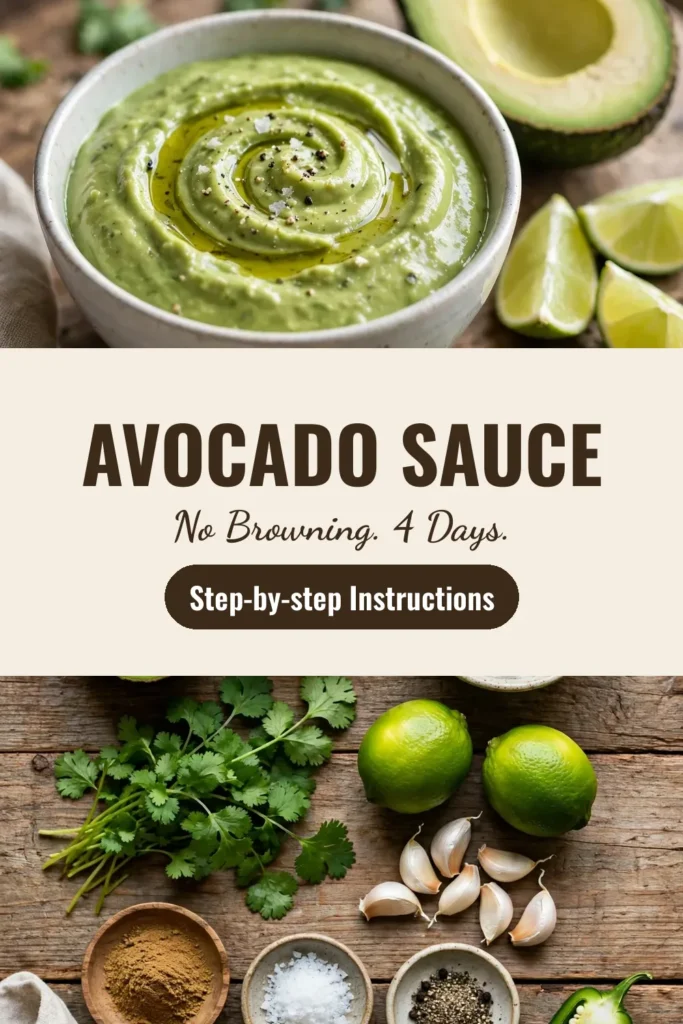
Every page on the search results names the same ten ingredients and explains none of them. Here is what each one is doing in the blender — because once you know the job of each ingredient, you can adjust the sauce instead of guessing.
| Ingredient | Amount in our batch | What it does |
|---|---|---|
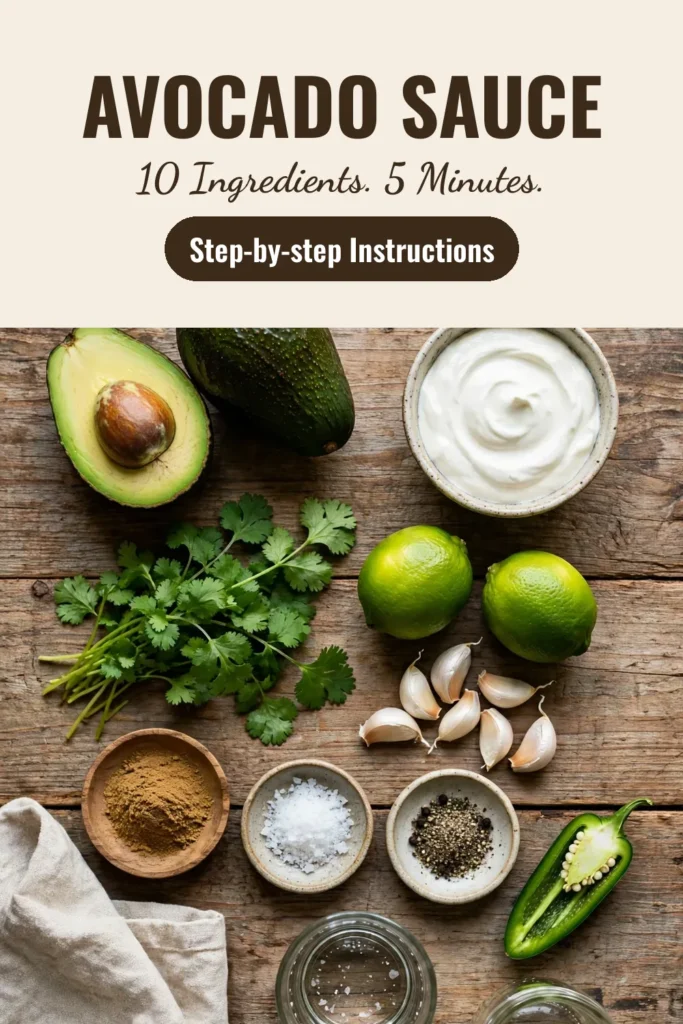
| Ripe avocado | 2 (Hass preferred, about 1 cup flesh) | The body and the richness. The avocado is the sauce — everything else is seasoning for it. Two avocados make about 1 cup, which is the most useful batch size on the search results. |
| Sour cream | 1/4 cup | The tang and the silk. Sour cream thins the avocado into a pourable sauce and adds the tangy note that separates a sauce from plain mashed avocado. Ours uses the lightest dairy load on the search results, so the avocado leads. |
| Fresh cilantro | 1/4 cup, loosely packed | The green, herbal note. Cilantro is the flavour that makes the sauce taste Mexican instead of just creamy. If you hate cilantro, the swap is in the variations H2 — the sauce still works. |
| Lime juice | Juice of 2 limes (about 3 Tbsp, fresh) | The brightness and the anti-browning acid. Lime juice does two jobs at once: it wakes the sauce up, and it is the first line of defence against browning. Fresh, not bottled — bottled lime juice tastes flat and dull. |
| Garlic | 1 clove | The punch. One clove is enough — the garlic should be a background note you only notice when it is missing, not the first thing you taste. |
| Ground cumin | 1/2 tsp | The warm note that separates a sauce from plain guacamole. Cumin is the earthy, warm flavour that makes the sauce taste like taco food instead of like a salad dressing. |
| Kosher salt | 1/2 tsp (plus more to taste) | The control. Salt is the one ingredient that decides whether the sauce tastes seasoned or salty — and the one you adjust last, after tasting. |
| Black pepper | 1/4 tsp | The bite. Pepper adds a sharp, bright heat that is different from the jalapeño’s slow burn — it hits the front of the tongue instead of the back of the throat. |
| Cold water | 2–3 Tbsp, to thin | The thickness dial. Water is not a filler here — it is how you choose between dip, drizzle and squeeze-bottle, and the rule is one tablespoon at a time. |
| Jalapeño | 1/2 small, seeded (optional) | The heat. Half a small jalapeño, seeded, is the middle of the range on the search results — noticeable warmth that sits behind the lime instead of on top of it. Omit it for mild. |
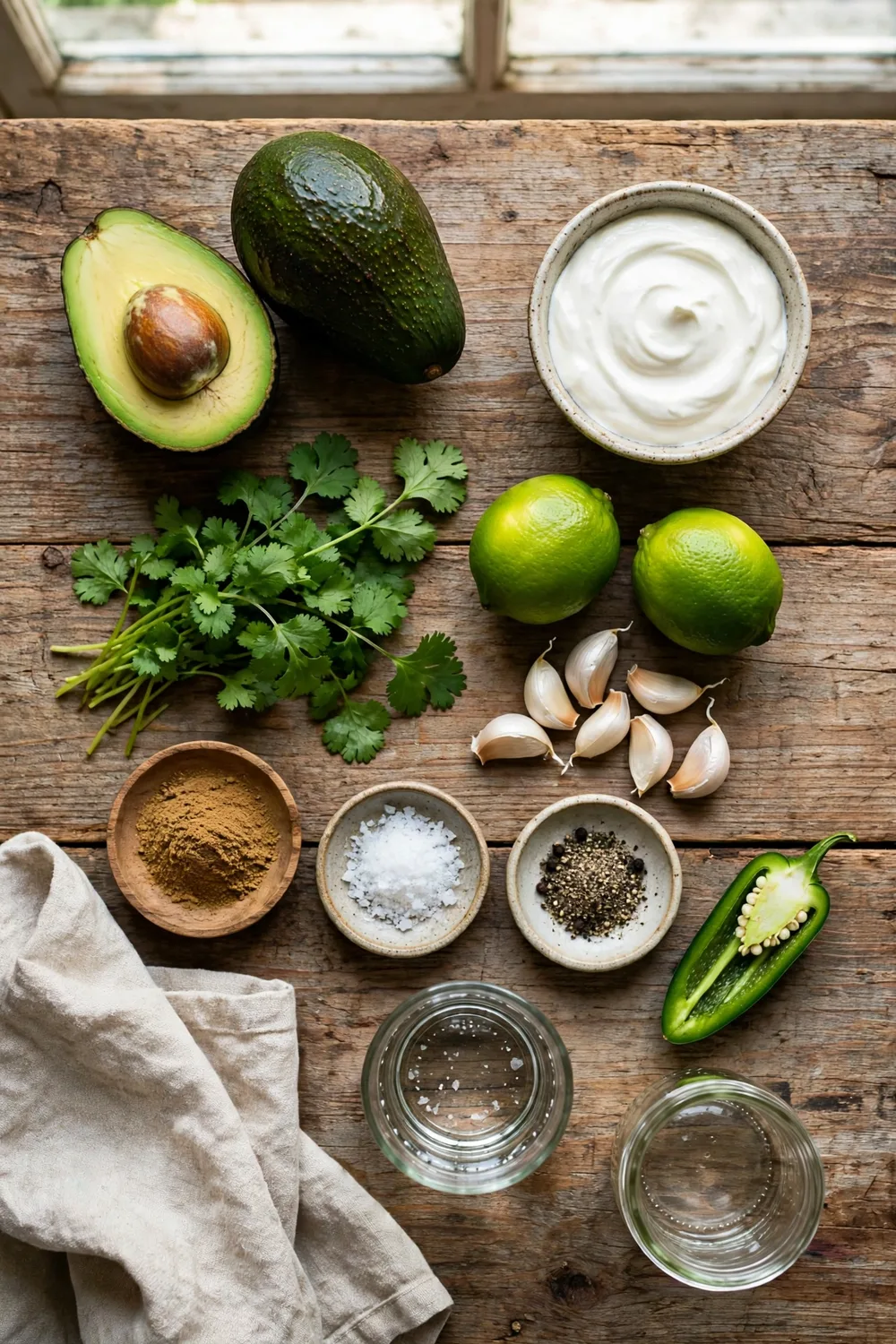
That is the whole list — ten items, every one of them in the recipe card below, and every one of them on the ingredients card image. A creamy avocado sauce recipe is really a question about the base: avocado plus sour cream plus lime plus cilantro plus garlic plus salt, with cumin as the signature and water as the dial. An avocado taco sauce is the same list, used thinner — the short form of the same dish, and the same ten items in the same proportions.
The Recipe — Our Sauce (2 Avocados = About 1 Cup)
This is a creamy avocado sauce recipe in the truest sense: five minutes, one blender, no cooking. The batch makes about 1 cup — eight servings of 2 tablespoons each — because a single-taco batch is barely worth washing the blender for, and a cup of sauce covers a whole taco night.
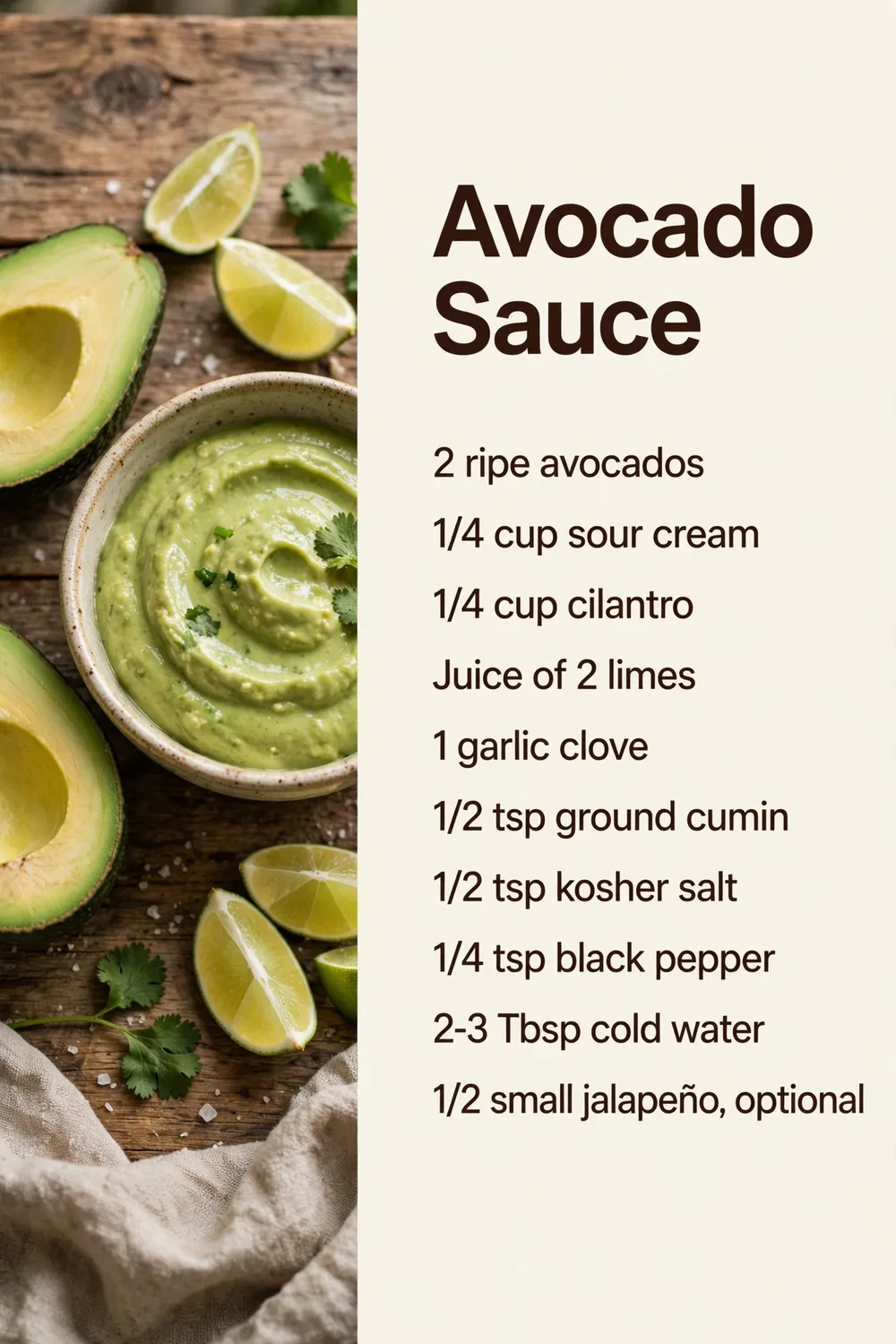
- 2 ripe avocados, halved, pitted and scooped (Hass preferred — about 1 cup flesh)
- 1/4 cup sour cream (plain Greek yogurt swaps in — see the variations H2)
- 1/4 cup fresh cilantro leaves, loosely packed
- Juice of 2 limes (about 3 Tbsp — fresh, not bottled)
- 1 garlic clove
- 1/2 tsp ground cumin
- 1/2 tsp kosher salt (plus more to taste)
- 1/4 tsp black pepper
- 2–3 Tbsp cold water, to thin
- 1/2 small jalapeño, seeded (optional — omit for mild)
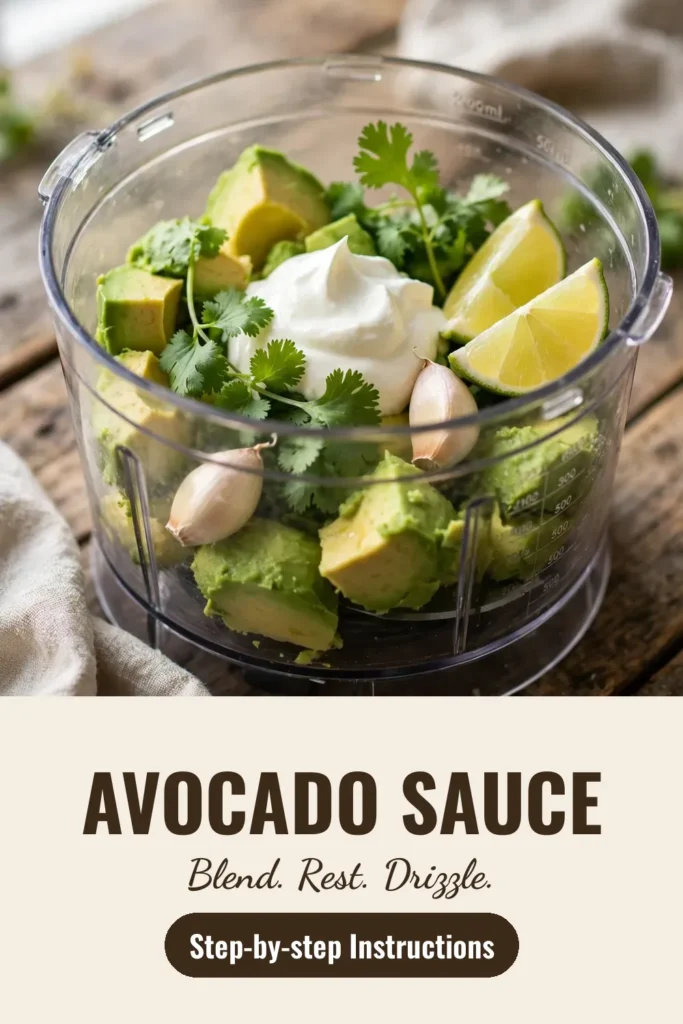
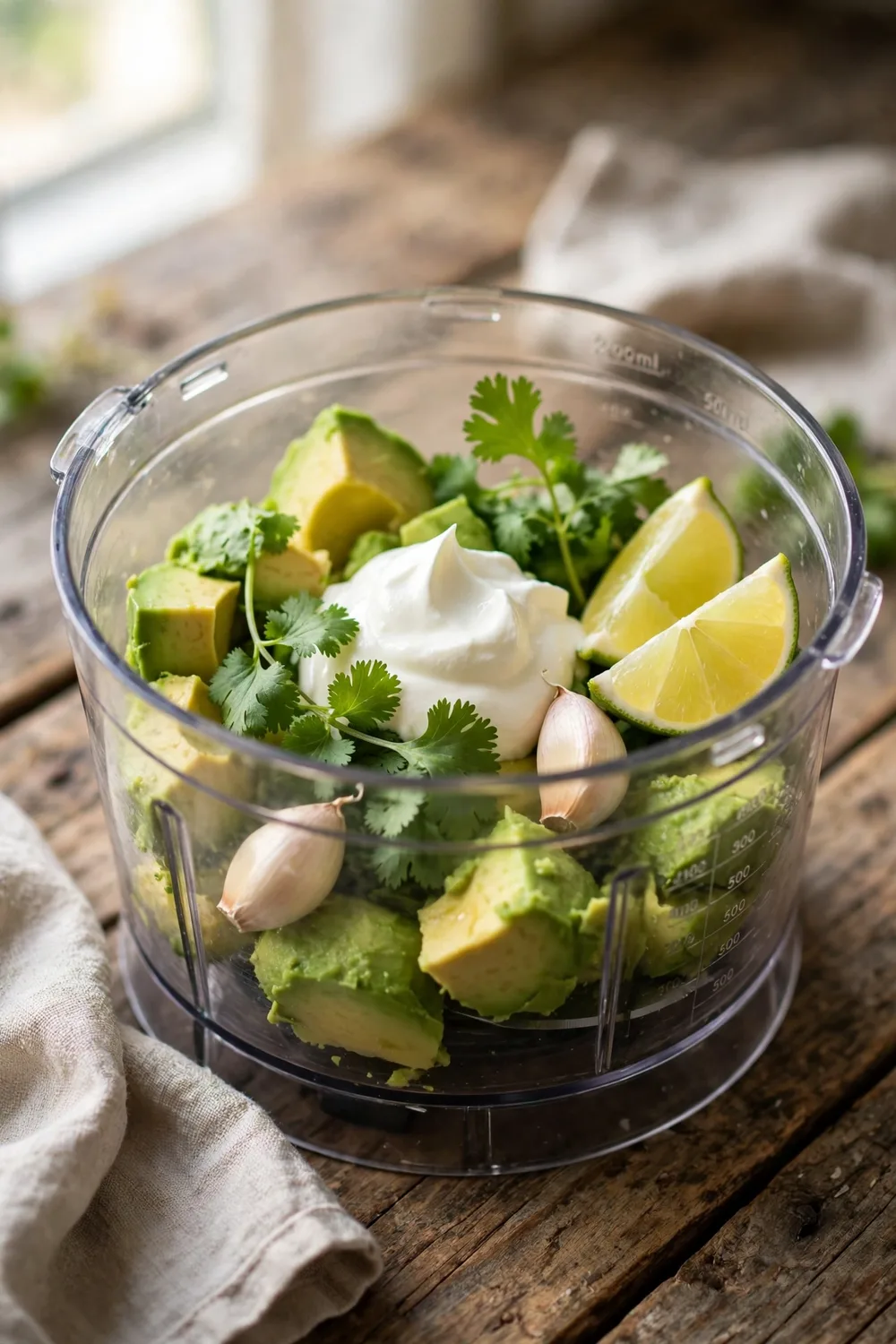
How to make it: add everything to a food processor or blender and pulse until smooth and creamy. Stop as soon as it is silky — over-processing warms the avocado and loosens the sauce, and a warm sauce is a thin sauce. Add the water one tablespoon at a time until it is the consistency you want (the three consistencies are tabled in the H2 below). Taste and adjust salt, lime and heat. Then rest it 10 minutes before serving — the flavours meld and the texture stabilises, and the sauce you taste after the rest is the sauce you are actually serving. If you want the brightest version, zest the limes before you juice them and add the zest to the blender — it costs thirty seconds and it is the difference between a sauce that tastes like lime and a sauce that tastes like avocado with lime in it.
How to make creamy avocado sauce, the short version: ripe avocado, sour cream, cilantro, lime juice, garlic, cumin, salt, pepper, water, jalapeño if you want it — pulse until smooth, thin by the tablespoon, rest 10 minutes. That is how to make avocado sauce for tacos, and it is the same method every page on the search results uses, because there is only one method that works: blend it, thin it, taste it, rest it.
Sour Cream vs Greek Yogurt vs No Dairy — Which Base?
Nobody on the search results makes this comparison, and it is the choice that decides everything else about the sauce — the flavour, the texture, how long it keeps, and whether it freezes. Here it is, tabled, because the three bases are three different sauces.
| Base | Flavour | Texture | Keeps |
|---|---|---|---|
| Sour cream (ours) | Tangy and silky, the classic | Smooth and pourable, the avocado leads | 4–5 days in the fridge — the longest |
| Greek yogurt | Tangier, more protein, sharper | Thick and creamy, slightly heavier | 2 days in the fridge — separates fastest |
| No dairy (water + olive oil) | Cleanest avocado flavour, brightest | Lighter, looser, the most pourable | 2–3 days in the fridge — and the ONLY one that freezes |
The house sauce uses sour cream — 1/4 cup, the lightest dairy load on the search results, so the avocado leads and the tang sits behind it instead of on top of it. Greek yogurt is the swap for a tangier, higher-protein sauce (Imperial’s version), but it keeps the worst — two days, and it separates first. The no-dairy version is Feasting at Home’s — water plus olive oil instead of sour cream, oil-free if you skip the oil — and it is the only version that freezes, because there is no dairy to separate. The swaps themselves live in the variations H2 below; this H2 is the decision, and the decision is: sour cream for the classic, yogurt for the protein, no dairy for the freezer.
How to Pick a Ripe Avocado (The Make-or-Break Skill)
This is the skill the whole recipe depends on, and it is one line everywhere on the search results: “use ripe avocados.” Nobody teaches it. Here it is, properly — because an underripe avocado makes a sauce that tastes grassy and will not blend smooth, and there is no fix for that batch once it is in the blender.
The stem test. Pop the little stem off the top of the avocado and look at the colour underneath. Green underneath means ripe. Brown underneath means overripe — the flesh inside will be brown and stringy. No stem to pop, or the stem will not come off? The avocado is not ripe yet.
The gentle-pressure test. Hold the avocado in your palm (never squeeze it with your fingertips — that bruises it) and press gently near the stem end. It should yield slightly under your palm, like pressing the heel of your hand. Hard means underripe. Mushy means overripe. Slight give means ripe.
The paper-bag trick. An underripe avocado ripens in 24–36 hours in a paper bag with a banana. The banana gives off ethylene gas, the gas speeds the ripening, and the bag traps the gas around the avocado. Keep the bag in a warm spot, about 70–75°F — on top of the fridge is ideal. Check it after a day, then every few hours; an avocado goes from ripe to overripe faster than you expect.
Refrigerate at peak ripeness. Once the avocado passes the stem test, put it in the fridge. Cold holds peak ripeness for 2–3 days, which buys you the weekend if taco night is Friday and the avocado was ripe on Wednesday.
The oven myth. Heating an underripe avocado in the oven does not truly ripen it — it softens the flesh by cooking it, and cooked avocado tastes dull and flat. It is the one shortcut on the search results that is worse than waiting. Skip it.
The underripe warning, plainly: an underripe avocado tastes grassy and bitter, and it will not blend smooth no matter how long you run the food processor — the flesh is too firm and too dry. If you have already blended it, add more lime juice and salt to the finished sauce and serve it anyway; the acid and the salt are the only rescue. Next time, use the stem test.
How to Keep It Green (Why Avocado Sauce Turns Brown)
Every page on the search results says “store it airtight” in one line and moves on. Nobody explains why the sauce browns, and nobody gives the full prevention system. Here is both — because the science is simple, and once you know it, the system writes itself.
Why it browns. Avocado flesh contains an enzyme called polyphenol oxidase. When the flesh is cut and exposed to air, the enzyme reacts with oxygen and produces a brown pigment called melanoidin. That is all browning is: an enzyme, oxygen, and time. The sauce does not go bad when it darkens — it just looks tired. But nobody wants to drizzle a brown sauce over tacos, so the prevention system matters.
The 4-step prevention system:
- Acid in the blend. The full juice of 2 limes — not a squeeze, the whole amount — goes into the blender. Acid slows the enzyme down. This is the single biggest factor, and it is why a sauce made with bottled lime juice (which is weaker and flatter) browns faster than one made with fresh.
- Plastic wrap pressed directly onto the surface. Not over the rim of the container — pressed down onto the sauce itself, so there is no air gap between the wrap and the sauce. Air is the enemy; the wrap is the barrier.
- An airtight container, in the fridge. A mason jar with a tight lid, or any container that actually seals. A bowl with cling film draped over the top is not airtight.
- An extra teaspoon of lime juice before storing. Stir a teaspoon of fresh lime juice into the sauce before you put the wrap on — it tops up the acid for the days ahead.
What to do if it darkens anyway. Stir it. A light olive-green tint on the surface is normal, and it is still fine to eat — the colour is on the surface, and the sauce underneath is still green. Stir the tint back in, taste it, and serve it. If the whole batch has gone brown and tastes flat, it has been in the fridge too long; make a fresh one. It takes five minutes.
Dip, Drizzle or Squeeze-Bottle? (The Three Consistencies)
Dip versus drizzle is one line on Feasting at Home (“add more water if you want it saucier”) and nobody tables it. Here is the table, because the consistency is the difference between a sauce that sits on a taco and a sauce that runs off it.
| Consistency | Water | Best use |
|---|---|---|
| Dip | No added water | Thick enough to scoop with a chip — the sauce as a dip, straight from the bowl |
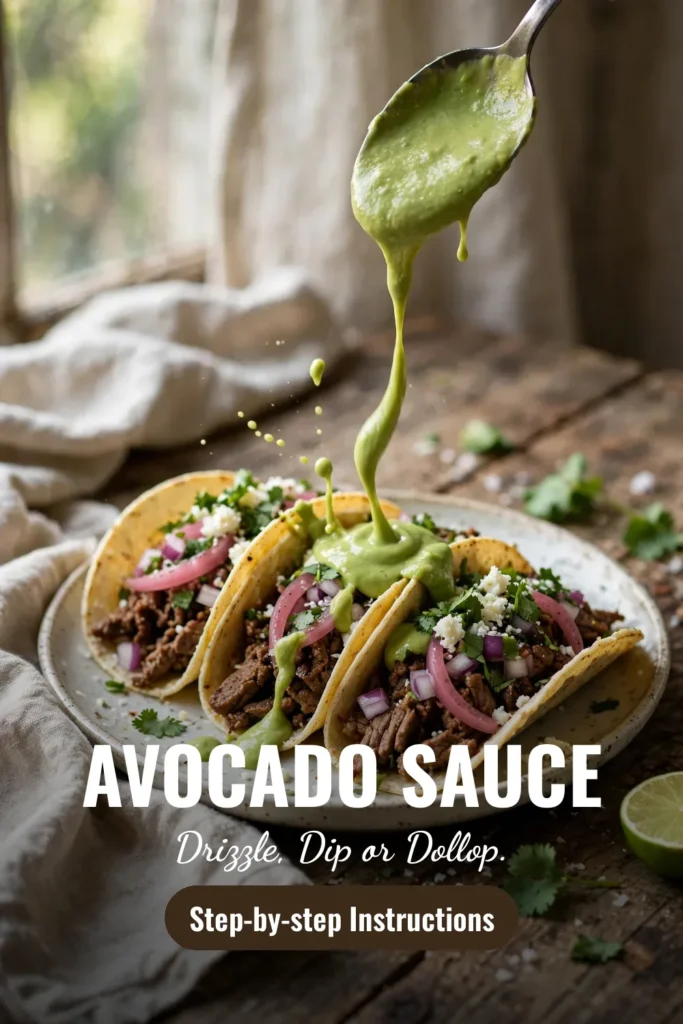
| Drizzle | 2 Tbsp water | Pours off a spoon in a ribbon — the sauce for tacos, the house consistency |
| Squeeze-bottle | 3–4 Tbsp water | Thin enough for a bottle — the catering move, for neat lines over a whole platter of tacos |
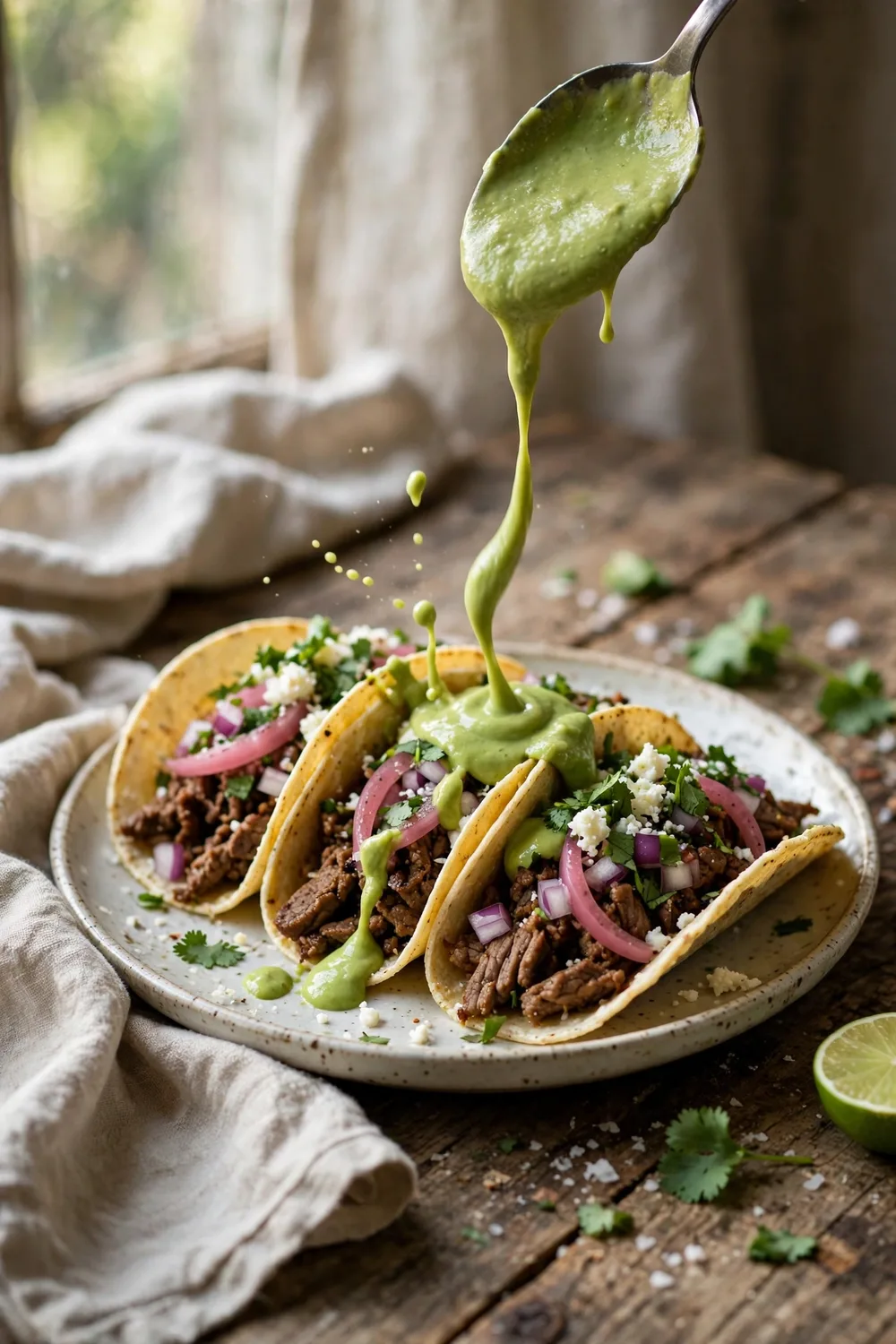
The rule: add water one tablespoon at a time, and pulse between additions. It is easier to thin a sauce than to fix a watery one — once the water is in, the only way back is more avocado, and that changes the batch. Start with 2 tablespoons for the drizzle, taste it, and add a third only if you want it thinner. The squeeze-bottle version is Feasting at Home’s catering detail — a clean plastic bottle, the kind with a pointed cap, filled with the thinned sauce — and it is the neatest way to serve a crowd: one bottle, one platter, no spoon.
How Much Sauce Per Taco?
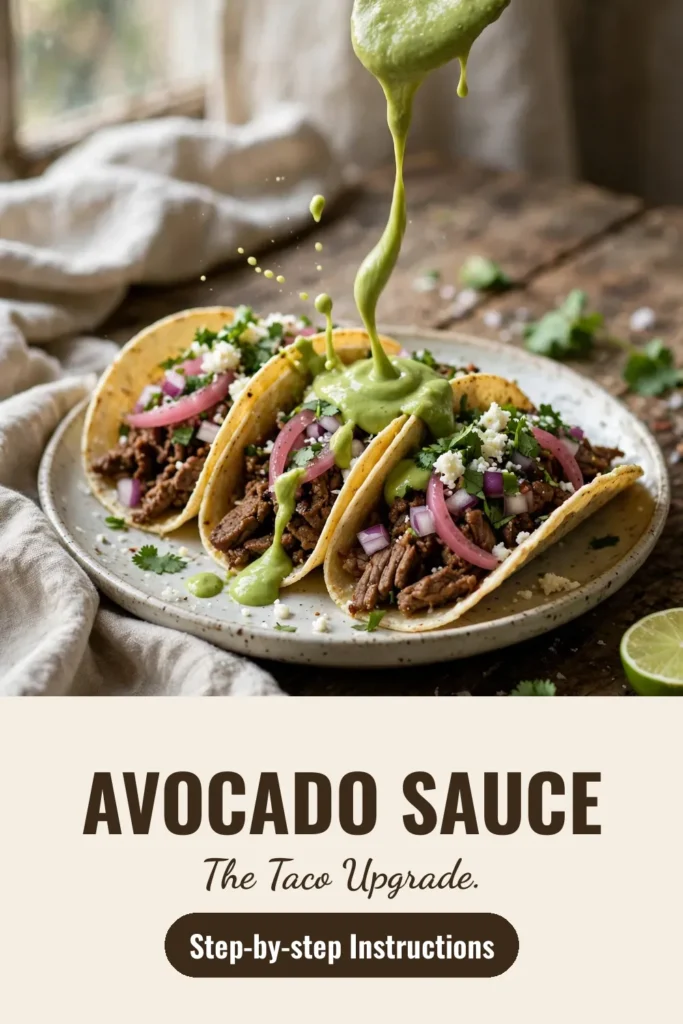
Nobody on the search results tables the usage amounts, and it is the question every cook asks the first time they make a batch. Here it is: 2 tablespoons per taco — a generous drizzle, enough to taste the sauce in every bite without drowning the filling. A cup of sauce is 8 tablespoons of drizzle per taco times eight — so one batch covers 8 tacos, or 4 burritos, or 1 large nacho platter. A squeeze bottle holds the whole batch, which is why the catering version exists: fill the bottle, set it on the table, and let everyone sauce their own tacos. For a dip, the same cup serves 4 people with chips. For a dressing, thin it to the squeeze-bottle consistency and use 2 tablespoons per salad bowl. The sauce is not precious — it is a condiment, and condiments are meant to be used generously.
The Taco Bell-Style Version (Creamy, Tangy, a Little Spicy)
The base sauce on this page is not a Taco Bell copycat — it is Midwest’s generic sauce, improved. But the Taco Bell-style version is the variation people ask for, and Copycat Kitchen owns it on the search results, so here it is, done properly: the fast-food profile is creamier, tangier and a little sweeter than the house sauce, and the difference comes from three additions.
The changes: add 2 tablespoons of mayonnaise, 1 tablespoon of distilled white vinegar (or apple cider vinegar), and 1/2–1 teaspoon of sugar to the base recipe, and keep the jalapeño in (1 small, seeded — use half for milder, keep some seeds for heat). The mayonnaise is the fast-food silkiness — it makes the sauce smoother and glossier than sour cream alone. The vinegar sharpens it — the tang that makes the sauce taste like it came from a packet, in a good way. The sugar smooths the edges — it does not make the sauce sweet, it rounds off the vinegar’s sharpness so the sauce tastes balanced instead of sour. Blend it the same way, rest it the same 10 minutes, and taste it the same way — salt for pop, lime for brightness, sugar if it is too sharp.
This is a homemade copycat in the style of Taco Bell’s creamy avocado sauce — close in texture and flavour, not the company’s formula, and with no stabilisers or specific oils a fast-food kitchen would use. Taco Bell is a trademark of Yum! Brands, used here only to describe the dish this recipe recreates. This is an independent homemade copycat written in our own words — Dinner Ideas Daily is not affiliated with, endorsed by or sponsored by Taco Bell or Yum! Brands. No logo, no packet photo, no trade dress anywhere on this page.
Variations — Dairy-Free, Greek Yogurt, Spicy, No Cilantro
One base sauce, six versions — because the sauce earns its shelf space by being the one green sauce that fits every taco night, not just one.
| Version | Swap | What changes |
|---|---|---|
| Dairy-free / vegan | Omit the sour cream; add 2 Tbsp olive oil + 2 Tbsp water (skip the oil for oil-free) | The cleanest avocado flavour, the brightest green — and the only version that freezes |
| Greek yogurt | Swap the sour cream 1:1 for plain Greek yogurt | Tangier, more protein, slightly thicker — but it keeps only 2 days and separates first |
| Spicy | 1 small jalapeño with seeds, or a serrano, or a pinch of cayenne | Real heat — the seeds carry the burn, the serrano is sharper than the jalapeño, the cayenne is the slowest heat of the three |
| No cilantro | Parsley, or skip it entirely | Softer and less herbal — the sauce still works, it just tastes less Mexican |
| Roasted | Char the jalapeño and a slice of onion under the broiler, cool, then blend | Smoky and deep — the roasted version tastes like the sauce came off a grill |
| Thicker spread | Skip the water entirely | A sandwich spread instead of a drizzle — thick enough to hold a knife line on toast |
The vegan version is Feasting at Home’s — water plus olive oil instead of sour cream, oil-free if you skip the oil — and it is the version that freezes, which is the point of the next H2 but one. The Greek-yogurt version is Imperial’s — tangier, more protein, and the shortest fridge life of the three. The spicy version is Copycat’s variations, combined: the seeds for heat, the serrano for sharpness, the cayenne for the slow burn. The no-cilantro version is Copycat’s FAQ answer, expanded: parsley is the closest swap, and skipping the cilantro entirely is fine too — the sauce loses the herbal note, not the sauce itself.
What to Serve It With
The sauce’s home is tacos, but the jar earns its shelf space on more than one dish — and the serving list is where the secondaries live, because every use is a search someone makes.
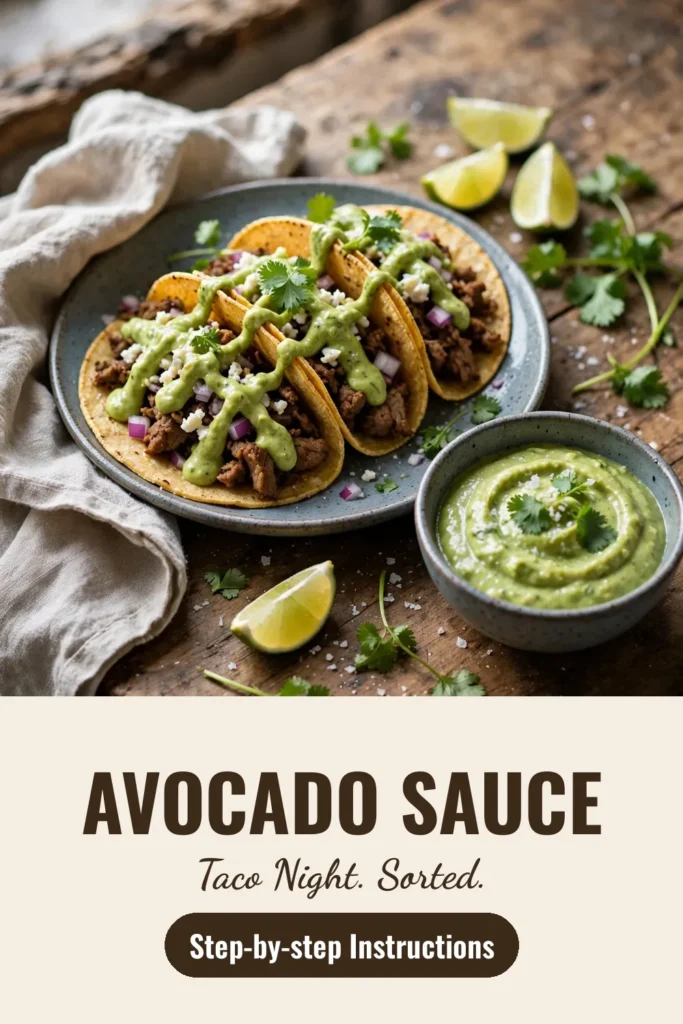
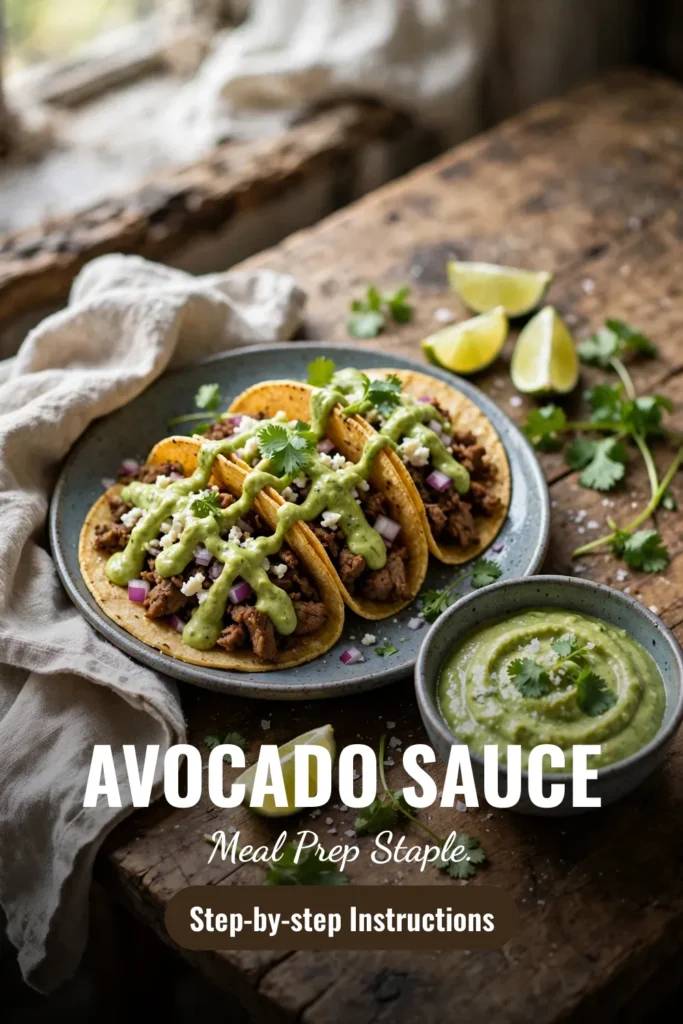
- Salmon tacos. Midwest’s own pairing, and the best one on the search results — the hero image on their page is blackened salmon tacos, not the sauce alone, because the cool green sauce against hot, spiced salmon is the combination that sells the sauce. Drizzle, don’t drown — 2 tablespoons per taco.
- Fish tacos. The same logic as salmon, lighter — battered or grilled fish, cabbage, lime, and the sauce as the cooling note. The fish-taco lane is a striking-distance term on this page, and the sauce is the reason the tacos work.
- Chicken tacos. Strips or thighs, grilled or shredded — the sauce is the moisture and the brightness, and the chicken is the protein that lets it show off.
- Beef tacos. Ground beef, seasoned the way the taco seasoning post teaches, with the sauce as the cool counterpoint to the warm spice.
- Shrimp tacos. The sauce’s smoky note — cumin and jalapeño — is at its best on shrimp, and the shrimp cook in 2–3 minutes, which is faster than the sauce takes to make.
- Black bean tacos. The vegetarian lane, and the cheapest taco filling there is — black beans, the sauce, and pickled onion, and the sauce does the work the meat would have done.
- Chorizo tacos. Well Seasoned’s pairing — the sauce cools the chorizo’s heat the way sour cream cools a curry.
- Burritos. Two tablespoons inside, or a drizzle over the top before rolling — a cup of sauce covers 4 burritos.
- Quesadillas. The sauce is the dip, not the filling — a small bowl beside the plate, thick enough to scoop.
- Nachos. A drizzle over the whole platter, squeeze-bottle consistency, so every chip gets some.
- Tostadas. The sauce as the base layer, under the beans and the toppings — it glues the tostada together.
- Taquitos. The sauce as the dip — a small bowl, dip consistency, no added water.
- Enchiladas. A drizzle over the top, after baking, so the sauce stays bright green instead of cooking dull.
- Burrito bowls and Buddha bowls. A spoonful over the top, drizzle consistency — the sauce is the dressing.
- Grilled chicken and steak. The steak lane is the lowest-KD secondary on this page, and the sauce is the reason: a cool green sauce over hot grilled steak is the combination that makes a weeknight steak feel like a restaurant plate.
- Fries. The sauce as a dip — thick, no added water, with a squeeze of lime on top.
- Eggs. A spoonful over scrambled eggs or a breakfast burrito — the sauce is a breakfast condiment too, and the lime wakes the eggs up.
Storage, Freezing & Make-Ahead
Five pages on the search results give five different fridge lives — 2 days, 2–3 days, 3–4 days, 4–5 days, 5 days — and nobody explains why they disagree. They are all describing the same sauce with different dairy loads and different caution levels. Here is the resolution, tabled, so the reader sees why the search results disagree instead of just picking a number.
| Version | Fridge | Freezer |
|---|---|---|
| Sour-cream version (ours) | 4–5 days | Do NOT freeze — the dairy separates on thawing and the texture turns grainy |
| Dairy-free version | 2–3 days | YES — freeze in ice-cube trays up to 2 months; thaw overnight in the fridge, stir smooth |
| Greek-yogurt version | 2 days | Do NOT freeze — the yogurt separates fastest |
The sour-cream version keeps 4–5 days because the plastic wrap pressed on the surface is what buys the extra days — Midwest and Well Seasoned agree on this, and the wrap is the difference between 3 days and 5. The dairy-free version keeps 2–3 days — no dairy to stabilise it, and it darkens faster — but it is the only one that freezes, because there is no dairy to separate. The Greek-yogurt version keeps 2 days — yogurt separates fastest, and it is the version you make the day you serve it. Best flavour is always day one, whichever version you make — the sauce is brightest, greenest and most alive on the day it is blended.
Make-ahead: make it the day before, stir it, taste it and adjust before serving, and add a spoonful of water if it thickened overnight — the sauce firms up in the fridge as the avocado settles, and a spoonful of water brings it back to the drizzle. If the surface has darkened, stir the tint back in — it is still fine to eat, and the stir is the fix.
Troubleshooting — 5 Fixes
Nobody on the search results has this section. Every page is the same blend with the batch size changed; none of them explains what happens when it goes wrong. Here are the five failures, why they happen, and how to fix them.
It turned brown
Why: air got in — the plastic wrap was not pressed onto the surface, or the container was not airtight, or the lime juice was bottled instead of fresh. Fix it now: stir it — a light olive-green tint is normal and the sauce underneath is still green; add a teaspoon of fresh lime juice and stir again. Next time: the full juice of 2 limes in the blend, plastic wrap pressed directly onto the sauce, airtight container, fridge.
Too thick
Why: not enough water, or the avocados were very large and the ratio shifted. Fix it now: add water 1 tablespoon at a time and pulse between additions — never all at once. Next time: start with 2 tablespoons and thin by the tablespoon; the thickness table above is the guide.
Too thin
Why: too much water went in at once, or the avocados were small and the water overwhelmed them. Fix it now: there is no way to un-thin it — add 1/4 avocado and re-blend, or use the thin sauce as a dressing instead of a drizzle. Next time: add the water one tablespoon at a time and pulse between additions; it is easier to thin than to fix a watery sauce.
It tastes flat
Why: not enough salt, or not enough lime — the two things that make the sauce taste seasoned instead of just creamy. Fix it now: more salt first, then more lime — salt alone will not fix a dull sauce, because the acid is the brightness. Next time: taste and adjust before the 10-minute rest, then taste again after it — the flavours meld in the rest, and the salt you thought was enough sometimes is not.
Bitter or grassy
Why: an underripe avocado — the flesh was too firm and too dry, and it tastes grassy no matter how long you blend it. Fix it now: there is no real fix for this batch — add more lime juice and salt to the finished sauce and serve it anyway; the acid and the salt are the only rescue. Next time: the stem test, from the ripe-avocado H2 above — green underneath the stem means ripe, brown means overripe, and a stem that will not come off means it is not ready yet.
The Avocado, in 150 Words
The word is older than the dish. Guacamole comes from the Classical Nahuatl āhuacamōlli — āhuacatl for avocado, mōlli for sauce — which literally means “avocado sauce.” Avocado seeds were first found in the Tehuacán Valley of Mexico, around 9,000–10,000 years ago, and the first written description of guacamole comes from 1697, when the English buccaneer William Dampier wrote about avocados ground with sugar and lime juice. In the early 1900s the fruit was sold in America as the “alligator pear,” for its green, pebbled skin. The Hass avocado — the variety this recipe calls for — is the one that took over, and National Guacamole Day is September 16, Mexican Independence Day. The Venezuelan cousin is guasacaca: a thinner, more acidic avocado sauce made with vinegar, which is the closest thing to a different answer to the same question.
Frequently Asked Questions
What is the difference between avocado sauce and guacamole?
Guacamole is avocado mashed with salt, lime, onion and jalapeño — chunky, spoonable, scooped with chips. Avocado sauce is the same ingredients blended smooth with sour cream and water — pourable, silky, drizzled over tacos. The naming table above has the full comparison: sauce, guacamole sauce, guacamole, crema, salsa and Mexican green sauce, side by side.
How long does avocado sauce last?
The sour-cream version keeps 4–5 days in the fridge, airtight, with plastic wrap pressed onto the surface. The dairy-free version keeps 2–3 days. The Greek-yogurt version keeps 2 days. Best flavour is always day one — the sauce is brightest and greenest on the day it is blended.
How do I keep it from turning brown?
Four steps: the full juice of 2 limes in the blend, plastic wrap pressed directly onto the surface, an airtight container in the fridge, and an extra teaspoon of lime juice before storing. If the surface darkens anyway, stir it — a light olive-green tint is normal, and the sauce underneath is still green.
Can I make it without a blender?
Yes — mash the avocado with a fork until smooth, then whisk in the sour cream, lime juice, cilantro, garlic, cumin, salt and pepper. It will be chunkier than the blended version, and you will want a little more water to loosen it. A food processor is better, but a fork works.
Is it the same as Taco Bell’s creamy avocado sauce?
No. This is a homemade copycat in the style of Taco Bell — close in texture and flavour, not the company’s formula, and with no stabilisers. The Taco Bell-style version is in its own H2 above, with the mayonnaise, vinegar and sugar that make the fast-food profile. Dinner Ideas Daily is not affiliated with, endorsed by or sponsored by Taco Bell or Yum! Brands.
Can I make it vegan?
Yes — omit the sour cream and add 2 tablespoons of olive oil plus 2 tablespoons of water, or skip the oil entirely for an oil-free version. It is the only version that freezes, in ice-cube trays, up to 2 months. The full swap is in the variations H2 above.
Is it gluten-free?
Yes — avocado, sour cream, lime, cilantro, garlic, cumin, salt, pepper, water and jalapeño are all naturally gluten-free. Check your spice labels for shared-equipment warnings if you cook for someone with celiac disease — the risk is cross-contact at the factory, not the recipe.
Can I use it on chicken, fish or steak?
Yes — drizzle, don’t drown. Two tablespoons per serving, over grilled chicken, fish tacos, salmon tacos or sliced steak. The serving H2 above has the full list, from tacos to fries to eggs.
Can I freeze it?
The dairy-free version, yes — in ice-cube trays, up to 2 months; thaw overnight in the fridge and stir smooth. Do not freeze the sour-cream or Greek-yogurt versions — the dairy separates on thawing and the texture turns grainy.
What if I don’t like cilantro?
Use parsley, or skip it entirely. The sauce loses the herbal note, not the sauce itself — the avocado, lime and cumin carry it. A pinch of dried oregano is the other swap if you have neither.
Conclusion
Avocado sauce is ripe avocados, sour cream, lime, and cilantro blended smooth — 5 minutes, no cooking, and it pours like guacamole. Blend a batch tonight — it goes on tacos, bowls, and pretty much everything else.
More Recipes to Serve It With
- Crockpot Chicken Tacos — 10 minutes of prep, 6 hours of waiting.
- Taco Seasoning (Old El Paso style) — 5 minutes, 10 spices, 3 tablespoons seasons a pound of meat.
- Cheeseburger Soup — the potato-camp cheeseburger soup, 45 minutes.
- Crockpot Beef Stew — 8 hours in the slow cooker, 25 minutes of prep.
- Gigi Hadid Pasta — the 30-minute vodka pasta, with a no-vodka version.
- Greek Pasta Bake — a real bake plus the 15-minute stovetop version, 45 minutes.
- Crack Green Beans — bacon and brown sugar glaze, 30 minutes.
- Vegetarian Lasagna Soup — one pot, 35 minutes, broken lasagna noodles and herbed ricotta.
- Olive Garden Chicken Gnocchi Soup — creamy, one-pot, 35 minutes, with a cream blend that never splits.
- Baked Ziti — sausage baked ziti, 55 minutes.
Avocado Sauce for Tacos (Creamy, 5 Minutes)
Ingredients
Equipment
Method
- Add everything to a food processor or blender.
- Pulse until smooth and creamy — stop as soon as it is silky (over-processing warms the avocado and loosens the sauce); add the water 1 Tbsp at a time until it is the consistency you want (dip = no water, drizzle = 2 Tbsp, squeeze-bottle = 3–4 Tbsp).
- Taste and adjust salt, lime and heat.
Notes
Nutrition information
| Nutrient | Per 2-Tbsp serving |
|---|---|
| Calories | ~75 kcal |
| Sodium | ~130mg |
| Carbohydrates | ~4g (sugars ~0.6g) |
| Fat | ~6.5g (saturated ~1.6g) |
| Protein | ~1g |
| Fiber | ~2.3g |
The inputs, shown plainly (USDA FoodData Central values for the exact ingredients listed): 2 ripe avocados, Hass, flesh ≈ 272g ≈ 435 kcal, ~40g fat (saturated ~5.8g), ~23g carbs (sugars ~1.8g), ~18g fiber, ~5.4g protein, ~19mg sodium (USDA FDC 171705, “Avocados, raw, all commercial varieties”: 160 kcal, 14.66g fat, 2.13g saturated, 8.53g carbs, 0.66g sugars, 6.7g fiber, 2g protein, 7mg sodium per 100g; one California Hass avocado, flesh only, ≈ 136g ≈ 227 kcal) · 1/4 cup sour cream ≈ 60g ≈ 116 kcal, ~12g fat (saturated ~6.8g), ~1.7g carbs, ~1.3g protein, ~24mg sodium (USDA FDC 171257, “Cream, sour, cultured”: 193 kcal, 19.35g fat, 11.34g saturated, 2.8g carbs, 2.1g protein per 100g) · Juice of 2 limes ≈ 60g ≈ 15 kcal, ~4.9g carbs · 1/4 cup cilantro ≈ 4g ≈ 1 kcal · 1 garlic clove ≈ 3g ≈ 4 kcal · 1/2 tsp ground cumin ≈ 5 kcal · 1/2 tsp kosher salt ≈ 0 kcal, ~1,000mg sodium (Morton kosher: 1/4 tsp ≈ 480mg — brands vary, Diamond Crystal runs lighter) · 1/4 tsp black pepper ≈ 1.5 kcal · 1/2 small jalapeño ≈ 7g ≈ 2 kcal · Water: 0. Batch total ≈ 580 kcal and ~1,006mg sodium — divided by 8 servings, about 75 kcal and about 130mg sodium per 2-tablespoon serving.
The SERP comparison, honestly: the published cards on the search results claim 2.2mg (Feasting at Home) and 9.9mg (Midwest) of sodium per serving — both implausibly low for a sauce that contains half a teaspoon of salt per batch. Half a teaspoon of kosher salt alone is about 1,000mg of sodium for the whole batch, which is about 125mg per serving before anything else is counted. Our estimate states the serving size plainly (2 tablespoons, 1/8 of the batch) and shows the working above, so the number can be checked instead of trusted.
Nutrition is an estimate calculated from USDA FoodData Central values for the exact ingredients listed. Values will vary with brands and substitutions.
Pin this recipe